

Methodology for Developing Deprescribing Guidelines: Using Evidence and GRADE to Guide Recommendations for Deprescribing
Open accessThe DOI matches its Crossref record; 40 of the 42 references it cites were found in a registry or an index.
Abstract
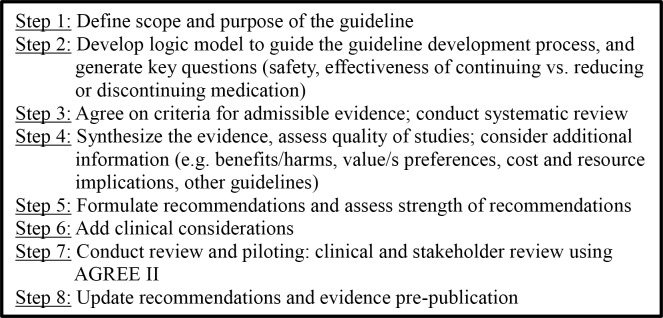
BACKGROUND: Class specific deprescribing guidelines could help clinicians taper and stop medications no longer needed or which may be causing more harm than benefit. We set out to develop methodology to create such guidelines using evidence-based methods for guideline development, evidence synthesis and recommendation rating. METHODS AND FINDINGS: Using a comprehensive checklist for a successful guideline enterprise, we conducted a national modified Delphi consensus process to identify priorities for deprescribing guidelines, then conducted scoping exercises to identify feasible topics, and sequentially developed three deprescribing guidelines. We selected guideline development team members for clinical expertise; a GRADE member worked with staff to ensure guideline development processes were followed. We conducted or used systematic searches and reviews of deprescribing trials of selected drug classes, reviews or systematic reviews of drug class effectiveness, reviews of reviews of drug class harm and narrative syntheses of contextual questions to inform recommendations and guideline development. Our 8 step process for guideline development included defining scope and purpose, developing a logic model to guide the process and generate key clinical questions, setting criteria for admissible evidence and conducting systematic reviews, synthesizing evidence considering additional contextual information and performing quality estimates, formulating recommendations and providing strength estimations, adding clinical considerations, conducting clinical and stakeholder review and finally updating content pre-publication. Innovative aspects of the guideline development process included synthesizing evidence for outcomes of tapering or stopping medication, and incorporating evidence for medication harm into the recommendation strength rating. Through the development of three deprescribing guidelines (for proton pump inhibitors, benzodiazepine receptor agonists and antipsychotics) and associated decision-support algorithms, we were able to gradually hone the methodology; each guideline will be published separately. CONCLUSION: Our methodology demonstrates the importance of searching for short and long-term outcomes, showing the benefits of deprescribing and studying patient preferences. This publication will support development of future deprescribing guidelines.
Overview
The claims and statistics of this paper haven’t been checked yet.
Free: it reads the open-access text and checks the first 5 claims that cite a source we can check. Create a free account to check every claim.
Integrity signals
Registry
Cites
Statistics
Figures


Verification
Claims the paper makes
The claims and statistics of this paper haven’t been checked yet.
Free: it reads the open-access text and checks the first 5 claims that cite a source we can check. Create a free account to check every claim.
Claims other papers make about this one
Each is checked against this paper’s own text: does it say what the citing paper says it does?
The check wasn’t confident either way, so it gives no verdict — never disputed.
In the citing paper
“Studies assessing the effect of abrupt versus gradual withdrawal [43,53,54,55,56] show that the withdrawal syndrome observed in the case of abrupt discontinuation makes it very difficult to stop the use of these molecules, especially in the case of short half-life BZDs. These studies recommend reducing BZD consumption over a period of at least 4 weeks.”
From Cognitive behavioral therapy and acceptance and commitment therapy for the discontinuation of long-term benzodiazepine use in insomnia and anxiety disorders (2021) · cites this paper as [54]
Experimental — accuracy not yet measured
Self-check
Percentages, sums and reported differences re-computed from the paper’s own numbers.
The self-check needs the paper’s full text.
Citations
Cites
Scoping studies: towards a methodological framework
Arksey, H., & O'Malley, L. (2005) · International Journal of Social Research Methodology · doi:10.1080/1364557032000119616 · Cited by 36,742 · cited 1×
“We conducted scoping exercises to identify three of the top five priority topics for which deprescribing guideline development would be feasible [21].”
MethodLiberati, A., Altman, D. G., Tetzlaff, J., Mulrow, C., Gøtzsche, P. C., Ioannidis, J. P. A., Clarke, M., Devereaux, P. J., Kleijnen, J., & Moher, D. (2009) · PLoS Medicine · doi:10.1371/journal.pmed.1000100 · Cited by 28,164
Cochrane Handbook for Systematic Reviews of Interventions: Cochrane Book Series
(2008) · doi:10.1002/9780470712184 · Cited by 25,048 · cited 1×
“They used the Cochrane methodological expectations for conduct of intervention reviews and the Cochrane handbook [27] and reported results of reviews using the PRISMA (Preferred Reporting in Systematic Reviews and Meta-Analyses) reporting guidelines with a PRISMA flow chart[28].”
MethodDermyshi, E., Wang, Y., Yan, C., Hong, W., Qiu, G., Gong, X., & Zhang, T. (2017) · Neonatology · doi:10.1159/000454668 · Cited by 24,451
Liberati, A., Altman, D. G., Tetzlaff, J., Mulrow, C., Gotzsche, P. C., Ioannidis, J. P. A., Clarke, M., Devereaux, P. J., Kleijnen, J., & Moher, D. (2009) · BMJ · doi:10.1136/bmj.b2700 · Cited by 17,648
GRADE guidelines: 1. Introduction—GRADE evidence profiles and summary of findings tables
Guyatt, G., Oxman, A. D., Akl, E. A., Kunz, R., Vist, G., Brozek, J., Norris, S., Falck-Ytter, Y., Glasziou, P., & deBeer, H. (2011) · Journal of Clinical Epidemiology · doi:10.1016/j.jclinepi.2010.04.026 · Cited by 10,681
GRADE guidelines: 3. Rating the quality of evidence
Balshem, H., Helfand, M., Schünemann, H. J., Oxman, A. D., Kunz, R., Brozek, J., Vist, G. E., Falck-Ytter, Y., Meerpohl, J., & Norris, S. (2011) · Journal of Clinical Epidemiology · doi:10.1016/j.jclinepi.2010.07.015 · Cited by 8,285 · cited 1×
“Each GDT used the GRADE approach to provide a formal rating of the synthesized evidence from the systematic review for the selected critical and important outcomes of deprescribing [29] (e.”
MethodAGREE II: advancing guideline development, reporting and evaluation in health care
Brouwers, M. C., Kho, M. E., Browman, G. P., Burgers, J. S., Cluzeau, F., Feder, G., Fervers, B., Graham, I. D., Grimshaw, J., Hanna, S. E., et al. (2010) · Canadian Medical Association Journal · doi:10.1503/cmaj.090449 · Cited by 3,790 · cited 3×
“A practicing family physician, nurse practitioner and pharmacist (who were not members of the Deprescribing project) provided a clinical review of each guideline using the AGREE II Global Rating Scale [33] to guide their evaluation in rating the scope and purpose of the guideline, stakeholder involvement, rigour of de…”
MethodInfluentialNorderyd, O. M., Koch, G., Papias, A., Köhler, A. A., Helkimo, A. N., Brahm, C., Lindmark, U., Lindfors, N., Mattsson, A., Rolander, B., et al. (2015) · PubMed · Cited by 3,584
By the American Geriatrics Society 2015 Beers Criteria Update Expert Panel (2015) · Journal of the American Geriatrics Society · doi:10.1111/jgs.13702 · Cited by 2,609
GRADE guidelines: 2. Framing the question and deciding on important outcomes
Guyatt, G. H., Oxman, A. D., Kunz, R., Atkins, D., Brozek, J., Vist, G., Alderson, P., Glasziou, P., Falck-Ytter, Y., & Schünemann, H. J. (2011) · Journal of Clinical Epidemiology · doi:10.1016/j.jclinepi.2010.09.012 · Cited by 1,911 · cited 1×
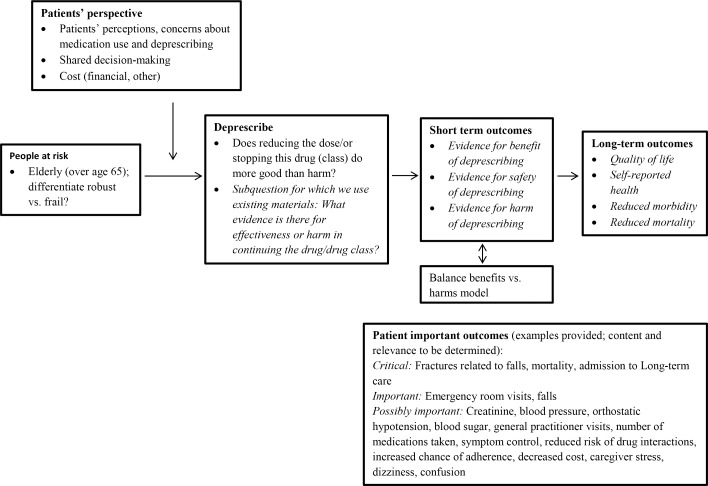
“The logic model used the “PICO” framework to identify the Population of interest (adults>18), the Intervention (deprescribing), the Comparator (continuation of the medication) and patient-importantOutcomes relevant for decision-making (both positive impact and adverse effects of deprescribing) [24].”
MethodGRADE guidelines: 8. Rating the quality of evidence—indirectness
Guyatt, G. H., Oxman, A. D., Kunz, R., Woodcock, J., Brozek, J., Helfand, M., Alonso-Coello, P., Falck-Ytter, Y., Jaeschke, R., Vist, G., et al. (2011) · Journal of Clinical Epidemiology · doi:10.1016/j.jclinepi.2011.04.014 · Cited by 1,843
Emergency Hospitalizations for Adverse Drug Events in Older Americans
Budnitz, D. S., Lovegrove, M. C., Shehab, N., & Richards, C. L. (2011) · New England Journal of Medicine · doi:10.1056/nejmsa1103053 · Cited by 1,820
Evidence based medicine: a movement in crisis?
Greenhalgh, T., Howick, J., Maskrey, N., & for the Evidence Based Medicine Renaissance Group (2014) · BMJ · doi:10.1136/bmj.g3725 · Cited by 1,766 · cited 1×
“Consistent with research that demonstrates guidelines are more likely to be implemented when accompanied by guideline implementation tools [34,35], each GDT developed PowerPoint presentations for communicating key guideline aspects to users, as well as decision-support tools in the form of algorithms.”
Reducing Inappropriate Polypharmacy: The Process of Deprescribing
Scott, I. A., Hilmer, S. N., Reeve, E., Potter, K., Le Couteur, D., Rigby, D., Gnjidic, D., Del Mar, C. B., Roughead, E. E., Page, A., et al. (2015) · JAMA Internal Medicine · doi:10.1001/jamainternmed.2015.0324 · Cited by 1,584
Andrews, J. C., Schünemann, H. J., Oxman, A. D., Pottie, K., Meerpohl, J. J., Coello, P. A., Rind, D., Montori, V. M., Brito, J. P., Norris, S., et al. (2013) · Journal of Clinical Epidemiology · doi:10.1016/j.jclinepi.2013.02.003 · Cited by 1,315
Self-citationPolypharmacy in elderly patients
Hajjar, E. R., Cafiero, A. C., & Hanlon, J. T. (2007) · The American Journal of Geriatric Pharmacotherapy · doi:10.1016/j.amjopharm.2007.12.002 · Cited by 1,265
Methodology in conducting a systematic review of systematic reviews of healthcare interventions
Smith, V., Devane, D., Begley, C. M., & Clarke, M. (2011) · BMC Medical Research Methodology · doi:10.1186/1471-2288-11-15 · Cited by 1,227 · cited 1×
“[30] Relevant literature from the search results was independently identified by two research assistants using the following inclusion criteria: systematic reviews of randomized controlled trials (RCTs) or observational studies with a priori objectives of assessing harms attributable to the drug(s) of interest.”
MethodAnderson, K., Stowasser, D., Freeman, C., & Scott, I. (2014) · BMJ Open · doi:10.1136/bmjopen-2014-006544 · Cited by 725 · cited 1×
“Prescribers report difficulty in weighing benefits and harms of continuing or stopping medications, as well as pressure to continue to prescribe according to prescribing guidelines [15].”
BackgroundSchünemann, H. J., Wiercioch, W., Etxeandia, I., Falavigna, M., Santesso, N., Mustafa, R., Ventresca, M., Brignardello-Petersen, R., Laisaar, K.-T., Kowalski, S., et al. (2014) · Canadian Medical Association Journal · doi:10.1503/cmaj.131237 · Cited by 686
AGREE II: Advancing guideline development, reporting and evaluation in health care
Brouwers, M. C., Kho, M. E., Browman, G. P., Burgers, J. S., Cluzeau, F., Feder, G., Fervers, B., Graham, I. D., Grimshaw, J., Hanna, S. E., et al. (2010) · Journal of Clinical Epidemiology · doi:10.1016/j.jclinepi.2010.07.001 · Cited by 563
Patient Barriers to and Enablers of Deprescribing: a Systematic Review
Reeve, E., To, J., Hendrix, I., Shakib, S., Roberts, M. S., & Wiese, M. D. (2013) · Drugs & Aging · doi:10.1007/s40266-013-0106-8 · Cited by 536
Garfinkel, D., & Mangin, D. (2010) · Archives of Internal Medicine · doi:10.1001/archinternmed.2010.355 · Cited by 533
Polypharmacy Status as an Indicator of Mortality in an Elderly Population
Jyrkkä, J., Enlund, H., Korhonen, M. J., Sulkava, R., & Hartikainen, S. (2009) · Drugs & Aging · doi:10.2165/11319530-000000000-00000 · Cited by 346
Medication Withdrawal Trials in People Aged 65 Years and Older: A Systematic Review
Iyer, S., Naganathan, V., McLachlan, A. J., & Le Couteur, D. G. (2008) · Drugs & Aging · doi:10.2165/0002512-200825120-00004 · Cited by 339
Polypharmacy, Adverse Drug Reactions, and Geriatric Syndromes
Shah, B. M., & Hajjar, E. R. (2012) · Clinics in Geriatric Medicine · doi:10.1016/j.cger.2012.01.002 · Cited by 329
Enhancing Physicians’ Use of Clinical Guidelines
Pronovost, P. J. (2013) · JAMA · doi:10.1001/jama.2013.281334 · Cited by 288 · cited 1×
“Consistent with research that demonstrates guidelines are more likely to be implemented when accompanied by guideline implementation tools [34,35], each GDT developed PowerPoint presentations for communicating key guideline aspects to users, as well as decision-support tools in the form of algorithms.”
Schuling, J., Gebben, H., Veehof, L. J. G., & Haaijer-Ruskamp, F. M. (2012) · BMC Family Practice · doi:10.1186/1471-2296-13-56 · Cited by 249 · cited 1×
“order to make deprescribing decisions [16].”
Wu, C. H., Bell, C. M., & Wodchis, W. P. (2012) · Drug Safety · doi:10.1007/bf03261973 · Cited by 191
Farrell, B., Tsang, C., Raman-Wilms, L., Irving, H., Conklin, J., & Pottie, K. (2015) · PLOS ONE · doi:10.1371/journal.pone.0122246 · Cited by 178 · cited 1×
“We began by conducting a national modified Delphi consensus process with potential users of the guidelines (including 11 family physicians, 8 geriatricians, 36 pharmacists and 10 nurse practitioners from 8 Canadian provinces) to identify priorities for deprescribing guideline development [19].”
MethodSelf-citationDeprescribing versus continuation of chronic proton pump inhibitor use in adults
Boghossian, T. A., Rashid, F. J., Thompson, W., Welch, V., Moayyedi, P., Rojas-Fernandez, C., Pottie, K., & Farrell, B. (2017) · Cochrane Database of Systematic Reviews · doi:10.1002/14651858.cd011969.pub2 · Cited by 169
Self-citationPharmacokinetics and Pharmacodynamic Changes Associated with Aging and Implications for Drug Therapy
Sera, L. C., & McPherson, M. L. (2012) · Clinics in Geriatric Medicine · doi:10.1016/j.cger.2012.01.007 · Cited by 168 · cited 1×
“This is particularly important to consider as people age, given changes in pharmacokinetics, pharmacodynamics and physiological reserve [6].”
BackgroundThe impact of polypharmacy on the health of Canadian seniors
Reason, B., Terner, M., McKeag, A. M., Tipper, B., & Webster, G. (2012) · Family Practice · doi:10.1093/fampra/cmr124 · Cited by 113
Atypical antipsychotics for insomnia: a systematic review
Thompson, W., Quay, T. A. W., Rojas‐Fernandez, C. H., Farrell, B. J., & Bjerre, L. M. (2016) · Sleep Medicine · doi:10.1016/j.sleep.2016.04.003 · Cited by 107
Self-citationWhy Consider Patients’ Preferences? A Discourse Analysis of Clinical Practice Guideline Developers
Boivin, A., Green, J., van der Meulen, J., Légaré, F., & Nolte, E. (2009) · Medical Care · doi:10.1097/mlr.0b013e3181a81158 · Cited by 80 · cited 1×
“also fraught with challenges [37] but feel strongly that such engagement would improve both the clarity and communication of recommendations and design of relevant implementation tools.”
BackgroundDeprescribing in the Last Year of Life
Hardy, J. E., & Hilmer, S. N. (2011) · Journal of Pharmacy Practice and Research · doi:10.1002/j.2055-2335.2011.tb00684.x · Cited by 59
The development of guideline implementation tools: a qualitative study
Gagliardi, A. R., Brouwers, M. C., & Bhattacharyya, O. K. (2015) · CMAJ Open · doi:10.9778/cmajo.20140064 · Cited by 41 · cited 1×
“This is consistent with the findings of Gagliardi et al, whose qualitative research examining guideline implementation tools also found that planning for them needed to commence in conjunction with guideline development but was often complicated by lack of resources [36].”
ResultConklin, J., Farrell, B. J., Ward, N. M., McCarthy, L. M., Irving, H. R., & Raman‐Wilms, L. (2015) · Implementation Science · doi:10.1186/s13012-015-0279-0 · Cited by 38 · cited 3×
“We conducted a developmental evaluation strategy of both the guideline development and implementation processes [5].”
MethodInfluentialSelf-citationProcess for guideline development by the reconstituted Canadian Task Force on Preventive Health Care
Gorber, S. C., Singh, H., Pottie, K. C., Jaramillo, A., & Tonelli, M. A. (2012) · Canadian Medical Association Journal · doi:10.1503/cmaj.120642 · Cited by 24
Self-citationWu, C., Bell, C. M., & Wodchis, W. P. (2012) · Drug Safety · doi:10.2165/11599540-000000000-00000 · Cited by 15
Cited by
Deprescribing proton pump inhibitors: Evidence-based clinical practice guideline.
Farrell, B. J., Pottie, K. C., Thompson, W., Boghossian, T. A., Pizzola, L., Rashid, F. J., Rojas‐Fernandez, C. H., Walsh, K., Welch, & Moayyedi, P. (2017) · Europe PMC (PubMed Central) · Cited by 430
Self-citationReeve, E., Thompson, W., & Farrell, B. (2017) · European Journal of Internal Medicine · doi:10.1016/j.ejim.2016.12.021 · Cited by 331
Self-citationDeprescribing benzodiazepine receptor agonists: Evidence-based clinical practice guideline.
(2018) · Europe PMC (PubMed Central) · Cited by 250
Self-citation(2018) · Europe PMC (PubMed Central) · Cited by 196
Self-citationDelirium in adult cancer patients: ESMO Clinical Practice Guidelines
Bush, S. H., Lawlor, P. G., Ryan, K., Centeno, C., Lucchesi, M., Kanji, S., Siddiqi, N., Morandi, A., Davis, D. H. J., Laurent, M., et al. (2018) · Annals of Oncology · doi:10.1093/annonc/mdy147 · Cited by 190
Metadata
- Authors
- Farrell, B., Pottie, K., Rojas-Fernandez, C. H., Bjerre, L. M., Thompson, W., & Welch, V.
- Affiliations
- University of Waterloo (CA)
- University of Ottawa (CA)
- Corresponding author
- Farrell, Barbara
- Venue
- PLOS ONE
- Publisher
- Public Library of Science (PLoS)
- Published
- 2016-08-12
- Volume
- 11
- Issue
- 8
- Pages
- e0161248
- ISSN
- 1932-6203 (ISSN-L)
- PMC
- PMC4982638
- OpenAlex
- W2510306467
- Cited by
- 134
- References
- 42
- Citations by year
- 2026: 9 · 2025: 6 · 2024: 10 · 2023: 25 · 2022: 17 · 2021: 7 · 2020: 21 · 2019: 13 · 2018: 18 · 2017: 8
- FWCI
- 7.49
- Type
- journal article
- Language
- en
- Open access
- gold
- doi.org
- Licence
- Locations
- PLoS ONE (publishedVersion, cc-by)
- PubMed Central (publishedVersion, cc-by)
- PubMed (publishedVersion)
- uO Research (University of Ottawa) (submittedVersion, public-domain)
- RePEc: Research Papers in Economics (submittedVersion)
- DOAJ (DOAJ: Directory of Open Access Journals) (submittedVersion, cc-by-sa)
- Figshare (submittedVersion, cc-by)
- University of Ottawa - Library
- Funders
- Government of Ontario (#06674)
- Topics
- Health Sciences › Medicine › Geriatrics and Gerontology › Pharmaceutical Practices and Patient Outcomes
- Health Sciences › Medicine › Public Health, Environmental and Occupational Health › Clinical practice guidelines implementation
- Health Sciences › Health Professions › General Health Professions › Healthcare cost, quality, practices
- Keywords
- deprescribing, guideline development methodology, GRADE, strength of recommendation, medication tapering, drug-related harm, proton pump inhibitors, benzodiazepine receptor agonists, antipsychotic drugs, decision support algorithm, Delphi consensus, evidence synthesis, patient preferences
- MeSH terms
- Deprescriptions, Health Services Needs and Demand, Humans, Drug Prescriptions, Practice Guidelines as Topic, Evidence-Based Medicine, Drug-Related Side Effects and Adverse Reactions
About these checks
Registry, retraction, Cites and statistics results are computed, not judged, with one exception: a printed reference that no index lists is read once by a model before it counts as a citation error. Claims are extracted by a model and kept only when their quote appears verbatim in the text; each cited source is then checked, with a model’s help, for whether it says what the claim relies on. Those verdicts can be wrong — read the claim’s quote and the cited source before relying on one.
Statistics and arithmetic are recomputed, not judged.
Confidence bands are shown only for fields calibrated on our annotated test set. None is calibrated yet, so no band is shown.
What counts as a claim ›How we measure confidence ›How we check this ›
Are you an author, or do you see a problem with this page? Request a review
Data sources
Bibliographic data: Semantic Scholar, OpenAlex, Crossref.
Contains information from the Semantic Scholar Academic Graph Datasets, made available under the ODC Attribution License (ODC-BY 1.0).
Semantic Scholar’s data is described in: Kinney, R., et al. (2023). The Semantic Scholar Open Data Platform. arXiv:2301.10140.
