

The DOI matches its Crossref record; 35 of the 35 references it cites were found in a registry or an index.
A systematic review of maternal smoking during pregnancy and fetal measurements with meta-analysis
Open accessAbstract
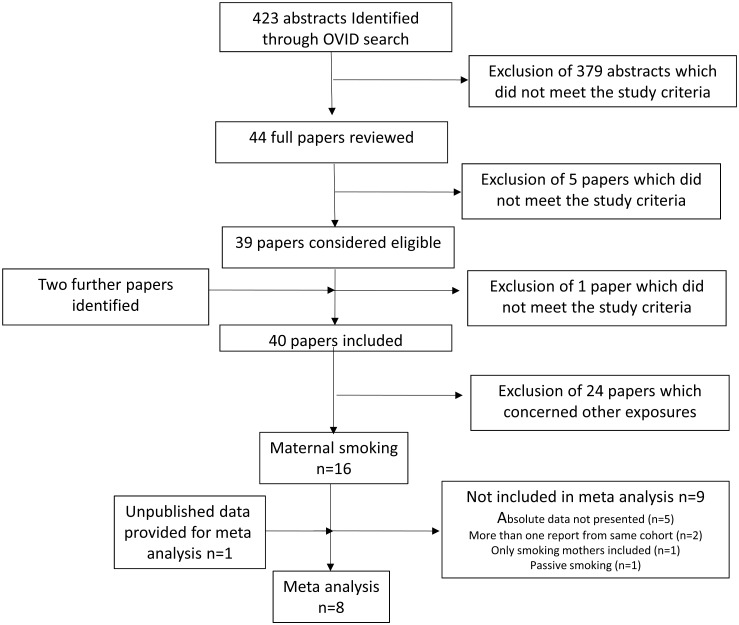
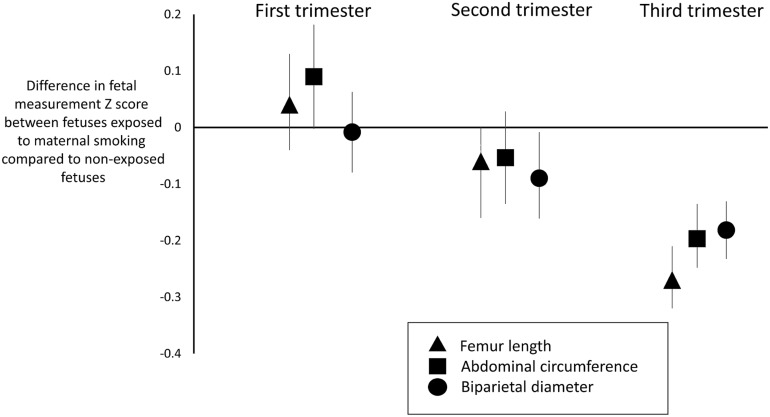
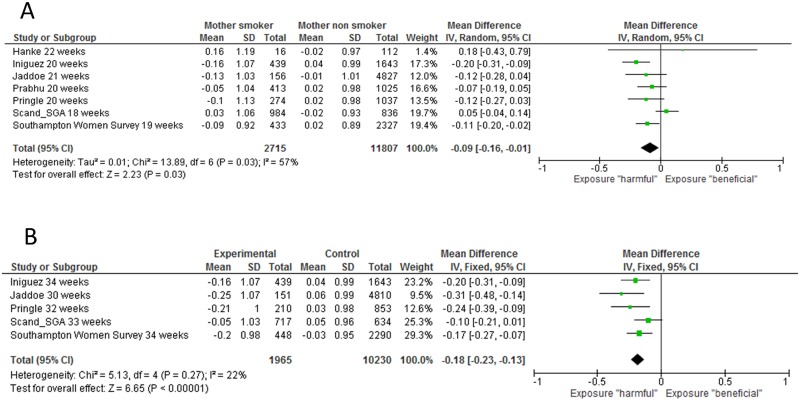
BACKGROUND: Maternal smoking during pregnancy is linked to reduced birth weight but the gestation at onset of this relationship is not certain. We present a systematic review of the literature describing associations between maternal smoking during pregnancy and ultrasound measurements of fetal size, together with an accompanying meta-analysis. METHODS: Studies were selected from electronic databases (OVID, EMBASE and Google Scholar) that examined associations between maternal smoking or smoke exposure and antenatal fetal ultrasound measurements. Outcome measures were first, second or third trimester fetal measurements. RESULTS: There were 284 abstracts identified, 16 papers were included in the review and the meta-analysis included data from eight populations. Maternal smoking was associated with reduced second trimester head size (mean reduction 0.09 standard deviation (SD) [95% CI 0.01, 0.16]) and femur length (0.06 [0.01, 0.10]) and reduced third trimester head size (0.18 SD [0.13, 0.23]), femur length (0.27 SD [0.21, 0.32]) and estimated fetal weight (0.18 SD [0.11, 0.24]). Higher maternal cigarette consumption was associated with a lower z score for head size in the second (mean difference 0.09 SD [0, 0.19]) and third (0.15 SD [0.03, 0.26]) trimesters compared to lower consumption. Fetal measurements were not reduced for those whose mothers quit before or after becoming pregnant compared to mothers who had never smoked. CONCLUSIONS: Maternal smoking during pregnancy is associated with reduced fetal measurements after the first trimester, particularly reduced head size and femur length. These effects may be attenuated if mothers quit or reduce cigarette consumption during pregnancy.
Overview
The claims and statistics of this paper haven’t been checked yet.
Run the check — free, no account needed. It reads the open-access text and checks the sources it cites.
Integrity signals
Registry
Cites
Statistics
Figures
Verification
Claims the paper makes
The claims and statistics of this paper haven’t been checked yet.
Run the check — free, no account needed. It reads the open-access text and checks the sources it cites.
Claims other papers make about this one
Each is checked against this paper’s own text: does it say what the citing paper says it does?
The source backs part of the claim, not all of it — or backs it for a different population, condition or comparison.
In the citing paper
“A previous systematic review showed that cessation of smoking before and shortly after becoming pregnant was not associated with SGA and this suggests that the mechanisms affecting fetal growth predominantly act beyond the first trimester [46].”
From Associations between periconceptional lifestyle behaviours and adverse pregnancy outcomes (2021) · cites this paper as [46]
Experimental — accuracy not yet measuredThe source backs part of the claim, not all of it — or backs it for a different population, condition or comparison.
In the citing paper
“A previous systematic review showed that cessation of smoking before and shortly after becoming pregnant was not associated with SGA and this suggests that the mechanisms affecting fetal growth predominantly act beyond the first trimester [46].”
From Associations between periconceptional lifestyle behaviours and adverse pregnancy outcomes (2021) · cites this paper as [46]
Experimental — accuracy not yet measured
Self-check
Percentages, sums and reported differences re-computed from the paper’s own numbers.
The self-check needs the paper’s full text.
Citations
Cites
Cochrane Handbook for Systematic Reviews of Interventions: Cochrane Book Series
(2008) · doi:10.1002/9780470712184 · Cited by 25,048
The environment and disease: association or causation?
Hill, A. B. (2015) · Journal of the Royal Society of Medicine · doi:10.1177/0141076814562718 · Cited by 7,804
Sterne, J. A. C., Sutton, A. J., Ioannidis, J. P. A., Terrin, N., Jones, D. R., Lau, J., Carpenter, J., Rucker, G., Harbord, R. M., Schmid, C. H., et al. (2011) · BMJ · doi:10.1136/bmj.d4002 · Cited by 7,709
The Environment and Disease: Association or Causation?
Hill, A. B. (1965) · Proceedings of the Royal Society of Medicine · doi:10.1177/003591576505800503 · Cited by 6,974
Hadlock, F. P., Harrist, R. B., Carpenter, R. J., Deter, R. L., & Park, S. K. (1984) · Radiology · doi:10.1148/radiology.150.2.6691115 · Cited by 784
Cohort Profile: The INMA—INfancia y Medio Ambiente—(Environment and Childhood) Project
Guxens, M., Ballester, F., Espada, M., Fernández, M. F., Grimalt, J. O., Ibarluzea, J. M., Olea, N., Rebagliato, M., Tardón, A., Torrent, M., et al. (2011) · International Journal of Epidemiology · doi:10.1093/ije/dyr054 · Cited by 637
Environmental tobacco smoke and fetal health: systematic review and meta-analysis
Leonardi‐Bee, J., Smyth, A. R., Britton, J. R., & Coleman, T. J. (2008) · Archives of Disease in Childhood Fetal & Neonatal · doi:10.1136/adc.2007.133553 · Cited by 329
Risk Factors and Outcomes Associated With First-Trimester Fetal Growth Restriction
Mook-Kanamori, D. O. (2010) · JAMA · doi:10.1001/jama.2010.78 · Cited by 266
Serum Cotinine Concentration and Self-reported Smoking during Pregnancy
Klebanoff, M. A., Levine, R. J., Clemens, J. D., DerSimonian, R., & Wilkins, D. G. (1998) · American Journal of Epidemiology · doi:10.1093/oxfordjournals.aje.a009633 · Cited by 264
Jaddoe, V. W. V., Verburg, B. O., de Ridder, M. A. J., Hofman, A., Mackenbach, J. P., Moll, H. A., Steegers, E. A. P., & Witteman, J. C. M. (2007) · American Journal of Epidemiology · doi:10.1093/aje/kwm014 · Cited by 202
Self-citation
Cited by
Sorted by citations
Wilson, R. D., Caughey, A. B., Wood, S. L., Macones, G. A., Wrench, I. J., Huang, J., Norman, M., Pettersson, K., Fawcett, W. J., Shalabi, M. M., et al. (2018) · American Journal of Obstetrics and Gynecology · doi:10.1016/j.ajog.2018.09.015 · Cited by 315
Finken, M. J. J., van der Steen, M., Smeets, C. C. J., Walenkamp, M. J. E., de Bruin, C., Hokken-Koelega, A., & Wit, J. M. (2018) · Endocrine Reviews · doi:10.1210/er.2018-00083 · Cited by 232
Identifying Malnutrition in Preterm and Neonatal Populations: Recommended Indicators
Goldberg, D. L., Becker, P. J., Brigham, K., Carlson, S. J., Fleck, L., Gollins, L. A., Sandrock, M., Fullmer, M., & Poots, H. A. V. (2018) · Journal of the Academy of Nutrition and Dietetics · doi:10.1016/j.jand.2017.10.006 · Cited by 190
Oluwasanmi, J. O. (1974) · Clinics in Plastic Surgery · doi:10.1016/s0094-1298(20)32271-9 · Cited by 156
Jafari, A., Rajabi, A., Gholian‐Aval, M., Peyman, N., Mahdizadeh, M., & Tehrani, H. (2021) · Environmental Health and Preventive Medicine · doi:10.1186/s12199-020-00924-y · Cited by 151
Metadata
- Authors
- Abraham, M., Alramadhan, S., Iniguez, C., Duijts, L., Jaddoe, V. W. V., Den Dekker, H. T., Crozier, S., Godfrey, K. M., Hindmarsh, P., Vik, T., Jacobsen, G. W., Hanke, W., Sobala, W., Devereux, G., & Turner, S.
- Affiliations
- University of Aberdeen (GB)
- Erasmus MC (NL)
- University Hospital Southampton NHS Foundation Trust (GB)
- University College London (GB)
- Norwegian University of Science and Technology (NO)
- Nofer Institute of Occupational Medicine (PL)
- Corresponding author
- Turner, Steve
- ORCID
- Venue
- PLOS ONE
- Publisher
- Public Library of Science (PLoS)
- Published
- 2017-02-23
- Volume
- 12
- Issue
- 2
- Pages
- e0170946
- ISSN
- 1932-6203 (ISSN-L)
- PMC
- PMC5322900
- OpenAlex
- W2589713358
- Cited by
- 282
- References
- 35
- Citations by year
- 2026: 13 · 2025: 23 · 2024: 36 · 2023: 41 · 2022: 30 · 2021: 56 · 2020: 36 · 2019: 20 · 2018: 23 · 2017: 3
- FWCI
- 4.20
- Type
- journal article
- Language
- en
- Open access
- gold
- doi.org
- Licence
- Locations
- PLoS ONE (publishedVersion, cc-by)
- Europe PMC (PubMed Central) (publishedVersion, cc-by)
- PubMed Central (publishedVersion, cc-by)
- PubMed (publishedVersion)
- EUR Research Repository (Erasmus University Rotterdam) (publishedVersion, other-oa)
- BIBSYS Brage (BIBSYS (Norway)) (acceptedVersion, cc-by)
- ePrints Soton (University of Southampton) (acceptedVersion)
- Aberdeen University Research Archive (Aberdeen University) (submittedVersion)
- NORA - Norwegian Open Research Archives (submittedVersion, cc-by)
- EUR Research Repository (Erasmus University Rotterdam) (submittedVersion, other-oa)
- RePub (Erasmus University Rotterdam) (submittedVersion, other-oa)
- RePEc: Research Papers in Economics (submittedVersion)
- DOAJ (DOAJ: Directory of Open Access Journals) (submittedVersion, cc-by-sa)
- Figshare (submittedVersion, cc-by)
- Funders
- European Cooperation in Science and Technology
- Topics
- Health Sciences › Medicine › Pediatrics, Perinatology and Child Health › Prenatal Substance Exposure Effects
- Health Sciences › Medicine › Public Health, Environmental and Occupational Health › Smoking Behavior and Cessation
- Health Sciences › Medicine › Obstetrics and Gynecology › Pregnancy and preeclampsia studies
- Keywords
- smoking during pregnancy, fetal growth, fetal head circumference, femur length, estimated fetal weight, cigarette consumption, smoking cessation, prenatal tobacco exposure, birth weight
- MeSH terms
- Birth Weight, Female, Fetal Growth Retardation, Head, Humans, Pregnancy, Pregnancy Trimester, First, Pregnancy Trimester, Second, Pregnancy Trimester, Third, Smoking, Tobacco Smoke Pollution, Fetal Development
About these checks
Registry, retraction, Cites and statistics results are computed, not judged, with one exception: a printed reference that no index lists is read once by a model before it counts as a citation error. Claims are extracted by a model and kept only when their quote appears verbatim in the text; each cited source is then checked, with a model’s help, for whether it says what the claim relies on. Those verdicts can be wrong — read the claim’s quote and the cited source before relying on one.
Statistics and arithmetic are recomputed, not judged.
Confidence bands are shown only for fields calibrated on our annotated test set. None is calibrated yet, so no band is shown.
What counts as a claim ›How we measure confidence ›How we check this ›
Are you an author, or do you see a problem with this page? Request a review
