

Genome-wide association analysis for heat tolerance at flowering detected a large set of genes involved in adaptation to thermal and other stresses
Open accessThe DOI matches its Crossref record; 72 of the 74 references it cites were found in a registry or an index.
Abstract
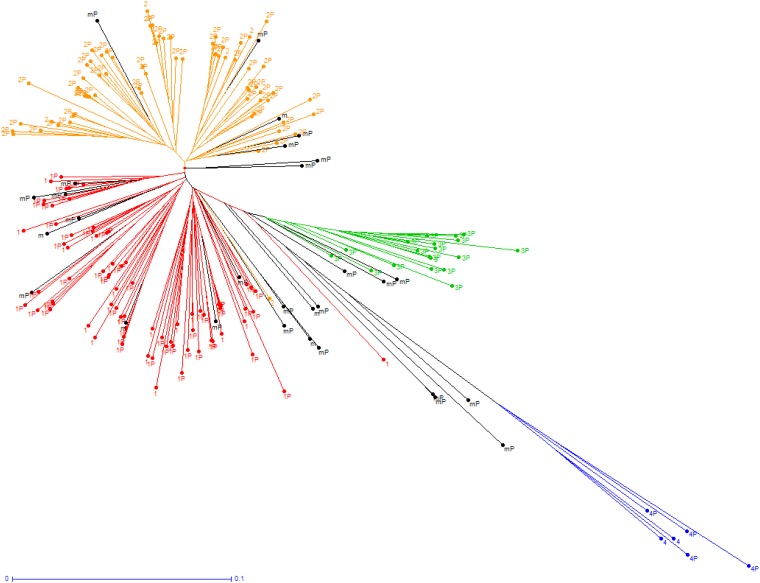
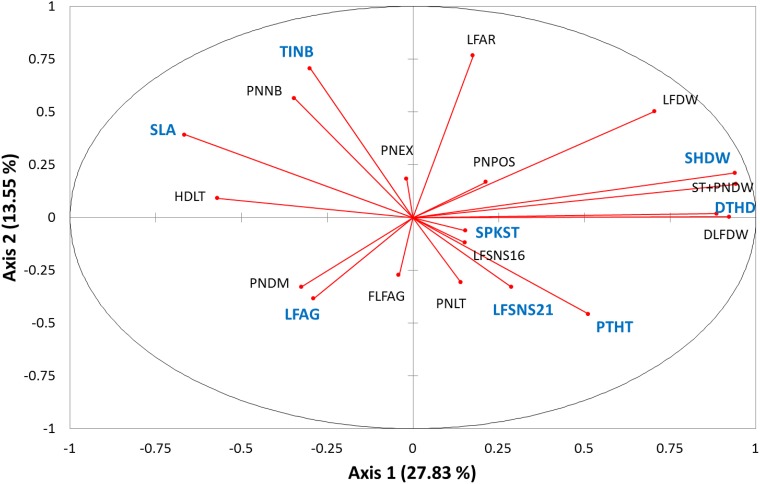
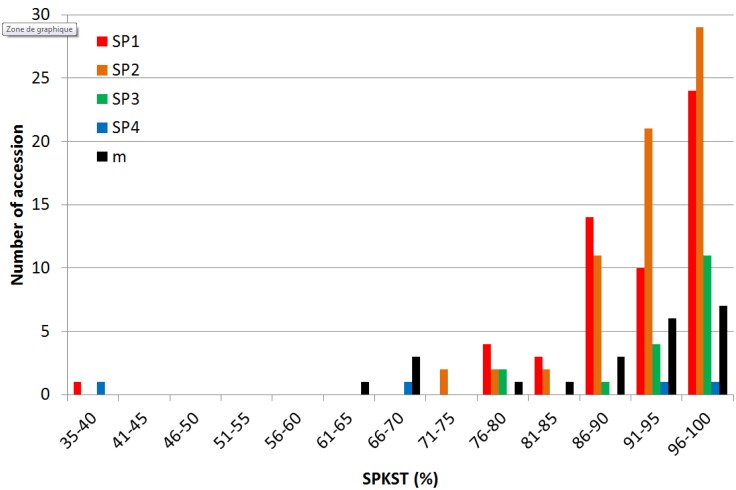
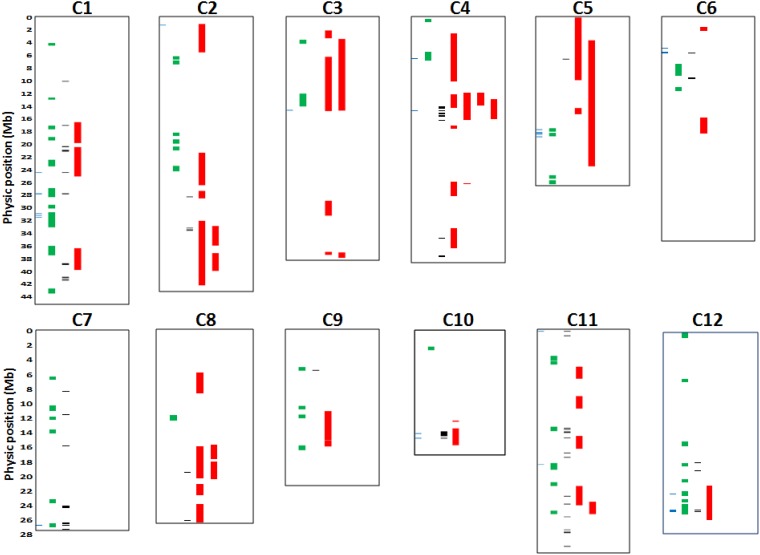
Fertilization sensitivity to heat in rice is a major issue within climate change scenarios in the tropics. A panel of 167 indica landraces and improved varieties was phenotyped for spikelet sterility (SPKST) under 38°C during anthesis and for several secondary traits potentially affecting panicle micro-climate and thus the fertilization process. The panel was genotyped with an average density of one marker per 29 kb using genotyping by sequencing. Genome-wide association analyses (GWAS) were conducted using three methods based on single marker regression, haplotype regression and simultaneous fitting of all markers, respectively. Fourteen loci significantly associated with SPKST under at least two GWAS methods were detected. A large number of associations was also detected for the secondary traits. Analysis of co-localization of SPKST associated loci with QTLs detected in progenies of bi-parental crosses reported in the literature allowed to narrow -down the position of eight of those QTLs, including the most documented one, qHTSF4.1. Gene families underlying loci associated with SPKST corresponded to functions ranging from sensing abiotic stresses and regulating plant response, such as wall-associated kinases and heat shock proteins, to cell division and gametophyte development. Analysis of diversity at the vicinity of loci associated with SPKST within the rice three thousand genomes, revealed widespread distribution of the favourable alleles across O. sativa genetic groups. However, few accessions assembled the favourable alleles at all loci. Effective donors included the heat tolerant variety N22 and some Indian and Taiwanese varieties. These results provide a basis for breeding for heat tolerance during anthesis and for functional validation of major loci governing this trait.
Overview
The claims and statistics of this paper haven’t been checked yet.
Free: it reads the open-access text and checks the first 5 claims that cite a source we can check. Create a free account to check every claim.
Integrity signals
Registry
Cites
Statistics
Figures
Verification
Claims the paper makes
The claims and statistics of this paper haven’t been checked yet.
Free: it reads the open-access text and checks the first 5 claims that cite a source we can check. Create a free account to check every claim.
Claims other papers make about this one
Each is checked against this paper’s own text: does it say what the citing paper says it does?
In the citing paper
“A significant association was present between SPKST, secondary traits, and 14 loci.”
From Impact of Climate Change on Crops Adaptation and Strategies to Tackle Its Outcome: A Review (2019) · cites this paper as [149]
In the citing paper
“GWAS have been applied to describe drought tolerance [147], salt tolerance [148], and heat tolerance [149].”
From Impact of Climate Change on Crops Adaptation and Strategies to Tackle Its Outcome: A Review (2019) · cites this paper as [149]
Self-check
Percentages, sums and reported differences re-computed from the paper’s own numbers.
The self-check needs the paper’s full text.
Citations
Cites
Inference of Population Structure Using Multilocus Genotype Data
Pritchard, J. K., Stephens, M., & Donnelly, P. (2000) · Genetics · doi:10.1093/genetics/155.2.945 · Cited by 33,908
Prediction of Total Genetic Value Using Genome-Wide Dense Marker Maps
Meuwissen, T. H. E., Hayes, B. J., & Goddard, M. E. (2001) · Genetics · doi:10.1093/genetics/157.4.1819 · Cited by 7,917
TASSEL: software for association mapping of complex traits in diverse samples
Bradbury, P. J., Zhang, Z., Kroon, D. E., Casstevens, T. M., Ramdoss, Y., & Buckler, E. S. (2007) · Bioinformatics · doi:10.1093/bioinformatics/btm308 · Cited by 7,759
The Future of Genetic Studies of Complex Human Diseases
Risch, N., & Merikangas, K. (1996) · Science · doi:10.1126/science.273.5281.1516 · Cited by 5,355
Climate change 2001: synthesis report
(2003) · Choice Reviews Online · doi:10.5860/choice.40-4660 · Cited by 5,272
Browning, S. R., & Browning, B. L. (2007) · The American Journal of Human Genetics · doi:10.1086/521987 · Cited by 3,210
Park, T., & Casella, G. (2008) · Journal of the American Statistical Association · doi:10.1198/016214508000000337 · Cited by 2,934
A meta-analysis of crop yield under climate change and adaptation
Challinor, A. J., Watson, J., Lobell, D. B., Howden, S. M., Smith, D. R., & Chhetri, N. (2014) · Nature Climate Change · doi:10.1038/nclimate2153 · Cited by 2,333
Kawahara, Y., de la Bastide, M., Hamilton, J. P., Kanamori, H., McCombie, W. R., Ouyang, S., Schwartz, D. C., Tanaka, T., Wu, J., Zhou, S., et al. (2013) · Rice · doi:10.1186/1939-8433-6-4 · Cited by 2,251
Mixed linear model approach adapted for genome-wide association studies
Zhang, Z., Ersoz, E., Lai, C.-Q., Todhunter, R. J., Tiwari, H. K., Gore, M. A., Bradbury, P. J., Yu, J., Arnett, D. K., Ordovas, J. M., et al. (2010) · Nature Genetics · doi:10.1038/ng.546 · Cited by 2,125
Research works printed but not linked: 3
- Xia MY, Qi HX. Effects of high temperature on the seed setting percent of hybrid rice bred with four male sterile lines. Hubei Agricultural Science. 2004; 2: 21– 22.
- Jagadish SVK, Muthurajan R, Oane R, Wheeler TR, Heuer S, Bennett J, et al Physiological and proteomic approaches to dissect reproductive stage heat tolerance in rice (Oryza sativa L.). Journal of Experimental Botany. 2010b; 61: 143– 156. 19858118 PMC2791117 · DOI · Paper page
- Zou J, Liu A, Chen X, Zhou X, Gao G, Wang W, et al. Expression analysis of nine heat shock protein genes in rice. 2008; http://www.paper.edu.cn. 19135278
Cited by
Impact of Climate Change on Crops Adaptation and Strategies to Tackle Its Outcome: A Review
Raza, A., Razzaq, A., Mehmood, S. S., Zou, X., Zhang, X., Lv, Y., & Xu, J. (2019) · Plants · doi:10.3390/plants8020034 · Cited by 1,762
“These loci were investigated for functions related to heat shock proteins, controlling plant responses, development of gametophyte, cell division, and detecting abiotic stresses [149].”
BackgroundMethodGenome-Wide Association Mapping of Seedling Heat Tolerance in Winter Wheat
Maulana, F., Ayalew, H., Anderson, J. D., Kumssa, T. T., Huang, W., & Ma, X. (2018) · Frontiers in Plant Science · doi:10.3389/fpls.2018.01272 · Cited by 155
Chaudhary, S., Devi, P., Bhardwaj, A., Jha, U. C., Sharma, K. D., Prasad, P. V. V., Siddique, K. H. M., Bindumadhava, H., Kumar, S., & Nayyar, H. (2020) · Frontiers in Plant Science · doi:10.3389/fpls.2020.587264 · Cited by 151
High Temperature Stress Tolerance in Maize (Zea mays L.): Physiological and Molecular Mechanisms
Tiwari, Y. K., & Yadav, S. K. (2019) · Journal of Plant Biology · doi:10.1007/s12374-018-0350-x · Cited by 137
Heat Stress-Mediated Constraints in Maize (Zea mays) Production: Challenges and Solutions
El‐Sappah, A. H., Rather, S. A., Wani, S. H., Elrys, A. S., Bilal, M., Huang, Q., Dar, Z. A., Elashtokhy, M. M. A., Soaud, N., Koul, M., et al. (2022) · Frontiers in Plant Science · doi:10.3389/fpls.2022.879366 · Cited by 126
Metadata
- Authors
- Lafarge, T., Bueno, C., Frouin, J., Jacquin, L., Courtois, B., & Ahmadi, N.
- Affiliations
- Centre de Coopération Internationale en Recherche Agronomique pour le Développement (FR)
- International Rice Research Institute (PH)
- Corresponding author
- Ahmadi, Nourollah
- Venue
- PLOS ONE
- Publisher
- Public Library of Science (PLoS)
- Published
- 2017-02-02
- Volume
- 12
- Issue
- 2
- Pages
- e0171254
- ISSN
- 1932-6203 (ISSN-L)
- PMC
- PMC5289576
- OpenAlex
- W2583376552
- Cited by
- 81
- References
- 74
- Citations by year
- 2026: 9 · 2025: 2 · 2024: 9 · 2023: 6 · 2022: 14 · 2021: 15 · 2020: 10 · 2019: 6 · 2018: 8 · 2017: 2
- FWCI
- 4.71
- Type
- journal article
- Language
- en
- Open access
- gold
- doi.org
- Licence
- Locations
- PLoS ONE (publishedVersion, cc-by)
- Europe PMC (PubMed Central) (publishedVersion, cc-by)
- PubMed Central (publishedVersion, cc-by)
- PubMed (publishedVersion)
- Agritrop (Cirad) (submittedVersion)
- CGSPace A Repository of Agricultural Research Outputs (Consultative Group for International Agricultural Research) (submittedVersion, other-oa)
- DOAJ (DOAJ: Directory of Open Access Journals) (submittedVersion)
- Figshare (submittedVersion, cc-by)
- Greater South Information System
- Funders
- CIRAD (ATP-Orytage)
- IRRI (IRRI-CIRAD MOU)
- Topics
- Life Sciences › Biochemistry, Genetics and Molecular Biology › Genetics › Genetic Mapping and Diversity in Plants and Animals
- Life Sciences › Agricultural and Biological Sciences › Plant Science › Rice Cultivation and Yield Improvement
- Life Sciences › Agricultural and Biological Sciences › Plant Science › Genetics and Plant Breeding
- Keywords
- rice, heat tolerance, spikelet sterility, anthesis, flowering, genome-wide association study, QTL mapping, heat shock proteins, wall-associated kinase, gametophyte development, climate change adaptation, heat tolerance breeding
- MeSH terms
- Thermotolerance, Genetic Markers, Phenotype, Oryza, Stress, Physiological, Linkage Disequilibrium, Genes, Plant, Polymorphism, Single Nucleotide, Flowers, Quantitative Trait Loci, Genome-Wide Association Study
About these checks
Registry, retraction, Cites and statistics results are computed, not judged, with one exception: a printed reference that no index lists is read once by a model before it counts as a citation error. Claims are extracted by a model and kept only when their quote appears verbatim in the text; each cited source is then checked, with a model’s help, for whether it says what the claim relies on. Those verdicts can be wrong — read the claim’s quote and the cited source before relying on one.
Statistics and arithmetic are recomputed, not judged.
Confidence bands are shown only for fields calibrated on our annotated test set. None is calibrated yet, so no band is shown.
What counts as a claim ›How we measure confidence ›How we check this ›
Are you an author, or do you see a problem with this page? Request a review
Data sources
Bibliographic data: Semantic Scholar, OpenAlex, Crossref.
Contains information from the Semantic Scholar Academic Graph Datasets, made available under the ODC Attribution License (ODC-BY 1.0).
Semantic Scholar’s data is described in: Kinney, R., et al. (2023). The Semantic Scholar Open Data Platform. arXiv:2301.10140.
