

The DOI matches its Crossref record; 97 of the 97 references it cites were found in a registry or an index.
Evolution of ischemic damage and behavioural deficit over 6 months after MCAo in the rat: selecting the optimal outcomes and statistical power for multi-centre preclinical trials.
Abstract
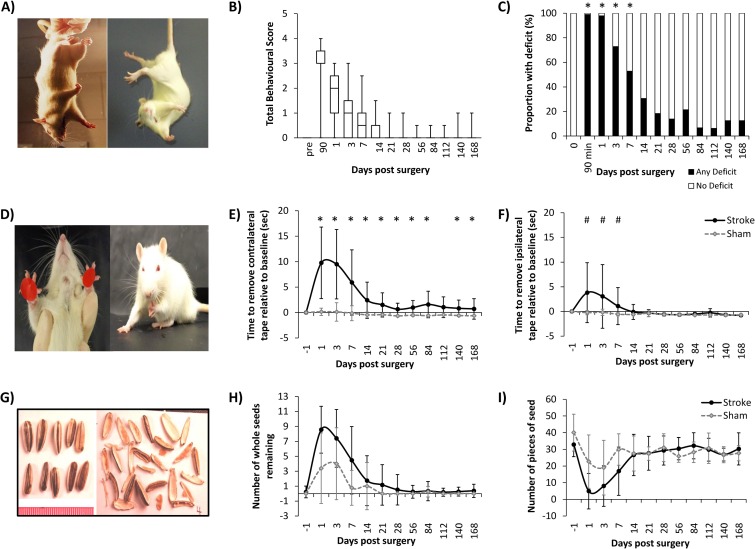
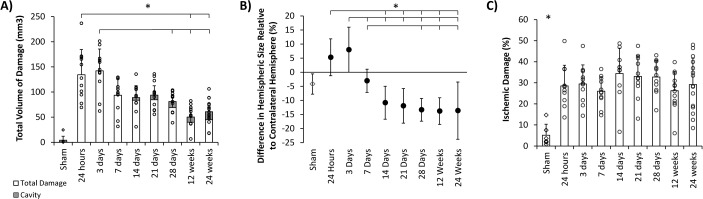
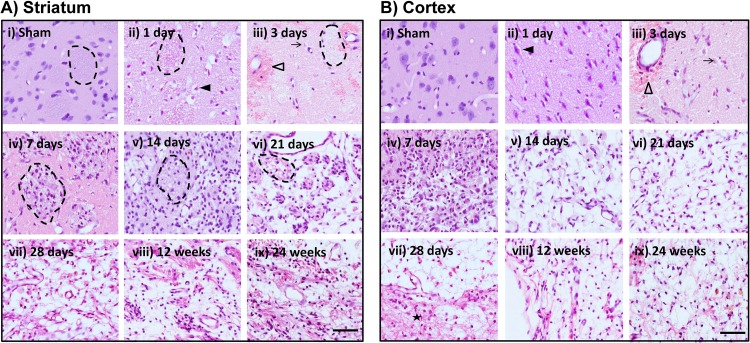
Key disparities between the timing and methods of assessment in animal stroke studies and clinical trial may be part of the reason for the failure to translate promising findings. This study investigates the development of ischemic damage after thread occlusion MCAo in the rat, using histological and behavioural outcomes. Using the adhesive removal test we investigate the longevity of behavioural deficit after ischemic stroke in rats, and examine the practicality of using such measures as the primary outcome for future studies. Ischemic stroke was induced in 132 Spontaneously Hypertensive Rats which were assessed for behavioural and histological deficits at 1, 3, 7, 14, 21, 28 days, 12 and 24 weeks (n>11 per timepoint). The basic behavioural score confirmed induction of stroke, with deficits specific to stroke animals. Within 7 days, these deficits resolved in 50% of animals. The adhesive removal test revealed contralateral neglect for up to 6 months following stroke. Sample size calculations to facilitate the use of this test as the primary experimental outcome resulted in cohort sizes much larger than are the norm for experimental studies. Histological damage progressed from a necrotic infarct to a hypercellular area that cleared to leave a fluid filled cavity. Whilst absolute volume of damage changed over time, when corrected for changes in hemispheric volume, an equivalent area of damage was lost at all timepoints. Using behavioural measures at chronic timepoints presents significant challenges to the basic science community in terms of the large number of animals required and the practicalities associated with this. Multicentre preclinical randomised controlled trials as advocated by the MultiPART consortium may be the only practical way to deal with this issue.
Overview
The claims and statistics of this paper haven’t been checked yet.
Run the check — free, no account needed. It reads the open-access text and checks the sources it cites.
Integrity signals
Registry
Cites
Statistics
Figures
Verification
Claims the paper makes
The claims and statistics of this paper haven’t been checked yet.
Run the check — free, no account needed. It reads the open-access text and checks the sources it cites.
Claims other papers make about this one
Each is checked against this paper’s own text: does it say what the citing paper says it does?
In the citing paper
“This temporal expression pattern is coordinated with the evolution of ischemic injury in animal stroke models (Rewell et al., 2017).”
From Acute Cerebral Ischemia Increases a Set of Brain-Specific miRNAs in Serum Small Extracellular Vesicles (2022) · cites this paper as Rewell et al., 2017
Self-check
Percentages, sums and reported differences re-computed from the paper’s own numbers.
The self-check needs the paper’s full text.
Citations
Cites
Reversible middle cerebral artery occlusion without craniectomy in rats.
Longa, E. Z., Weinstein, P. R., Carlson, S., & Cummins, R. (1989) · Stroke · doi:10.1161/01.str.20.1.84 · Cited by 7,463
Improving Bioscience Research Reporting: The ARRIVE Guidelines for Reporting Animal Research
Kilkenny, C., Browne, W. J., Cuthill, I. C., Emerson, M., & Altman, D. G. (2010) · PLoS Biology · doi:10.1371/journal.pbio.1000412 · Cited by 7,300
Improving bioscience research reporting: The ARRIVE guidelines for reporting animal research
Kilkenny, C., Browne, W. J., Cuthill, I. C., Emerson, M., & Altman, D. G. (2010) · Journal of Pharmacology and Pharmacotherapeutics · doi:10.4103/0976-500x.72351 · Cited by 6,277
Bederson, J. B., Pitts, L. H., Tsuji, M., Nishimura, M. C., Davis, R. L., & Bartkowski, H. (1986) · Stroke · doi:10.1161/01.str.17.3.472 · Cited by 2,681
Banks, J. L., & Marotta, C. A. (2007) · Stroke · doi:10.1161/01.str.0000258355.23810.c6 · Cited by 2,253
Disseminated Intravascular Coagulation
Levi, M., & ten Cate, H. (1999) · New England Journal of Medicine · doi:10.1056/nejm199908193410807 · Cited by 2,005
Update of the Stroke Therapy Academic Industry Roundtable Preclinical Recommendations
Fisher, M., Feuerstein, G., Howells, D. W., Hurn, P. D., Kent, T. A., Savitz, S. I., & Lo, E. H. (2009) · Stroke · doi:10.1161/strokeaha.108.541128 · Cited by 1,352
Self-citationRecommendations for Standards Regarding Preclinical Neuroprotective and Restorative Drug Development
(1999) · Stroke · doi:10.1161/01.str.30.12.2752 · Cited by 1,251
Temporal and Spatial Dynamics of Cerebral Immune Cell Accumulation in Stroke
Gelderblom, M., Leypoldt, F., Steinbach, K., Behrens, D., Choe, C.-U., Siler, D. A., Arumugam, T. V., Orthey, E., Gerloff, C., Tolosa, E., et al. (2009) · Stroke · doi:10.1161/strokeaha.108.534503 · Cited by 1,066
Gladstone, D. J., Black, S. E., & Hakim, A. M. (2002) · Stroke · doi:10.1161/01.str.0000025518.34157.51 · Cited by 635
Research works printed but not linked: 1
- PD Schellinger, 2012, Assessment of additional endpoints for trials in acute stroke—what, when, where, in who?, Int J Stroke, 7, 227, 10.1111/j.1747-4949.2012.00773.x · DOI
Cited by
Translational Stroke Research: Vision and Opportunities
Bosetti, F., Koenig, J. I., Ayata, C., Back, S. A., Becker, K., Broderick, J. P., Carmichael, S. T., Cho, S., Cipolla, M. J., Corbett, D., et al. (2017) · Stroke · doi:10.1161/strokeaha.117.017112 · Cited by 171
“Research Team group demonstrated the feasibility of a multilaboratory approach embracing rigorous research principles.(15,16)”
MethodInflammation within the neurovascular unit: Focus on microglia for stroke injury and recovery
Eldahshan, W., Fagan, S. C., & Ergul, A. (2019) · Pharmacological Research · doi:10.1016/j.phrs.2019.104349 · Cited by 104
The Stroke Preclinical Assessment Network: Rationale, Design, Feasibility, and Stage 1 Results
Lyden, P. D., Bosetti, F., Diniz, M. A., Rogatko, A., Koenig, J. I., Lamb, J., Nagarkatti, K. A., Cabeen, R. P., Hess, D. C., Kamat, P. K., et al. (2022) · Stroke · doi:10.1161/strokeaha.121.038047 · Cited by 73
Zhou, X., Xu, C., Chao, D., Chen, Z., Li, S., Shi, M., Pei, Y., Dai, Y., Ji, J., Ji, Y., et al. (2022) · Frontiers in Molecular Neuroscience · doi:10.3389/fnmol.2022.874903 · Cited by 13
Metadata
- Authors
- Rewell, S. S. J., Churilov, L., Sidon, T. K., Aleksoska, E., Cox, S. F., Macleod, M. R., & Howells, D. W.
- ORCID
- Rewell, Sarah S. J.
- Venue
- PLOS ONE
- Publisher
- Public Library of Science (PLoS)
- Published
- 2017-02-09
- Volume
- 12
- Issue
- 2
- Pages
- e0171688
- ISSN
- 1932-6203
- PMC
- PMC5300105
- Cited by
- 54
- References
- 97
- Language
- en
- Funders
- National Health and Medical Research Council (GNT1013612)
About these checks
Registry, retraction, Cites and statistics results are computed, not judged, with one exception: a printed reference that no index lists is read once by a model before it counts as a citation error. Claims are extracted by a model and kept only when their quote appears verbatim in the text; each cited source is then checked, with a model’s help, for whether it says what the claim relies on. Those verdicts can be wrong — read the claim’s quote and the cited source before relying on one.
Statistics and arithmetic are recomputed, not judged.
Confidence bands are shown only for fields calibrated on our annotated test set. None is calibrated yet, so no band is shown.
What counts as a claim ›How we measure confidence ›How we check this ›
Are you an author, or do you see a problem with this page? Request a review
How to cite
Cite CoChat for the checks on this page, and the paper for its own findings.
- This page
- CoChat. (2026). Citation check: Evolution of ischemic damage and behavioural deficit over 6 months after MCAo in the rat: selecting the optimal outcomes and statistical power for multi-centre preclinical trials. https://app.cochat.ai/papers/10.1371/journal.pone.0171688
- The paper
- Rewell, S. S. J., Churilov, L., Sidon, T. K., Aleksoska, E., Cox, S. F., Macleod, M. R., & Howells, D. W. (2017). Evolution of ischemic damage and behavioural deficit over 6 months after MCAo in the rat: selecting the optimal outcomes and statistical power for multi-centre preclinical trials. PLOS ONE. https://doi.org/10.1371/journal.pone.0171688
Data sources
Bibliographic data: Semantic Scholar, OpenAlex, Crossref.
Contains information from the Semantic Scholar Academic Graph Datasets, made available under the ODC Attribution License (ODC-BY 1.0).
Semantic Scholar’s data is described in: Kinney, R., et al. (2023). The Semantic Scholar Open Data Platform. arXiv:2301.10140.
