

The DOI matches its Crossref record; 72 of the 73 references it cites were found in a registry or an index.
Interventions to treat mental disorders during pregnancy: A systematic review and multiple treatment meta-analysis
Open accessAbstract
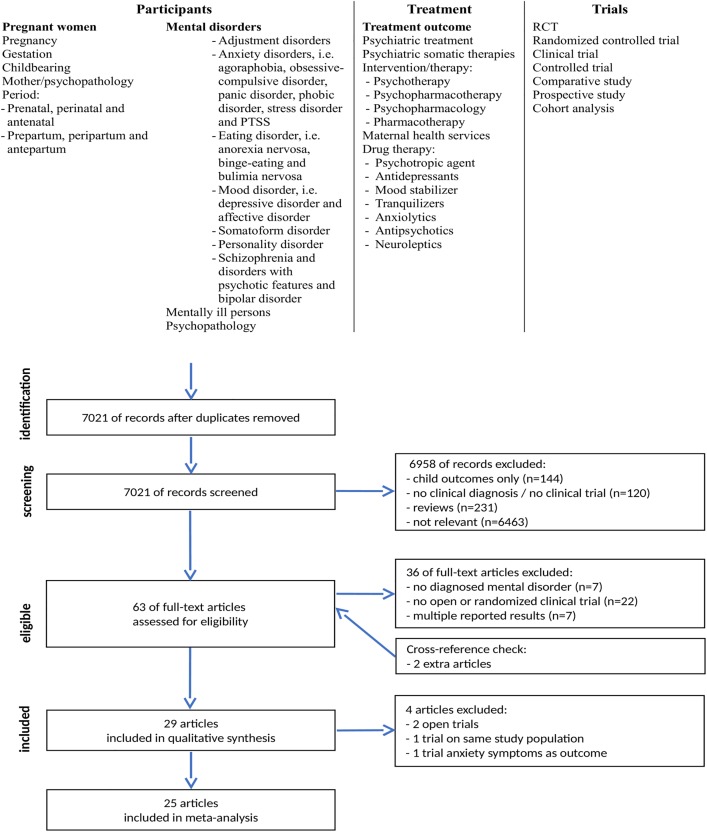
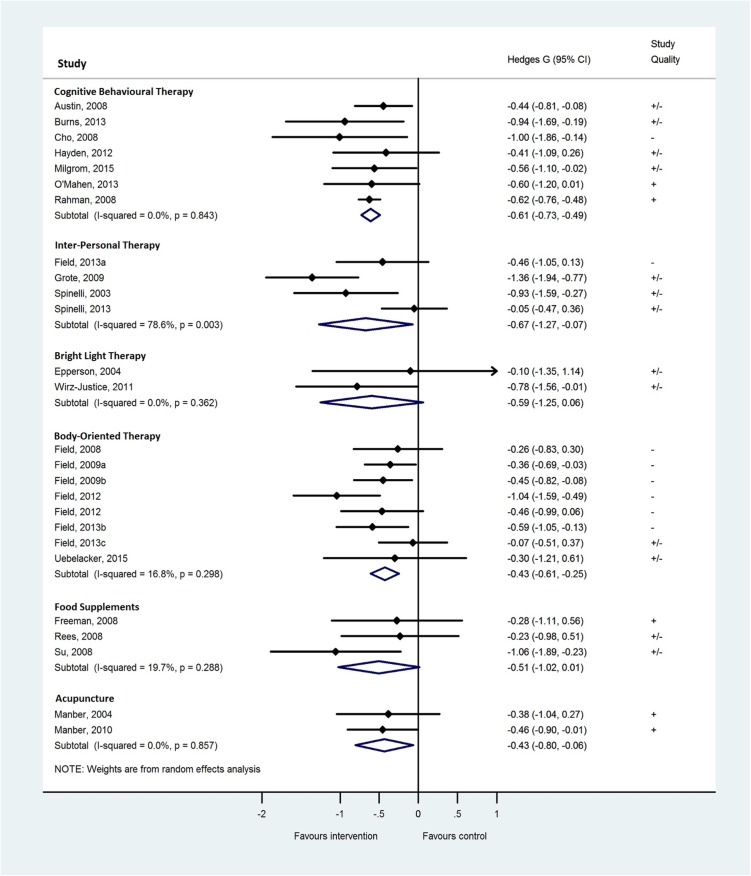
BACKGROUND: For women suffering from an antepartum mental disorder (AMD), there is lack of evidence-based treatment algorithms due to the complicated risk-benefit analysis for both mother and unborn child. We aimed to provide a comprehensive overview of pharmacological and non-pharmacological interventions to treat AMD and performed a meta-analysis of the estimated treatment effect on the psychiatric symptoms during pregnancy. METHODS: MedLine, PsycINFO and Embase databases were searched by two independent reviewers for clinical trials with a control condition on treatment of women with AMD, i.e. major depressive (MDD), anxiety, psychotic, eating, somatoform and personality disorders. We inventoried the effect of the treatment, i.e. decrease of psychiatric symptoms at the end of the treatment or postpartum. We adhered to the PRISMA-protocol. FINDINGS: Twenty-nine trials were found involving 2779 patients. Trials studied patients with depressive disorders (k = 28), and anxiety disorders (k = 1). No pharmacological trials were detected. A form of psychotherapy, like Cognitive Behavioural Therapy (g = -0.61; 95%CI:-0.73 to -0.49, I2 = 0%; k = 7) or Interpersonal Psychotherapy (g = -0.67; 95%CI:-1.27 to -0.07; I2 = 79%; k = 4), holds robust benefit for pregnant women with MDD. Body-oriented interventions (g = -0.43; 95%CI:-0.61 to -0.25; I2 = 17%; k = 7) and acupuncture (g = -0.43; 95%CI:-0.80 to -0.06; I2 = 0%; k = 2) showed medium sized reduction of depressive symptoms. Bright light therapy (g = -0.59; 95%CI:-1.25 to 0.06; I2 = 0%; k = 2), and food supplements (g = -0.51; 95%CI:-1.02 to 0.01; I2 = 20%; k = 3) did not show significant treatment effects. One study was found on Integrative Collaborative Care. CONCLUSIONS: This meta-analysis found a robust moderate treatment effect of CBT for MDD during pregnancy, and to a lesser extent for IPT. As an alternative, positive results were found for body-oriented interventions and acupuncture. No evidence was found for bright light therapy and food supplements. Only non-pharmacological trials on women with MDD were found. Research on a wider range of AMD is needed.
Overview
The claims and statistics of this paper haven’t been checked yet.
Run the check — free, no account needed. It reads the open-access text and checks the sources it cites.
Integrity signals
Registry
Cites
Statistics
Figures
Verification
Claims the paper makes
The claims and statistics of this paper haven’t been checked yet.
Run the check — free, no account needed. It reads the open-access text and checks the sources it cites.
Claims other papers make about this one
Each is checked against this paper’s own text: does it say what the citing paper says it does?
The source backs part of the claim, not all of it — or backs it for a different population, condition or comparison.
In the citing paper
“A systematic review on various studies in treating antepartum depression with a control condition showed that these trials often show a considerable reduction in symptom scores in both treatment arms.39”
From Effects of bright light therapy for depression during pregnancy: a randomised, double-blind controlled trial (2020) · cites this paper as [39]
Experimental — accuracy not yet measuredThe source backs part of the claim, not all of it — or backs it for a different population, condition or comparison.
In the citing paper
“Psychotherapeutic interventions such as interpersonal psychotherapy and cognitive behavioral therapy (CBT), which have been shown to be effective in treating perinatal depression and anxiety (28, 29), are preferred (27, 30, 31).”
From Acceptance, experiences, and needs of hospitalized pregnant women toward an electronic mindfulness-based intervention: A pilot mixed-methods study (2022) · cites this paper as [28]
Experimental — accuracy not yet measuredThe source backs part of the claim, not all of it — or backs it for a different population, condition or comparison.
In the citing paper
“From previous trials, we also know that to overcome high attrition rates and improve effectiveness, interventions should be aimed primarily at at-risk women (e.g., women with subclinical depression) and should fit the unique preferences and needs of pregnant women [22–24].”
From Effectiveness of a guided ACT-based self-help resilience training for depressive symptoms during pregnancy: Study protocol of a randomized controlled trial embedded in a prospective cohort. (2020) · cites this paper as [22]
Experimental — accuracy not yet measured
Self-check
Percentages, sums and reported differences re-computed from the paper’s own numbers.
The self-check needs the paper’s full text.
Citations
Cites
Statistical Power Analysis for the Behavioral Sciences
Muller, K. E., & Cohen, J. (1989) · Technometrics · doi:10.2307/1270020 · Cited by 99,603
Preferred Reporting Items for Systematic Reviews and Meta-Analyses: the PRISMA statement
Moher, D., Liberati, A., Tetzlaff, J., Altman, D. G., & for the PRISMA Group (2009) · BMJ · doi:10.1136/bmj.b2535 · Cited by 83,823
Statistical power analysis for the behavioral sciences
Cohen, J. (1990) · Computers Environment and Urban Systems · doi:10.1016/0198-9715(90)90050-4 · Cited by 65,417
Preferred Reporting Items for Systematic Reviews and Meta-Analyses: The PRISMA Statement
Moher, D., Liberati, A., Tetzlaff, J., Altman, D. G., & The PRISMA Group (2009) · PLoS Medicine · doi:10.1371/journal.pmed.1000097 · Cited by 64,042
Bias in meta-analysis detected by a simple, graphical test
Egger, M., Smith, G. D., Schneider, M., & Minder, C. (1997) · BMJ · doi:10.1136/bmj.315.7109.629 · Cited by 56,722
Preferred reporting items for systematic reviews and meta-analyses: the PRISMA Statement.
(2009) · PubMed Central · Cited by 44,859
Wang, G., Ma, R., Qiao, G., Wada, K., Aizawa, Y., & Satoh, T. (2015) · Integrative Medicine International · doi:10.1159/000368408 · Cited by 18,762
Wasserman, S. S., Hedges, L. V., & Olkin, I. (1988) · Journal of Educational Statistics · doi:10.2307/1164953 · Cited by 10,377
(2005) · PubMed · Cited by 7,011
Assessing the quality of controlled clinical trials
Jüni, P., Altman, D. G., & Egger, M. (2001) · BMJ · doi:10.1136/bmj.323.7303.42 · Cited by 3,309
Research works printed but not linked: 1
- LC Lamprou, 2013, Randomized controlled trial assessing the efficacy of transcranial magnetic stimulation for the treatment of major depressive disorder in pregnancy, J ECT, 29, 150
Cited by
Sorted by citations
Perinatal mental health: a review of progress and challenges
Howard, L. M., & Khalifeh, H. (2020) · World Psychiatry · doi:10.1002/wps.20769 · Cited by 1,118
Evidence-Based Nonpharmacologic Strategies for Comprehensive Pain Care
Tick, H., Nielsen, A., Pelletier, K. R., Bonakdar, R. A., Simmons, S., Glick, R. M., Ratner, E. F., Lemmon, R., Wayne, P. M., & Zador, V. (2018) · EXPLORE · doi:10.1016/j.explore.2018.02.001 · Cited by 404
Antiviral, Antibacterial, Antifungal, and Antiparasitic Properties of Propolis: A Review
Zulhendri, F., Chandrasekaran, K., Kowacz, M., Ravalia, M., Kripal, K., Fearnley, J., & Perera, C. O. (2021) · Foods · doi:10.3390/foods10061360 · Cited by 247
A systematic review and meta-analysis of interpersonal psychotherapy for perinatal women
Sockol, L. E. (2018) · Journal of Affective Disorders · doi:10.1016/j.jad.2018.01.018 · Cited by 158
Guidelines on treatment of perinatal depression with antidepressants: An international review
Molenaar, N. M., Kamperman, A. M., Boyce, P., & Bergink, V. (2018) · Australian & New Zealand Journal of Psychiatry · doi:10.1177/0004867418762057 · Cited by 156
Self-citation
Metadata
- Authors
- van Ravesteyn, L. M., Lambregtse - van den Berg, M. P., Hoogendijk, W. J. G., & Kamperman, A. M.
- Affiliations
- Erasmus MC (NL)
- Corresponding author
- Kamperman, Astrid M.
- Venue
- PLOS ONE
- Publisher
- Public Library of Science (PLoS)
- Published
- 2017-03-30
- Volume
- 12
- Issue
- 3
- Pages
- e0173397
- ISSN
- 1932-6203 (ISSN-L)
- PMC
- PMC5373816
- OpenAlex
- W2599194757
- Semantic Scholar
- 9d01af578d6ed04023e9ec64e63c387bd4d95122
- Cited by
- 138
- References
- 73
- Citations by year
- 2026: 7 · 2025: 10 · 2024: 12 · 2023: 16 · 2022: 17 · 2021: 27 · 2020: 20 · 2019: 14 · 2018: 13 · 2017: 2
- FWCI
- 2.17
- Type
- journal article
- Language
- en
- Open access
- gold
- doi.org
- Licence
- Locations
- PLoS ONE (publishedVersion, cc-by)
- PubMed Central (publishedVersion, cc-by)
- PubMed (publishedVersion)
- EUR Research Repository (Erasmus University Rotterdam) (publishedVersion, other-oa)
- EUR Research Repository (Erasmus University Rotterdam) (submittedVersion, other-oa)
- RePub (Erasmus University Rotterdam) (submittedVersion, other-oa)
- RePEc: Research Papers in Economics (submittedVersion)
- DOAJ (DOAJ: Directory of Open Access Journals) (submittedVersion, cc-by-sa)
- Figshare (submittedVersion, cc-by)
- University of Groningen research database (University of Groningen / Centre for Information Technology) (submittedVersion, cc-by)
- Funders
- Erasmus University Medical Center (MRACE) (2008-8111)
- Coolsingel Foundation (2009)
- Topics
- Health Sciences › Medicine › Public Health, Environmental and Occupational Health › Maternal Mental Health During Pregnancy and Postpartum
- Health Sciences › Medicine › Obstetrics and Gynecology › Pregnancy-related medical research
- Social Sciences › Psychology › Clinical Psychology › Personality Disorders and Psychopathology
- Keywords
- antenatal depression, anxiety disorders in pregnancy, psychotherapy, cognitive behavioral therapy, interpersonal psychotherapy, body-oriented interventions, acupuncture, bright light therapy, dietary supplements, maternal mental health, postpartum outcomes, treatment algorithm, risk-benefit assessment, psychosis, eating disorders, somatoform disorders, personality disorders
- MeSH terms
- Adult, Anxiety Disorders, Depression, Female, Humans, Phototherapy, Pregnancy, Pregnancy Complications, Psychotherapy, Acupuncture Therapy, Cognitive Behavioral Therapy
About these checks
Registry, retraction, Cites and statistics results are computed, not judged, with one exception: a printed reference that no index lists is read once by a model before it counts as a citation error. Claims are extracted by a model and kept only when their quote appears verbatim in the text; each cited source is then checked, with a model’s help, for whether it says what the claim relies on. Those verdicts can be wrong — read the claim’s quote and the cited source before relying on one.
Statistics and arithmetic are recomputed, not judged.
Confidence bands are shown only for fields calibrated on our annotated test set. None is calibrated yet, so no band is shown.
What counts as a claim ›How we measure confidence ›How we check this ›
Are you an author, or do you see a problem with this page? Request a review
