

The DOI matches its Crossref record; 94 of the 97 references it cites were found in a registry or an index.
Joint action aesthetics
Open accessAbstract
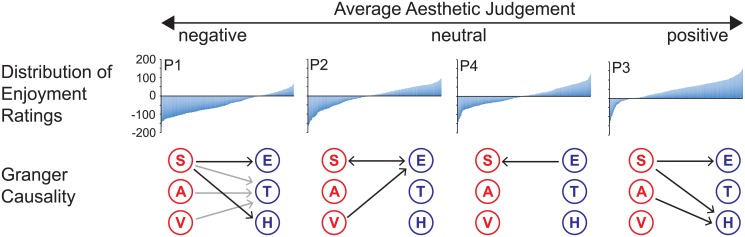
Synchronized movement is a ubiquitous feature of dance and music performance. Much research into the evolutionary origins of these cultural practices has focused on why humans perform rather than watch or listen to dance and music. In this study, we show that movement synchrony among a group of performers predicts the aesthetic appreciation of live dance performances. We developed a choreography that continuously manipulated group synchronization using a defined movement vocabulary based on arm swinging, walking and running. The choreography was performed live to four audiences, as we continuously tracked the performers' movements, and the spectators' affective responses. We computed dynamic synchrony among performers using cross recurrence analysis of data from wrist accelerometers, and implicit measures of arousal from spectators' heart rates. Additionally, a subset of spectators provided continuous ratings of enjoyment and perceived synchrony using tablet computers. Granger causality analyses demonstrate predictive relationships between synchrony, enjoyment ratings and spectator arousal, if audiences form a collectively consistent positive or negative aesthetic evaluation. Controlling for the influence of overall movement acceleration and visual change, we show that dance communicates group coordination via coupled movement dynamics among a group of performers. Our findings are in line with an evolutionary function of dance-and perhaps all performing arts-in transmitting social signals between groups of people. Human movement is the common denominator of dance, music and theatre. Acknowledging the time-sensitive and immediate nature of the performer-spectator relationship, our study makes a significant step towards an aesthetics of joint actions in the performing arts.
Overview
The claims and statistics of this paper haven’t been checked yet.
Free: it reads the open-access text and checks the first 5 claims that cite a source we can check. Create a free account to check every claim.
Integrity signals
Registry
Cites
Statistics
Figures



Verification
Claims the paper makes
The claims and statistics of this paper haven’t been checked yet.
Free: it reads the open-access text and checks the first 5 claims that cite a source we can check. Create a free account to check every claim.
Claims other papers make about this one
Each is checked against this paper’s own text: does it say what the citing paper says it does?
The source backs part of the claim, not all of it — or backs it for a different population, condition or comparison.
In the citing paper
“Therefore aligned with previous research in dance [19, 36, 57, 60] and public visual art [38] spaces, we were able to extract various frequencies of movement, and through time stamps and video footage were able to dissect the movements that were occurring to make observations about human social behaviour.”
From Using Wearable Sensors to Measure Interpersonal Synchrony in Actors and Audience Members During a Live Theatre Performance (2023) · cites this paper as [57]
Experimental — accuracy not yet measured
Self-check
Percentages, sums and reported differences re-computed from the paper’s own numbers.
The self-check needs the paper’s full text.
Citations
Cites
Investigating causal relations by econometric models and cross-spectral methods
Granger, C. W. J. (1969) · Econometrica · doi:10.2307/1912791 · Cited by 22,989
Multimodel Inference: Understanding AIC and BIC in Model Selection
Burnham, K. P., & Anderson, D. R. (2004) · Sociological Methods & Research · doi:10.1177/0049124104268644 · Cited by 11,648
Investigating Causal Relations by Econometric Models and Cross-Spectral Methods
Granger, C. W. J. (2010) · Essays in Econometrics · doi:10.1017/cbo9780511753978.002 · Cited by 4,762
OpenSesame: An open-source, graphical experiment builder for the social sciences
Mathôt, S., Schreij, D., & Theeuwes, J. (2012) · Behavior Research Methods · doi:10.3758/s13428-011-0168-7 · Cited by 2,586
Action Observation and Acquired Motor Skills: An fMRI Study with Expert Dancers
Calvo-Merino, B., Glaser, D. E., Grèzes, J., Passingham, R. E., & Haggard, P. (2005) · Cerebral Cortex · doi:10.1093/cercor/bhi007 · Cited by 1,995
Wiltermuth, S. S., & Heath, C. (2009) · Psychological Science · doi:10.1111/j.1467-9280.2008.02253.x · Cited by 1,717
It's All in the Timing: Interpersonal Synchrony Increases Affiliation
Hove, M. J., & Risen, J. L. (2009) · Social Cognition · doi:10.1521/soco.2009.27.6.949 · Cited by 1,334
Model selection for ecologists: the worldviews of AIC and BIC
Aho, K., Derryberry, D., & Peterson, T. (2014) · Ecology · doi:10.1890/13-1452.1 · Cited by 1,165
(2004) · doi:10.1177/0049124103262065 · Cited by 906
Synchronized arousal between performers and related spectators in a fire-walking ritual
Konvalinka, I., Xygalatas, D., Bulbulia, J., Schjødt, U., Jegindø, E.-M., Wallot, S., Van Orden, G., & Roepstorff, A. (2011) · Proceedings of the National Academy of Sciences · doi:10.1073/pnas.1016955108 · Cited by 632
Research works printed but not linked: 2
- E Waterhouse, 2014, Doing Duo—a case study of entrainment in William Forsythe’s choreography “Duo.”, Front Hum Neurosci, 8, 812, 10.3389/fnhum.2014.00812 · DOI
- P Valdesolo, 2010, The rhythm of joint action: Synchrony promotes cooperative ability, J Exp Soc Psychol, 46, 693, 10.1016/j.jesp.2010.03.004 · DOI · Paper page
Cited by
Soon, S., Svavarsdottir, H. S., Downey, C. L., & Jayne, D. G. (2020) · BMJ Innovations · doi:10.1136/bmjinnov-2019-000354 · Cited by 150
Timing is everything: Dance aesthetics depend on the complexity of movement kinematics
Orlandi, A., Cross, E. S., & Orgs, G. (2020) · Cognition · doi:10.1016/j.cognition.2020.104446 · Cited by 106
Self-citationEvolution and functions of human dance
Fink, B., Bläsing, B. E., Ravignani, A., & Shackelford, T. K. (2021) · Evolution and Human Behavior · doi:10.1016/j.evolhumbehav.2021.01.003 · Cited by 118
“The study of dance is often limited to a particular setting in a given society in that it considers social and cultural information transmitted through symbols and meanings for a particular space-time entity (Siegfried, 1988; Vicary, Sperling, Zimmermann, Richardson, & Orgs, 2017).”
BackgroundZheng, L., Liu, W., Long, Y., Zhai, Y., Zhao, H., Bai, X., Zhou, S., Li, K., Zhang, H., Liu, L., et al. (2020) · Social Cognitive and Affective Neuroscience · doi:10.1093/scan/nsaa016 · Cited by 93
Interpersonal Entrainment in Music Performance
Clayton, M. R. L., Jakubowski, K., Eerola, T., Keller, P. E., Camurri, A., Volpe, G., & Alborno, P. (2020) · Music Perception An Interdisciplinary Journal · doi:10.1525/mp.2020.38.2.136 · Cited by 144
Metadata
- Authors
- Vicary, S., Sperling, M., von Zimmermann, J., Richardson, D. C., & Orgs, G.
- Affiliations
- Goldsmiths University of London (GB)
- University College London (GB)
- Corresponding author
- Orgs, Guido
- Venue
- PLOS ONE
- Publisher
- Public Library of Science (PLoS)
- Published
- 2017-07-25
- Volume
- 12
- Issue
- 7
- Pages
- e0180101
- ISSN
- 1932-6203 (ISSN-L)
- PMC
- PMC5526561
- OpenAlex
- W2736620563
- Cited by
- 102
- References
- 97
- Citations by year
- 2026: 12 · 2025: 8 · 2024: 11 · 2023: 16 · 2022: 5 · 2021: 13 · 2020: 18 · 2019: 6 · 2018: 11 · 2017: 2
- FWCI
- 14.41
- Type
- journal article
- Language
- en
- Open access
- gold
- doi.org
- Licence
- Locations
- PLoS ONE (publishedVersion, cc-by)
- Europe PMC (PubMed Central) (publishedVersion, cc-by)
- PubMed Central (publishedVersion, cc-by)
- PubMed (publishedVersion)
- Goldsmiths (University of London) (acceptedVersion)
- DOAJ (DOAJ: Directory of Open Access Journals) (submittedVersion, cc-by-sa)
- UCL Discovery (University College London) (submittedVersion)
- Figshare (submittedVersion, cc-by)
- Brunel University Research Archive (BURA) (Brunel University London) (submittedVersion, cc-by)
- Funders
- Economic and Social Research Council (ES/M000680/1)
- Topics
- Social Sciences › Psychology › Social Psychology › Action Observation and Synchronization
- Life Sciences › Neuroscience › Cognitive Neuroscience › Aesthetic Perception and Analysis
- Life Sciences › Neuroscience › Cognitive Neuroscience › Neuroscience and Music Perception
- Keywords
- motor synchronization, joint action, dance aesthetics, aesthetic appreciation, group coordination, social signaling, performing arts, wrist accelerometry, heart rate, Granger causality, choreography
- MeSH terms
- Adolescent, Adult, Arousal, Auditory Perception, Dancing, Esthetics, Female, Heart Rate, Humans, Male, Middle Aged, Movement, Music, Visual Perception, Walking, Young Adult, Pleasure
About these checks
Registry, retraction, Cites and statistics results are computed, not judged, with one exception: a printed reference that no index lists is read once by a model before it counts as a citation error. Claims are extracted by a model and kept only when their quote appears verbatim in the text; each cited source is then checked, with a model’s help, for whether it says what the claim relies on. Those verdicts can be wrong — read the claim’s quote and the cited source before relying on one.
Statistics and arithmetic are recomputed, not judged.
Confidence bands are shown only for fields calibrated on our annotated test set. None is calibrated yet, so no band is shown.
What counts as a claim ›How we measure confidence ›How we check this ›
Are you an author, or do you see a problem with this page? Request a review
How to cite
Cite CoChat for the checks on this page, and the paper for its own findings.
- This page
- CoChat. (2026). Citation check: Joint action aesthetics. https://app.cochat.ai/papers/10.1371/journal.pone.0180101
- The paper
- Vicary, S., Sperling, M., von Zimmermann, J., Richardson, D. C., & Orgs, G. (2017). Joint action aesthetics. PLOS ONE. https://doi.org/10.1371/journal.pone.0180101
Data sources
Bibliographic data: Semantic Scholar, OpenAlex, Crossref.
Contains information from the Semantic Scholar Academic Graph Datasets, made available under the ODC Attribution License (ODC-BY 1.0).
Semantic Scholar’s data is described in: Kinney, R., et al. (2023). The Semantic Scholar Open Data Platform. arXiv:2301.10140.
