

The DOI matches its Crossref record; 41 of the 41 references it cites were found in a registry or an index.
Conformational risk factors of brachycephalic obstructive airway syndrome (BOAS) in pugs, French bulldogs, and bulldogs
Open accessAbstract
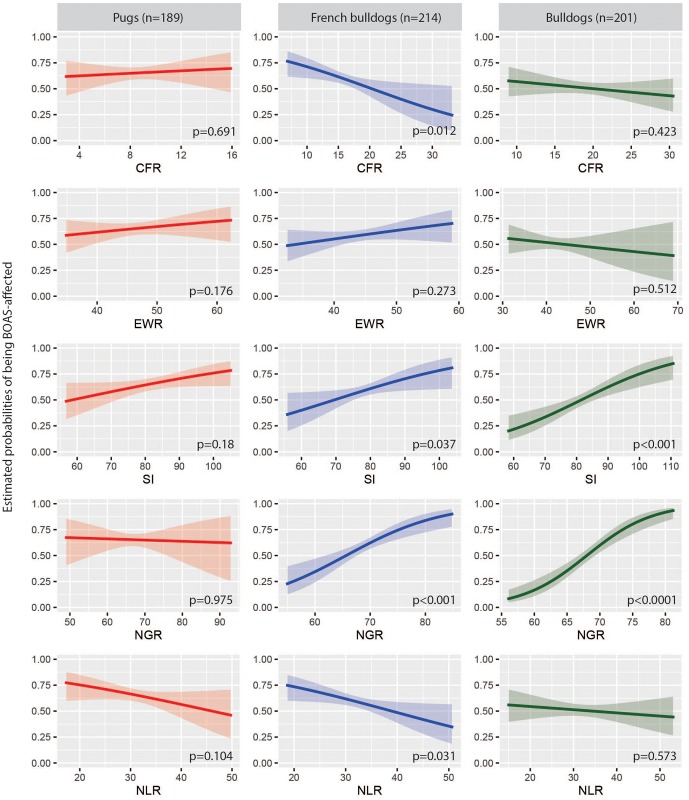
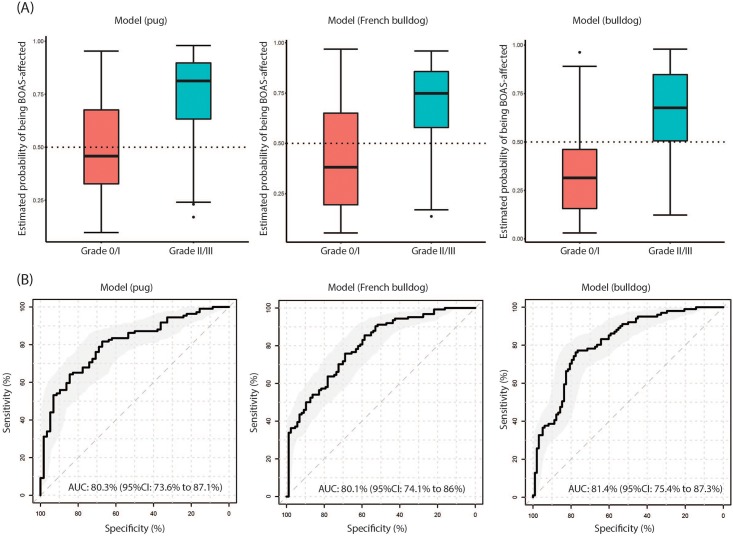
Extremely brachycephalic, or short-muzzled, dog breeds such as pugs, French bulldogs, and bulldogs are prone to the conformation-related respiratory disorder-brachycephalic obstructive airway syndrome (BOAS). Affected dogs present with a wide range of clinical signs from snoring and exercise intolerance, to life-threatening events such as syncope. In this study, conformational risk factors for BOAS that could potentially aid in breeding away from BOAS were sought. Six hundred and four pugs, French bulldogs, and bulldogs were included in the study. Soft tape measurements of the head and body were used and the inter-observer reproducibility was evaluated. Breed-specific models were developed to assess the associations between the conformational factors and BOAS status based on functional grading. The models were further validated by means of a BOAS index, which is an objective measurement of respiratory function using whole-body barometric plethysmography. The final models have good predictive power for discriminating BOAS (-) and BOAS (+) phenotypes indicated by the area under the curve values of >80% on the receiver operating curves. When other factors were controlled, stenotic nostrils were associated with BOAS in all three breeds; pugs and bulldogs with higher body condition scores (BCS) had a higher risk of developing BOAS. Among the standardized conformational measurements (i.e. craniofacial ratio (CFR), eye width ratio (EWR), skull index (SI), neck girth ratio (NGR), and neck length ratio (NLR)), for pugs EWR and SI, for French bulldogs NGR and NLR, and for bulldogs SI and NGR showed significant associations with BOAS status. However, the NGR in bulldogs was the only significant predictor that also had satisfactory inter-observer reproducibility. A NGR higher than 0.71 in male bulldogs was predictive of BOAS with approximately 70% sensitivity and specificity. In conclusion, stenotic nostrils, BCS, and NGR were found to be valid, easily applicable predictors for BOAS (+).
Overview
The claims and statistics of this paper haven’t been checked yet.
Run the check — free, no account needed. It reads the open-access text and checks the sources it cites.
Integrity signals
Registry
Cites
Statistics
Figures
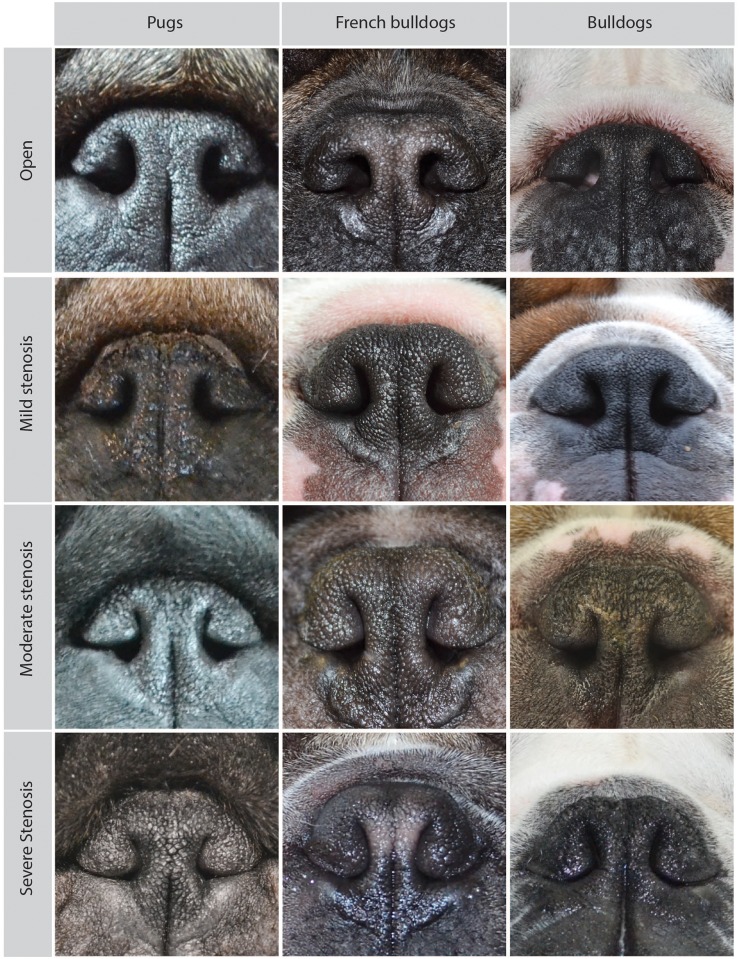
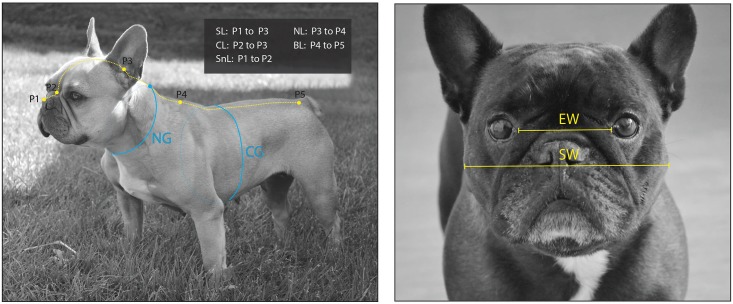
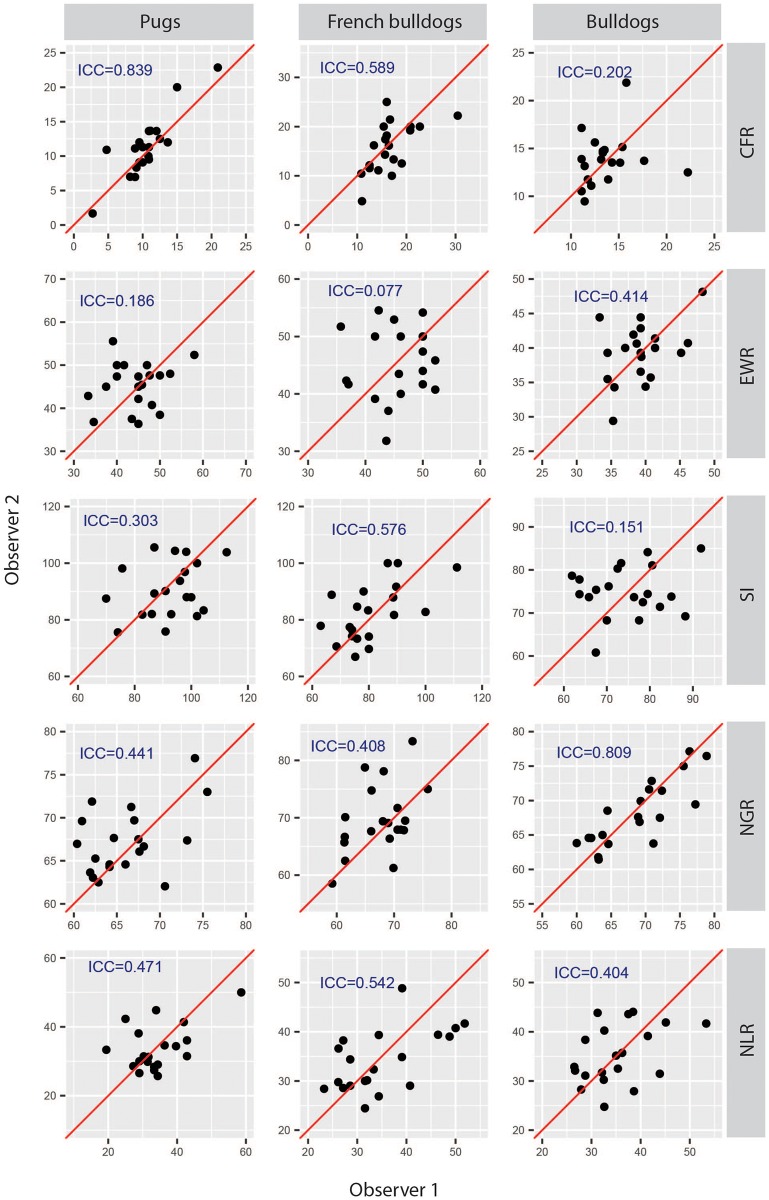
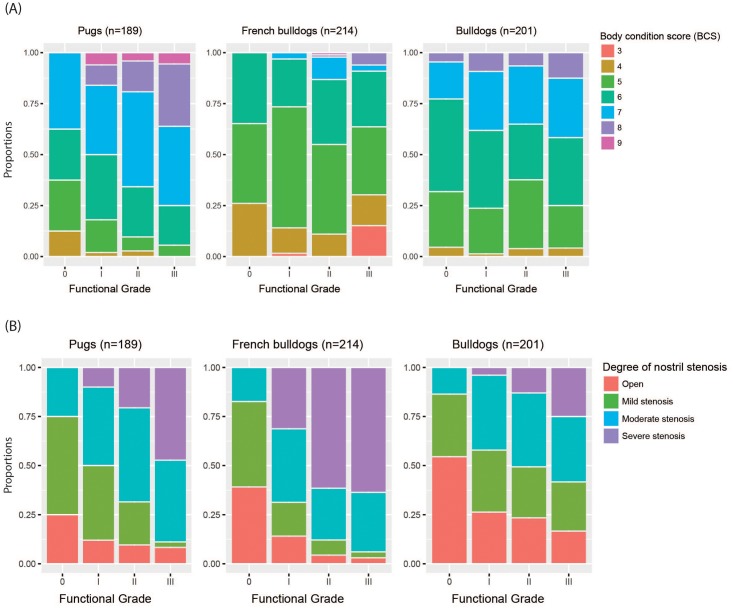
Verification
Claims the paper makes
The claims and statistics of this paper haven’t been checked yet.
Run the check — free, no account needed. It reads the open-access text and checks the sources it cites.
Claims other papers make about this one
Each is checked against this paper’s own text: does it say what the citing paper says it does?
The source backs part of the claim, not all of it — or backs it for a different population, condition or comparison.
In the citing paper
“Breeding animals with this type of severe skull and muzzle abnormalities leads to physical and physiological hardship and limits their natural behavior [89,90].”
From A One Health Perspective on the Human-Companion Animal Relationship with Emphasis on Zoonotic Aspects. (2020) · cites this paper as [89]
Experimental — accuracy not yet measured
Self-check
Percentages, sums and reported differences re-computed from the paper’s own numbers.
The self-check needs the paper’s full text.
Citations
Cites
A new look at the statistical model identification
Akaike, H. (1974) · IEEE Transactions on Automatic Control · doi:10.1109/tac.1974.1100705 · Cited by 51,879
Intraclass correlations: Uses in assessing rater reliability.
Shrout, P. E., & Fleiss, J. L. (1979) · Psychological Bulletin · doi:10.1037/0033-2909.86.2.420 · Cited by 24,532
Foundations of Clinical Research: Applications to Practice,
(2002) · Survey of Ophthalmology · doi:10.1016/s0039-6257(02)00362-4 · Cited by 9,494
Foundations of clinical research application to practice
Portney, L. (1993) · Medical Entomology and Zoology · Cited by 1,135
Development and validation of a body condition score system for dogs
Laflamme, D. P. (1997) · Canine practice · Cited by 1,071
Upper airway pressure-flow relationships in obstructive sleep apnea
Smith, P. L., Wise, R. A., Gold, A. R., Schwartz, A. R., & Permutt, S. (1988) · Journal of Applied Physiology · doi:10.1152/jappl.1988.64.2.789 · Cited by 446
Mortimore, I. L., Marshall, I., WRAITH, P. K., Sellar, R. J., & Douglas, N. J. (1998) · American Journal of Respiratory and Critical Care Medicine · doi:10.1164/ajrccm.157.1.9703018 · Cited by 378
Longevity and mortality of owned dogs in England
O'Neill, D. G., Church, D. B., McGreevy, P. D., Thomson, P. C., & Brodbelt, D. C. (2013) · The Veterinary Journal · doi:10.1016/j.tvjl.2013.09.020 · Cited by 352
Onat, A., Hergenç, G., Yüksel, H., Can, G., Ayhan, E., Kaya, Z., & Dursunoğlu, D. (2008) · Clinical Nutrition · doi:10.1016/j.clnu.2008.10.006 · Cited by 314
Poncet, C. M., Dupré, G., Freiche, V., Estrada, M. M., Poubanne, Y. A., & Bouvy, B. M. (2005) · Journal of Small Animal Practice · doi:10.1111/j.1748-5827.2005.tb00320.x · Cited by 282
Research works printed but not linked: 5
- C Knecht, 1979, Upper airway obstruction in brachycephalic dogs, Comp Cont Educ Pract, 1, 25
- JC Hendricks, 1992, Brachycephalic airway syndrome, Vet Clin North Am Small Anim Pract, 22, 1145, 10.1016/S0195-5616(92)50306-0 · DOI
- D Koch, 2015, Veränderung des Schädels bei brachycephalen Hunden im Verlaufe der letzten 100 Jahre, Kurzmitteilungen, 157, 1
- NC Liu, 2016, Whole-body barometric plethysmography characterizes upper airway obstruction in 3 brachycephalic breeds of dogs, J Vet Intern Med, 30, 853, 10.1111/jvim.13933 · DOI
- J Hendricks, 1987, The English bulldog: a natural model of sleep-disordered breathing, J Appl Physiol, 63, 1344, 10.1152/jappl.1987.63.4.1344 · DOI
Cited by
Sorted by citations
Overgaauw, P. A. M., Vinke, C. M., van Hagen, M. A. E., & Lipman, L. J. A. (2020) · International Journal of Environmental Research and Public Health · doi:10.3390/ijerph17113789 · Cited by 301
“Breeding animals with this type of severe skull and muzzle abnormalities leads to physical and physiological hardship and limits their natural behavior [89,90].”
BackgroundDomestication of Industrial Microbes
Steensels, J., Gallone, B., Voordeckers, K., & Verstrepen, K. J. (2019) · Current Biology · doi:10.1016/j.cub.2019.04.025 · Cited by 221
Brachycephalic obstructive airway syndrome: much more than a surgical problem
Mitze, S., Barrs, V. R., Beatty, J. A., Hobi, S., & Bęczkowski, P. M. (2022) · Veterinary Quarterly · doi:10.1080/01652176.2022.2145621 · Cited by 65
Brachycephalic obstructive airway syndrome
Ladlow, J. F., Liu, N., Kalmár, L., & Sargan, D. R. (2018) · Veterinary Record · doi:10.1136/vr.k1403 · Cited by 61
Self-citationBrachycephalic Obstructive Airway Syndrome
Krainer, D., & Dupré, G. (2022) · Veterinary Clinics of North America Small Animal Practice · doi:10.1016/j.cvsm.2022.01.013 · Cited by 55
Metadata
- Authors
- Liu, N.-C., Troconis, E. L., Kalmar, L., Price, D. J., Wright, H. E., Adams, V. J., Sargan, D. R., & Ladlow, J. F.
- Affiliations
- University of Cambridge (GB)
- Suffolk University Madrid (ES)
- Corresponding author
- Ladlow, Jane F.
- Venue
- PLOS ONE
- Publisher
- Public Library of Science (PLoS)
- Published
- 2017-08-01
- Volume
- 12
- Issue
- 8
- Pages
- e0181928
- ISSN
- 1932-6203 (ISSN-L)
- PMC
- PMC5538678
- OpenAlex
- W2740722812
- Cited by
- 148
- References
- 41
- Citations by year
- 2026: 7 · 2025: 24 · 2024: 22 · 2023: 27 · 2022: 32 · 2021: 17 · 2020: 5 · 2019: 7 · 2018: 7
- FWCI
- 3.45
- Type
- journal article
- Language
- en
- Open access
- gold
- doi.org
- Licence
- Locations
- PLoS ONE (publishedVersion, cc-by)
- Europe PMC (PubMed Central) (publishedVersion, cc-by)
- PubMed Central (publishedVersion, cc-by)
- PubMed (publishedVersion)
- RePEc: Research Papers in Economics (submittedVersion, cc-by)
- DOAJ (DOAJ: Directory of Open Access Journals) (submittedVersion, cc-by-sa)
- Figshare (submittedVersion, cc-by)
- Minerva Access (University of Melbourne) (submittedVersion, cc-by)
- Apollo (University of Cambridge) (submittedVersion, cc-by)
- Apollo (cc-by)
- Funders
- The Kennel Club Charitable Trust (RG71960)
- Cambridge Overseas Trust
- Topics
- Life Sciences › Agricultural and Biological Sciences › Animal Science and Zoology › Human-Animal Interaction Studies
- Health Sciences › Veterinary › Small Animals › Veterinary Medicine and Surgery
- Health Sciences › Veterinary › Equine › Veterinary Equine Medical Research
- Keywords
- brachycephalic obstructive airway syndrome, Pug, French bulldog, bulldogs, body condition score, barometric plethysmography, interobserver reproducibility, dog breeding
- MeSH terms
- Airway Obstruction, Animals, Breeding, Craniosynostoses, Dog Diseases, Dogs, Female, Male, Plethysmography, Whole Body, Regression Analysis, Risk Factors, Species Specificity, Syndrome, Reproducibility of Results, Observer Variation
About these checks
Registry, retraction, Cites and statistics results are computed, not judged, with one exception: a printed reference that no index lists is read once by a model before it counts as a citation error. Claims are extracted by a model and kept only when their quote appears verbatim in the text; each cited source is then checked, with a model’s help, for whether it says what the claim relies on. Those verdicts can be wrong — read the claim’s quote and the cited source before relying on one.
Statistics and arithmetic are recomputed, not judged.
Confidence bands are shown only for fields calibrated on our annotated test set. None is calibrated yet, so no band is shown.
What counts as a claim ›How we measure confidence ›How we check this ›
Are you an author, or do you see a problem with this page? Request a review
