

Nutritional interventions for adolescents using information and communication technologies (ICTs): A systematic review
Open accessThe DOI matches its Crossref record; the references it cites are not checked yet.
Abstract
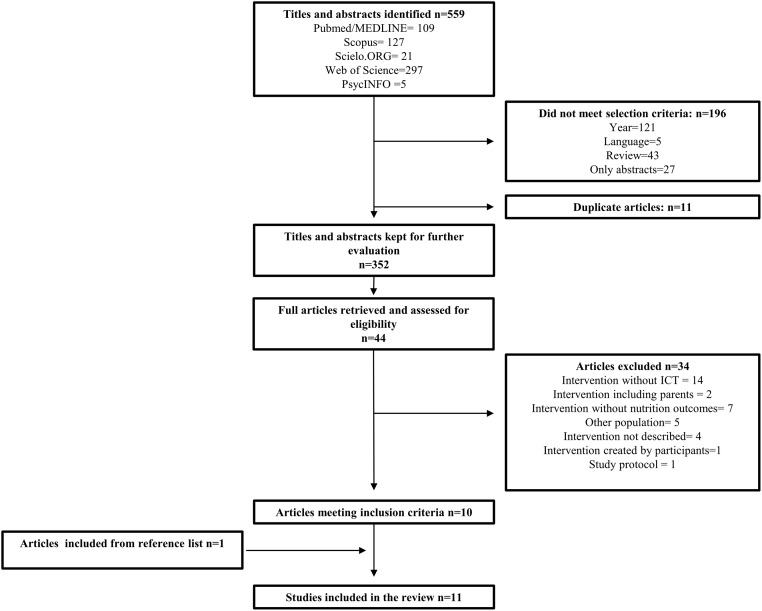
A cost-effective and interactive way of promoting healthy nutrition behaviors among adolescents is using information and communication technologies (ICTs). We systematically reviewed studies to identify technologies and their main characteristics used for nutritional interventions for adolescents, as well as to evaluate their quality and effectiveness. Our full protocol is available on the PROSPERO website (#CRD42016035882). A search was conducted across five databases for articles describing nutritional interventions that used ICTs designed mainly for healthy adolescents. Randomized controlled trials, quasi-experimental and observational studies, and full and original papers, all of them published from 2005 to 2015, were included. Study quality was assessed by the Effective Public Health Practice Project Quality Assessment Tool. Our search yielded 559 titles and abstracts. Eleven studies met the inclusion criteria. Participants were recruited mostly from schools. Study follow-up ranged from two weeks to two years. Four interventions were based on the Social Cognitive Theory. Interventional strategies included computer games, programs, text messages, and interactive CD-ROMs. Nine studies used computer-mediated ICTs. Five studies focused on multiple behaviors simultaneously. Participants were exposed to interventions only once, daily, weekly, or according to a pre-determined number of lessons. Five studies had significant outcomes. Our quality assessment revealed three studies to be weak due to non-representativeness of their samples and usage of non-validated questionnaires. Besides the heterogeneity and poor quality of the analyzed studies, it can be suggested that long-term interventions for adolescents that make use of frequent exposure to technological resources, and that have a theoretical component aimed at a single health behavior change, tend to be more successful.
Overview
The claims and statistics of this paper haven’t been checked yet.
Free: it reads the open-access text and checks the first 5 claims that cite a source we can check. Create a free account to check every claim.
Integrity signals
Registry
Cites
Statistics
Figures

Verification
Claims the paper makes
The claims and statistics of this paper haven’t been checked yet.
Free: it reads the open-access text and checks the first 5 claims that cite a source we can check. Create a free account to check every claim.
Claims other papers make about this one
Each is checked against this paper’s own text: does it say what the citing paper says it does?
The source backs part of the claim, not all of it — or backs it for a different population, condition or comparison.
In the citing paper
“Out of 17 reviews, three reviews [29, 33, 41], comprising a total of 32 unique primary studies, focused on single-component individual-level interventions (Table 2).”
From School-based healthy eating interventions for adolescents aged 10–19 years: an umbrella review (2024) · cites this paper as [41]
Experimental — accuracy not yet measuredThe cited source says what the claim attributes to it.
In the citing paper
“The methodological quality of these reviews was mixed: one study was rated as high [41], one as moderate [33], and one was rated as poor methodological quality [29].”
From School-based healthy eating interventions for adolescents aged 10–19 years: an umbrella review (2024) · cites this paper as [41]
Self-check
Percentages, sums and reported differences re-computed from the paper’s own numbers.
The self-check needs the paper’s full text.
Citations
The citation lists are queued
They are fetched later and appear here then.
References 34 · Cited by 57
Metadata
- Authors
- do Amaral e Melo, G. R., de Carvalho Silva Vargas, F., dos Santos Chagas, C. M., & Toral, N.
- Affiliations
- Universidade de Brasília (BR)
- Venue
- PLOS ONE
- Publisher
- Public Library of Science (PLoS)
- Published
- 2017-09-29
- Volume
- 12
- Issue
- 9
- Pages
- e0184509
- ISSN
- 1932-6203 (ISSN-L)
- PMC
- PMC5621667
- OpenAlex
- W2600428119
- Cited by
- 57
- References
- 34
- Citations by year
- 2026: 1 · 2025: 6 · 2024: 5 · 2023: 10 · 2022: 7 · 2021: 10 · 2020: 8 · 2019: 7 · 2018: 3
- FWCI
- 0.87
- Type
- journal article
- Language
- en
- Open access
- gold
- doi.org
- Licence
- Locations
- PLoS ONE (publishedVersion, cc-by)
- Europe PMC (PubMed Central) (publishedVersion, cc-by)
- PubMed Central (publishedVersion, cc-by)
- PubMed (publishedVersion)
- RePEc: Research Papers in Economics (submittedVersion)
- DOAJ (DOAJ: Directory of Open Access Journals) (submittedVersion, cc-by-sa)
- Figshare (submittedVersion, cc-by)
- Topics
- Health Sciences › Health Professions › General Health Professions › Mobile Health and mHealth Applications
- Health Sciences › Nursing › Nutrition and Dietetics › Nutrition, Health and Food Behavior
- Social Sciences › Communication › Media Influence and Health
- Keywords
- dietary intervention, adolescents, information and communication technologies, video games, text messaging, interactive CD, social cognitive theory, healthy eating habits, school-based intervention, health behavior change
- MeSH terms
- Adolescent, Diet, Health Promotion, Humans, Internet
About these checks
Registry, retraction, Cites and statistics results are computed, not judged, with one exception: a printed reference that no index lists is read once by a model before it counts as a citation error. Claims are extracted by a model and kept only when their quote appears verbatim in the text; each cited source is then checked, with a model’s help, for whether it says what the claim relies on. Those verdicts can be wrong — read the claim’s quote and the cited source before relying on one.
Statistics and arithmetic are recomputed, not judged.
Confidence bands are shown only for fields calibrated on our annotated test set. None is calibrated yet, so no band is shown.
What counts as a claim ›How we measure confidence ›How we check this ›
Are you an author, or do you see a problem with this page? Request a review
How to cite
Cite CoChat for the checks on this page, and the paper for its own findings.
- This page
- CoChat. (2026). Citation check: Nutritional interventions for adolescents using information and communication technologies (ICTs): A systematic review. https://app.cochat.ai/papers/10.1371/journal.pone.0184509
- The paper
- do Amaral e Melo, G. R., de Carvalho Silva Vargas, F., dos Santos Chagas, C. M., & Toral, N. (2017). Nutritional interventions for adolescents using information and communication technologies (ICTs): A systematic review. PLOS ONE. https://doi.org/10.1371/journal.pone.0184509
Data sources
Bibliographic data: Semantic Scholar, OpenAlex, Crossref.
Contains information from the Semantic Scholar Academic Graph Datasets, made available under the ODC Attribution License (ODC-BY 1.0).
Semantic Scholar’s data is described in: Kinney, R., et al. (2023). The Semantic Scholar Open Data Platform. arXiv:2301.10140.
