

Overstatements in abstract conclusions claiming effectiveness of interventions in psychiatry: A meta-epidemiological investigation
Open accessThe DOI matches its Crossref record; 30 of the 30 references it cites were found in a registry or an index; 12 of the 29 sources its claims cite were checked for support.
Abstract
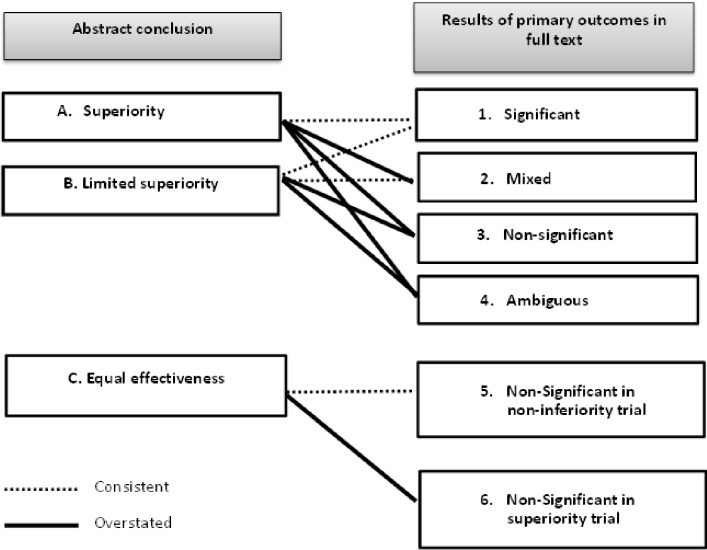
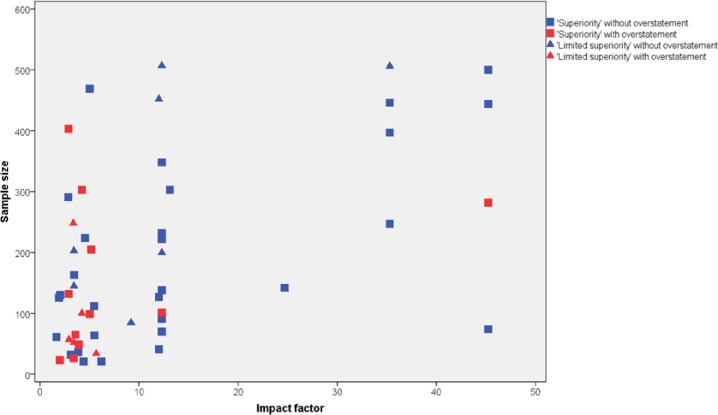
OBJECTIVE: Abstracts of scientific reports are sometimes criticized for exaggerating significant results when compared to the corresponding full texts. Such abstracts can mislead the readers. We aimed to conduct a systematic review of overstatements in abstract conclusions in psychiatry trials. METHODS: We searched for randomized controlled trials published in 2014 that explicitly claimed effectiveness of any intervention for mental disorders in their abstract conclusion, using the Cochrane Register of Controlled Trials. Claims of effectiveness in abstract conclusion were categorized into three types: superiority (stating superiority of intervention to control), limited superiority (intervention has limited superiority), and equal efficactiveness (claiming equal effectiveness of intervention with standard treatment control), and full text results into three types: significant (all primary outcomes were statistically significant in favor of the intervention), mixed (primary outcomes included both significant and non-significant results), or all results non-significant. By comparing these classifications, we assessed whether each abstract was overstated. Our primary outcome was the proportion of overstated abstract conclusions. RESULTS: We identified and included 60 relevant trials. 20 out of 60 studies (33.3%) showed overstatements. Nine reports reported only significant results although none of their primary outcomes were significant. Large sample size (>300) and publication in high impact factor (IF>10) journals were associated with low occurrence of overstatements. CONCLUSIONS: We found that one in three psychiatry studies claiming effectiveness in their abstract conclusion, either superior to control or equal to standard treatment, for any mental disorders were overstated in comparison with the full text results. Readers of the psychiatry literature are advised to scrutinize the full text results regardless of the claims in the abstract. TRIAL REGISTRATION: University hospital Medical Information Network (UMIN) Clinical Trials Registry (UMIN000018668).
Overview
CoChat Summary
TL;DR
In a meta-epidemiological review of 60 psychiatry RCTs published in 2014 that claimed intervention effectiveness in their abstract conclusions, 20 (33.3%) were overstated relative to full-text primary outcomes. High-impact-factor journals and larger sample sizes were associated with less overstatement.
Key findings
- 20/60 studies (33.3%) had overstated abstract conclusions; 38 (63.3%) did not. Among abstracts claiming clear superiority, 14/44 (32%) were overstated; including limited or equal effectiveness claims, 20/60 (33%) were overstated.
- Abstract conclusions were classified as superiority in 44 (73.3%), limited superiority in 13 (21.7%), and equal effectiveness in 3 (5.0%). Full-text primary outcomes were all significant in 30 (50.0%), mixed in 13 (21.7%), all non-significant in 9 (15.0%), and ambiguous in 3 (5%).
- Overstatement was less common in high-impact-factor journals (RR 0.15, 95% CI 0.04–0.57; multivariable OR 0.09, 95% CI 0.02–0.47 vs low IF) and with larger sample size (Mann-Whitney p = 0.049; multivariable OR 0.86 per 100 persons, 95% CI 0.53–1.39). No significant association was found with sponsorship.
- No significant difference in overstatement was found between superiority and limited-superiority claims (RR 0.82, 95% CI 0.35–1.93). Inter-rater reliability was kappa 0.62 for abstract classification and 0.83 for full-text classification.
Methods
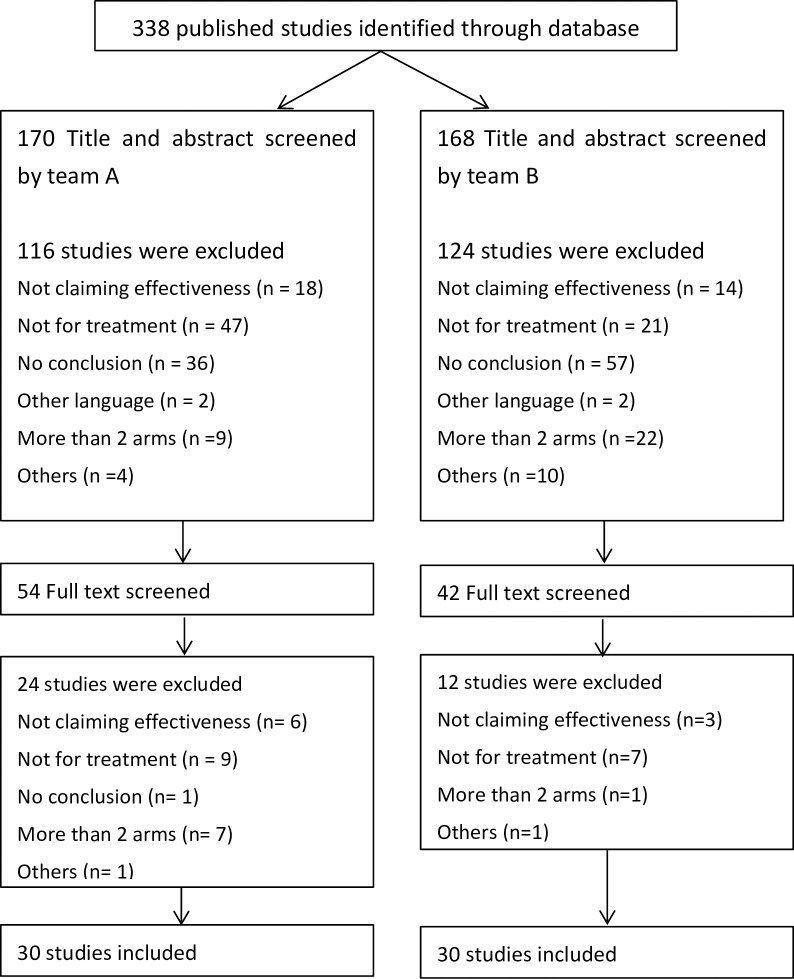
- Systematic review/meta-epidemiological investigation; searched Cochrane CENTRAL for English-language RCTs published in 2014 that claimed effectiveness of any intervention for mental disorders in their abstract conclusion; 60 trials were included.
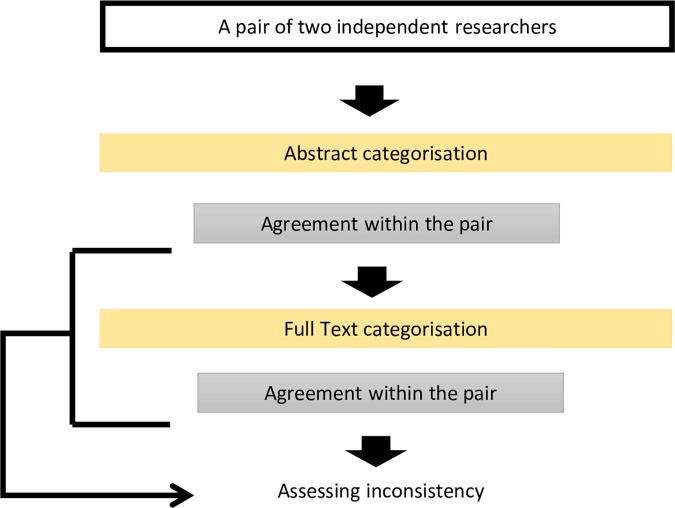
- Abstract conclusions were categorized as superiority, limited superiority, or equal effectiveness; full-text primary outcomes were categorized as significant, mixed, or all non-significant; overstatement was defined by mismatch between these classifications. Two independent assessors categorized abstracts and full texts separately.
- Subgroup analyses used Fisher’s exact test, Mann-Whitney U test, and multivariable logistic regression for factors associated with overstatement; the protocol was registered as UMIN000018668.
Limitations
- Paper-stated: some judgment remained in categorizing abstract conclusions and full-text results despite high inter-rater reliability; the approach has not been tested outside mental disorders; the study did not assess how much overstatements affect readers’ interpretation.
- Evident from the text: the study included only English-language RCTs published in 2014 identified via CENTRAL, so findings may not generalize to other years, languages, or databases; 93 of 338 identified studies were excluded for lacking an abstract conclusion section, and non-structured abstracts were common (93/338, 28%).
Model-written summary. Check it against the paper before relying on it.
Integrity signals
Registry
Cites
Statistics
Figures
Verification
Claims the paper makes
6 Valid · 1 Not valid · 8 Not checked · 40 Own results and interpretations
At least one cited source doesn’t support this claim or points to a different paper, and none confirmed it — see the verdicts below.
In the paper
“For example, some trials with no significant primary outcomes failed to refer to non-significant results and claimed effectiveness by focusing on significant results from subgroup analyses or secondary outcomes [19, 20].”
§ Overstatements in abstract conclusions claiming effectiveness of interventions in psychiatry: A meta-epidemiological investigation > Results > Categorization of abstracts and full text
What the sources say
- Disputedcites [19] Wade SL, Stancin T, Kirkwood M, Brown TM, McMullen KM, Taylor HG. Counselor-assisted problem solving (CAPS) improves behavioral outcomes in older adolescents with complicated mild to severe TBI. The Journal of head trauma rehabilitation. 2014; 29(3): 198– 207. doi: 10.1097/HTR.0b013e31828f9fe8. CN-00993584. 23640543 PMC3840164 sourceExperimental — accuracy not yet measured
The Results (page unavailable) explicitly report no significant CAPS–comparison differences on any behavioral outcome in the full sample. The paper also reports significant findings for older adolescents, but it did not fail to refer to the nonsignificant overall results as the citing sentence claims. (LLM, conf=0.88)
Checked by a reasoning model — may be wrong.
- Disputedcites [20] Melville JL, Reed SD, Russo J, Croicu CA, Ludman E, LaRocco-Cockburn A, et al Improving care for depression in obstetrics and gynecology: a randomized controlled trial. Obstet Gynecol. 2014; 123(6): 1237– 46. doi: 10.1097/AOG.0000000000000231. CN-00992790. 24807320 PMC4052378 sourceExperimental — accuracy not yet measured
The Results section reports a significant improvement in the primary depression-symptom outcome at 12 months (p<0.001). It also explicitly reports that the primary functional-status difference at 12 months was not significant. Thus this trial neither had no significant primary outcomes nor failed to mention its nonsignificant primary result. (LLM, conf=0.91)
Checked by a reasoning model — may be wrong.
plain- Asserted: passes — The authors put it forward as true.
- Checkable: passes — It can be checked against evidence.
- Load-bearing: passes — The paper’s conclusions depend on it.
- Based: passes — The paper gives a reason why it holds.
- Disputed
The sources with a verdict support this claim; the rest weren’t checked yet, have no full text we could read, or their verdicts aren’t rated yet.
In the paper
“Second, each of previous studies was limited to specific subspecialties such as rheumatology [7], wound research [16], surgery [8] or to limited topics such as early psychosis trials [6].”
§ Overstatements in abstract conclusions claiming effectiveness of interventions in psychiatry: A meta-epidemiological investigation > Introduction
What the sources say
- Not checked yetcites [7] Mathieu S, Giraudeau B, Soubrier M, Ravaud P. Misleading abstract conclusions in randomized controlled trials in rheumatology: comparison of the abstract conclusions and the results section. Joint Bone Spine. 2012; 79(3): 262– 7. Epub 2011/07/08. doi: 10.1016/j.jbspin.2011.05.008. 21733728 source
- Supportedcites [16] Lockyer S, Hodgson R, Dumville JC, Cullum N. "Spin" in wound care research: the reporting and interpretation of randomized controlled trials with statistically non-significant primary outcome results or unspecified primary outcomes. Trials. 2013; 14: 371 Epub 2013/11/08. doi: 10.1186/1745-6215-14-371; PubMed Central PMCID: PMCPMC3832286. 24195770 PMC3832286 source
The Eligibility, search and study selection section says the authors confined their study to randomized trials of treatments for leg, foot and pressure ulcers. This supports the part of the citing sentence for which this paper is cited: that it was limited to wound research. (LLM, conf=0.94)
- Not checked yetcites [8] Arunachalam L, Hunter IA, Killeen S. Reporting of Randomized Controlled Trials With Statistically Nonsignificant Primary Outcomes Published in High-Impact Surgical Journals. Ann Surg. 2016 Epub 2016/06/04. doi: 10.1097/sla.0000000000001795. 27257737
plain- Asserted: passes — The authors put it forward as true.
- Checkable: passes — It can be checked against evidence.
- Load-bearing: passes — The paper’s conclusions depend on it.
- Based: passes — The paper gives a reason why it holds.
A result the paper reports from its own data — it cites no other source for it, so there is none to check. The quote shows it is in the paper.
In the paper
“There was not a significant difference in our secondary outcomes, the proportion of explicit overstatement, among ‘superiority’ studies (11 out of 44) and ‘limited superiority’ studies (5 out of 13) (RR; 0.82, 95% CI, 0.35–1.93).”
§ Overstatements in abstract conclusions claiming effectiveness of interventions in psychiatry: A meta-epidemiological investigation > Results > Categorization of abstracts and full text
plain- Asserted: passes — The authors put it forward as true.
- Checkable: passes — It can be checked against evidence.
- Load-bearing: unclear — It is unclear whether the paper’s conclusions depend on it.
- Based: passes — The paper gives a reason why it holds.
A result the paper reports from its own data — it cites no other source for it, so there is none to check. The quote shows it is in the paper.
In the paper
“Overstatements were less common in studies published in high impact factor journals than otherwise (the risk ratio was 0.15, 95% CI: 0.04 to 0.57).”
§ Overstatements in abstract conclusions claiming effectiveness of interventions in psychiatry: A meta-epidemiological investigation > Results > Study characteristics associated with overstatement
plainstates an association- Asserted: passes — The authors put it forward as true.
- Checkable: passes — It can be checked against evidence.
- Load-bearing: passes — The paper’s conclusions depend on it.
- Based: passes — The paper gives a reason why it holds.
A result the paper reports from its own data — it cites no other source for it, so there is none to check. The quote shows it is in the paper.
In the paper
“Studies with smaller sample size overstated more than those with larger sample size (by Mann-Whitney U- test, p = 0.049).”
§ Overstatements in abstract conclusions claiming effectiveness of interventions in psychiatry: A meta-epidemiological investigation > Results > Study characteristics associated with overstatement
plainstates an association- Asserted: passes — The authors put it forward as true.
- Checkable: passes — It can be checked against evidence.
- Load-bearing: passes — The paper’s conclusions depend on it.
- Based: passes — The paper gives a reason why it holds.
7 more claims
Create a free account to see all 55 claims and to verify the 17 references still open.
- Probably not a substantial claim. 34
- It may state two separate claims as one. 20
Claims other papers make about this one
Each is checked against this paper’s own text: does it say what the citing paper says it does?
The source backs part of the claim, not all of it — or backs it for a different population, condition or comparison.
In the citing paper
“For example, Shinohara et al. analysis of psychiatry trial papers revealed that 30% of abstracts contained exaggerated claims relative to the full text32.”
From Scientific publications that use promotional language in the abstract receive more citations and public attention (2025) · cites this paper as [32]
Experimental — accuracy not yet measuredThe source backs part of the claim, not all of it — or backs it for a different population, condition or comparison.
In the citing paper
“Further, abstracts are often criticized for overstating significant findings compared to the respective papers’ full texts and are therefore even referred to as a “promotional genre”31,32.”
From Scientific publications that use promotional language in the abstract receive more citations and public attention (2025) · cites this paper as [32]
Experimental — accuracy not yet measured
Citations
Cites
Piaggio, G., Elbourne, D. R., Pocock, S. J., Evans, S. J. W., Altman, D. G., & CONSORT Group, F. T. (2012) · JAMA · doi:10.1001/jama.2012.87802 · Cited by 2,428
Reporting of Noninferiority and Equivalence Randomized Trials: An Extension of the CONSORT Statement
Piaggio, G., Elbourne, D. R., Altman, D. G., Pocock, S. J., Evans, S. J. W., & CONSORT Group, F. T. (2006) · JAMA · doi:10.1001/jama.295.10.1152 · Cited by 1,153
Boutron, I. (2010) · JAMA · doi:10.1001/jama.2010.651 · Cited by 842
Hoyles, R. K., Ellis, R. W., Wellsbury, J., Lees, B., Newlands, P., Goh, N. S. L., Roberts, C., Desai, S., Herrick, A. L., McHugh, N. J., et al. (2006) · Arthritis & Rheumatism · doi:10.1002/art.22204 · Cited by 732
Hopewell, S., Clarke, M., Moher, D., Wager, E., Middleton, P., Altman, D. G., Schulz, K. F., & and the CONSORT Group (2008) · PLoS Medicine · doi:10.1371/journal.pmed.0050020 · Cited by 674
Sumner, P., Vivian-Griffiths, S., Boivin, J., Williams, A., Venetis, C. A., Davies, A., Ogden, J., Whelan, L., Hughes, B., Dalton, B., et al. (2014) · BMJ · doi:10.1136/bmj.g7015 · Cited by 489
Internet-delivered treatment for substance abuse: a multisite randomized controlled trial
Campbell, A. N. C., Nunes, E. V., Matthews, A. G., Stitzer, M., Miele, G. M., Polsky, D., Turrigiano, E., Walters, S., McClure, E. A., Kyle, T. L., et al. (2014) · American Journal of Psychiatry · doi:10.1176/appi.ajp.2014.13081055 · Cited by 263
Vinkers, C. H., Tijdink, J. K., & Otte, W. M. (2015) · BMJ · doi:10.1136/bmj.h6467 · Cited by 237
Hopewell, S., Ravaud, P., Baron, G., & Boutron, I. (2012) · BMJ · doi:10.1136/bmj.e4178 · Cited by 235
Efficacy of exercise for menopausal symptoms: a randomized controlled trial
Sternfeld, B., Guthrie, K. A., Ensrud, K. E., LaCroix, A. Z., Larson, J. C., Dunn, A. L., Anderson, G. L., Seguin, R. A., Carpenter, J. S., Newton, K. M., et al. (2014) · Menopause · doi:10.1097/gme.0b013e31829e4089 · Cited by 184
Cited by
Millar, N., Salager-Meyer, F., & Budgell, B. (2019) · English for Specific Purposes · doi:10.1016/j.esp.2019.02.004 · Cited by 85
Puljak, L., Makarić, Z. L., Buljan, I., & Pieper, D. (2020) · Journal of Comparative Effectiveness Research · doi:10.2217/cer-2019-0201 · Cited by 33
Over‐promotion and caution in abstracts of preprints during the COVID‐19 crisis
Bordignon, F., Ermakova, L., & Noel, M. (2021) · Learned Publishing · doi:10.1002/leap.1411 · Cited by 31
“This is what triggers the overuse of positive terms (Vinkers et al., 2015), and overstatements in abstract conclusions (Boutron, 2020; Shinohara et al., 2017).”
BackgroundLawson, D. O., Leenus, A., & Mbuagbaw, L. C. E. (2020) · Pilot and Feasibility Studies · doi:10.1186/s40814-019-0544-0 · Cited by 25
Xie, S., & Mi, C. (2023) · Learned Publishing · doi:10.1002/leap.1515 · Cited by 15
“, 2021), overstatement (Shinohara et al., 2017), or even hype (Millar et al.”
Background
Metadata
- Authors
- Shinohara, K., Suganuma, A. M., Imai, H., Takeshima, N., Hayasaka, Y., & Furukawa, T. A.
- Affiliations
- Kyoto University (JP)
- Corresponding author
- Shinohara, Kiyomi
- Venue
- PLOS ONE
- Publisher
- Public Library of Science (PLoS)
- Published
- 2017-09-13
- Volume
- 12
- Issue
- 9
- Pages
- e0184786
- ISSN
- 1932-6203 (ISSN-L)
- PMC
- PMC5597227
- OpenAlex
- W2755387422
- Semantic Scholar
- 8643c9b58b7b4d4e0ec04ed5cada8403789bc629
- Cited by
- 15
- References
- 30
- Citations by year
- 2026: 1 · 2025: 1 · 2024: 2 · 2023: 2 · 2022: 1 · 2021: 2 · 2020: 2 · 2019: 3 · 2017: 1
- FWCI
- 1.47
- Type
- journal article
- Language
- en
- Open access
- gold
- doi.org
- Licence
- Locations
- PLoS ONE (publishedVersion, cc-by)
- PubMed Central (publishedVersion, cc-by)
- PubMed (publishedVersion)
- RePEc: Research Papers in Economics (submittedVersion)
- DOAJ (DOAJ: Directory of Open Access Journals) (submittedVersion, cc-by-sa)
- Figshare (submittedVersion, cc-by)
- Funders
- JSPS KAKENHI (Grant-in-Aid for Scientific Research) (Grant Number 26670314)
- Topics
- Social Sciences › Decision Sciences › Statistics, Probability and Uncertainty › Meta-analysis and systematic reviews
- Social Sciences › Library and Information Sciences › Academic Publishing and Open Access
- Health Sciences › Nursing › Issues, ethics and legal aspects › Pharmaceutical industry and healthcare
- Keywords
- publication bias, statistical significance, sample size, journal impact factor, mental illness, meta-epidemiology
- MeSH terms
- Abstracting and Indexing, Mental Disorders, Humans, Psychiatry, Meta-Analysis as Topic, Randomized Controlled Trials as Topic, Biomedical Research, Journal Impact Factor
About these checks
Registry, retraction, Cites and statistics results are computed, not judged, with one exception: a printed reference that no index lists is read once by a model before it counts as a citation error. Claims are extracted by a model and kept only when their quote appears verbatim in the text; each cited source is then checked, with a model’s help, for whether it says what the claim relies on. Those verdicts can be wrong — read the claim’s quote and the cited source before relying on one.
The claim verdicts this report counts are experimental: their accuracy is not yet measured.
A language model drew the claims from the paper on 2026-10-08, under version 3 of the claim definition (model deepseek-v4.1-flash, prompt extract-v3).
A second model labelled each claim on 2026-10-08 (model jev-1.13-20260917, definition revision gold-guideline-v0.2).
Cited sources are checked with a language model’s help (gpt-6-sol).
Statistics and arithmetic are recomputed, not judged.
Confidence bands are shown only for fields calibrated on our annotated test set. None is calibrated yet, so no band is shown.
What counts as a claim ›How we measure confidence ›How we check this ›
Are you an author, or do you see a problem with this page? Request a review
Data sources
Bibliographic data: Semantic Scholar, OpenAlex, Crossref.
Contains information from the Semantic Scholar Academic Graph Datasets, made available under the ODC Attribution License (ODC-BY 1.0).
Semantic Scholar’s data is described in: Kinney, R., et al. (2023). The Semantic Scholar Open Data Platform. arXiv:2301.10140.
