

The DOI matches its Crossref record; 40 of the 40 references it cites were found in a registry or an index.
Hospital-associated methicillin-resistant Staphylococcus aureus: A cross-sectional analysis of risk factors in South African tertiary public hospitals
Open accessAbstract
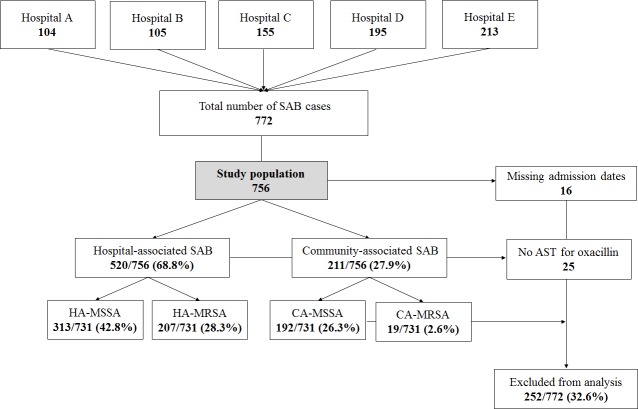
INTRODUCTION: Hospital-associated methicillin-resistant S. aureus (HA-MRSA) remains a significant cause of morbidity and mortality worldwide. We conducted a study to determine risk factors for HA-MRSA in order to inform control strategies in South Africa. METHODS: We used surveillance data collected from five tertiary hospitals in Gauteng and Western Cape provinces during 2014 for analysis. A case of HA-MRSA was defined as isolation of MRSA from a blood culture 48 hours after admission and/or if the patient was hospitalised in the six months prior to the current culture. Multivariable logistic regression modelling was used to determine risk factors for HA-MRSA. RESULTS: Of the 9971 patients with positive blood cultures, 7.7% (772) had S. aureus bacteraemia (SAB). The overall prevalence of MRSA among those with SAB was 30.9% (231/747; 95% confidence interval [CI] 27.6%- 34.3%). HA-MRSA infections accounted for 28.3% of patients with SAB (207/731; 95% CI 25.1%- 31.7%). Burns (adjusted odds ratio [aOR] 12.7; 95% CI 4.7-34.4), age ≤1 month (aOR 8.7; 95% CI 3.0-24.6), residency at a long-term care facility (aOR 5.2; 95% CI, 1.5-17.4), antibiotic use within two months of the current SAB episode (aOR 5.1; 95% CI 2.8-9.1), hospital stay of 13 days or more (aOR 2.8; 95% CI 1.3-5.6) and mechanical ventilation (aOR 2.2; 95% CI 1.07-4.6), were independent risk factors for HA-MRSA infection. CONCLUSION: The prevalence of MRSA remains high in South African tertiary public hospitals. Several identified risk factors of HA-MRSA infections should be considered when instituting infection and prevention strategies in public-sector hospitals, including intensifying the implementation of antimicrobial stewardship programmes. There is an urgent need to strengthen infection prevention and control in burn wards, neonatal wards, and intensive care units which house mechanically ventilated patients.
Overview
The claims and statistics of this paper haven’t been checked yet.
Run the check — free, no account needed. It reads the open-access text and checks the sources it cites.
Integrity signals
Registry
Cites
Statistics
Figures
Verification
Claims the paper makes
The claims and statistics of this paper haven’t been checked yet.
Run the check — free, no account needed. It reads the open-access text and checks the sources it cites.
Claims other papers make about this one
Each is checked against this paper’s own text: does it say what the citing paper says it does?
The source backs part of the claim, not all of it — or backs it for a different population, condition or comparison.
In the citing paper
“The most common risk factors associated with MRSA infection are HIV infection, prior antibiotic use, ICU admission, prior or prolonged hospitalization, indwelling catheters, invasive procedures, open wounds and burns, residency at long-term care facilities, mechanical ventilation, renal failure, and MRSA colonization history.165,166”
From Antimicrobial Resistance Rates and Surveillance in Sub-Saharan Africa: Where Are We Now? (2022) · cites this paper as [165]
Experimental — accuracy not yet measured
Self-check
Percentages, sums and reported differences re-computed from the paper’s own numbers.
The self-check needs the paper’s full text.
Citations
Cites
Multistate point-prevalence survey of health care-associated infections
Magill, S. S., Edwards, J. R., Bamberg, W., Beldavs, Z. G., Dumyati, G., Kainer, M. A., Lynfield, R., Maloney, M., McAllister-Hollod, L., Nadle, J., et al. (2014) · New England Journal of Medicine · doi:10.1056/nejmoa1306801 · Cited by 3,931
Cosgrove, S. E., Sakoulas, G., Perencevich, E. N., Schwaber, M. J., Karchmer, A. W., & Carmeli, Y. (2003) · Clinical Infectious Diseases · doi:10.1086/345476 · Cited by 1,981
Stefani, S., Chung, D. R., Lindsay, J. A., Friedrich, A. W., Kearns, A. M., Westh, H., & MacKenzie, F. M. (2012) · International Journal of Antimicrobial Agents · doi:10.1016/j.ijantimicag.2011.09.030 · Cited by 590
Health Care–Associated Invasive MRSA Infections, 2005-2008
Kallen, A. J. (2010) · JAMA · doi:10.1001/jama.2010.1115 · Cited by 439
Graffunder, E. M. (2002) · Journal of Antimicrobial Chemotherapy · doi:10.1093/jac/dkf009 · Cited by 411
Risk of death from methicillin‐resistant Staphylococcus aureus bacteraemia: a meta‐analysis
Whitby, M., McLaws, M., & Berry, G. (2001) · Medical Journal of Australia · doi:10.5694/j.1326-5377.2001.tb143562.x · Cited by 296
Kaasch, A. J., Barlow, G. D., Edgeworth, J. D., Fowler, V. G., Hellmich, M., Hopkins, S., Kern, W. V., Llewelyn, M., Rieg, S., Rodríguez‐Baño, J., et al. (2013) · Journal of Infection · doi:10.1016/j.jinf.2013.10.015 · Cited by 278
MRSA in Africa: Filling the Global Map of Antimicrobial Resistance
Falagas, M. E., Karageorgopoulos, D. E., Leptidis, J., & Korbila, I. P. (2013) · PLoS ONE · doi:10.1371/journal.pone.0068024 · Cited by 248
Antimicrobial stewardship across 47 South African hospitals: an implementation study
Brink, A. J., Messina, A. P., Feldman, C. H., Richards, G. A., Becker, P., Goff, D. A., Bauer, K. A. A., Nathwani, D., & van den Bergh, D. (2016) · The Lancet Infectious Diseases · doi:10.1016/s1473-3099(16)30012-3 · Cited by 217
Bahemia, I. A., Muganza, A., Moore, R., Sahid, F., & Menezes, C. N. (2015) · Burns · doi:10.1016/j.burns.2015.05.007 · Cited by 123
Research works printed but not linked: 1
- M Mendelson, 2015, The South African antimicrobial resistance strategy framework, Monitoring, surveillance and National Plans, 54
Cited by
Antimicrobial Resistance Rates and Surveillance in Sub-Saharan Africa: Where Are We Now?
Kariuki, S., Kering, K., Wairimu, C., Onsare, R., & Mbae, C. (2022) · Infection and Drug Resistance · doi:10.2147/idr.s342753 · Cited by 245
Metadata
- Authors
- Shuping, L. L., Kuonza, L., Musekiwa, A., Iyaloo, S., & Perovic, O.
- Affiliations
- National Health Laboratory Service (ZA)
- Corresponding author
- Perovic, Olga
- Venue
- PLOS ONE
- Publisher
- Public Library of Science (PLoS)
- Published
- 2017-11-16
- Volume
- 12
- Issue
- 11
- Pages
- e0188216
- ISSN
- 1932-6203 (ISSN-L)
- PMC
- PMC5690649
- OpenAlex
- W2768406667
- Cited by
- 30
- References
- 40
- Citations by year
- 2026: 2 · 2025: 5 · 2024: 2 · 2023: 6 · 2022: 5 · 2021: 2 · 2020: 4 · 2019: 1 · 2018: 3
- FWCI
- 1.68
- Type
- journal article
- Language
- en
- Open access
- gold
- doi.org
- Licence
- Locations
- PLoS ONE (publishedVersion, cc-by)
- PubMed Central (publishedVersion, cc-by)
- PubMed (publishedVersion)
- DOAJ (DOAJ: Directory of Open Access Journals) (submittedVersion, cc-by-sa)
- UpSpace Institutional Repository (University of Pretoria) (submittedVersion, cc-by)
- Funders
- U.S. Department of Health and Human Services
- National Health Laboratory Service
- Centers for Disease Control and Prevention
- Topics
- Health Sciences › Medicine › Infectious Diseases › Antimicrobial Resistance in Staphylococcus
- Health Sciences › Medicine › Infectious Diseases › Infection Control in Healthcare
- Health Sciences › Medicine › Infectious Diseases › Antibiotic Use and Resistance
- Keywords
- risk factors, Staphylococcus aureus bacteremia, bloodstream infection, burns, neonates, long-term care facilities, mechanical ventilation, length of hospital stay, antibiotic use, antimicrobial stewardship, infection control, MRSA prevalence, intensive care unit, burn ward
- MeSH terms
- Adolescent, Adult, Aged, Child, Child, Preschool, Cross Infection, Cross-Sectional Studies, Female, Humans, Infant, Infant, Newborn, Male, Middle Aged, Risk Factors, South Africa, Staphylococcal Infections, Prevalence, Methicillin-Resistant Staphylococcus aureus, Young Adult
About these checks
Registry, retraction, Cites and statistics results are computed, not judged, with one exception: a printed reference that no index lists is read once by a model before it counts as a citation error. Claims are extracted by a model and kept only when their quote appears verbatim in the text; each cited source is then checked, with a model’s help, for whether it says what the claim relies on. Those verdicts can be wrong — read the claim’s quote and the cited source before relying on one.
Statistics and arithmetic are recomputed, not judged.
Confidence bands are shown only for fields calibrated on our annotated test set. None is calibrated yet, so no band is shown.
What counts as a claim ›How we measure confidence ›How we check this ›
Are you an author, or do you see a problem with this page? Request a review
How to cite
Cite CoChat for the checks on this page, and the paper for its own findings.
- This page
- CoChat. (2026). Citation check: Hospital-associated methicillin-resistant Staphylococcus aureus: A cross-sectional analysis of risk factors in South African tertiary public hospitals. https://app.cochat.ai/papers/10.1371/journal.pone.0188216
- The paper
- Shuping, L. L., Kuonza, L., Musekiwa, A., Iyaloo, S., & Perovic, O. (2017). Hospital-associated methicillin-resistant Staphylococcus aureus: A cross-sectional analysis of risk factors in South African tertiary public hospitals. PLOS ONE. https://doi.org/10.1371/journal.pone.0188216
Data sources
Bibliographic data: Semantic Scholar, OpenAlex, Crossref.
Contains information from the Semantic Scholar Academic Graph Datasets, made available under the ODC Attribution License (ODC-BY 1.0).
Semantic Scholar’s data is described in: Kinney, R., et al. (2023). The Semantic Scholar Open Data Platform. arXiv:2301.10140.
