

The DOI matches its Crossref record; 35 of the 36 references it cites were found in a registry or an index.
Sexual identity, attraction and behaviour in Britain: The implications of using different dimensions of sexual orientation to estimate the size of sexual minority populations and inform public health interventions
Open accessAbstract
BACKGROUND: Sexual orientation encompasses three dimensions: sexual identity, attraction and behaviour. There is increasing demand for data on sexual orientation to meet equality legislation, monitor potential inequalities and address public health needs. We present estimates of all three dimensions and their overlap in British men and women, and consider the implications for health services, research and the development and evaluation of public health interventions. METHODS: Analyses of data from Britain's third National Survey of Sexual Attitudes and Lifestyles, a probability sample survey (15,162 people aged 16-74 years) undertaken in 2010-2012. FINDINGS: A lesbian, gay or bisexual (LGB) identity was reported by 2·5% of men and 2·4% of women, whilst 6·5% of men and 11·5% of women reported any same-sex attraction and 5·5% of men and 6·1% of women reported ever experience of same-sex sex. This equates to approximately 547,000 men and 546,000 women aged 16-74 in Britain self-identifying as LGB and 1,204,000 men and 1,389,000 women ever having experience of same-sex sex. Of those reporting same-sex sex in the past 5 years, 28% of men and 45% of women identified as heterosexual. INTERPRETATION: There is large variation in the size of sexual minority populations depending on the dimension applied, with implications for the design of epidemiological studies, targeting and monitoring of public health interventions and estimating population-based denominators. There is also substantial diversity on an individual level between identity, behaviour and attraction, adding to the complexity of delivering appropriate services and interventions.
Overview
The claims and statistics of this paper haven’t been checked yet.
Run the check — free, no account needed. It reads the open-access text and checks the sources it cites.
Integrity signals
Registry
Cites
Statistics
Figures
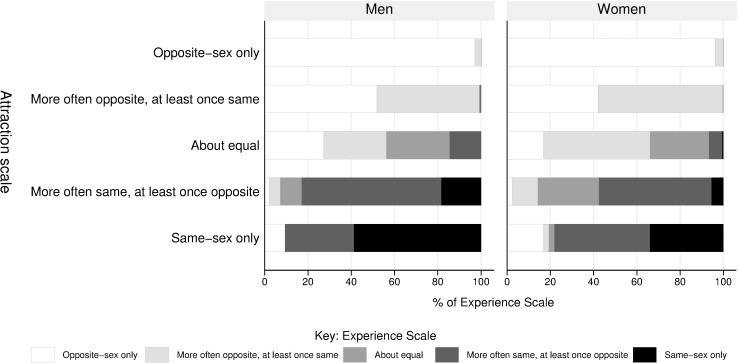
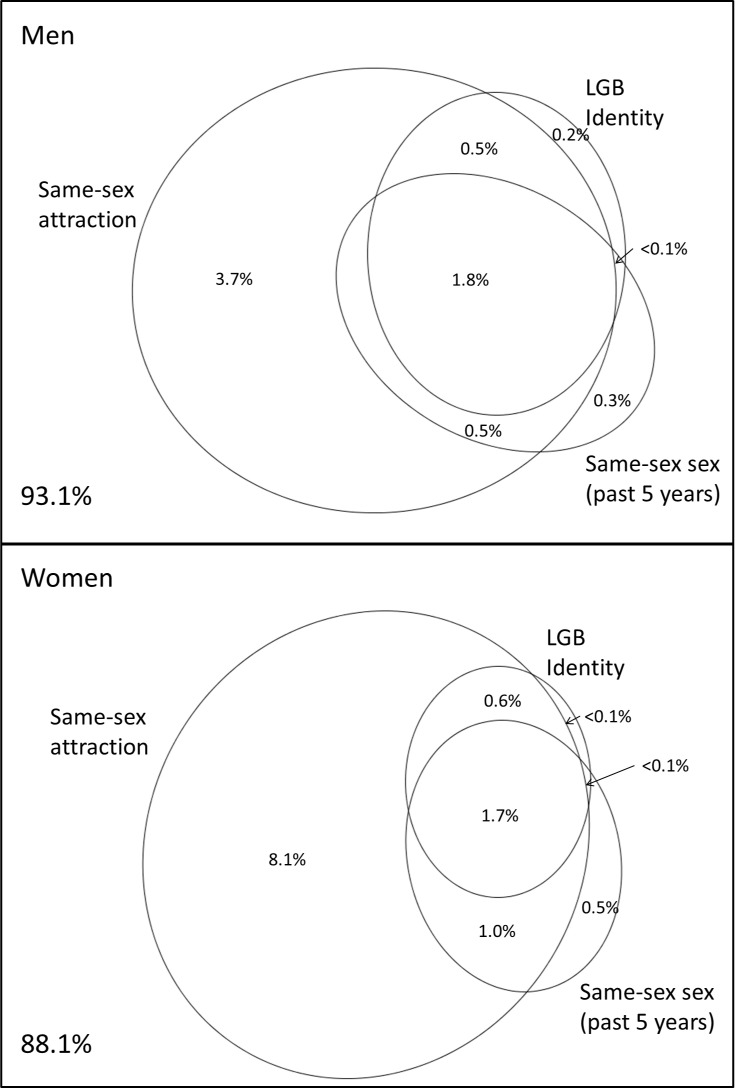
Verification
Claims the paper makes
The claims and statistics of this paper haven’t been checked yet.
Run the check — free, no account needed. It reads the open-access text and checks the sources it cites.
Claims other papers make about this one
Each is checked against this paper’s own text: does it say what the citing paper says it does?
The cited source says what the claim attributes to it.
In the citing paper
“and similar results were found in the United Kingdom (Geary et al. 2018; Wellings et al. 1994).”
From Intersections between Sexual Identity, Sexual Attraction, and Sexual Behavior among a Nationally Representative Sample of American Men and Women (2019) · cites this paper as Geary et al. 2018
The cited source says what the claim attributes to it.
In the citing paper
“The estimates for those who identify as gay or bisexual are slightly larger here compared to the proportion of people who identify as gay or bisexual in the United Kingdom and Australia (see Geary et al. 2018; Richters et al. 2014)”
From Intersections between Sexual Identity, Sexual Attraction, and Sexual Behavior among a Nationally Representative Sample of American Men and Women (2019) · cites this paper as Geary et al. 2018
The cited source says what the claim attributes to it.
In the citing paper
“This pattern is also seen in data from Australia (Richters et al. 2014) and the United Kingdom (Geary et al. 2018), and is consistent with past research in the United States (England et al. 2016; Gates 2011; Korchmaros et al. 2013).”
From Intersections between Sexual Identity, Sexual Attraction, and Sexual Behavior among a Nationally Representative Sample of American Men and Women (2019) · cites this paper as Geary et al. 2018
Self-check
Percentages, sums and reported differences re-computed from the paper’s own numbers.
The self-check needs the paper’s full text.
Citations
Cites
King, M., Semlyen, J., Tai, S. S., Killaspy, H., Osborn, D., Popelyuk, D., & Nazareth, I. (2008) · BMC Psychiatry · doi:10.1186/1471-244x-8-70 · Cited by 2,300
Gender differences in erotic plasticity: The female sex drive as socially flexible and responsive.
Baumeister, R. F. (2000) · Psychological Bulletin · doi:10.1037/0033-2909.126.3.347 · Cited by 808
Mercer, C. H., Tanton, C., Prah, P., Erens, B., Sonnenberg, P., Clifton, S., Macdowall, W., Lewis, R., Field, N., Datta, J., et al. (2013) · The Lancet · doi:10.1016/s0140-6736(13)62035-8 · Cited by 724
Self-citationFemale bisexuality from adolescence to adulthood: Results from a 10-year longitudinal study
Diamond, L. M. (2008) · Developmental Psychology · doi:10.1037/0012-1649.44.1.5 · Cited by 564
Klein, F., Sepekoff, B., & Wolf, T. J. (1985) · Journal of Homosexuality · doi:10.1300/j082v11n01_04 · Cited by 536
A Sex Difference in the Specificity of Sexual Arousal
Chivers, M. L., Rieger, G., Latty, E., & Bailey, J. M. (2004) · Psychological Science · doi:10.1111/j.0956-7976.2004.00750.x · Cited by 534
Measuring sexual behaviour: methodological challenges in survey research
Fenton, K. A. (2001) · Sexually Transmitted Infections · doi:10.1136/sti.77.2.84 · Cited by 531
eulerAPE: Drawing Area-Proportional 3-Venn Diagrams Using Ellipses
Micallef, L., & Rodgers, P. J. (2014) · PLoS ONE · doi:10.1371/journal.pone.0101717 · Cited by 493
SexualPrejudice and Gender: Do Heterosexuals' Attitudes Toward Lesbians and Gay Men Differ?
Herek, G. M. (2000) · Journal of Social Issues · doi:10.1111/0022-4537.00164 · Cited by 470
Sexual Minorities in England Have Poorer Health and Worse Health Care Experiences: A National Survey
Elliott, M. N., Kanouse, D. E., Burkhart, Q., Abel, G., Lyratzopoulos, G., Beckett, M. K., Schuster, M. A., & Roland, M. O. (2014) · Journal of General Internal Medicine · doi:10.1007/s11606-014-2905-y · Cited by 211
Cited by
Sorted by citations
Gender/Sex, Sexual Orientation, and Identity Are in the Body: How Did They Get There?
Fausto‐Sterling, A. (2019) · The Journal of Sex Research · doi:10.1080/00224499.2019.1581883 · Cited by 290
Asexual and Non-Asexual Respondents from a U.S. Population-Based Study of Sexual Minorities
Rothblum, E. D., Krueger, E. A., Kittle, K. R., & Meyer, I. H. (2019) · Archives of Sexual Behavior · doi:10.1007/s10508-019-01485-0 · Cited by 105
Anzani, A., Lindley, L. M., Tognasso, G., Galupo, M. P., & Prunas, A. (2021) · Archives of Sexual Behavior · doi:10.1007/s10508-021-01935-8 · Cited by 114
Kneale, D., Henley, J., Thomas, J., & French, R. (2019) · Ageing and Society · doi:10.1017/s0144686x19001326 · Cited by 106
Gender identity, sexual orientation and adverse sexual experiences in autistic females
Pecora, L. A., Hancock, G. I., Hooley, M., Demmer, D. H., Attwood, T., Mesibov, G. B., & Stokes, M. A. (2020) · Molecular Autism · doi:10.1186/s13229-020-00363-0 · Cited by 97
Metadata
- Authors
- Geary, R. S., Tanton, C., Erens, B., Clifton, S., Prah, P., Wellings, K., Mitchell, K. R., Datta, J., Gravningen, K., Fuller, E., Johnson, A. M., Sonnenberg, P., & Mercer, C. H.
- Affiliations
- London School of Hygiene & Tropical Medicine (GB)
- University College London (GB)
- University Hospital of North Norway (NO)
- NatCen Social Research (GB)
- Corresponding author
- Tanton, Clare
- ORCID
- Venue
- PLOS ONE
- Publisher
- Public Library of Science (PLoS)
- Published
- 2018-01-02
- Volume
- 13
- Issue
- 1
- Pages
- e0189607
- ISSN
- 1932-6203 (ISSN-L)
- PMC
- PMC5749676
- OpenAlex
- W2782502410
- Cited by
- 134
- References
- 36
- Citations by year
- 2026: 9 · 2025: 15 · 2024: 11 · 2023: 16 · 2022: 21 · 2021: 22 · 2020: 14 · 2019: 22 · 2018: 4
- FWCI
- 20.99
- Type
- journal article
- Language
- en
- Open access
- gold
- doi.org
- Licence
- Locations
- PLoS ONE (publishedVersion, cc-by)
- Europe PMC (PubMed Central) (publishedVersion, cc-by)
- PubMed Central (publishedVersion, cc-by)
- PubMed (publishedVersion)
- ENLIGHTEN (Jurnal Bimbingan dan Konseling Islam) (acceptedVersion, cc-by-sa)
- LSHTM Research Online (London School of Hygiene and Tropical Medicine) (acceptedVersion)
- RePEc: Research Papers in Economics (submittedVersion)
- DOAJ (DOAJ: Directory of Open Access Journals) (submittedVersion, cc-by-sa)
- UCL Discovery (University College London) (submittedVersion)
- Figshare (submittedVersion, cc-by)
- Funders
- Medical Research Council (G0701757)
- Wellcome Trust (084840)
- Topics
- Social Sciences › Psychology › Social Psychology › LGBTQ Health, Identity, and Policy
- Health Sciences › Medicine › Infectious Diseases › HIV/AIDS Research and Interventions
- Social Sciences › Gender Studies › Gender and Feminist Studies
- Keywords
- sexual orientation, sexual identity, sexual attraction, sexual behavior, public health interventions, Great Britain
- MeSH terms
- Adolescent, Adult, Aged, Female, United Kingdom, Humans, Male, Middle Aged, Minority Groups, Sexual Behavior, Public Health Practice, Young Adult
About these checks
Registry, retraction, Cites and statistics results are computed, not judged, with one exception: a printed reference that no index lists is read once by a model before it counts as a citation error. Claims are extracted by a model and kept only when their quote appears verbatim in the text; each cited source is then checked, with a model’s help, for whether it says what the claim relies on. Those verdicts can be wrong — read the claim’s quote and the cited source before relying on one.
Statistics and arithmetic are recomputed, not judged.
Confidence bands are shown only for fields calibrated on our annotated test set. None is calibrated yet, so no band is shown.
What counts as a claim ›How we measure confidence ›How we check this ›
Are you an author, or do you see a problem with this page? Request a review
