

The DOI matches its Crossref record; 29 of the 31 references it cites were found in a registry or an index.
Increase in suicides the months after the death of Robin Williams in the US
Open accessAbstract
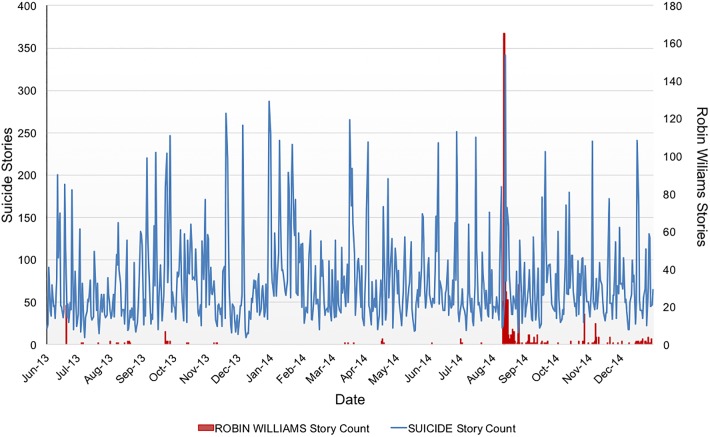
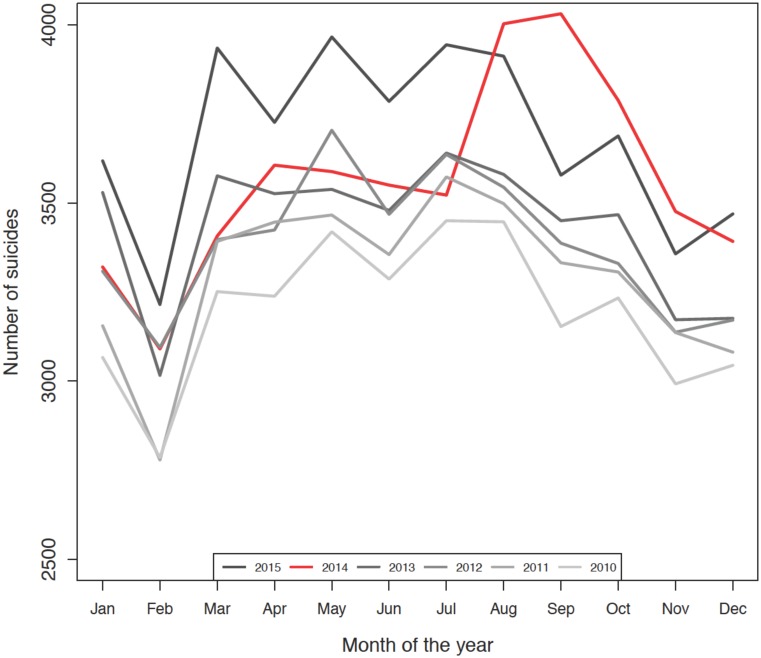
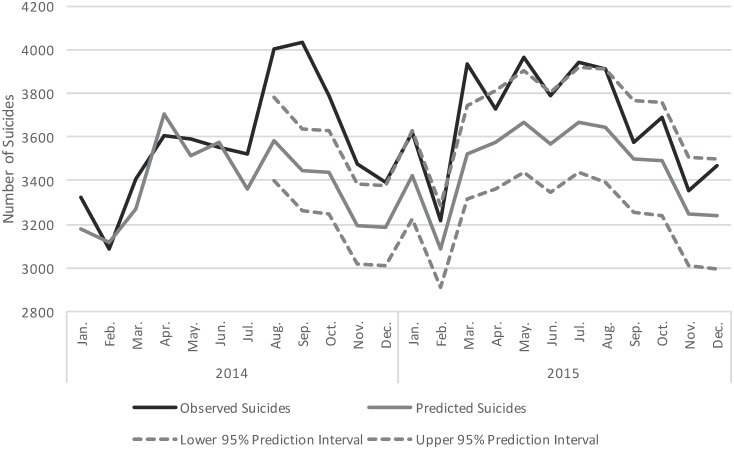
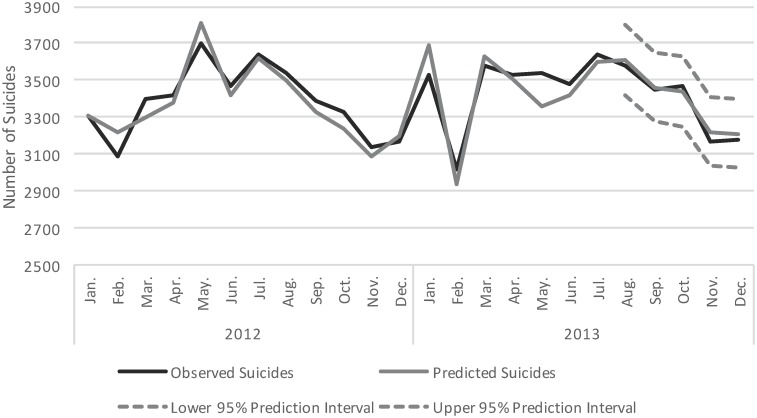
Investigating suicides following the death of Robin Williams, a beloved actor and comedian, on August 11th, 2014, we used time-series analysis to estimate the expected number of suicides during the months following Williams' death. Monthly suicide count data in the US (1999-2015) were from the Centers for Disease Control and Prevention Wide-ranging ONline Data for Epidemiologic Research (CDC WONDER). Expected suicides were calculated using a seasonal autoregressive integrated moving averages model to account for both the seasonal patterns and autoregression. Time-series models indicated that we would expect 16,849 suicides from August to December 2014; however, we observed 18,690 suicides in that period, suggesting an excess of 1,841 cases (9.85% increase). Although excess suicides were observed across gender and age groups, males and persons aged 30-44 had the greatest increase in excess suicide events. This study documents associations between Robin Williams' death and suicide deaths in the population thereafter.
Overview
The claims and statistics of this paper haven’t been checked yet.
Run the check — free, no account needed. It reads the open-access text and checks the sources it cites.
Integrity signals
Registry
Cites
Statistics
Figures
Verification
Claims the paper makes
The claims and statistics of this paper haven’t been checked yet.
Run the check — free, no account needed. It reads the open-access text and checks the sources it cites.
Claims other papers make about this one
Each is checked against this paper’s own text: does it say what the citing paper says it does?
The cited source says what the claim attributes to it.
In the citing paper
“Well-known is how suicide rates went up when Robin Williams completed suicide (Fink et al. 2018).”
From The realities of Medical Assistance in Dying in Canada (2023) · cites this paper as Fink et al. 2018
Self-check
Percentages, sums and reported differences re-computed from the paper’s own numbers.
The self-check needs the paper’s full text.
Citations
Cites
Self-efficacy: Toward a unifying theory of behavioral change
Bandura, A. (1977) · Psychological Review · doi:10.1037/0033-295x.84.2.191 · Cited by 43,925
Self-efficacy: Toward a unifying theory of behavioral change
Bandura, A. (1978) · Advances in Behaviour Research and Therapy · doi:10.1016/0146-6402(78)90002-4 · Cited by 10,586
Suicide Prevention Strategies: A Systematic Review
Mann, J. J., Apter, A., Bertolote, J., Beautrais, A., Currier, D., Haas, A., Hegerl, U., Lonnqvist, J., Malone, K., Marusic, A., et al. (2005) · JAMA · doi:10.1001/jama.294.16.2064 · Cited by 2,852
Time Series Analysis and Its Applications
Shumway, R. H., & Stoffer, D. S. (2010) · Springer texts in statistics · doi:10.1007/978-1-4419-7865-3 · Cited by 2,015
Phillips, D. P. (1974) · American Sociological Review · doi:10.2307/2094294 · Cited by 1,063
Role of media reports in completed and prevented suicide: Werther v. Papageno effects
Niederkrotenthaler, T., Voracek, M., Herberth, A., Till, B., Strauss, M., Etzersdorfer, E., Eisenwort, B., & Sonneck, G. (2010) · British Journal of Psychiatry · doi:10.1192/bjp.bp.109.074633 · Cited by 719
Wide-ranging Online Data for Epidemiologic Research (WONDER)
(2017) · Cited by 415
Media Roles in Suicide Prevention: A Systematic Review
Sisask, M., & Värnik, A. (2012) · International Journal of Environmental Research and Public Health · doi:10.3390/ijerph9010123 · Cited by 359
Suicide in the Media: A Quantitative Review of Studies Based on Nonfictional Stories
Stack, S. J. (2005) · Suicide and Life-Threatening Behavior · doi:10.1521/suli.35.2.121.62877 · Cited by 332
The Werther effect after television films: new evidence for an old hypothesis
Schmidtke, A., & Häfner, H. (1988) · Psychological Medicine · doi:10.1017/s0033291700008345 · Cited by 312
Cited by
Sorted by citations
Contributing factors to suicide: Political, social, cultural and economic
Stack, S. J. (2021) · Preventive Medicine · doi:10.1016/j.ypmed.2021.106498 · Cited by 224
Suicide and Suicide Risk in Adolescents
Hua, L. L., Lee, J., Rahmandar, M. H., Sigel, E. J., COMMITTEE ON ADOLESCENCE, & COUNCIL ON INJURY, V. (2024) · Pediatrics · doi:10.1542/peds.2023-064800 · Cited by 205
Bridge, J. A., Greenhouse, J. B., Ruch, D., Stevens, J., Ackerman, J., Sheftall, A. H., Horowitz, L. M., Kelleher, K. J., & Campo, J. V. (2020) · Journal of the American Academy of Child & Adolescent Psychiatry · doi:10.1016/j.jaac.2019.04.020 · Cited by 194
The Recent Rise of Suicide Mortality in the United States
Martínez‐Alés, G., Jiang, T., Keyes, K. M., & Gradus, J. L. (2021) · Annual Review of Public Health · doi:10.1146/annurev-publhealth-051920-123206 · Cited by 158
Self-citationThe Werther effect, the Papageno effect or no effect? A literature review
Domaradzki, J. (2021) · International Journal of Environmental Research and Public Health · doi:10.3390/ijerph18052396 · Cited by 119
Metadata
- Authors
- Fink, D. S., Santaella-Tenorio, J., & Keyes, K. M.
- Affiliations
- Columbia University (US)
- Corresponding author
- Fink, David S.
- Venue
- PLOS ONE
- Publisher
- Public Library of Science (PLoS)
- Published
- 2018-02-07
- Volume
- 13
- Issue
- 2
- Pages
- e0191405
- ISSN
- 1932-6203 (ISSN-L)
- PMC
- PMC5802858
- OpenAlex
- W2785475303
- Cited by
- 156
- References
- 31
- Citations by year
- 2026: 4 · 2025: 22 · 2024: 15 · 2023: 14 · 2022: 14 · 2021: 31 · 2020: 28 · 2019: 21 · 2018: 7
- FWCI
- 25.56
- Type
- journal article
- Language
- en
- Open access
- gold
- doi.org
- Licence
- Locations
- PLoS ONE (publishedVersion, cc-by)
- PubMed Central (publishedVersion, cc-by)
- PubMed (publishedVersion)
- RePEc: Research Papers in Economics (submittedVersion)
- DOAJ (DOAJ: Directory of Open Access Journals) (submittedVersion, cc-by-sa)
- Columbia Academic Commons (Columbia University)
- Funders
- National Institute on Drug Abuse (T32DA031099)
- Topics
- Social Sciences › Psychology › Clinical Psychology › Suicide and Self-Harm Studies
- Social Sciences › Sociology and Political Science › Homicide, Infanticide, and Child Abuse
- Social Sciences › Health › Gun Ownership and Violence Research
- Keywords
- Robin Williams, celebrity death, suicide, excess mortality, celebrity influence, public figures, suicide rates, seasonal patterns, gender differences, age groups
- MeSH terms
- Adolescent, Adult, Child, Drama, Famous Persons, Female, Humans, Male, Middle Aged, Suicide, United States, Incidence, Young Adult
About these checks
Registry, retraction, Cites and statistics results are computed, not judged, with one exception: a printed reference that no index lists is read once by a model before it counts as a citation error. Claims are extracted by a model and kept only when their quote appears verbatim in the text; each cited source is then checked, with a model’s help, for whether it says what the claim relies on. Those verdicts can be wrong — read the claim’s quote and the cited source before relying on one.
Statistics and arithmetic are recomputed, not judged.
Confidence bands are shown only for fields calibrated on our annotated test set. None is calibrated yet, so no band is shown.
What counts as a claim ›How we measure confidence ›How we check this ›
Are you an author, or do you see a problem with this page? Request a review
