

Gender-transformative Bandebereho couples' intervention to promote male engagement in reproductive and maternal health and violence prevention in Rwanda: Findings from a randomized controlled trial
Open accessThe DOI matches its Crossref record; 28 of the 31 references it cites were found in a registry or an index; 9 of the 15 sources its claims cite were checked for support.
Abstract
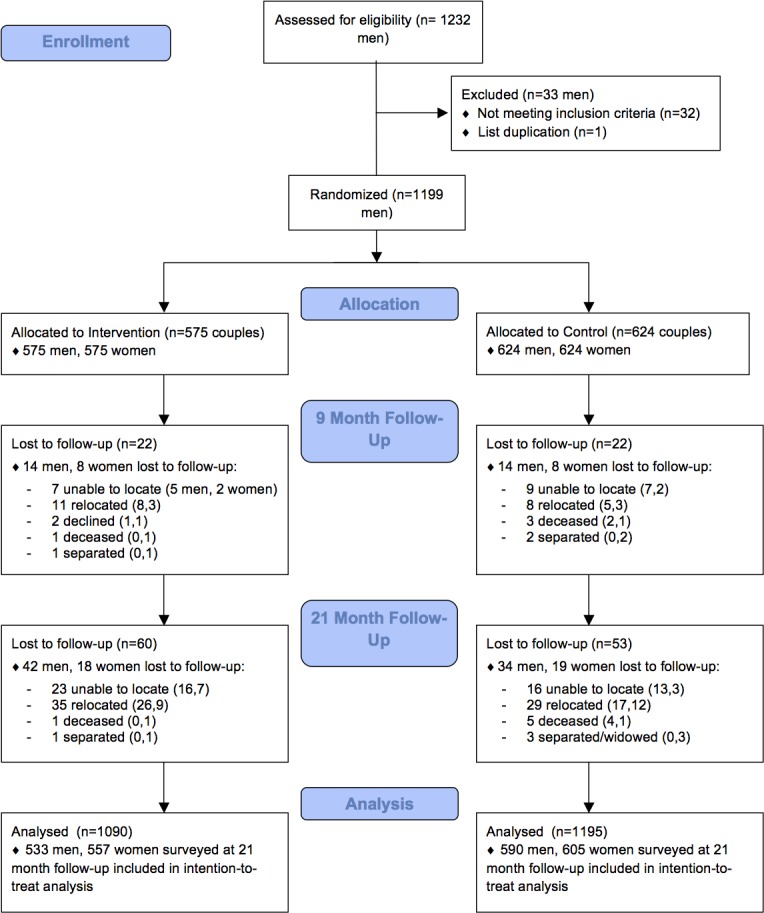
BACKGROUND: Rigorous evidence of the effectiveness of male engagement interventions, particularly on how these interventions impact relationship power dynamics and women's decision-making, remains limited. This study assessed the impact of the Bandebereho gender-transformative couples' intervention on impact on multiple behavioral and health-related outcomes influenced by gender norms and power relations. METHODS: We conducted a multi-site randomised controlled trial in four Rwandan districts with expectant/current fathers and their partners, who were randomised to the intervention (n = 575 couples) or control group (n = 624 couples). Primary outcomes include women's experience of physical and sexual IPV, women's attendance and men's accompaniment at ANC, modern contraceptive use, and partner support during pregnancy. At 21-months post-baseline, 1123 men and 1162 partners were included in intention to treat analysis. Generalized estimating equations with robust standard errors were used to fit the models. FINDINGS: The Bandebereho intervention led to substantial improvements in multiple reported outcomes. Compared to the control group, women in the intervention group reported: less past-year physical (OR 0.37, p<0.001) and sexual IPV (OR 0.34, p<0.001); and greater attendance (IRR 1.09, p<0.001) and male accompaniment at antenatal care (IRR 1.50, p<0.001); and women and men in the intervention group reported: less child physical punishment (women: OR 0.56, p = 0.001; men: OR 0.66, p = 0.005); greater modern contraceptive use (women: OR 1.53, p = 0.004; men: OR 1.65, p = 0.001); higher levels of men's participation in childcare and household tasks (women: beta 0.39, p<0.001; men: beta 0.33, p<0.001); and less dominance of men in decision-making. CONCLUSIONS: Our study strengthens the existing evidence on male engagement approaches; together with earlier studies our findings suggest that culturally adapted gender-transformative interventions with men and couples can be effective at changing deeply entrenched gender inequalities and a range of health-related behavioral outcomes. TRIAL REGISTRATION: ClinicalTrials.gov NCT02694627.
Overview
CoChat Summary
## TL;DR
This randomized controlled trial in four Rwandan districts found that the Bandebereho gender-transformative couples’ intervention improved multiple relationship, reproductive/maternal health, and violence-related outcomes at 21 months. Compared with control, the intervention group reported lower physical and sexual IPV, higher ANC attendance and male accompaniment, more modern contraceptive use, more shared childcare/household tasks, and less male dominance in decision-making.
## Key findings
- At 21-month follow-up, women in the intervention group reported less past-year physical IPV than control women: 33.33% vs 56.53%; OR 0.37, p<0.001. They also reported less sexual IPV: 35.01% vs 60.17%; OR 0.34, p<0.001.
- The intervention improved antenatal care behaviors: women’s ANC attendance increased (IRR 1.09, 95% CI 1.05–1.14) and male accompaniment at ANC increased (IRR 1.50, 95% CI 1.36–1.65, p<0.001).
- Modern contraceptive use was higher in the intervention group for both women and men: women OR 1.53 (p=0.004); men OR 1.65 (p=0.001).
- The intervention reduced reported child physical punishment and men’s dominance in decision-making, and increased men’s participation in childcare/household tasks. For example, physical punishment was reported by 68.25% of women vs 79.15% in control (OR 0.56, p=0.001) and 57.71% of men vs 67.30% in control (OR 0.66, p=0.005).
## Methods
- Two-arm, multi-site randomized controlled trial in four Rwandan districts (Karongi, Musanze, Nyaruguru, Rwamagana) with expectant/current fathers and their partners; couples were randomized to intervention (n=575 couples) or control (n=624 couples).
- Men were recruited from 48 pre-selected sites; eligible men were 21–35 years, married/cohabitating, expectant and/or fathers of children under five, living within accessible distance, and not previous Bandebereho participants.
- Main analysis used intention-to-treat models at 21 months post-baseline, estimated with generalized estimating equations and robust standard errors, with adjusted models controlling for age, education, and baseline socioeconomic status.
## Limitations
- The paper states several limitations: no baseline data from women, randomization at the individual level constrained by the intervention, no masking of participants or data collectors, self-reported outcomes with possible social desirability bias, prevalence findings not generalizable to Rwanda, and a 21-month follow-up that does not capture life-course change.
- Evident from the text: women were not surveyed at baseline because of funding constraints, so some analyses could not adjust for baseline values for women’s indicators.
Model-written summary. Check it against the paper before relying on it.
Integrity signals
Registry
Cites
Statistics
Figures
Verification
Claims the paper makes
8 Valid · 0 Not valid · 3 Not checked · 50 Own results and interpretations
The cited sources support only part of this claim — read each source’s verdict below.
In the paper
“the degree of IPV risk reduction we report is seldom achieved in rigorously evaluated interventions [25].”
§ Gender-transformative Bandebereho couples’ intervention to promote male engagement in reproductive and maternal health and violence prevention in Rwanda: Findings from a randomized controlled trial > Discussion
What the sources say
- Partly supportedcites [25] Arango D, Morton M, Gennari F, Kiplesund S, Ellsberg M. Interventions to reduce or prevent violence against women and girls: a systematic review of reviews Washington, DC: World Bank; 2014. sourceExperimental — accuracy not yet measured
Our copy of Arango et al. (2014) — the abstract/concluding paragraph of the Open Knowledge Repository record, which carries no section labels — supports only the general backdrop: 'knowledge of intervention impacts on VAWG prevention is growing, but is still highly limited,' and 'a small but growing body of rigorously tested interventions demonstrates that preventing VAWG is possible and can achieve large effect sizes.' It nowhere compares a magnitude of IPV risk reduction across rigorously evaluated interventions or states that a given degree of reduction is seldom achieved; if anything it emphasises that large effect sizes have been demonstrated in rigorous tests. Note also that the line 'Few approaches have been rigorously evaluated, even in high-income countries' appears in a related-item abstract (Bott, Morrison, Ellsberg 2005) listed on the same page, not in this paper, so it is not evidence for the claim. (LLM, conf=0.72)
plain- Asserted: passes — The authors put it forward as true.
- Checkable: passes — It can be checked against evidence.
- Load-bearing: passes — The paper’s conclusions depend on it.
- Based: passes — The paper gives a reason why it holds.
- Partly supported
Every source the paper cites for this claim was checked and supports it.
In the paper
“The Bandebereho intervention demonstrated a reduction in men’s dominance in household decision-making, which is associated with negative health-related outcomes for women and children [32].”
§ Gender-transformative Bandebereho couples’ intervention to promote male engagement in reproductive and maternal health and violence prevention in Rwanda: Findings from a randomized controlled trial > Discussion
What the sources say
- Supportedcites [32] Singh K, Bloom S, Brodish P. Gender Equality as a Means to Improve Maternal and Child Health in Africa. Health Care Women Int. 2015; 36: 57– 69. doi: 10.1080/07399332.2013.824971 24028632 PMC4333143 source
The Conclusions report that women with greater household decision-making authority were less likely to have low BMI and more likely to seek treatment for a child with an acute respiratory infection. This supports the stated association between less-equal household decision-making and adverse outcomes for women and children; the paper does not claim that decision-making was associated with every outcome studied. (LLM, conf=0.91)
plainstates an association- Asserted: passes — The authors put it forward as true.
- Checkable: passes — It can be checked against evidence.
- Load-bearing: passes — The paper’s conclusions depend on it.
- Based: passes — The paper gives a reason why it holds.
- Supported
The cited sources support only part of this claim — read each source’s verdict below.
In the paper
“This is the first trial of a male engagement intervention, to our knowledge, to demonstrate at least a modest impact on women’s ANC attendance [3,28].”
§ Gender-transformative Bandebereho couples’ intervention to promote male engagement in reproductive and maternal health and violence prevention in Rwanda: Findings from a randomized controlled trial > Discussion
What the sources say
- Not matchedcites [3] WHO. WHO recommendations on health promotion interventions for maternal and newborn health 2015 Geneva: World Health Organization; 2015. 26180864
Its entry has no title and year that we can search by.
- Partly supportedcites [28] Yargawa J, Leonardi-Bee J. Male involvement and maternal health outcomes: systematic review and meta-analysis. J Epidemiol Community Health. 2015; 69: 604– 12. doi: 10.1136/jech-2014-204784 25700533 PMC4453485 sourceExperimental — accuracy not yet measured
The Results (Findings from studies by outcome; page unavailable) report that an earlier male-involvement study found no significant association with women’s ANC attendance. That provides context for the novelty claim, but this review does not establish that the citing authors’ trial was the first to show an impact or report that trial’s effect. (LLM, conf=0.84)
hedgedstates a cause- Asserted: passes — The authors put it forward as true.
- Checkable: passes — It can be checked against evidence.
- Load-bearing: passes — The paper’s conclusions depend on it.
- Based: passes — The paper gives a reason why it holds.
- Not matched
The cited sources support only part of this claim — read each source’s verdict below.
In the paper
“Non-trial research has found that male partner support is associated with women’s antenatal attendance, birth preparedness and use of a skilled birth attendant [3,28].”
§ Gender-transformative Bandebereho couples’ intervention to promote male engagement in reproductive and maternal health and violence prevention in Rwanda: Findings from a randomized controlled trial > Discussion
What the sources say
- Not matchedcites [3] WHO. WHO recommendations on health promotion interventions for maternal and newborn health 2015 Geneva: World Health Organization; 2015. 26180864
Its entry has no title and year that we can search by.
- Partly supportedcites [28] Yargawa J, Leonardi-Bee J. Male involvement and maternal health outcomes: systematic review and meta-analysis. J Epidemiol Community Health. 2015; 69: 604– 12. doi: 10.1136/jech-2014-204784 25700533 PMC4453485 sourceExperimental — accuracy not yet measured
The Results (Findings from studies by outcome; page not provided) report a significant association between husbands’ antenatal attendance and skilled attendance at birth in a cross-sectional study. The Discussion (Interpretation; page not provided) links male involvement to birth preparation. But the reported antenatal-care finding comes from a trial and was not statistically significant, so the source does not support all three outcomes as findings of non-trial research. (LLM, conf=0.88)
plainstates an association- Asserted: passes — The authors put it forward as true.
- Checkable: passes — It can be checked against evidence.
- Load-bearing: passes — The paper’s conclusions depend on it.
- Based: passes — The paper gives a reason why it holds.
- Not matched
A result the paper reports from its own data — it cites no other source for it, so there is none to check. The quote shows it is in the paper.
In the paper
“In the intervention group, 56.08% of women (OR 0.31, 95% CI 0.24–0.42, p<0.001) and 45.47% of men (OR 0.35, 95% CI 0.25–0.48, p<0.001) reported that the man had the final say on decisions regarding the household’s income and expenses, compared to 78.74% and 70.27% in the control group, respectively.”
§ Gender-transformative Bandebereho couples’ intervention to promote male engagement in reproductive and maternal health and violence prevention in Rwanda: Findings from a randomized controlled trial > Results
plainstates an association- Asserted: passes — The authors put it forward as true.
- Checkable: passes — It can be checked against evidence.
- Load-bearing: passes — The paper’s conclusions depend on it.
- Based: passes — The paper gives a reason why it holds.
- Rests on an assumption not shown here.
31 more claims
Create a free account to see all 61 claims and to verify the 1 reference still open.
- It may state two separate claims as one. 14
- Probably not a substantial claim. 21
Citations
Cites
García‐Moreno, C., Jansen, H. A. F. M., Ellsberg, M. C., Heise, L., & Watts, C. H. (2005) · Cited by 1,819
Garcia‐Moreno, C. (2001) · DigitalGeorgetown (Georgetown University Library) · Cited by 933
Prevention of violence against women and girls: what does the evidence say?
Ellsberg, M., Arango, D. J., Morton, M., Gennari, F., Kiplesund, S., Contreras, M., & Watts, C. (2015) · The Lancet · doi:10.1016/s0140-6736(14)61703-7 · Cited by 875
Deutsch, F. M. (2007) · Gender & Society · doi:10.1177/0891243206293577 · Cited by 870
Jewkes, R., Nduna, M., Levin, J., Jama, N., Dunkle, K., Puren, A., & Duvvury, N. (2008) · BMJ · doi:10.1136/bmj.a506 · Cited by 757
Barker, G., Ricardo, C., & do Nascimento, M. A. F. (2007) · Cited by 649
Self-citationRwanda Demographic and Health Survey 2010
Rwanda (2012) · Cited by 553
Abramsky, T., Devries, K., Kiss, L., Nakuti, J., Kyegombe, N., Starmann, E., Cundill, B., Francisco, L., Kaye, D., Musuya, T., et al. (2014) · BMC Medicine · doi:10.1186/s12916-014-0122-5 · Cited by 507
Male involvement and maternal health outcomes: systematic review and meta-analysis
Yargawa, J., & Leonardi-Bee, J. (2015) · Journal of Epidemiology and Community Health · doi:10.1136/jech-2014-204784 · Cited by 499 · cited 2×
“Non-trial research has found that male partner support is associated with women’s antenatal attendance, birth preparedness and use of a skilled birth attendant [3,28].”
Background(2015) · Choice Reviews Online · doi:10.5860/choice.190427 · Cited by 357
Research works printed but not linked: 1
- WHO. WHO recommendations on health promotion interventions for maternal and newborn health 2015 Geneva: World Health Organization; 2015. 26180864
Cited by
Items 101–200 of 269
Rwanda Systematic Country Diagnostic
World Bank Group (2019) · World Bank, Washington, DC eBooks · doi:10.1596/32113 · Cited by 11
Young, C. R., Gill, E. S., Bwana, M., Muyindike, W. R., Hock, R. S., Pratt, M. C., Owembabazi, M., Tukwasibwe, D., Najjuma, A., Kalyebara, P. K., et al. (2021) · AIDS and Behavior · doi:10.1007/s10461-021-03343-4 · Cited by 10
Kalbarczyk, A., Rao, A., Adebayo, A., Decker, E., Gerber, S., & Morgan, R. (2021) · Global Health Research and Policy · doi:10.1186/s41256-021-00203-5 · Cited by 12
“children therefore becomes very important [28, 29].”
Trillingsgaard, T., Maimburg, R. D., & Simonsen, M. (2021) · Social Science & Medicine · doi:10.1016/j.socscimed.2021.114340 · Cited by 16
Improving and sustaining livelihoods through group-based interventions: mapping the evidence
(3ie), I. I. F. I. E., Barooah, B., Chinoy, S. L., 3ie, Dubey, P., 3ie, Sarkar, R., 3ie, Bagai, A., 3ie, et al. (2019) · doi:10.23846/egm013 · Cited by 17
Ambrosio, M. D. G., Lachman, J. M., Zinzer, P., Sacolo-Gwebu, H., Vyas, S., Vallance, I., Calderón, F., Gardner, F. E. M., Markle, L., Stern, D., et al. (2024) · JMIR Research Protocols · doi:10.2196/52145 · Cited by 13
“Gender-equitable behavior will be measured using items adapted from the core questionnaire in the World Health Organization multicountry study on domestic violence [82] and from questionnaires used in previous violence prevention studies [83,84].”
Jeong, J., McCann, J. K., Bhojani, A., Maguet, Z., Uyehara, M., & Ochieng, M. (2024) · PLOS Global Public Health · doi:10.1371/journal.pgph.0003520 · Cited by 16
Jeong, J., Bartoli, B., & McCann, J. K. (2024) · BMC Public Health · doi:10.1186/s12889-024-20344-9 · Cited by 28
“…the fact that fathers were least engaged in household chores and early learning activities, gender-transform-ative parenting interventions in Uganda, Rwanda, and Tanzania have shown success in shifting gender attitudes and increasing fathers’ engagement in such caregiving activities [31, 53, 54].”
BackgroundLevtov, R., Doyle, K., Bingenheimer, J. B., Lahiri, S., Kazimbaya, S., Karamage, E., Sayinzoga, F., Mutoni, M., Rubayita, C. H., & Barker, G. (2022) · Prevention Science · doi:10.1007/s11121-022-01445-6 · Cited by 10
“Women and men in the intervention group also reported less child physical punishment, higher levels of men’s participation in childcare and household tasks, and less dominance of men in decision-making, among other outcomes (Doyle et al., 2018).”
BackgroundSelf-citationPrakash, R., Beattie, T., Cislaghi, B., Bhattacharjee, P., Javalkar, P., Ramanaik, S., Thalinja, R., Davey, C., Gafos, M., Watts, C. H., et al. (2020) · Prevention Science · doi:10.1007/s11121-020-01143-1 · Cited by 10
Women’s modern contraceptive use in sub-Saharan Africa: does men’s involvement matter?
Assaf, S., & Davis, L. M. (2019) · Journal of Global Health Reports · doi:10.29392/joghr.3.e2019013 · Cited by 10
“Gender-transformative approaches—that is, interventions or programs that promote understanding and challenge social norms and attitudes that perpetuate inequalities between men and women—have proven effective in changing gender inequalities and improving health-related behaviors (16-18).”
BackgroundNair, S., Dixit, A., Ghule, M., Battala, M., Gajanan, V., Dasgupta, A., Begum, S., Averbach, S., Donta, B., Silverman, J. G., et al. (2019) · Gates Open Research · doi:10.12688/gatesopenres.13026.1 · Cited by 11
Intimate partner violence negatively affects parenting
Jewkes, R. K., & Mahlangu, P. (2023) · The Lancet Global Health · doi:10.1016/s2214-109x(23)00363-7 · Cited by 10
Kalra, N., Habumugisha, L., & Shankar, A. (2024) · BMC Public Health · doi:10.1186/s12889-024-18780-8 · Cited by 9
“Another approach to addressing GBV shown to successfully reduce rates of IPV outside of humanitarian settings includes adapting programs that used group learning and engaged partners through community gender dialogues [12, 13].”
BackgroundMethodInfluentialRossum, A. V., van Laar, C., & Scheepers, D. T. (2024) · Social Issues and Policy Review · doi:10.1111/sipr.12107 · Cited by 16
Awolaran, O., Olubumuyi, O., OlaOlorun, F. M., Assink, M., van Rooij, F. B., & Leijten, P. H. O. (2022) · Aggression and Violent Behavior · doi:10.1016/j.avb.2022.101746 · Cited by 11
Kenny, L., Lokot, M., Bhatia, A., Hassan, R., Pyror, S., Dagadu, N. A., Aden, A. H., Shariff, A., Bacchus, L., Hossain, M., et al. (2022) · Sexual and Reproductive Health Matters · doi:10.1080/26410397.2022.2135736 · Cited by 10
Udenigwe, O., Omonaiye, O., & Yaya, S. (2023) · Frontiers in Digital Health · doi:10.3389/fdgth.2023.1263488 · Cited by 12
Sarı, E., & Yalçın, S. S. (2024) · The Italian Journal of Pediatrics/Italian journal of pediatrics · doi:10.1186/s13052-024-01802-x · Cited by 13
“These behavioral changes include a reduction in physical violence towards children and women, greater use of modern contraception, improved health awareness, higher uptake of prenatal care, and fathers quitting smoking [18–21].”
BackgroundChatterji, S., Johns, N. E., Ghule, M., Begum, S., Averbach, S., Battala, M., & Raj, A. (2022) · Journal of Family Violence · doi:10.1007/s10896-022-00363-z · Cited by 10
“However, when conducted safely, couple-based approaches have shown success in addressing IPV in Rwanda (Doyle et al., 2018; Dunkle et al., 2020), South Africa (Hatcher et al.”
BackgroundLessons learned from implementing the parenting Program P in Bolivia to prevent family violence
Stern, E. A., Alemann, C., Delgado, G. A. F., & Vásquez, A. E. (2022) · Evaluation and Program Planning · doi:10.1016/j.evalprogplan.2022.102207 · Cited by 11
“By emphasizing joint decision-making through skills-based activities and by creating spaces for couple communication, the intervention demonstrated strong evidence of targeting unequal gendered power dynamics (Doyle et al., 2018).”
InfluentialPascoe, L. A. (2020) · Culture Health & Sexuality · doi:10.1080/13691058.2019.1696983 · Cited by 12
Helping Families Help Themselves? Heterogeneous Effects of a Digital Parenting Program
Amaral, S., Diaz, L. D., Domínguez, P., & Perez-Vincent, S. M. (2021) · World Bank, Washington, DC eBooks · doi:10.1596/1813-9450-9850 · Cited by 8
“…help parents cope with these emotions can improve the mental health of mothers (Persson and Rossin-Slater, 2019; Baranov et al., 2020) and the relationship between parents and children (Knerr et al., 2013; Cluver et al., 2018), as well as reduce the risk of child maltreatment (Doyle et al., 2018).”
BackgroundEaton, J., Krishna, A., Sudi, C., George, J., Magomba, C., Eckman, A., Houck, F., & Taukobong, H. F. G. (2021) · Frontiers in Sociology · doi:10.3389/fsoc.2021.672989 · Cited by 13
“, 2020), while other interventions which have taken gender-transformative approaches have had success in targeting men (Doyle et al., 2018).”
BackgroundDyke, C., Bird, K. S., & Rivas, C. A. (2020) · Criminal Behaviour and Mental Health · doi:10.1002/cbm.2183 · Cited by 9
Okwako, J. M., Mbuthia, G. W., & Magutah, K. (2023) · Pan African Medical Journal · doi:10.11604/pamj.2023.44.189.38293 · Cited by 7
EFFECTS Study Investigators, Lyaatu, I., Mosha, D., Mwanyika‐Sando, M., Jeong, J., Yousafzai, A. K., PrayGod, G., Evarist, R., Galvin, L., Kieffer, M. P., et al. (2024) · Trials · doi:10.1186/s13063-022-07002-4 · Cited by 9
“…engagement in maternal and child health, and violence prevention found improvements in women’s attendance and men’s accompaniment at antenatal care visits, fathers’ engagement in household responsibilities, and couples’ relationships and reduced fathers’ violence against women and children [29].”
BackgroundJeong, J., McCann, J. K., Bhojani, A., Joseph, J., Sangarara, G., & Joachim, D. (2025) · SSM - Mental Health · doi:10.1016/j.ssmmh.2025.100499 · Cited by 9
Chi, H., Eom, Y., Jung, S., Kim, J., Jeong, J., & Kim, R. (2024) · American Journal of Tropical Medicine and Hygiene · doi:10.4269/ajtmh.23-0511 · Cited by 9
Bhardwaj, A., Maharjan, S. M., Magar, A. J., Shrestha, R., Dongol, A. S., Hagaman, A. K., van Heerden, A. C., Caracoglia, J., Gallo, J. J., Murray, S. M., et al. (2024) · SSM - Mental Health · doi:10.1016/j.ssmmh.2024.100340 · Cited by 15
Wynter, K. H., Francis, L. M., Borgkvist, A., Dixson, B. J. W., D’Souza, L., Duursma, E., May, C. D., Sher, L., & StGeorge, J. M. (2024) · Trauma Violence & Abuse · doi:10.1177/15248380241277270 · Cited by 9
“For example, some reported interventions increased men’s attendance and accompaniment at antenatal care (Doyle et al., 2018), improved emotion regulation and reflective functioning as well as reduced anger and hostility among men (Stover et al., 2020), reduced child physical punishment (Doyle et…”
InfluentialBertelli, O., Calvo, T., Lavallée, E., Mercier, M., & Mesplé‐Somps, S. (2025) · Journal of Development Economics · doi:10.1016/j.jdeveco.2025.103479 · Cited by 7
“Our study also adds to an emerging literature evaluating interventions aimed at fighting violence against women by engaging boys and men (Hossain et al., 2014; Doyle et al., 2018; Vaillant et al., 2020).”
Doyle, K., Bhatnagar, I., Karamage, E., Tuyisingize, J. P., Muhimpundu, C., Nyiransabimana, A. M. Y., Cyiza, F. R., Rutayisire, F., Ngayaboshya, S., & Mavhu, W. M. (2025) · Frontiers in Reproductive Health · doi:10.3389/frph.2025.1602136 · Cited by 6
Self-citationFactors associated with reported modern contraceptive use among married men in Afghanistan
Packer, C. A., Rastagar, S. H., Chen, M., Bernholc, A. S., Hemat, S., Seddiqi, S., McIntosh, R., Costenbader, E., & Todd, C. S. (2020) · Reproductive Health · doi:10.1186/s12978-020-0908-1 · Cited by 8
Redesigning and delivering inclusive parenting interventions for fathers
Jeong, J. (2021) · The Lancet Global Health · doi:10.1016/s2214-109x(21)00037-1 · Cited by 6
Two Sides of Gender: Sex, Power, and Adolescence
Shah, M., Seager, J. E., Montalvao, J., & Goldstein, M. (2022) · World Bank policy research working paper · doi:10.1596/1813-9450-10072 · Cited by 8
Sex, Power, and Adolescence: Intimate Partner Violence and Sexual Behaviors
Shah, M., Seager, J. E., Montalvao, J., & Goldstein, M. (2023) · National Bureau of Economic Research · doi:10.3386/w31624 · Cited by 14
“Second, experimental methods around improving SRH outcomes in low-income settings have often focused on married couples and long-term partners (Shattuck et al., 2011; Doyle et al., 2018; Minnis et al., 2015; Dunkle et al., 2020; Gupta et al., 2013) or individual adults (Pronyk et al.”
BackgroundIncreasing Women's Empowerment: Implications for Family WelfarePreprint
Ambler, K., Jones, K., & O'Sullivan, M. (2021) · SSRN Electronic Journal · doi:10.2139/ssrn.5243325 · Cited by 23
Schafer, M., Lachman, J. M., Zinser, P., Calderón, F., Han, Q., Facciolà, C., Clements, L., Gardner, F. E. M., Ronnie, G. H., & Sheil, R. (2025) · JMIR Formative Research · doi:10.2196/58611 · Cited by 9
Supporting Women-Led Businesses: Narrative Review of Recent Causal Evidence
Ubfal, D. J. (2024) · The World Bank Research Observer · doi:10.1093/wbro/lkae012 · Cited by 15
“For instance, involving men in group discussions about GBV led to a reduction in reported violence and increased decision making in Rwanda ( Doyle et al. 2018 ).”
Black, C. J., Placencio‐Castro, M., Phend, G., Havugimana, J. M. V., Umulisa, G., Uwamahoro, P., Nyirahabimana, M. G., Bond, L., Hernandez, K., Jensen, S. K. G., et al. (2025) · Journal of Child Psychology and Psychiatry · doi:10.1111/jcpp.14160 · Cited by 9
Promoting gender equity in a home visits programme: a qualitative study in Northern Nigeria
Belaid, L., Mudi, H., Omer, K., Gidado, Y., Ansari, U., Rilwanu, M., Andersson, N., & Cockcroft, A. (2024) · BMC Women s Health · doi:10.1186/s12905-024-03293-8 · Cited by 11
“Since the 1990s, researchers have implemented interventions involving male partners to improve maternal and child health outcomes [10].”
BackgroundResultInfluentialAlderman, H., Gilligan, D., Hidrobo, M., Leight, J., Mulford, M. R., & Tambet, H. (2024) · World Development · doi:10.1016/j.worlddev.2024.106781 · Cited by 8
Couples and Family Interventions for Intimate Partner Aggression: A Comprehensive Review
Bennett, V. E., Godfrey, D. A., Snead, A. L., Kehoe, C. M., Bastardas-Albero, A., & Babcock, J. C. (2020) · Partner Abuse · doi:10.1891/pa-2020-0011 · Cited by 6
Findings from a WE-Care project final evaluation: January 2020
Leon‐Himmelstine, C., & Salomon, H. (2020) · doi:10.21201/2020.5587 · Cited by 5
Dixit, A., Johns, N. E., Ghule, M., Battala, M., Begum, S., Yore, J. B., Saggurti, N., Silverman, J. G., Reed, E., Benmarhnia, T., et al. (2021) · Research Square · doi:10.21203/rs.3.rs-358822/v1 · Cited by 5
González, P., Goldstein, M., Papineni, S., et al. (2022) · World Bank, Washington, DC eBooks · doi:10.1596/1813-9450-10012 · Cited by 5
“…en- gaged expectant fathers and their partners in sessions of critical reflection on fatherhood and caregiving resulted in higher levels of men’s participation in childcare and household tasks compared with participants in a comparison group who did not receive training (Doyle et al., 2018).”
BackgroundEngelbrecht, M., Mulu, N. N. T., & Kigozi, G. (2024) · International Journal of Environmental Research and Public Health · doi:10.3390/ijerph21111482 · Cited by 9
“In a gender-transformative approach, men and women work together to identify gender inequitable norms that act as barriers to sexual and reproductive health as well as maternal and child health services and then to develop practical solutions [46,47].”
Ahmed, F., Nyamwanza, O., Ladur, A. N., Dambi, J. M., Cowan, F. M., & Mavhu, W. M. (2025) · BMC Public Health · doi:10.1186/s12889-025-25736-z · Cited by 8
Kohli, A., Doyle, K., Uysal, J., Ojamuge, D., Karamage, E., & Lundgren, R. (2025) · BMC Public Health · doi:10.1186/s12889-025-24883-7 · Cited by 5
“Detailed results are published elsewhere [19, 20] and described in the TOC below.”
InfluentialSelf-citationSileo, K. M., Muhumuza, C., Sekamatte, S., Lule, H., Wanyenze, R. K., Kershaw, T., & Kiene, S. M. (2022) · Pilot and Feasibility Studies · doi:10.1186/s40814-022-01226-6 · Cited by 4
Kanagasabai, U., Valleau, C., Cain, M., Chevalier, M. S., Hegle, J., Patel, P., Benevides, R., Trika, J., Angumua, C., Mpingulu, M., et al. (2023) · AIDS Education and Prevention · doi:10.1521/aeap.2023.35.suppa.39 · Cited by 6
Mind Over Matter in the Philippines
Sen, I., Mbuya, N. V. N., Demombynes, G., & Gauri, V. (2020) · World Bank, Washington, DC eBooks · doi:10.1596/34377 · Cited by 4
“A recent couples intervention in Rwanda increased male involvement in maternal and reproductive health and reduced IPV through critical reflection, dialogue, and participation in small group sessions (Doyle et al. 2018).”
BackgroundBank, W. (2022) · World Bank, Washington, DC eBooks · doi:10.1596/36940 · Cited by 5
Pulerwitz, J., McClair, T. L., Gottert, A., Shabangu, P., Cawood, C., Chipeta, E. K., & Mathur, S. (2022) · AIDS · doi:10.1097/qad.0000000000003224 · Cited by 6
Self-citationUganda Economic Update, 10th Edition, December 2017
Bank, W. (2017) · World Bank, Washington, DC eBooks · doi:10.1596/29031 · Cited by 4
Anikamadu, O., Nwaozuru, U., Obodoechina, N., Olusanya, O. A., Ojo, T., & Iwelunmor, J. (2025) · Frontiers in Health Services · doi:10.3389/frhs.2025.1659276 · Cited by 6
A critical evaluation of adolescent sexual and reproductive health and rights in Rwanda
Habikigeni, B. D., Parfaite, U. M. M., Siddig, E. E., & Ndicunguye, V. M. (2025) · AJOG Global Reports · doi:10.1016/j.xagr.2025.100594 · Cited by 5
Effectiveness of a peer education gender and health project for men in Timor‐Leste
Smith, H. E., Botfield, J. R., Soares, M., Cheng, Y., & McGeechan, K. (2020) · Health Promotion Journal of Australia · doi:10.1002/hpja.359 · Cited by 4
Wood, F. E., Gage, A. J., Mafuta, E., & Bertrand, J. T. (2024) · BMC Pregnancy and Childbirth · doi:10.1186/s12884-024-06638-1 · Cited by 6
Macleod, G., & Lesch, E. (2024) · Journal of Comparative Family Studies · doi:10.3138/jcfs.54.4.04 · Cited by 5
Bank, W. (2022) · The World Bank Open Knowledge Repository (World Bank) · doi:10.1596/37537 · Cited by 3
Jurinsky, J., Perkins, J. M., Kakuhikire, B., Nyakato, V. N., Baguma, C., Rasmussen, J. D., Satinsky, E. N., Ahereza, P., Kananura, J., Audet, C. M., et al. (2021) · Social Psychiatry and Psychiatric Epidemiology · doi:10.1007/s00127-021-02135-4 · Cited by 4
“For example, “gender-transformative” health interventions aim to shift norms of masculinity to be more gender equitable and have been associated with increased protective sexual behaviors and contraception use, decreased partner violence, more gender equitable attitudes, and reduced STI/HIV transmission [83, 84].”
BackgroundReproductive Health and Domestic Violence: An Evidence Based Study from District Gujrat (Pakistan)
Afzal, A., Adil, F., & Hasan, S. T. (2024) · Journal of Asian Development Studies · doi:10.62345/jads.2024.13.3.8 · Cited by 2
Isanovic, S., Sanoe, M., Wooten, S., Frongillo, E. A., Yousafzai, A. K., Blake, C. E., Kanyangarara, M., Swan, M., Rodger, N., Murray, M., et al. (2024) · PLoS ONE · doi:10.1371/journal.pone.0311486 · Cited by 6
Sharif, A., Pichon, M., Gimunta, V., Rutenge, O., Sono, R., Buller, A. M., & Howard‐Merrill, L. (2025) · PLoS ONE · doi:10.1371/journal.pone.0321191 · Cited by 2
Fikadu, K., Yihune, M., Sidamo, N. B., & Abebo, Z. H. (2025) · SAGE Open · doi:10.1177/21582440251339887 · Cited by 7
“A gender-transformative intervention demonstrated that promoting joint decision-making through skills-based activities effectively addressed the root causes of child malnutrition (Doyle et al., 2018).”
Lasater, M. E., Woldeyes, G. M., Roch, K. L., Poku, O. B., Phan, X., Bhardwaj, A., Kassa, G., Solomon-Osborne, A., & Murray, S. M. (2025) · Global Health Action · doi:10.1080/16549716.2025.2563422 · Cited by 3
“Even then, interventions that engage family members have been shown to have positive impacts in addressing gender norms, women’s empowerment, family communication, and relationship dynamics that help with reducing GBV [41,42].”
Böhret, I., Pillai, V. S., & Steinert, J. (2025) · Trauma Violence & Abuse · doi:10.1177/15248380251383915 · Cited by 5
Abdul, F., Dzorgbesi, K. K., Lutterodt, S.-A., Kotey, D. D., Appiah, R., & Ahun, M. N. (2026) · PLOS Global Public Health · doi:10.1371/journal.pgph.0005915 · Cited by 4
“Evidence shows that interventions with gender-transformative approaches lead to more equitable division of responsibilities and paternal engagement [27,38–40].”
Gender Economics in the Global South
Bertelli, O. (2026) · Cambridge University Press eBooks · doi:10.1017/9781009576369 · Cited by 2
Brown, A. N. (2022) · International Journal of Environmental Research and Public Health · doi:10.3390/ijerph19127312 · Cited by 4
“The health studies that are not about HIV or interpersonal violence include: a community-based program to improve maternal health seeking [50]; a couples intervention to improve maternal health seeking and other behaviors [51]; a school-based program to reduce bullying [52]; a school-based sex education program to enc…”
BackgroundInfluentialBelus, J. M., van Heerden, A. C., Hines, A. C., Pita, T. P., Mdakane, Y., Magidson, J. F., van Rooyen, H., & Barnabas, R. V. (2025) · Journal of the International Association of Providers of AIDS Care (JIAPAC) · doi:10.1177/23259582241307694 · Cited by 5
Women Empowerment for Poverty and Inequality Reduction in Sudan
Osman, E., Etang, A., & Kirkwood, D. (2020) · World Bank, Washington, DC eBooks · doi:10.1596/36106 · Cited by 4
Sexual aggression in a global perspective: Theory and intervention efficacy
Sikweyiya, Y. M., & Gibbs, A. (2022) · Elsevier eBooks · doi:10.1016/b978-0-12-819202-3.00012-2 · Cited by 4
The Untapped Resource: Engaging Men in Supporting Women in Business in Uganda
Kavuma, S. N., Muhanguzi, F. K., Bogere, G., & Cunningham, K. (2022) · Springer eBooks · doi:10.1007/978-3-030-75556-0_19 · Cited by 3
Secondary Education for Youth Affected by Humanitarian Emergencies and Protracted Crises
Ndirangu, C., King, E. K., Dunlop, E., & Kelcey, J. (2019) · Issue Lab (Candid) · doi:10.15868/socialsector.36830 · Cited by 3
“The benefits of targeting not only women and girls, but also men and boys, to promote more equitable gender norms is evidenced in an RCT conducted in Rwanda by Doyle et al. (2018).”
BackgroundTwo Heads are Better than One: Agricultural Production and Investment in Côte D'Ivoire
Donald, A. A., Goldstein, M., & Rouanet, L. M. (2022) · World Bank policy research working paper · doi:10.1596/1813-9450-10047 · Cited by 20
“…are descriptive in nature (Bishop-Sambrook and Wonani 2009, Farnworth et al. 2018), focus on reproductive health and intimate partner violence (e.g., Doyle et al. 2018, McCarthy 2019, Raj et al. 2016) or target information asymmetry within the couple (Abate et al. 2019; Lecoutere et al. 2019).”
BackgroundHelping Families Help Themselves? The (Un)intended Impacts of a Digital Parenting Program
Amaral, S., Dinarte, L., Domínguez, P., & Perez-Vincent, S. M. (2022) · doi:10.18235/0004123 · Cited by 4
What Works in Supporting Women-Led Businesses?Preprint
Ubfal, D. J. (2024) · SSRN Electronic Journal · doi:10.2139/ssrn.4811765 · Cited by 2
Bank, W. (2022) · The World Bank Open Knowledge Repository (World Bank) · doi:10.1596/37935 · Cited by 1
Sileo, K. M., Muhumuza, C., Tuhebwe, D., Muñoz, S., Wanyenze, R. K., Kershaw, T., Sekamatte, S., Lule, H., & Kiene, S. M. (2024) · Contraception and Reproductive Medicine · doi:10.1186/s40834-024-00290-y · Cited by 1
“Further, when family planning programs are delivered in ways that engage men and reduce utilization barriers related to gender ineq-uity, they can have positive impacts on relationships (e.g., improved communication, equitable decision-making, reduced intimate partner violence) [3–5].”
BackgroundNamasivayam, A., Schlüter, P. J., Namutamba, S., & Lovell, S. A. (2024) · Culture Health & Sexuality · doi:10.1080/13691058.2024.2406472 · Cited by 1
“Some studies have attributed these shifting perceptions to the effects of gender-transformative programmes directed towards men and boys (Dworkin et al. 2013; Wegs et al. 2016; Stern et al. 2015; Doyle et al. 2018; Barker et al. 2010; Doyle et al. 2014).”
Lawry, L. L., Gabor, R., Katele, J., Madut, L. B., Sommers, K., Mánuel, D., Nadolski, C., Lado, M., Koehlmoos, T. P., & Clemmer, W. (2025) · BMJ Open · doi:10.1136/bmjopen-2024-083905 · Cited by 5
Pizarro, K. W., Chomat, A. M., Quieju, D. P., López, B. Y., Sarmiento, I., Lebel, N., Mancini, C., Andersson, N., Groleau, D., & Cockcroft, A. (2025) · Community Health Equity Research & Policy · doi:10.1177/2752535x241312378 · Cited by 2
Bhardwaj, A., Schulhofer, L., Ledbetter, J. M., Gallo, J. J., & Murray, S. M. (2025) · PLOS Global Public Health · doi:10.1371/journal.pgph.0005168 · Cited by 1
“The primary pathways hypothesized to lead to positive health outcomes are: dismantling gender imbalances and inequities; improving men’s understanding and feelings of the importance of women’s health issues; enhancing communication and collaborative and equitable decision-making [6,8–13].”
Fu, Y., Kong, F., Kayimu, K., Hao, G., Luo, H., Sun, Y., Xu, Y., Meisong, L., Cao, Y., Zhao, J., et al. (2025) · BMC Public Health · doi:10.1186/s12889-025-25447-5 · Cited by 1
Kim, S., McCann, J. K., Joachim, D., Kabati, M., & Jeong, J. (2026) · PLoS ONE · doi:10.1371/journal.pone.0341670 · Cited by 3
Reshaping gender norms and building trust: Evidence from a community-based couple counseling RCT
Pakrashi, D., Rahut, D. B., Sedai, A. K., Sinha, A., & Sonobe, T. (2026) · European Economic Review · doi:10.1016/j.euroecorev.2026.105306 · Cited by 3
Badri, D., Krumeich, A. J. S. M., & van den Borne, B. H. P. (2026) · PLoS ONE · doi:10.1371/journal.pone.0343941 · Cited by 1
Claiming Space: Implications of Girls’ Access to Space in a Haitian Residential Care Facility
Vinciguerra, R. (2018) · Affilia · doi:10.1177/0886109918796241 · Cited by 1
Baagø-Rasmussen, L., Atterby, C., & Dutordoir, L. (2023) · International Review of the Red Cross · doi:10.1017/s1816383123000346 · Cited by 2
Sileo, K. M., Muhumuza, C., Wanyenze, R. K., Kershaw, T., Ellerbe, B., Muñoz, S., Sekamatte, S., Lule, H., & Kiene, S. M. (2024) · British Journal of Health Psychology · doi:10.1111/bjhp.12713 · Cited by 3
Intimate Partner Violence Predicts Child Marriage and Pregnancy Among Adolescents in Malawi
Swain, S., Kidman, R. C., Breton, E., Kawalazira, R. C., & Kohler, H. (2024) · Journal of Interpersonal Violence · doi:10.1177/08862605241270074 · Cited by 3
“In Rwanda, the Bandebereho gender-transformative couples’ intervention reduced physical and sexual IPV in the preceding 12 months (Doyle et al., 2018).”
Junkins, E. J., Briley, D. A., Ogolsky, B. G., & Derringer, J. L. (2025) · Journal of Research in Personality · doi:10.1016/j.jrp.2025.104597 · Cited by 1
Gibbs, A., Khoza, Z., Khaula, S., Mkhwanazi, S., Mannell, J., & Washington, L. (2025) · PLOS Global Public Health · doi:10.1371/journal.pgph.0004332 · Cited by 1
“A third drew from Bandebereho, an intervention to promote male engagement around children [38], which was effective at reducing IPV, and the fourth used problem solving methodologies [39], which have been shown to be effective in addressing low mood [40].”
Women’s modern contraceptive use in sub-Saharan Africa: does men’s involvement matter?
Assaf, S., & Davis, L. M. (2019) · Journal of Global Health Reports · doi:10.29392//001c.12029 · Cited by 1
A systematic review of various interventions on domestic violence in pregnant women
Asadi, N., Rad, A. M., Masoumi, S. Z., Kazemi, F., & Khodaveisi, M. (2023) · Family Medicine & Primary Care Review · doi:10.5114/fmpcr.2023.127681 · Cited by 1
What Works to Prevent Sexual Violence from a Global Health Perspective
Massetti, G. M., Chiang, L. F., & Fortson, B. L. (2020) · Wiley eBooks · doi:10.1002/9781119439325.ch4 · Cited by 1
Helping Families Help Themselves: ∗ the (Un)Intended Impacts of a Digital Parenting ProgramPreprint
Amaral, S., Dinarte, L., Domínguez, P., & Perez-Vincent, S. M. (2022) · SSRN Electronic Journal · doi:10.2139/ssrn.4117066 · Cited by 1
Metadata
- Authors
- Doyle, K., Levtov, R. G., Barker, G., Bastian, G. G., Bingenheimer, J. B., Kazimbaya, S., Nzabonimpa, A., Pulerwitz, J., Sayinzoga, F., Sharma, V., & Shattuck, D.
- Affiliations
- Promundo (US)
- World Bank (US)
- George Washington University (US)
- Rwanda Biomedical Center (RW)
- Population Council (US)
- Harvard University (US)
- Georgetown University (US)
- Corresponding author
- Levtov, Ruti G.
- ORCID
- Venue
- PLOS ONE
- Publisher
- Public Library of Science (PLoS)
- Published
- 2018-04-04
- Volume
- 13
- Issue
- 4
- Pages
- e0192756
- ISSN
- 1932-6203 (ISSN-L)
- PMC
- PMC5884496
- OpenAlex
- W2795793925
- Cited by
- 290
- References
- 31
- Citations by year
- 2026: 59 · 2025: 33 · 2024: 47 · 2023: 26 · 2022: 36 · 2021: 35 · 2020: 29 · 2019: 21 · 2018: 3
- FWCI
- 21.16
- Type
- journal article
- Language
- en
- Open access
- gold
- doi.org
- Licence
- Locations
- PLoS ONE (publishedVersion, cc-by)
- Europe PMC (PubMed Central) (publishedVersion, cc-by)
- PubMed Central (publishedVersion, cc-by)
- PubMed (publishedVersion)
- DOAJ (DOAJ: Directory of Open Access Journals) (submittedVersion)
- Figshare (submittedVersion, cc-by)
- Funders
- Anonymous Donor (5669)
- Dutch Ministry of Foreign Affairs (24935)
- John D. and Catherine T. MacArthur Foundation (13-103720-000-INP)
- Topics
- Social Sciences › Health › Intimate Partner and Family Violence
- Health Sciences › Medicine › Public Health, Environmental and Occupational Health › Reproductive Health and Contraception
- Health Sciences › Medicine › Pediatrics, Perinatology and Child Health › Global Maternal and Child Health
- Keywords
- men's engagement, gender-transformative interventions, couple-based interventions, intimate partner violence, physical and sexual violence, antenatal care attendance, modern contraceptive use, household decision-making, gender norms, Rwanda, pregnancy
- MeSH terms
- Intimate Partner Violence, Maternal Health, Adult, Family, Fathers, Female, Humans, Male, Men, Pregnancy, Rwanda, Sexual Behavior, Sexual Partners, Socioeconomic Factors, Young Adult
About these checks
Registry, retraction, Cites and statistics results are computed, not judged, with one exception: a printed reference that no index lists is read once by a model before it counts as a citation error. Claims are extracted by a model and kept only when their quote appears verbatim in the text; each cited source is then checked, with a model’s help, for whether it says what the claim relies on. Those verdicts can be wrong — read the claim’s quote and the cited source before relying on one.
The claim verdicts this report counts are experimental: their accuracy is not yet measured.
A language model drew the claims from the paper on 2026-10-10, under version 3 of the claim definition (model deepseek-v4.1-flash, prompt extract-v3).
A second model labelled each claim on 2026-10-10 (model jev-1.13-20260917, definition revision gold-guideline-v0.2).
Cited sources are checked with a language model’s help (qwen3.8-omni-flash and gpt-6-sol).
Statistics and arithmetic are recomputed, not judged.
Confidence bands are shown only for fields calibrated on our annotated test set. None is calibrated yet, so no band is shown.
What counts as a claim ›How we measure confidence ›How we check this ›
Are you an author, or do you see a problem with this page? Request a review
Data sources
Bibliographic data: Semantic Scholar, OpenAlex, Crossref.
Contains information from the Semantic Scholar Academic Graph Datasets, made available under the ODC Attribution License (ODC-BY 1.0).
Semantic Scholar’s data is described in: Kinney, R., et al. (2023). The Semantic Scholar Open Data Platform. arXiv:2301.10140.
