

Gender-transformative Bandebereho couples' intervention to promote male engagement in reproductive and maternal health and violence prevention in Rwanda: Findings from a randomized controlled trial
Open accessThe DOI matches its Crossref record; 28 of the 31 references it cites were found in a registry or an index; 9 of the 15 sources its claims cite were checked for support.
Abstract
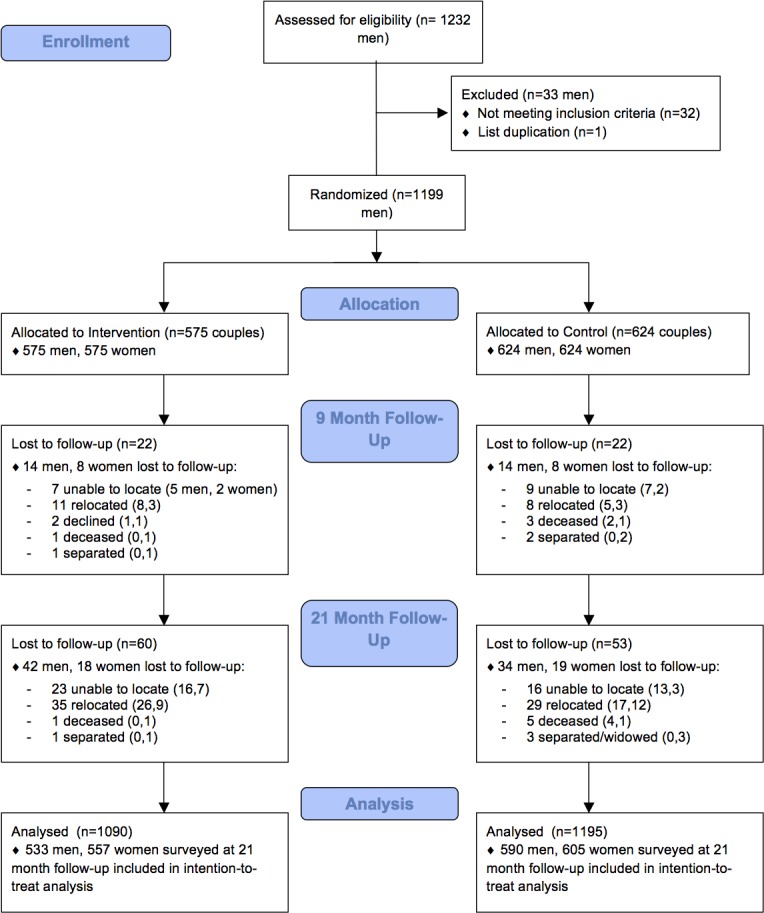
BACKGROUND: Rigorous evidence of the effectiveness of male engagement interventions, particularly on how these interventions impact relationship power dynamics and women's decision-making, remains limited. This study assessed the impact of the Bandebereho gender-transformative couples' intervention on impact on multiple behavioral and health-related outcomes influenced by gender norms and power relations. METHODS: We conducted a multi-site randomised controlled trial in four Rwandan districts with expectant/current fathers and their partners, who were randomised to the intervention (n = 575 couples) or control group (n = 624 couples). Primary outcomes include women's experience of physical and sexual IPV, women's attendance and men's accompaniment at ANC, modern contraceptive use, and partner support during pregnancy. At 21-months post-baseline, 1123 men and 1162 partners were included in intention to treat analysis. Generalized estimating equations with robust standard errors were used to fit the models. FINDINGS: The Bandebereho intervention led to substantial improvements in multiple reported outcomes. Compared to the control group, women in the intervention group reported: less past-year physical (OR 0.37, p<0.001) and sexual IPV (OR 0.34, p<0.001); and greater attendance (IRR 1.09, p<0.001) and male accompaniment at antenatal care (IRR 1.50, p<0.001); and women and men in the intervention group reported: less child physical punishment (women: OR 0.56, p = 0.001; men: OR 0.66, p = 0.005); greater modern contraceptive use (women: OR 1.53, p = 0.004; men: OR 1.65, p = 0.001); higher levels of men's participation in childcare and household tasks (women: beta 0.39, p<0.001; men: beta 0.33, p<0.001); and less dominance of men in decision-making. CONCLUSIONS: Our study strengthens the existing evidence on male engagement approaches; together with earlier studies our findings suggest that culturally adapted gender-transformative interventions with men and couples can be effective at changing deeply entrenched gender inequalities and a range of health-related behavioral outcomes. TRIAL REGISTRATION: ClinicalTrials.gov NCT02694627.
Overview
CoChat Summary
## TL;DR
This randomized controlled trial in four Rwandan districts found that the Bandebereho gender-transformative couples’ intervention improved multiple relationship, reproductive/maternal health, and violence-related outcomes at 21 months. Compared with control, the intervention group reported lower physical and sexual IPV, higher ANC attendance and male accompaniment, more modern contraceptive use, more shared childcare/household tasks, and less male dominance in decision-making.
## Key findings
- At 21-month follow-up, women in the intervention group reported less past-year physical IPV than control women: 33.33% vs 56.53%; OR 0.37, p<0.001. They also reported less sexual IPV: 35.01% vs 60.17%; OR 0.34, p<0.001.
- The intervention improved antenatal care behaviors: women’s ANC attendance increased (IRR 1.09, 95% CI 1.05–1.14) and male accompaniment at ANC increased (IRR 1.50, 95% CI 1.36–1.65, p<0.001).
- Modern contraceptive use was higher in the intervention group for both women and men: women OR 1.53 (p=0.004); men OR 1.65 (p=0.001).
- The intervention reduced reported child physical punishment and men’s dominance in decision-making, and increased men’s participation in childcare/household tasks. For example, physical punishment was reported by 68.25% of women vs 79.15% in control (OR 0.56, p=0.001) and 57.71% of men vs 67.30% in control (OR 0.66, p=0.005).
## Methods
- Two-arm, multi-site randomized controlled trial in four Rwandan districts (Karongi, Musanze, Nyaruguru, Rwamagana) with expectant/current fathers and their partners; couples were randomized to intervention (n=575 couples) or control (n=624 couples).
- Men were recruited from 48 pre-selected sites; eligible men were 21–35 years, married/cohabitating, expectant and/or fathers of children under five, living within accessible distance, and not previous Bandebereho participants.
- Main analysis used intention-to-treat models at 21 months post-baseline, estimated with generalized estimating equations and robust standard errors, with adjusted models controlling for age, education, and baseline socioeconomic status.
## Limitations
- The paper states several limitations: no baseline data from women, randomization at the individual level constrained by the intervention, no masking of participants or data collectors, self-reported outcomes with possible social desirability bias, prevalence findings not generalizable to Rwanda, and a 21-month follow-up that does not capture life-course change.
- Evident from the text: women were not surveyed at baseline because of funding constraints, so some analyses could not adjust for baseline values for women’s indicators.
Model-written summary. Check it against the paper before relying on it.
Integrity signals
Registry
Cites
Statistics
Figures
Verification
Claims the paper makes
8 Valid · 0 Not valid · 3 Not checked · 50 Own results and interpretations
The cited sources support only part of this claim — read each source’s verdict below.
In the paper
“the degree of IPV risk reduction we report is seldom achieved in rigorously evaluated interventions [25].”
§ Gender-transformative Bandebereho couples’ intervention to promote male engagement in reproductive and maternal health and violence prevention in Rwanda: Findings from a randomized controlled trial > Discussion
What the sources say
- Partly supportedcites [25] Arango D, Morton M, Gennari F, Kiplesund S, Ellsberg M. Interventions to reduce or prevent violence against women and girls: a systematic review of reviews Washington, DC: World Bank; 2014. sourceExperimental — accuracy not yet measured
Our copy of Arango et al. (2014) — the abstract/concluding paragraph of the Open Knowledge Repository record, which carries no section labels — supports only the general backdrop: 'knowledge of intervention impacts on VAWG prevention is growing, but is still highly limited,' and 'a small but growing body of rigorously tested interventions demonstrates that preventing VAWG is possible and can achieve large effect sizes.' It nowhere compares a magnitude of IPV risk reduction across rigorously evaluated interventions or states that a given degree of reduction is seldom achieved; if anything it emphasises that large effect sizes have been demonstrated in rigorous tests. Note also that the line 'Few approaches have been rigorously evaluated, even in high-income countries' appears in a related-item abstract (Bott, Morrison, Ellsberg 2005) listed on the same page, not in this paper, so it is not evidence for the claim. (LLM, conf=0.72)
plain- Asserted: passes — The authors put it forward as true.
- Checkable: passes — It can be checked against evidence.
- Load-bearing: passes — The paper’s conclusions depend on it.
- Based: passes — The paper gives a reason why it holds.
- Partly supported
Every source the paper cites for this claim was checked and supports it.
In the paper
“The Bandebereho intervention demonstrated a reduction in men’s dominance in household decision-making, which is associated with negative health-related outcomes for women and children [32].”
§ Gender-transformative Bandebereho couples’ intervention to promote male engagement in reproductive and maternal health and violence prevention in Rwanda: Findings from a randomized controlled trial > Discussion
What the sources say
- Supportedcites [32] Singh K, Bloom S, Brodish P. Gender Equality as a Means to Improve Maternal and Child Health in Africa. Health Care Women Int. 2015; 36: 57– 69. doi: 10.1080/07399332.2013.824971 24028632 PMC4333143 source
The Conclusions report that women with greater household decision-making authority were less likely to have low BMI and more likely to seek treatment for a child with an acute respiratory infection. This supports the stated association between less-equal household decision-making and adverse outcomes for women and children; the paper does not claim that decision-making was associated with every outcome studied. (LLM, conf=0.91)
plainstates an association- Asserted: passes — The authors put it forward as true.
- Checkable: passes — It can be checked against evidence.
- Load-bearing: passes — The paper’s conclusions depend on it.
- Based: passes — The paper gives a reason why it holds.
- Supported
The cited sources support only part of this claim — read each source’s verdict below.
In the paper
“This is the first trial of a male engagement intervention, to our knowledge, to demonstrate at least a modest impact on women’s ANC attendance [3,28].”
§ Gender-transformative Bandebereho couples’ intervention to promote male engagement in reproductive and maternal health and violence prevention in Rwanda: Findings from a randomized controlled trial > Discussion
What the sources say
- Not matchedcites [3] WHO. WHO recommendations on health promotion interventions for maternal and newborn health 2015 Geneva: World Health Organization; 2015. 26180864
Its entry has no title and year that we can search by.
- Partly supportedcites [28] Yargawa J, Leonardi-Bee J. Male involvement and maternal health outcomes: systematic review and meta-analysis. J Epidemiol Community Health. 2015; 69: 604– 12. doi: 10.1136/jech-2014-204784 25700533 PMC4453485 sourceExperimental — accuracy not yet measured
The Results (Findings from studies by outcome; page unavailable) report that an earlier male-involvement study found no significant association with women’s ANC attendance. That provides context for the novelty claim, but this review does not establish that the citing authors’ trial was the first to show an impact or report that trial’s effect. (LLM, conf=0.84)
hedgedstates a cause- Asserted: passes — The authors put it forward as true.
- Checkable: passes — It can be checked against evidence.
- Load-bearing: passes — The paper’s conclusions depend on it.
- Based: passes — The paper gives a reason why it holds.
- Not matched
The cited sources support only part of this claim — read each source’s verdict below.
In the paper
“Non-trial research has found that male partner support is associated with women’s antenatal attendance, birth preparedness and use of a skilled birth attendant [3,28].”
§ Gender-transformative Bandebereho couples’ intervention to promote male engagement in reproductive and maternal health and violence prevention in Rwanda: Findings from a randomized controlled trial > Discussion
What the sources say
- Not matchedcites [3] WHO. WHO recommendations on health promotion interventions for maternal and newborn health 2015 Geneva: World Health Organization; 2015. 26180864
Its entry has no title and year that we can search by.
- Partly supportedcites [28] Yargawa J, Leonardi-Bee J. Male involvement and maternal health outcomes: systematic review and meta-analysis. J Epidemiol Community Health. 2015; 69: 604– 12. doi: 10.1136/jech-2014-204784 25700533 PMC4453485 sourceExperimental — accuracy not yet measured
The Results (Findings from studies by outcome; page not provided) report a significant association between husbands’ antenatal attendance and skilled attendance at birth in a cross-sectional study. The Discussion (Interpretation; page not provided) links male involvement to birth preparation. But the reported antenatal-care finding comes from a trial and was not statistically significant, so the source does not support all three outcomes as findings of non-trial research. (LLM, conf=0.88)
plainstates an association- Asserted: passes — The authors put it forward as true.
- Checkable: passes — It can be checked against evidence.
- Load-bearing: passes — The paper’s conclusions depend on it.
- Based: passes — The paper gives a reason why it holds.
- Not matched
A result the paper reports from its own data — it cites no other source for it, so there is none to check. The quote shows it is in the paper.
In the paper
“In the intervention group, 56.08% of women (OR 0.31, 95% CI 0.24–0.42, p<0.001) and 45.47% of men (OR 0.35, 95% CI 0.25–0.48, p<0.001) reported that the man had the final say on decisions regarding the household’s income and expenses, compared to 78.74% and 70.27% in the control group, respectively.”
§ Gender-transformative Bandebereho couples’ intervention to promote male engagement in reproductive and maternal health and violence prevention in Rwanda: Findings from a randomized controlled trial > Results
plainstates an association- Asserted: passes — The authors put it forward as true.
- Checkable: passes — It can be checked against evidence.
- Load-bearing: passes — The paper’s conclusions depend on it.
- Based: passes — The paper gives a reason why it holds.
- Rests on an assumption not shown here.
31 more claims
Create a free account to see all 61 claims and to verify the 1 reference still open.
- It may state two separate claims as one. 14
- Probably not a substantial claim. 21
Citations
Cites
García‐Moreno, C., Jansen, H. A. F. M., Ellsberg, M. C., Heise, L., & Watts, C. H. (2005) · Cited by 1,819
Garcia‐Moreno, C. (2001) · DigitalGeorgetown (Georgetown University Library) · Cited by 933
Prevention of violence against women and girls: what does the evidence say?
Ellsberg, M., Arango, D. J., Morton, M., Gennari, F., Kiplesund, S., Contreras, M., & Watts, C. (2015) · The Lancet · doi:10.1016/s0140-6736(14)61703-7 · Cited by 875
Deutsch, F. M. (2007) · Gender & Society · doi:10.1177/0891243206293577 · Cited by 870
Jewkes, R., Nduna, M., Levin, J., Jama, N., Dunkle, K., Puren, A., & Duvvury, N. (2008) · BMJ · doi:10.1136/bmj.a506 · Cited by 757
Barker, G., Ricardo, C., & do Nascimento, M. A. F. (2007) · Cited by 649
Self-citationRwanda Demographic and Health Survey 2010
Rwanda (2012) · Cited by 553
Abramsky, T., Devries, K., Kiss, L., Nakuti, J., Kyegombe, N., Starmann, E., Cundill, B., Francisco, L., Kaye, D., Musuya, T., et al. (2014) · BMC Medicine · doi:10.1186/s12916-014-0122-5 · Cited by 507
Male involvement and maternal health outcomes: systematic review and meta-analysis
Yargawa, J., & Leonardi-Bee, J. (2015) · Journal of Epidemiology and Community Health · doi:10.1136/jech-2014-204784 · Cited by 499 · cited 2×
“Non-trial research has found that male partner support is associated with women’s antenatal attendance, birth preparedness and use of a skilled birth attendant [3,28].”
Background(2015) · Choice Reviews Online · doi:10.5860/choice.190427 · Cited by 357
Research works printed but not linked: 1
- WHO. WHO recommendations on health promotion interventions for maternal and newborn health 2015 Geneva: World Health Organization; 2015. 26180864
Cited by
Items 201–269 of 269
Women Empowerment for Poverty and Inequality Reduction in Sudan
Osman, E., Etang, A., & Kirkwood, D. (2022) · World Bank, Washington, DC eBooks · doi:10.1596/1813-9450-10245 · Cited by 3
Chatterji, S., Boyer, C., Sharma, V., Abramsky, T., Levtov, R., Doyle, K., Harvey, S. E., & Heise, L. (2023) · medRxiv · doi:10.1101/2023.02.07.23285510 · Cited by 1
“In the Bandebereho trial, outcomes were analysed using generalised estimating equations accounting for the clustered nature of the data (Doyle et al., 2018).”
BackgroundMethodInfluentialSelf-citationKalra, N., Habumugisha, L., & Shankar, A. (2023) · Research Square · doi:10.21203/rs.3.rs-2883412/v1 · Cited by 1
Bustelo, M., Suaya, A., Viollaz, M., & Martinez, K. (2024) · doi:10.18235/0005665 · Cited by 5
Ahmed, F., Nyamwanza, O., Ladur, A. N., et al. (2025) · medRxiv · doi:10.1101/2025.08.05.25333028 · Cited by 1
Explaining Gender Differences in Economic Outcomes in Burkina FasoPreprint
Donald, A. A., Islam, T. M. T., & Robakowski, A. (2025) · Research Square · doi:10.21203/rs.3.rs-7311093/v1 · Cited by 1
Jeong, J., Lambert, V. J., Wolfram, C., Uyehara, M., Sangarara, G., Joseph, J., Louttit, M., McCann, J. K., & Joachim, D. (2025) · medRxiv · doi:10.1101/2025.09.16.25334267 · Cited by 2
Addressing gaps in global data on violence against children and adolescents
Massetti, G. M., & Dahlberg, L. L. (2019) · The Lancet Child & Adolescent Health · doi:10.1016/s2352-4642(19)30187-7
Educating men about vaginal microbicides: considerations from Kenya
Gitome, S. W., Kwena, Z., Harper, C. C., Cohen, C. R., & Bukusi, E. A. (2019) · Culture Health & Sexuality · doi:10.1080/13691058.2019.1627583
“Gender-transformative interventions, communication skills training and raising awareness among men can promote male involvement in reproductive health, thus leading to improved outcomes (Doyle et al. 2018; Shattuck et al. 2011; Tokhi et al. 2018).”
BackgroundFeminist Research in Rwanda: Challenges and Importance
Fellman, A. C. (2021) · University of Technology, Sydney eBooks · doi:10.5130/aag.c
Women's Economic Empowerment in the Democratic Republic of the Congo
Bank, W. (2021) · World Bank, Washington, DC eBooks · doi:10.1596/36703
Uganda Economic Update, 18th Edition, December 2021
Bank, W. (2021) · World Bank, Washington, DC eBooks · doi:10.1596/36825 · Cited by 4
Against the norms: designing violence prevention through engaging men
Fiadeiro, R., Bichard, J.-A., & Stevens, J. (2023) · International Association of Societies of Design Research Congress (IASDR) · doi:10.21606/iasdr.2023.359
Abramsky, T., Guadarrama, D. S., Kapiga, S., Mtolela, G. J., Madaha, F., Lees, S. S., & Harvey, S. E. (2023) · PLOS Global Public Health · doi:10.1371/journal.pgph.0002497 · Cited by 2
Uhawenimana, T. C., Muhayimana, A., Edouard, N., Mbabazi, E., Nsengiyumva, R., & Murekezi, J. (2024) · Research Square · doi:10.21203/rs.3.rs-3851288/v1 · Cited by 1
Nelson, K. A., Magut, F., Mulwa, S. N., Osindo, J., Kamire, V., Khagayi, S., Pulerwitz, J., Cook, S., Gourlay, A. J., Ziraba, A. K., et al. (2024) · PLOS Global Public Health · doi:10.1371/journal.pgph.0002929 · Cited by 2
Self-citationDomestic Violence and Community Organizing in India
Menon, S. V., & Allen, N. E. (2024) · Cambridge University Press eBooks · doi:10.1017/9781009153720.005
Christens, B. D. (2024) · Cambridge University Press eBooks · doi:10.1017/9781009153720.002
Choi, S., Shibanuma, A., Kiriya, J., Kazembe, N., & Jimba, M. (2024) · Qeios · doi:10.32388/3xfllw
“Father involvement in childcare Father involvement in childcare was assessed using the gendered division of childcare questions from Promundo’s Bandebereho study in Rwanda [47] .”
Klapwijk, J. M., Meléndez‐Torres, G. J., Ornellas, A., et al. (2024) · Trials · doi:10.1186/s13063-024-08292-6
Shamu, S., Shamu, P., & Machisa, M. (2025) · BMC Public Health · doi:10.1186/s12889-025-22310-5 · Cited by 1
“For example, Sinovuyo Programme in South Africa [53] and a trial by Promundo engaged men and boys and increased fathers’ support to their pregnant partners including men’s participation in childcare tasks and reduced violence and dominance in decision making [54].”
Rupture and the rehearsal of new worlds: disrupting norms in the Democratic Republic of Congo
Maubert, C. (2025) · Development in Practice · doi:10.1080/09614524.2025.2510333
“In the development sector, gender-transformative interventions have largely adapted that model to tackle health-related challenges from adolescent health to female genital cutting (Cislaghi and Heise 2019; Doyle 2018).”
Apalebilah, S., Oware, A. F., Freeman, S., Nyarkoh, J. K., Jingbeja, E., Adu, P., & Boachie, J. (2025) · BMC Public Health · doi:10.1186/s12889-025-25087-9 · Cited by 1
“Cultural permission refers to the extent to which individuals (particularly women) are granted autonomy through social norms and intra-household relations to make health-related decisions, such as determining daily meal preparation or participating in health education activities [14, 15].”
Ogbonnaya, I. N., Nakigudde, J., Naigino, R., Stockman, J. K., Chung, Y., Nantongo, M., Marsiglia, F. F., Hahn, J. A., Wechsberg, W. M., Mwebembezi, A., et al. (2025) · Contemporary Clinical Trials · doi:10.1016/j.cct.2025.108136
Rwanda: Genocide against the Tutsis
Maercker, A. (2025) · Cambridge University Press eBooks · doi:10.1017/9781009629744.010
Separate Paths: Some Atypical Constellations
Maercker, A. (2025) · Cambridge University Press eBooks · doi:10.1017/9781009629744.008
Kadınların Geleneksel Rollerinde Ücret Eşitsizliği: Uygulamalar ve İncelemeler
KARABABA, A. G. (2025) · Ankara Hacı Bayram Veli Üniversitesi İktisadi ve İdari Bilimler Fakültesi Dergisi · doi:10.26745/ahbvuibfd.1641500
Ifashabayo, B., Winaryo, W., & Susilo, J. (2025) · African Quarterly Social Science Review · doi:10.51867/aqssr.2.4.66
“GTA literature (Doyle et al., 2018; Hazra et al., 2023; Hillenbrand et al., 2015) confirms that interventions are most effective when they combine personal reflection, relational reinforcement, and community - level validation.”
Ndunguru, F. E., & Mbunda, K. A. (2026) · Culture Health & Sexuality · doi:10.1080/13691058.2025.2609885
“As a result, attending antenatal visits, performing domestic chores, or offering emotional support may be seen as signs of weakness or loss of masculine status (Doyle et al. 2018).”
Exploring the determinants of child marriage among boys: a systematic review
Wahyuningsih, S., Widati, S., Puspitasari, N., Hayati, N., & Azkiya, M. W. (2026) · International Journal of Adolescence and Youth · doi:10.1080/02673843.2026.2629236
Sharma, V., Pichon, M., Tewolde, S., Solomon, A., Deyessa, N., & Leight, J. (2026) · BMC Public Health · doi:10.1186/s12889-025-25838-8
“Some of the most successful IPV prevention programs have engaged men by working with them as part of a couple [11, 14–16] or in a community-level mobilization process [9].”
Self-citationSpousal Communication, Child Marriage, and Modern Contraceptive Use Among Married Women in Mali
Block, S. J., Werwie, T. R., Cronin, C., Kapadia‐Kundu, N., Diarra, H. B., Doumbia, L., Tounkara, M., Ameur, A. B., LaRochelle, D., Bettings, M., et al. (2026) · Women s Reproductive Health · doi:10.1080/23293691.2026.2629433
Tesso, F. Y., Tura, G., & Birhanu, Z. (2026) · Journal of Health Population and Nutrition · doi:10.1186/s41043-026-01305-x
“…partners approve of family planning are significantly more likely to use contraceptives than those whose partners disapprove or remain neutral [38, 39] Interventions that involve men and encourage couple dialogue have therefore been recommended as effective strategies to improve family planning…”
Dozier, J. L., Wood, S. N., Yirgu, R., et al. (2026) · Studies in Family Planning · doi:10.1111/sifp.70050
“…interventions that engage men have shown promise in shifting inequitable gender norms and reducing intimate partner violence in sub-Saharan Africa, suggesting one possible avenue for addressing norms that legitimize partner control over fertility decisions (Jewkes et al. 2008; Doyle et al. 2018).”
Iqbal, Y., Yoshikawa, H., Michael, D., Bolisetty, S., Yesmin, S., Mian, A. U., Nyeu, M., Lee, S., Bowden, A. B., Schwartz, K., et al. (2026) · BMC Global and Public Health · doi:10.1186/s44263-026-00266-x
“…focused on involving fathers in reproductive/prenatal care (programs conducted in Bangladesh, Brazil [32], Burkina Faso [33], Kenya [34], Nepal [35], Korea [36] and Rwanda [27]) or on reducing intimate partner violence or child maltreatment (e.g., in Tanzania [37], Colombia [38], and China [39]).”
Chongwo, E. J., Adina, J., Mwangi, K., Shali, T., Dzoro, E., Shitote, C., Angwenyi, V., Ngunu, C., Macharia, J., Kigani, N., et al. (2026) · PLOS Global Public Health · doi:10.1371/journal.pgph.0006037 · Cited by 1
Piolanti, A., & Foran, H. M. (2026) · Trauma Violence & Abuse · doi:10.1177/15248380261440354
Semahegn, A., Tiruneh, G. T., Fesseha, N., Teferi, M., Tadesse, H., Bogale, B., Mulu, S., Mirkuzie, A. H., Girma, A., Tesfaye, C., et al. (2026) · Research Square · doi:10.21203/rs.3.rs-9247560/v1
Terada, S., Morita, A., Isumi, A., Ugajin, C., Khin, Y. P., Shakagori, S., & Fujiwara, T. (2026) · International Journal of Gynecology & Obstetrics · doi:10.1002/ijgo.71063 · Cited by 1
Conceptualising Gender Equality in Rwanda through the Lenses of Different Actors
Uwihangana, C., & Starke, M. (2026) · Journal of Applied Social Science · doi:10.1177/19367244261439667
Murphy, K., Gardner, F. E. M., Kirwa, S., Kiptui, R., Christine, L., Puffer, E. S., Ruggiero, E. D., Kimani, S., O’Gara, R., Okal, E. O., et al. (2026) · Research Square · doi:10.21203/rs.3.rs-9500444/v1
Policy in practice: assessing Senegal’s family planning progress using a mixed-methods approach
Faye, S. L., Sow, G. H. C., Faye, R. A., Ndong, M. G., Tine, M. E., Diagne, N. A., Doucouré, A., Najmi, H., Zulfiqar, M., Ahmad, S. S.-O., et al. (2026) · BMJ Global Health · doi:10.1136/bmjgh-2024-018774 · Cited by 3
Ojanduru, L., Bukenya, J. N., Amongin, D., Ekirapa, E., Tumwesigye, N. M., & Siu, G. (2026) · Frontiers in Global Women s Health · doi:10.3389/fgwh.2026.1778239
Ravindran, T. S., George, A. S., Jacobs, T., Bello, K., & Amde, W. K. (2026) · Global Health Action · doi:10.1080/16549716.2026.2685464
Bargain, O. (2026) · Oxford University Press eBooks · doi:10.1093/9780197912812.003.0005
Bargain, O. (2026) · Oxford University Press eBooks · doi:10.1093/9780197912812.002.0008
Evaluating the intra-household effects of redistributive policies
Bargain, O. (2026) · Oxford University Press eBooks · doi:10.1093/9780197912812.003.0004
Intra-household distribution: Determinants and correlates
Bargain, O. (2026) · Oxford University Press eBooks · doi:10.1093/9780197912812.003.0003
Bargain, O. (2026) · Oxford University Press eBooks · doi:10.1093/9780197912812.003.0001
Bargain, O. (2026) · Oxford University Press eBooks · doi:10.1093/9780197912812.002.0007
Bargain, O. (2026) · Oxford University Press eBooks · doi:10.1093/9780197912812.002.0005
Bargain, O. (2026) · Oxford University Press eBooks · doi:10.1093/9780197912812.005.0001
Intra-household access to resources, power, and well-being: measurement issues
Bargain, O. (2026) · Oxford University Press eBooks · doi:10.1093/9780197912812.003.0002
Bargain, O. (2026) · Oxford University Press eBooks · doi:10.1093/9780197912812.002.0006
Prioritizing Work or Family? Investigating Women’s and Men’s Work-Family Decisions
Aarntzen, L., Meeussen, L., Morgenroth, T., & Ryan, M. K. (2026) · Sex Roles · doi:10.1007/s11199-026-01663-0
“For example, Program P by Promundo (Doyle et al., 2018) and the American National Fatherhood Initiative (Olshansky, 2006, as cited in Obure et al., 2020 ) demonstrating that programs training fathers’ caregiving skills and self-efficacy can lead to lasting changes in involvement and attitudes.”
Factors associated with men's family planning discussions with health workers in Ghana
Boakye, A., Hormenu, T., & Adu‐Gyamfi, A. B. (2026) · Frontiers in Communication · doi:10.3389/fcomm.2026.1825424
Baruwa, O. J., Singini, M. G., Gwebu, H., & Nduka, C. C. (2026) · Preventive Medicine Reports · doi:10.1016/j.pmedr.2026.103572
“Evidence from maternal and HIV programs suggests that carefully designed male engagement strategies can improve service uptake when they promote shared decision-making and respect women's autonomy (Asaolu et al., 2018; Doyle et al., 2018).”
Janowski, R., Cluver, L. D., Wamoyi, J., Meléndez‐Torres, G. J., Lachman, J. M., Stern, D., van Niekerk, L.-J., & Shenderovich, Y. (2026) · JMIR Pediatrics and Parenting · doi:10.2196/86129
“Promising examples include in-person parenting programs such as REAL Fathers in Uganda [50], Bandebereho in Rwanda [51], and Parenting for Respectability in Uganda [52], which have achieved shifts in father involvement, reductions in intimate partner violence (IPV), and improvements in household…”
Wang, X., Yan, H., Li, C., Feng, Y., Gao, S., Zhang, J., Zhao, H., Zhang, J., Guo, C., & Zhao, M. (2026) · Frontiers in Medicine · doi:10.3389/fmed.2026.1914158 · Cited by 1
Supporting parenting in early childhood to foster human development and mental health
Cuartas, J. A., Lansford, J. E., Backhaus, S., Freire, S. M., & Jeong, J. (2026) · Nature Mental Health · doi:10.1038/s44220-026-00726-1 · Cited by 1
Guruge, G. N. D., Herath, H. M. T. P., Young, S. M., Perera, M. N., Dharmaratne, S. D., & Gunathunga, M. W. (2026) · Health Promotion Practice · doi:10.1177/15248399261485465
Snow, K., Langan, D., Cislaghi, B., Backman-Levy, J. K., Steele, B., Little, M. T., Blackwell, A., Backhaus, S., Rodriguez-Baena, D., Shenderovich, Y., et al. (2026) · Research Square · doi:10.21203/rs.3.rs-10909540/v2
Bebeley, S. J., Sellu, E. J., Mabey, P. T., & Mbavai, J. J. (2026) · Occupational Diseases and Environmental Medicine · doi:10.4236/odem.2026.144021
Lambert, V. J., Bhojani, A., Sangarara, G., Joseph, J., Yang, N. T., Joachim, D., & Jeong, J. (2026) · PLOS Global Public Health · doi:10.1371/journal.pgph.0006203
Advancing research on gender-based violence: The role of randomised control trials
Mahmood, R., & Mavisakalyan, A. (2026) · De Gruyter eBooks · doi:10.1515/9783112222881-007
Metadata
- Authors
- Doyle, K., Levtov, R. G., Barker, G., Bastian, G. G., Bingenheimer, J. B., Kazimbaya, S., Nzabonimpa, A., Pulerwitz, J., Sayinzoga, F., Sharma, V., & Shattuck, D.
- Affiliations
- Promundo (US)
- World Bank (US)
- George Washington University (US)
- Rwanda Biomedical Center (RW)
- Population Council (US)
- Harvard University (US)
- Georgetown University (US)
- Corresponding author
- Levtov, Ruti G.
- ORCID
- Venue
- PLOS ONE
- Publisher
- Public Library of Science (PLoS)
- Published
- 2018-04-04
- Volume
- 13
- Issue
- 4
- Pages
- e0192756
- ISSN
- 1932-6203 (ISSN-L)
- PMC
- PMC5884496
- OpenAlex
- W2795793925
- Cited by
- 290
- References
- 31
- Citations by year
- 2026: 59 · 2025: 33 · 2024: 47 · 2023: 26 · 2022: 36 · 2021: 35 · 2020: 29 · 2019: 21 · 2018: 3
- FWCI
- 21.16
- Type
- journal article
- Language
- en
- Open access
- gold
- doi.org
- Licence
- Locations
- PLoS ONE (publishedVersion, cc-by)
- Europe PMC (PubMed Central) (publishedVersion, cc-by)
- PubMed Central (publishedVersion, cc-by)
- PubMed (publishedVersion)
- DOAJ (DOAJ: Directory of Open Access Journals) (submittedVersion)
- Figshare (submittedVersion, cc-by)
- Funders
- Anonymous Donor (5669)
- Dutch Ministry of Foreign Affairs (24935)
- John D. and Catherine T. MacArthur Foundation (13-103720-000-INP)
- Topics
- Social Sciences › Health › Intimate Partner and Family Violence
- Health Sciences › Medicine › Public Health, Environmental and Occupational Health › Reproductive Health and Contraception
- Health Sciences › Medicine › Pediatrics, Perinatology and Child Health › Global Maternal and Child Health
- Keywords
- men's engagement, gender-transformative interventions, couple-based interventions, intimate partner violence, physical and sexual violence, antenatal care attendance, modern contraceptive use, household decision-making, gender norms, Rwanda, pregnancy
- MeSH terms
- Intimate Partner Violence, Maternal Health, Adult, Family, Fathers, Female, Humans, Male, Men, Pregnancy, Rwanda, Sexual Behavior, Sexual Partners, Socioeconomic Factors, Young Adult
About these checks
Registry, retraction, Cites and statistics results are computed, not judged, with one exception: a printed reference that no index lists is read once by a model before it counts as a citation error. Claims are extracted by a model and kept only when their quote appears verbatim in the text; each cited source is then checked, with a model’s help, for whether it says what the claim relies on. Those verdicts can be wrong — read the claim’s quote and the cited source before relying on one.
The claim verdicts this report counts are experimental: their accuracy is not yet measured.
A language model drew the claims from the paper on 2026-10-10, under version 3 of the claim definition (model deepseek-v4.1-flash, prompt extract-v3).
A second model labelled each claim on 2026-10-10 (model jev-1.13-20260917, definition revision gold-guideline-v0.2).
Cited sources are checked with a language model’s help (qwen3.8-omni-flash and gpt-6-sol).
Statistics and arithmetic are recomputed, not judged.
Confidence bands are shown only for fields calibrated on our annotated test set. None is calibrated yet, so no band is shown.
What counts as a claim ›How we measure confidence ›How we check this ›
Are you an author, or do you see a problem with this page? Request a review
Data sources
Bibliographic data: Semantic Scholar, OpenAlex, Crossref.
Contains information from the Semantic Scholar Academic Graph Datasets, made available under the ODC Attribution License (ODC-BY 1.0).
Semantic Scholar’s data is described in: Kinney, R., et al. (2023). The Semantic Scholar Open Data Platform. arXiv:2301.10140.
