

What drives centralisation in cancer care?
Open accessThe DOI matches its Crossref record; 27 of the 27 references it cites were found in a registry or an index.
Abstract
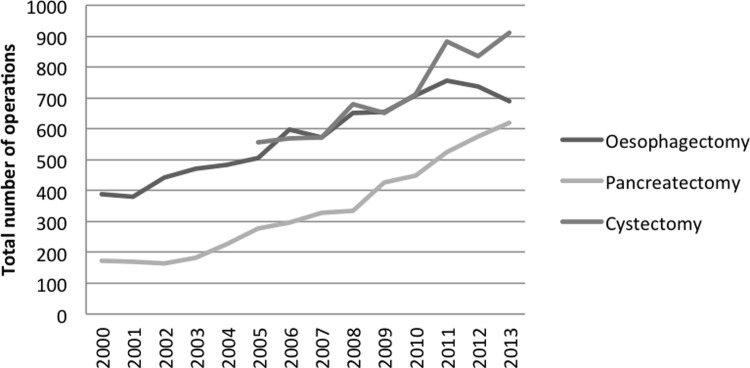
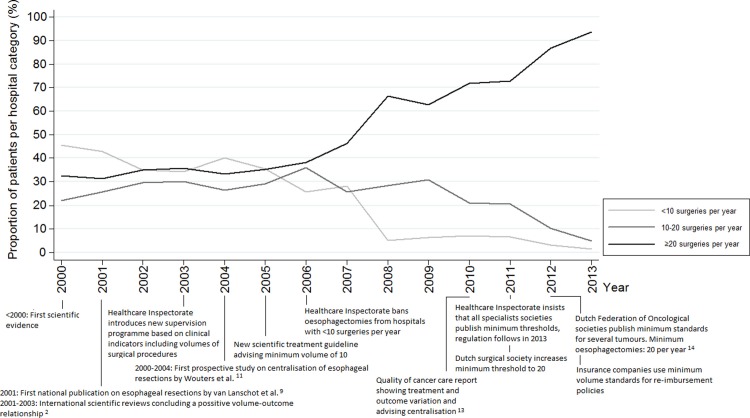
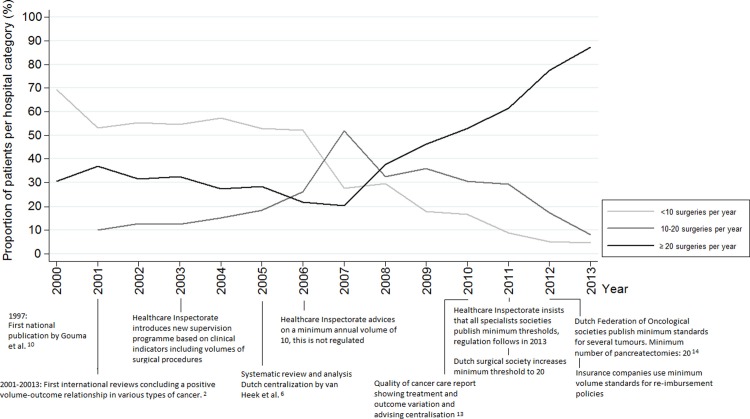
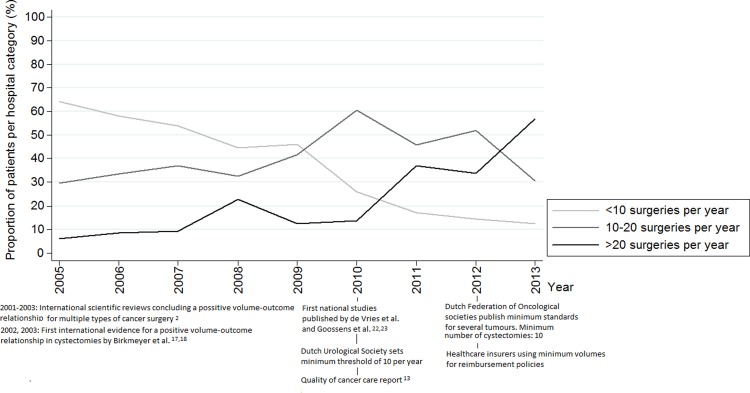
BACKGROUND: To improve quality of care, centralisation of cancer services in high-volume centres has been stimulated. Studies linking specialisation and high (surgical) volumes to better outcomes already appeared in the 1990's. However, actual centralisation was a difficult process in many countries. In this study, factors influencing the centralisation of cancer services in the Netherlands were determined. MATERIAL AND METHODS: Centralisation patterns were studied for three types of cancer that are known to benefit from high surgical caseloads: oesophagus-, pancreas- and bladder cancer. The Netherlands Cancer Registry provided data on tumour and treatment characteristics from 2000-2013 for respectively 8037, 4747 and 6362 patients receiving surgery. By plotting timelines of centralisation of cancer surgery, relations with the appearance of (inter)national scientific evidence, actions of medical specialist societies, specific regulation and other important factors on the degree of centralisation were ascertained. RESULTS: For oesophagus and pancreas cancer, a gradual increase in centralisation of surgery is seen from 2005 and 2006 onwards following (inter)national scientific evidence. Centralisation steps for bladder cancer surgery can be seen in 2010 and 2013 anticipating on the publication of norms by the professional society. The most influential stimulus seems to have been regulations on minimum volumes. CONCLUSION: Scientific evidence on the relationship between volume and outcome lead to the start of centralisation of surgical cancer care in the Netherlands. Once a body of evidence has been established on organisational change that influences professional practice, in addition some form of regulation is needed to ensure widespread implementation.
Overview
The claims and statistics of this paper haven’t been checked yet.
Free: it reads the open-access text and checks the first 5 claims that cite a source we can check. Create a free account to check every claim.
Integrity signals
Registry
Cites
Statistics
Figures
Verification
Claims the paper makes
The claims and statistics of this paper haven’t been checked yet.
Free: it reads the open-access text and checks the first 5 claims that cite a source we can check. Create a free account to check every claim.
Self-check
Percentages, sums and reported differences re-computed from the paper’s own numbers.
The self-check needs the paper’s full text.
Citations
Cites
Hospital Volume and Surgical Mortality in the United States
Birkmeyer, J. D., Siewers, A. E., Finlayson, E. V. A., Stukel, T. A., Lucas, F. L., Batista, I., Welch, H. G., & Wennberg, D. E. (2002) · New England Journal of Medicine · doi:10.1056/nejmsa012337 · Cited by 4,999
Surgeon Volume and Operative Mortality in the United States
Birkmeyer, J. D., Stukel, T. A., Siewers, A. E., Goodney, P. P., Wennberg, D. E., & Lucas, F. L. (2003) · New England Journal of Medicine · doi:10.1056/nejmsa035205 · Cited by 3,106
Should Operations Be Regionalized?: The Empirical Relation between Surgical Volume and Mortality
Luft, H. S., Bunker, J. P., & Enthoven, A. C. (1979) · New England Journal of Medicine · doi:10.1056/nejm197912203012503 · Cited by 1,759
Halm, E. A., Lee, C., & Chassin, M. R. (2002) · Annals of Internal Medicine · doi:10.7326/0003-4819-137-6-200209170-00012 · Cited by 1,704 · cited 2×
“[5] Possible differences in case-mix restricted the generalisa-bility of the available scientific evidence to the Dutch healthcare situation (as most studies were performed in the Unites States).”
Surgeon volume and operative mortality in the United States
Birkmeyer, J. D., Stukel, T. A., Siewers, A. E., Goodney, P. P., Wennberg, D. E., & Lucas, F. L. (2004) · ACC Current Journal Review · doi:10.1016/j.accreview.2003.12.065 · Cited by 1,113
Gouma, D. J., van Geenen, R. C. I., van Gulik, T. M., de Haan, R. J., de Wit, L. T., Busch, O. R. C., & Obertop, H. (2000) · Annals of Surgery · doi:10.1097/00000658-200012000-00007 · Cited by 836
Selective Referral to High-Volume Hospitals: Estimating Potentially Avoidable Deaths
Dudley, R. A., Johansen, K. L., Brand, R., Rennie, D. J., & Milstein, A. (2000) · JAMA · doi:10.1001/jama.283.9.1159 · Cited by 768 · cited 1×
“[3] In general, a higher volume of surgery is associated with lower postoperative mortality and morbidity.[2, 4, 5] Nevertheless, in the Netherlands, referral patterns for pancreatic and oesophageal cancer remained largely unchanged up to the early 2000’s, despite a lively debate on the introduction of minimum surgica…”
Hillner, B. E., Smith, T. J., & Desch, C. E. (2000) · Journal of Clinical Oncology · doi:10.1200/jco.2000.18.11.2327 · Cited by 638 · cited 2×
“[1] In the following decades numerous studies have addressed the question whether higher surgical volumes result in an increased quality of care.[2] Many of these studies concerned cancer surgery and a large body of evidence developed in favour of centralisation of surgical procedures such as pancreatectomies and oeso…”
InfluentialCompleteness of Cancer Registration in Limburg, the Netherlands
SCHOUTEN, L. J., HÖPPENER, P., VAN DEN BRANDT, P. A., KNOTTNERUS, J. A., & JAGER, J. J. (1993) · International Journal of Epidemiology · doi:10.1093/ije/22.3.369 · Cited by 375
van Heek, N. T., Kuhlmann, K. F. D., Scholten, R. J., de Castro, S. M. M., Busch, O. R. C., van Gulik, T. M., Obertop, H., & Gouma, D. J. (2005) · Annals of Surgery · doi:10.1097/01.sla.0000188462.00249.36 · Cited by 374
Cited by
Hopstaken, J. S., Verweij, L., van Laarhoven, C. J. H. M., Blijlevens, N. M. A., Stommel, M. W. J., & Hermens, R. (2021) · Journal of Medical Internet Research · doi:10.2196/28869 · Cited by 69
“This refers to the fact that cancer patients are usually cared for by multiple health care providers (HCPs), and that, as a result of centralization of complex care to high-volume centers [5], patients may receive parts of their treatment in multiple hospitals [6-9].”
Centralisation of cancer surgery and the impact on patients’ travel burden
Versteeg, S. E., Ho, V. K. Y., Siesling, S., & Varkevisser, M. (2018) · Health Policy · doi:10.1016/j.healthpol.2018.07.002 · Cited by 41
Self-citationValue and Quality of Care in Head and Neck Oncology
Takes, R. P., Halmos, G. B., Ridge, J. A., Bossi, P., Merkx, M. A. W., Rinaldo, A., Sanabria, Á., Smeele, L. E., Mäkitie, A. A., & Ferlito, A. (2020) · Current Oncology Reports · doi:10.1007/s11912-020-00952-5 · Cited by 36
de Jong, E. J. M., van der Geest, L. G., Besselink, M. G., Bouwense, S. A. W., Buijsen, J., Dejong, C. H. C., Koerkamp, B. G., Heij, L. R., de Hingh, I. H. J. T., Hoge, C. V., et al. (2022) · HPB · doi:10.1016/j.hpb.2022.01.009 · Cited by 31
Innovation, value and reimbursement in radiation and complex surgical oncology: Time to rethink
Borràs, J. M., Corral, J., Aggarwal, A. K., Audisio, R. A., Espinàs, J. A., Figueras, J., Naredi, P. L. J., Пантели, Д., Pourel, N., Prades, J., et al. (2021) · Radiotherapy and Oncology · doi:10.1016/j.radonc.2021.08.002 · Cited by 28
Metadata
- Authors
- Kilsdonk, M. J., Siesling, S., van Dijk, B. A. C., Wouters, M. W., & van Harten, W. H.
- Affiliations
- Netherlands Comprehensive Cancer Organisation (NL)
- The Netherlands Cancer Institute (NL)
- Corresponding author
- Kilsdonk, Melvin J.
- Venue
- PLOS ONE
- Publisher
- Public Library of Science (PLoS)
- Published
- 2018-04-12
- Volume
- 13
- Issue
- 4
- Pages
- e0195673
- ISSN
- 1932-6203 (ISSN-L)
- PMC
- PMC5896991
- OpenAlex
- W2797703427
- Cited by
- 40
- References
- 26
- Citations by year
- 2026: 2 · 2025: 8 · 2024: 6 · 2023: 5 · 2022: 4 · 2021: 7 · 2020: 4 · 2019: 2 · 2018: 2
- FWCI
- 4.73
- Type
- journal article
- Language
- en
- Open access
- gold
- doi.org
- Licence
- Locations
- PLoS ONE (publishedVersion, cc-by)
- Europe PMC (PubMed Central) (publishedVersion, cc-by)
- PubMed Central (publishedVersion, cc-by)
- PubMed (publishedVersion)
- University of Groningen research database (University of Groningen / Centre for Information Technology) (publishedVersion, cc-by)
- University of Twente Research Information (publishedVersion, cc-by)
- DOAJ (DOAJ: Directory of Open Access Journals) (submittedVersion, cc-by-sa)
- University of Groningen research database (University of Groningen / Centre for Information Technology) (submittedVersion, cc-by)
- University of Twente Research Information (submittedVersion, cc-by)
- Topics
- Health Sciences › Medicine › Public Health, Environmental and Occupational Health › Healthcare Quality and Management
- Health Sciences › Health Professions › General Health Professions › Health Services Management and Policy
- Health Sciences › Medicine › Public Health, Environmental and Occupational Health › Healthcare Systems and Practices
- Keywords
- cancer surgery, surgical volume, volume-outcome relationship, esophageal cancer, pancreatic cancer, bladder cancer, professional society guidelines, Netherlands
- MeSH terms
- Delivery of Health Care, Female, Humans, Male, Neoplasms
About these checks
Registry, retraction, Cites and statistics results are computed, not judged, with one exception: a printed reference that no index lists is read once by a model before it counts as a citation error. Claims are extracted by a model and kept only when their quote appears verbatim in the text; each cited source is then checked, with a model’s help, for whether it says what the claim relies on. Those verdicts can be wrong — read the claim’s quote and the cited source before relying on one.
Statistics and arithmetic are recomputed, not judged.
Confidence bands are shown only for fields calibrated on our annotated test set. None is calibrated yet, so no band is shown.
What counts as a claim ›How we measure confidence ›How we check this ›
Are you an author, or do you see a problem with this page? Request a review
How to cite
Cite CoChat for the checks on this page, and the paper for its own findings.
- This page
- CoChat. (2026). Citation check: What drives centralisation in cancer care? https://app.cochat.ai/papers/10.1371/journal.pone.0195673
- The paper
- Kilsdonk, M. J., Siesling, S., van Dijk, B. A. C., Wouters, M. W., & van Harten, W. H. (2018). What drives centralisation in cancer care? PLOS ONE. https://doi.org/10.1371/journal.pone.0195673
Data sources
Bibliographic data: Semantic Scholar, OpenAlex, Crossref.
Contains information from the Semantic Scholar Academic Graph Datasets, made available under the ODC Attribution License (ODC-BY 1.0).
Semantic Scholar’s data is described in: Kinney, R., et al. (2023). The Semantic Scholar Open Data Platform. arXiv:2301.10140.
