

Nonnegative/Binary matrix factorization with a D-Wave quantum annealer
Open accessThe DOI matches its Crossref record; 55 of the 56 references it cites were found in a registry or an index.
Abstract
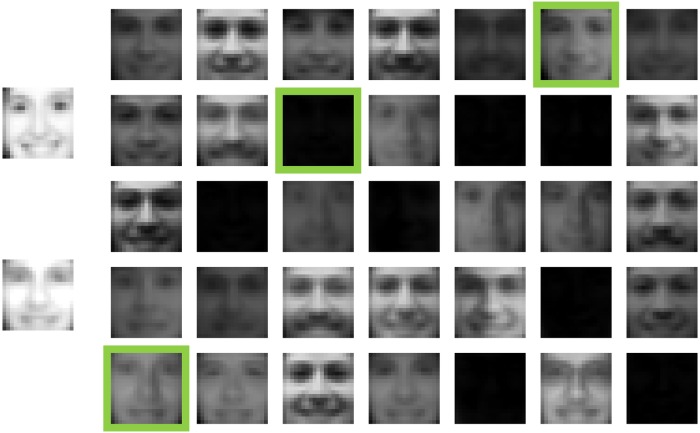
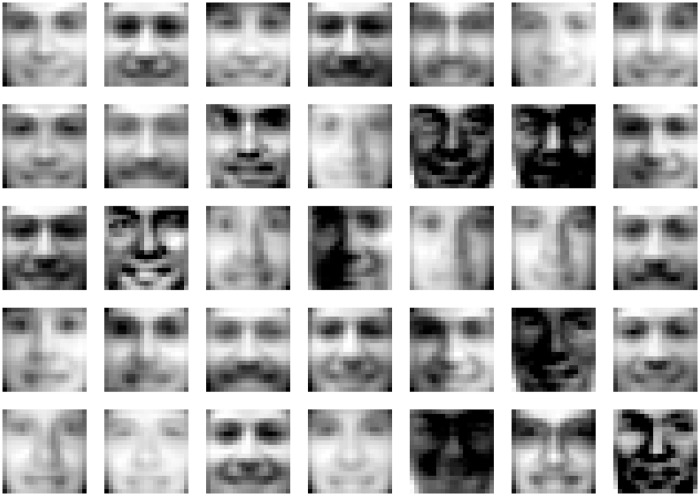
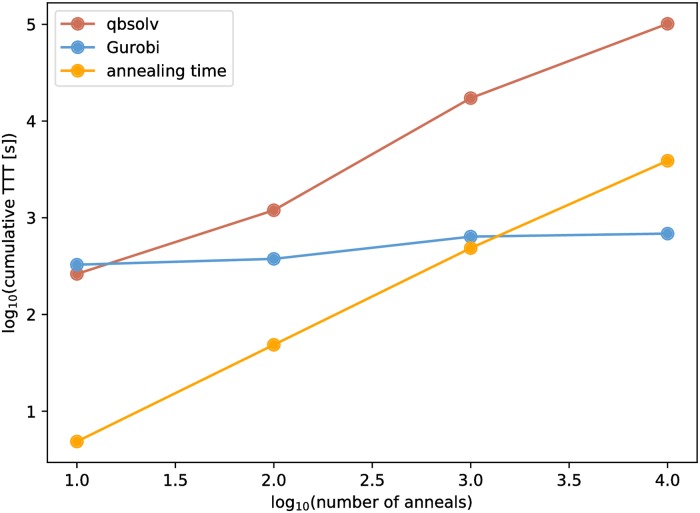
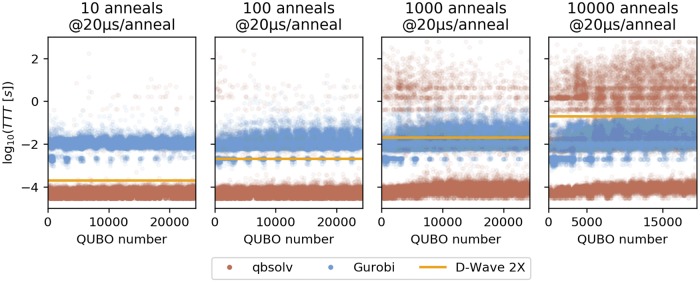
D-Wave quantum annealers represent a novel computational architecture and have attracted significant interest. Much of this interest has focused on the quantum behavior of D-Wave machines, and there have been few practical algorithms that use the D-Wave. Machine learning has been identified as an area where quantum annealing may be useful. Here, we show that the D-Wave 2X can be effectively used as part of an unsupervised machine learning method. This method takes a matrix as input and produces two low-rank matrices as output-one containing latent features in the data and another matrix describing how the features can be combined to approximately reproduce the input matrix. Despite the limited number of bits in the D-Wave hardware, this method is capable of handling a large input matrix. The D-Wave only limits the rank of the two output matrices. We apply this method to learn the features from a set of facial images and compare the performance of the D-Wave to two classical tools. This method is able to learn facial features and accurately reproduce the set of facial images. The performance of the D-Wave shows some promise, but has some limitations. It outperforms the two classical codes in a benchmark when only a short amount of computational time is allowed (200-20,000 microseconds), but these results suggest heuristics that would likely outperform the D-Wave in this benchmark.
Overview
The claims and statistics of this paper haven’t been checked yet.
Free: it reads the open-access text and checks the first 5 claims that cite a source we can check. Create a free account to check every claim.
Integrity signals
Registry
Cites
Statistics
Figures
Verification
Claims the paper makes
The claims and statistics of this paper haven’t been checked yet.
Free: it reads the open-access text and checks the first 5 claims that cite a source we can check. Create a free account to check every claim.
Claims other papers make about this one
Each is checked against this paper’s own text: does it say what the citing paper says it does?
The source backs part of the claim, not all of it — or backs it for a different population, condition or comparison.
In the citing paper
“However,duetothelimitednumberofqubitsandtheirconnectivity, the QAhardwaredidnot show such an advantage over classical methods in past benchmarking studies.”
From Quantum annealing for combinatorial optimization: a benchmarking study (2025) · cites this paper as [17]
Experimental — accuracy not yet measuredThe source backs part of the claim, not all of it — or backs it for a different population, condition or comparison.
In the citing paper
“Whilepreviousbenchmarkingstudiesshowedsomeadvantages of QA, most used low-dimensional or the sparse con fi gurations of QUBO matrices due to the lack of available qubits in the QA hardware and poor topology to connect qubits 17 -19 .”
From Quantum annealing for combinatorial optimization: a benchmarking study (2025) · cites this paper as [17]
Experimental — accuracy not yet measuredThe source backs part of the claim, not all of it — or backs it for a different population, condition or comparison.
In the citing paper
“Consequently, these benchmarking studies show that QA methods and their classical counterparts can exhibit similar solution quality and time complexity.”
From Quantum annealing for combinatorial optimization: a benchmarking study (2025) · cites this paper as [17]
Experimental — accuracy not yet measuredThe source backs part of the claim, not all of it — or backs it for a different population, condition or comparison.
In the citing paper
“We measure the computational time dedicated solely to solving given problems, excluding problem reading time, queue time, or communication time between the local computer and quantum annealer. This is consistent with other benchmarking studies 17,18 .”
From Quantum annealing for combinatorial optimization: a benchmarking study (2025) · cites this paper as [17]
Experimental — accuracy not yet measuredThe cited source says what the claim attributes to it.
In the citing paper
“For example, O ' Malley et al. 17 compared the performance of QA with classical methods (mathematical programming), but they limited the number of binary variables to 35 due to the QA hardware limitation.”
From Quantum annealing for combinatorial optimization: a benchmarking study (2025) · cites this paper as [17]
Self-check
Percentages, sums and reported differences re-computed from the paper’s own numbers.
The self-check needs the paper’s full text.
Citations
Cites
Golub, G. (2012) · doi:10.56021/9781421407944 · Cited by 34,505
Book Review: Pattern Recognition and Machine Learning
Nasrabadi, N. M. (2007) · Journal of Electronic Imaging · doi:10.1117/1.2819119 · Cited by 22,066
Rapid object detection using a boosted cascade of simple features
Viola, P., & Jones, M. (2005) · Proceedings of the 2001 IEEE Computer Society Conference on Computer Vision and Pattern Recognition. CVPR 2001 · doi:10.1109/cvpr.2001.990517 · Cited by 18,300
Learning the parts of objects by non-negative matrix factorization
Lee, D. D., & Seung, H. S. (1999) · Nature · doi:10.1038/44565 · Cited by 13,868 · cited 3×
“In particular, we utilize the form of quantum annealing realized with D-Wave hardware [6, 7], which has been used to solve a PLOS ONE | https://doi.org/10.1371/journal.pone.0206653 December 10, 2018 1 / 12 OPEN ACCESS Citation: O’Malley D, Vesselinov VV, Alexandrov BS, Alexandrov LB (2018)…”
BackgroundMethodInfluentialGlover, F. (1990) · ORSA Journal on Computing · doi:10.1287/ijoc.2.1.4 · Cited by 5,647
Face recognition using eigenfaces
Turk, M. A., & Pentland, A. P. (2002) · Proceedings. 1991 IEEE Computer Society Conference on Computer Vision and Pattern Recognition · doi:10.1109/cvpr.1991.139758 · Cited by 5,197
Glover, F. (1989) · ORSA Journal on Computing · doi:10.1287/ijoc.1.3.190 · Cited by 5,106
Quantum annealing in the transverse Ising model
Kadowaki, T., & Nishimori, H. (1998) · Physical Review E · doi:10.1103/physreve.58.5355 · Cited by 2,339 · cited 1×
“Here we explore the use of another new architecture: quantum annealing [11].”
MethodQuantum annealing with manufactured spins
Johnson, M. W., Amin, M. H. S., Gildert, S., Lanting, T., Hamze, F., Dickson, N., Harris, R., Berkley, A. J., Johansson, J., Bunyk, P., et al. (2011) · Nature · doi:10.1038/nature10012 · Cited by 1,891 · cited 1×
“This method takes a matrix as input and produces two low-rank matrices as output—one containing latent features in the data and another matrix describing how the features can be combined to approximately reproduce the input matrix.”
MethodProjected Gradient Methods for Nonnegative Matrix Factorization
Lin, C.-J. (2007) · Neural Computation · doi:10.1162/neco.2007.19.10.2756 · Cited by 1,737 · cited 1×
“To satisfy equation 1, we utilize an alternating least squares algorithm [17] (see Algorithm 1). where || · || F is the Frobenius norm.”
Method
Research works printed but not linked: 1
- Slawski M, Hein M, Lutsik P. Matrix factorization with binary components. In: Advances in Neural Information Processing Systems; 2013. p. 3210–3218.
Cited by
A Tutorial on Formulating and Using QUBO Models
Glover, F., Kochenberger, G. A., & Du, Y. (2018) · arXiv (Cornell University) · doi:10.48550/arxiv.1811.11538 · Cited by 159
Quantum bridge analytics I: a tutorial on formulating and using QUBO models
Glover, F., Kochenberger, G., Hennig, R., & Du, Y. (2022) · Annals of Operations Research · doi:10.1007/s10479-022-04634-2 · Cited by 297
“A related application in O’Malley et al. (2018) investigates nonnegative/binary matrix factorization with a D-Wave quantum annealer.”
BackgroundQuantum annealing for industry applications: introduction and review
Yarkoni, S., Raponi, E., Bäck, T., & Schmitt, S. (2022) · Reports on Progress in Physics · doi:10.1088/1361-6633/ac8c54 · Cited by 341
“Here we discuss different machine learning problems that have been addressed by making use of QA: classification [127] and reinforcement learning problems [135], cluster analysis [104, 134], and matrix factorization [67, 142, 145].”
Quantum Bridge Analytics I: a tutorial on formulating and using QUBO models
Glover, F., Kochenberger, G., & Du, Y. (2019) · 4OR · doi:10.1007/s10288-019-00424-y · Cited by 298
Efficient partition of integer optimization problems with one-hot encoding
Okada, S., Ohzeki, M., & Taguchi, S. (2019) · Scientific Reports · doi:10.1038/s41598-019-49539-6 · Cited by 190
Metadata
- Authors
- O’Malley, D., Vesselinov, V. V., Alexandrov, B. S., & Alexandrov, L. B.
- Affiliations
- Los Alamos National Laboratory (US)
- Corresponding author
- O’Malley, Daniel
- Venue
- PLOS ONE
- Publisher
- Public Library of Science (PLoS)
- Published
- 2018-12-10
- Volume
- 13
- Issue
- 12
- Pages
- e0206653
- ISSN
- 1932-6203 (ISSN-L)
- PMC
- PMC6287781
- OpenAlex
- W2605422054
- Semantic Scholar
- ef5a2a394d57f728a4833454e9936beafa0fdc1a
- Cited by
- 140
- References
- 56
- Citations by year
- 2026: 3 · 2025: 15 · 2024: 19 · 2023: 23 · 2022: 15 · 2021: 21 · 2020: 19 · 2019: 15 · 2018: 8
- FWCI
- 8.75
- Type
- journal article
- Language
- en
- Open access
- gold
- doi.org
- Licence
- public-domain
- creativecommons.org/publicdomain/zero/1.0/ (vor)
- Locations
- PLoS ONE (publishedVersion, public-domain)
- Europe PMC (PubMed Central) (publishedVersion, public-domain)
- PubMed Central (publishedVersion, public-domain)
- PubMed (publishedVersion)
- arXiv (Cornell University) (submittedVersion)
- RePEc: Research Papers in Economics (submittedVersion)
- DOAJ (DOAJ: Directory of Open Access Journals) (submittedVersion, cc-by-sa)
- OSTI OAI (U.S. Department of Energy Office of Scientific and Technical Information) (submittedVersion)
- arXiv (Cornell University)
- Funders
- Los Alamos National Laboratory
- Topics
- Physical Sciences › Computer Science › Artificial Intelligence › Quantum Computing Algorithms and Architecture
- Physical Sciences › Computer Science › Computer Vision and Pattern Recognition › Face and Expression Recognition
- Physical Sciences › Computer Science › Artificial Intelligence › Stochastic Gradient Optimization Techniques
- Keywords
- D-Wave quantum annealer, non-negative matrix factorization, binary matrix factorization, quantum annealing, unsupervised feature learning, low-rank approximation, facial image features, quantum machine learning
- MeSH terms
- Machine Learning, Models, Theoretical, Quantum Theory
About these checks
Registry, retraction, Cites and statistics results are computed, not judged, with one exception: a printed reference that no index lists is read once by a model before it counts as a citation error. Claims are extracted by a model and kept only when their quote appears verbatim in the text; each cited source is then checked, with a model’s help, for whether it says what the claim relies on. Those verdicts can be wrong — read the claim’s quote and the cited source before relying on one.
Statistics and arithmetic are recomputed, not judged.
Confidence bands are shown only for fields calibrated on our annotated test set. None is calibrated yet, so no band is shown.
What counts as a claim ›How we measure confidence ›How we check this ›
Are you an author, or do you see a problem with this page? Request a review
How to cite
Cite CoChat for the checks on this page, and the paper for its own findings.
- This page
- CoChat. (2026). Citation check: Nonnegative/Binary matrix factorization with a D-Wave quantum annealer. https://app.cochat.ai/papers/10.1371/journal.pone.0206653
- The paper
- O’Malley, D., Vesselinov, V. V., Alexandrov, B. S., & Alexandrov, L. B. (2018). Nonnegative/Binary matrix factorization with a D-Wave quantum annealer. PLOS ONE. https://doi.org/10.1371/journal.pone.0206653
Data sources
Bibliographic data: Semantic Scholar, OpenAlex, Crossref.
Contains information from the Semantic Scholar Academic Graph Datasets, made available under the ODC Attribution License (ODC-BY 1.0).
Semantic Scholar’s data is described in: Kinney, R., et al. (2023). The Semantic Scholar Open Data Platform. arXiv:2301.10140.
