

Blood neutrophil counts in HIV-infected patients with cryptococcal meningitis: Association with mortality
Open accessThe DOI matches its Crossref record; 60 of the 60 references it cites were found in a registry or an index.
Abstract
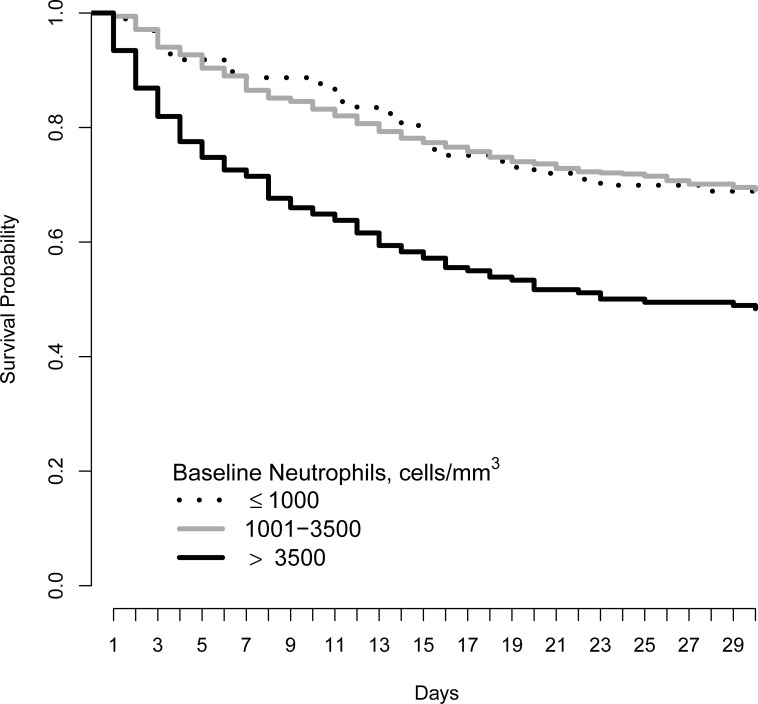
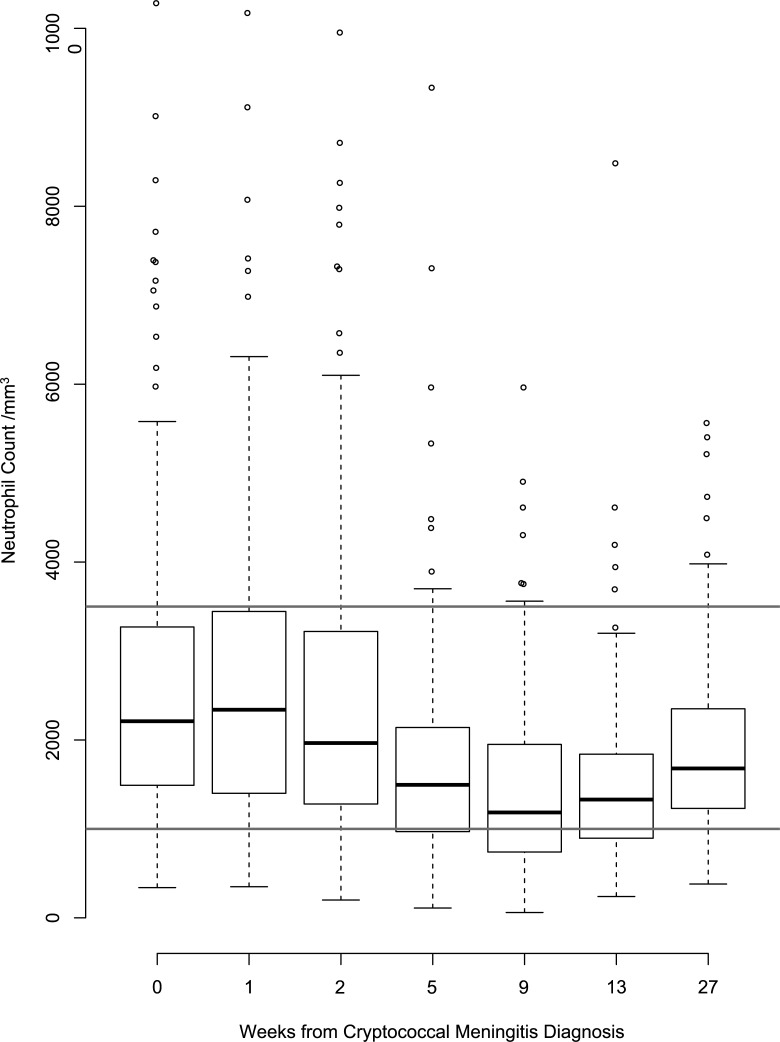
BACKGROUND: The mortality from cryptococcal meningitis remains high, despite the availability of antiretroviral therapy (ART) and amphotericin-based fungal regimens. The role of neutrophils in cryptococcosis is controversial. Our objective was to examine the association between blood neutrophil counts and outcomes in terms of mortality, the incidence of bacterial infections (including Mycobacterium tuberculosis) and hospitalization among HIV-infected patients presenting with cryptococcal meningitis. METHODS: We used data from participants from the Cryptococcal Optimal ART Timing (COAT) trial (2010-2012; Uganda and South Africa) and the Adjunctive Sertraline for Treatment of Cryptococcal Meningitis (ASTRO-CM) trial (2013-2017; Uganda). We estimated 30-day mortality risk with Cox proportional hazards models by baseline neutrophil counts (a) on a continuous scale and (b) with indicators for both relatively high (> 3,500 cells/mm3) and low (≤ 1,000 cells/mm3) counts. Follow-up neutrophil counts from the COAT trial were used to examine the time-dependent association of neutrophil counts with 12-month mortality and rehospitalization. RESULTS: 801 participants had an absolute neutrophil value at meningitis diagnosis. The median baseline absolute neutrophil count was 2100 cells/mm3 (IQR, 1400 to 3300 cells/mm3). Baseline neutrophil count was positively associated with 30-day mortality (adjusted hazard ratio = 1.09, 95%CI, 1.04-1.13, per 1000 cells/mm3 increase; p<0.001). Baseline absolute neutrophil counts ≤ 1000 cells/mm3 did not have increased risk of 30-day mortality compared to those with baseline neutrophils of 1001-3500 cells/mm3; however, baseline >3500 cells/mm3 had significantly increased risk, with an adjusted hazard ratio of 1.85(95%CI, 1.40-2.44; p<0.001). Among the COAT participants with follow-up neutrophil data, there was a strong association between time-updated neutrophil count and 12-month mortality (adjusted hazard ratio = 1.16, 95% CI 1.09-1.24; p<0.001. CONCLUSION: Higher blood neutrophil counts in HIV-infected patients with cryptococcal meningitis were associated with mortality. Neutrophils role requires further investigation as to whether this may be a mediator directly contributing to mortality or merely a marker of underlying pathologies that increase mortality risk.
Overview
The claims and statistics of this paper haven’t been checked yet.
Free: it reads the open-access text and checks the first 5 claims that cite a source we can check. Create a free account to check every claim.
Integrity signals
Registry
Cites
Statistics
Figures
Verification
Claims the paper makes
The claims and statistics of this paper haven’t been checked yet.
Free: it reads the open-access text and checks the first 5 claims that cite a source we can check. Create a free account to check every claim.
Claims other papers make about this one
Each is checked against this paper’s own text: does it say what the citing paper says it does?
The cited source says what the claim attributes to it.
In the citing paper
“By contrast, depletion of neutrophils markedly reduced pulmonary fungal burdens following infection with C. neoformans [89], and in AIDS patients with cryptococcosis, enhanced blood neutrophil counts are associated with mortality [90], indicating instead neutrophils may play a detrimental role during cryptococcal infection.”
From Mechanisms of fungal dissemination (2021) · cites this paper as [90]
Self-check
Percentages, sums and reported differences re-computed from the paper’s own numbers.
The self-check needs the paper’s full text.
Citations
Cites
Global burden of disease of HIV-associated cryptococcal meningitis: an updated analysis
Rajasingham, R., Smith, R. M., Park, B. J., Jarvis, J. N., Govender, N. P., Chiller, T. M., Denning, D. W., Loyse, A., & Boulware, D. R. (2017) · The Lancet Infectious Diseases · doi:10.1016/s1473-3099(17)30243-8 · Cited by 1,861
Self-citationTiming of Antiretroviral Therapy after Diagnosis of Cryptococcal Meningitis
Boulware, D. R., Meya, D. B., Muzoora, C., Rolfes, M. A., Huppler Hullsiek, K., Musubire, A., Taseera, K., Nabeta, H. W., Schutz, C., Williams, D. A., et al. (2014) · New England Journal of Medicine · doi:10.1056/nejmoa1312884 · Cited by 497
Self-citationCryptococcus neoformans Is a Facultative Intracellular Pathogen in Murine Pulmonary Infection
Feldmesser, M., Kress, Y., Novikoff, P., & Casadevall, A. (2000) · Infection and Immunity · doi:10.1128/iai.68.7.4225-4237.2000 · Cited by 423
Jarvis, J. N., Bicanic, T., Loyse, A., Namarika, D., Jackson, A., Nussbaum, J. C., Longley, N., Muzoora, C., Phulusa, J., Taseera, K., et al. (2014) · Clinical Infectious Diseases · doi:10.1093/cid/cit794 · Cited by 367
Self-citationBahr, N. C., Nuwagira, E., Evans, E. E., Cresswell, F. V., Bystrom, P. V., Byamukama, A., Bridge, S. C., Bangdiwala, A. S., Meya, D. B., Denkinger, C. M., et al. (2018) · The Lancet Infectious Diseases · doi:10.1016/s1473-3099(17)30474-7 · Cited by 308
Self-citationKambugu, A., Meya, D. B., Rhein, J., O’Brien, M., Janoff, E. N., Ronald, A. R., Kamya, M. R., Mayanja‐Kizza, H., Sande, M. A., Bohjanen, P. R., et al. (2008) · Clinical Infectious Diseases · doi:10.1086/587667 · Cited by 300
Self-citationBoulware, D. R., Meya, D. B., Bergemann, T. L., Wiesner, D. L., Rhein, J., Musubire, A., Lee, S. J., Kambugu, A., Janoff, E. N., & Bohjanen, P. R. (2010) · PLoS Medicine · doi:10.1371/journal.pmed.1000384 · Cited by 279
Self-citationCryptococcal meningitis: epidemiology and therapeutic options
Sloan, D., & Parris, V. (2014) · Clinical Epidemiology · doi:10.2147/clep.s38850 · Cited by 277
The Effect of Therapeutic Lumbar Punctures on Acute Mortality From Cryptococcal Meningitis
Rolfes, M. A., Hullsiek, K. H., Rhein, J., Nabeta, H. W., Taseera, K., Schutz, C., Musubire, A., Rajasingham, R., Williams, D. A., Thienemann, F., et al. (2014) · Clinical Infectious Diseases · doi:10.1093/cid/ciu596 · Cited by 192
Self-citationRhein, J., Morawski, B. M., Hullsiek, K. H., Nabeta, H. W., Kiggundu, R., Tugume, L., Musubire, A., Akampurira, A., Smith, K. D., Alhadab, A., et al. (2016) · The Lancet Infectious Diseases · doi:10.1016/s1473-3099(16)00074-8 · Cited by 183
Self-citation
Cited by
Mechanisms of fungal dissemination
Strickland, A. B., & Shi, M. (2021) · Cellular and Molecular Life Sciences · doi:10.1007/s00018-020-03736-z · Cited by 127
Cryptococcal Disease in Diverse Hosts
Meya, D. B., & Williamson, P. R. (2024) · New England Journal of Medicine · doi:10.1056/nejmra2311057 · Cited by 96
Self-citationGovender, N. P., Meintjes, G., Mangena, P., Nel, J. S., Potgieter, S., Reddy, D. L., Rabie, H., Wilson, D., Black, J. M., Boulware, D. R., et al. (2019) · Southern African Journal of HIV Medicine · doi:10.4102/sajhivmed.v20i1.1030 · Cited by 83
Self-citationBrienze, V. M. S., André, J. C., Liso, E., & Louis, I. V.-S. (2021) · Life · doi:10.3390/life11020095 · Cited by 33
“Blood granulocyte activation status, particularly neutrophils’, has been correlated with high mortality, including that from CM-IRIS, perhaps reflecting systemic oxidative stress generated by these short-lived effector cells of the innate immune system [78].”
BackgroundPullen, M. F., Hullsiek, K. H., Rhein, J., Musubire, A. K., Tugume, L., Nuwagira, E., Abassi, M., Ssebambulidde, K., Mpoza, E., Kiggundu, R., et al. (2020) · Clinical Infectious Diseases · doi:10.1093/cid/ciaa016 · Cited by 33
Self-citationHematologic alterations and early mortality in a cohort of HIV positive African patients
Ciccacci, F., Lucaroni, F., Latagliata, R., Morciano, L., Mondlane, E., Balama, M., Tembo, D., Gondwe, J., Orlando, S., Palombi, L., et al. (2020) · PLoS ONE · doi:10.1371/journal.pone.0242068 · Cited by 28
“Moreover, a higher mortality rate was observed in HIV+ patients with concomitant cryptococcal meningitis and neutrophilia [36].”
BackgroundContribution of Laccase Expression to Immune Response against Cryptococcus gattii Infection
Hansakon, A., Ngamskulrungroj, P., & Angkasekwinai, P. (2019) · Infection and Immunity · doi:10.1128/iai.00712-19 · Cited by 24
Importance of Clinical Isolates in Cryptococcus neoformans Research
Jackson, K. M., Ding, M., & Nielsen, K. (2023) · Journal of Fungi · doi:10.3390/jof9030364 · Cited by 23
Neglected mycobiome in HIV infection: Alterations, common fungal diseases and antifungal immunity
Li, S., Yang, X., Moog, C., Wu, H., Su, B., & Zhang, T. (2022) · Frontiers in Immunology · doi:10.3389/fimmu.2022.1015775 · Cited by 17
Jackson, K. M., Kono, T. J. Y., Betancourt, J. J., Wang, Y., Kabbale, K. D., Ding, M., Kezh, P., Ha, G., Yoder, J. M., Fulton, S. R., et al. (2024) · Nature Communications · doi:10.1038/s41467-024-54729-6 · Cited by 16
Self-citationCryptococcal infection: host immunity, immune evasion and emerging immunotherapeutic strategies
Li, F., Yu, X., Li, M., Ning, X., & Zhou, K. (2025) · Frontiers in Cellular and Infection Microbiology · doi:10.3389/fcimb.2025.1671873 · Cited by 14
Zhao, T. S., Xu, X.-L., Nie, J.-M., Chen, X.-H., Jiang, Z., Liu, S.-Q., Yang, T., Yang, X., Sun, F., Lu, Y., et al. (2021) · BMC Infectious Diseases · doi:10.1186/s12879-021-06417-9 · Cited by 14
“Despite advances in CM diagnostic and therapeutic strategies, early mortality from CM in the developing world remains high during the therapeutic antifungal induction and consolidation phases [5].”
BackgroundTian, Y., Wang, J., Shen, Y., Zhao, J., Hu, J., Zhu, X., Zhu, M., & Guan, M. (2023) · International Journal of Infectious Diseases · doi:10.1016/j.ijid.2023.01.015 · Cited by 13
Prével, R., Guillotin, V., Imbert, S., Blanco, P., Delhaès, L., & Duffau, P. (2022) · Frontiers in Medicine · doi:10.3389/fmed.2022.836886 · Cited by 9
Wang, Y., Wei, H., Shen, L., Su, X., Liu, J., Xu, X., Li, M., Yang, L., Liu, J., Wang, A., et al. (2022) · Frontiers in Immunology · doi:10.3389/fimmu.2022.895456 · Cited by 9
Innate Pulmonary Phagocytes and Their Interactions with Pathogenic Cryptococcus Species
Conn, B. N., & Wozniak, K. L. (2023) · Journal of Fungi · doi:10.3390/jof9060617 · Cited by 9
Wu, X., & Shen, Y. (2019) · Mycoses · doi:10.1111/myc.12977 · Cited by 6
Urazán, D. T., Cajicá-Martínez, G., Valencia‐Enciso, N., & Jovel, C. A. E. (2023) · Neurology Perspectives · doi:10.1016/j.neurop.2023.100127 · Cited by 6
Okurut, S., Boulware, D. R., Okafor, E. C., Rhein, J., Kajumbula, H., Bagaya, B. S., Bwanga, F., Olobo, J. O., Manabe, Y. C., Meya, D. B., et al. (2023) · Frontiers in Immunology · doi:10.3389/fimmu.2023.1275443 · Cited by 5
Self-citationZhao, T., Wang, X., Song, Y., Harypursat, V., & Chen, Y. (2025) · Journal of Inflammation Research · doi:10.2147/jir.s555540 · Cited by 4
Elicer, I., Eugenin, L., Acuña, M. P., Uslar, W., Fernández, A., & Lasso, M. (2024) · Clinical Neurology and Neurosurgery · doi:10.1016/j.clineuro.2024.108423 · Cited by 4
Ding, M., Jackson, K. M., Harris-Gordon, M., Dileepan, T., Meya, D. B., & Nielsen, K. (2025) · Infection and Immunity · doi:10.1128/iai.00585-24 · Cited by 4
Self-citationLouis, I. V.-S., & Mohei, H. (2024) · Diseases · doi:10.3390/diseases12050101 · Cited by 3
“An increase in activated circulating neutrophils has been correlated with high mortality and can be considered a predictor of the degree of systemic oxidative stress and fatal outcomes [49].”
BackgroundOlaniyi, J. A., Emeka, G. J., Onifade, A. A., Adeyanju, A., & Rahamon, S. K. (2021) · European Journal of Clinical and Experimental Medicine · doi:10.15584/ejcem.2021.1.5 · Cited by 3
Wyncoll, J., Kamolrattana, R., Archary, M., Mujuru, H. A., Kekitiinwa, A., Violari, A., Na-Rajsima, S., Lugemwa, A., Variava, E., Cotton, M. F., et al. (2026) · Clinical Infectious Diseases · doi:10.1093/cid/ciag232 · Cited by 2
“Underlying coinfections may explain our finding that a higher neutrophil count was associated with treatment failure in this study [31].”
Fungal Infections in Disorders of Inborn Errors of Immunity
Dhaliwal, M., Thakur, V., Warris, A., Brown, G. D., Pilania, R. K., & Dambuza, I. M. (2026) · Clinical Reviews in Allergy & Immunology · doi:10.1007/s12016-026-09182-2 · Cited by 2
“It was seen that a baseline neutrophil count above 3,500 cells/µL confers a higher 30-day and 12-month mortality in a cohort of 801 patients [248].”
Liao, J., Liao, G., Gao, Y. L., Chai, X., Wu, Q., & Zhao, Q. (2021) · Chemistry of Natural Compounds · doi:10.1007/s10600-021-03552-2
MECANISMOS PATOGÊNICOS E FISIOPATOLÓGICOS DOS AGENTES CAUSADORES DA MENINGITE
Pinto, B. G., Fontes, Í. G., CAVALCANTE, F. R. F., de Queiroz, E. B., SOUZA, A. G. L. D., Custódio, M. L. L., CAETANO, M. B. A., LOBO, M. S. G., & Pereira, V. S. (2023) · doi:10.56161/sci.ed.202312288c18
ATENDIMENTO MULTIDISCIPLINAR E ACADÊMICO DA MARINHA À POPULAÇÃO RIBEIRINHA NO MATO GROSSO
CURSOS, L. C. E. E., Malacarne, L. P., D’Artibale, E. F., Angoneze, I. R., Silva, M. P., Gonçales, T. A., & Cortela, D. D. C. B. (2025) · Congresso On-line Nacional de Ciências & Saúde (CONCS) · doi:10.53524/lit.edt.978-65-84528-50-5/03
CARVALHO, B. D. C. D., de Carvalho, V. D. C., & Neves, P. H. G. (2025) · doi:10.22533/at.ed.5211225010413
Dissecting how natural killer cells change in tumours to rationalise immunotherapies
Dean, I. (2023) · University of Birmingham Institutional Research Archive (University of Birmingham)
de Castro, R. J. A. (2019) · LA Referencia (Red Federada de Repositorios Institucionales de Publicaciones Científicas)
The role of tissue resident macrophages during cryptococcal infection
Mohamed, S. H. (2023) · University of Birmingham Institutional Research Archive (University of Birmingham)
Rutakingirwa, M. K., Skipper, C. P., & Meya, D. B. (2026) · Infection and Drug Resistance · doi:10.2147/idr.s546344
“36 Similarly, a peripheral leukocyte count of >10,000 cells/mm 3 was associated with an almost nine-fold risk of mortality compared to a leukocyte count of 10,000 cells/mm. 3,33 These hematological observations may be a result of coinfections, which can be either hospital acquired or opportunistic…”
Self-citationWang, Y., Wei, H., Shen, L., Su, X., Liu, J., Xu, X., Li, M., Yang, L., Liu, J., Wang, A., et al. (2022) · doi:10.3389/fimmu.2022.895456.s001
Metadata
- Authors
- Musubire, A. K., Meya, D. B., Rhein, J., Meintjes, G., Bohjanen, P. R., Nuwagira, E., Muzoora, C., Boulware, D. R., Hullsiek, K. H., & teams, T. C. A. A. T.
- Affiliations
- Infectious Diseases Institute (UG)
- Mulago Hospital (UG)
- University of Minnesota (US)
- University of Cape Town (ZA)
- Mbarara University of Science and Technology (UG)
- Corresponding author
- Musubire, Abdu Kisekka
- ORCID
- Venue
- PLOS ONE
- Publisher
- Public Library of Science (PLoS)
- Published
- 2018-12-31
- Volume
- 13
- Issue
- 12
- Pages
- e0209337
- ISSN
- 1932-6203 (ISSN-L)
- PMC
- PMC6312212
- OpenAlex
- W2907378598
- Cited by
- 27
- References
- 60
- Citations by year
- 2026: 2 · 2025: 3 · 2024: 4 · 2023: 6 · 2022: 3 · 2021: 4 · 2020: 2 · 2019: 3
- FWCI
- 1.76
- Type
- journal article
- Language
- en
- Open access
- gold
- doi.org
- Licence
- Locations
- PLoS ONE (publishedVersion, cc-by)
- Europe PMC (PubMed Central) (publishedVersion, cc-by)
- PubMed Central (publishedVersion, cc-by)
- PubMed (publishedVersion)
- DOAJ (DOAJ: Directory of Open Access Journals) (submittedVersion, cc-by-sa)
- Funders
- Fogarty International Center (R25TW009345, 5K43TW010718-02)
- U.S. National Institute of Neurologic Diseases and Stroke (NINDS) (R01NS086312)
- Division of Intramural Research, National Institute of Allergy and Infectious Diseases (US) (U01AI089244)
- National Institute of Allergy and Infectious Diseases (T32AI055433)
- United Kingdom Medical Research Council/Wellcome Trust Global Health Trials (MR/M007413/1)
- Wellcome Trust (098316)
- South African Research Chairs Initiative of the Department of Science and Technology and National Research Foundation (NRF) of South Africa (64787)
- Topics
- Health Sciences › Medicine › Infectious Diseases › Fungal Infections and Studies
- Health Sciences › Medicine › Infectious Diseases › Infectious Diseases and Tuberculosis
- Life Sciences › Immunology and Microbiology › Microbiology › Bacterial Infections and Vaccines
- Keywords
- cryptococcal meningitis, HIV infection, neutrophil count, mortality, cryptococcosis, bacterial co-infection, Mycobacterium tuberculosis, hospital readmission, antiretroviral therapy, prognostic factors, amphotericin B deoxycholate
- MeSH terms
- Adult, Female, Humans, Leukocyte Count, Male, Neutrophils, Patient Readmission, Prognosis, South Africa, Time Factors, Uganda, HIV Infections, Survival Analysis, Meningitis, Cryptococcal, Anti-HIV Agents, Coinfection
About these checks
Registry, retraction, Cites and statistics results are computed, not judged, with one exception: a printed reference that no index lists is read once by a model before it counts as a citation error. Claims are extracted by a model and kept only when their quote appears verbatim in the text; each cited source is then checked, with a model’s help, for whether it says what the claim relies on. Those verdicts can be wrong — read the claim’s quote and the cited source before relying on one.
Statistics and arithmetic are recomputed, not judged.
Confidence bands are shown only for fields calibrated on our annotated test set. None is calibrated yet, so no band is shown.
What counts as a claim ›How we measure confidence ›How we check this ›
Are you an author, or do you see a problem with this page? Request a review
Data sources
Bibliographic data: Semantic Scholar, OpenAlex, Crossref.
Contains information from the Semantic Scholar Academic Graph Datasets, made available under the ODC Attribution License (ODC-BY 1.0).
Semantic Scholar’s data is described in: Kinney, R., et al. (2023). The Semantic Scholar Open Data Platform. arXiv:2301.10140.
