

The DOI matches its Crossref record; 38 of the 39 references it cites were found in a registry or an index.
Validity and reliability of the Kinovea program in obtaining angles and distances using coordinates in 4 perspectives
Open accessAbstract
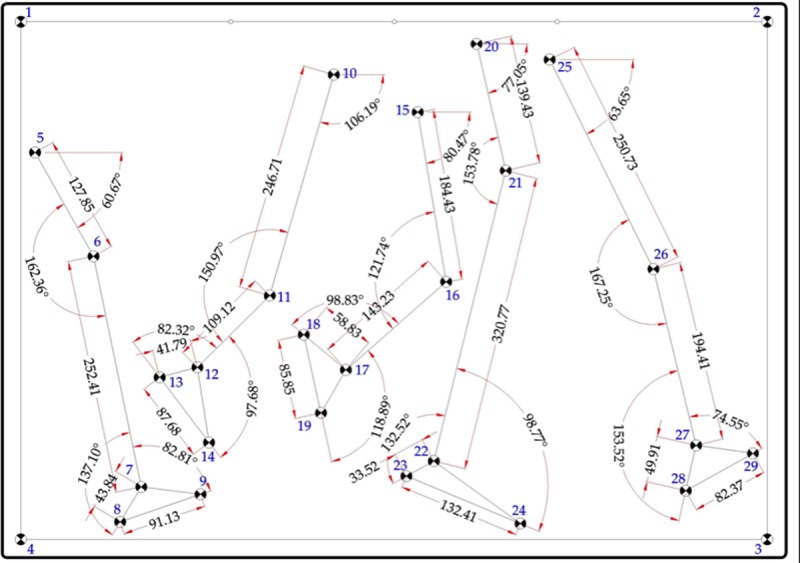
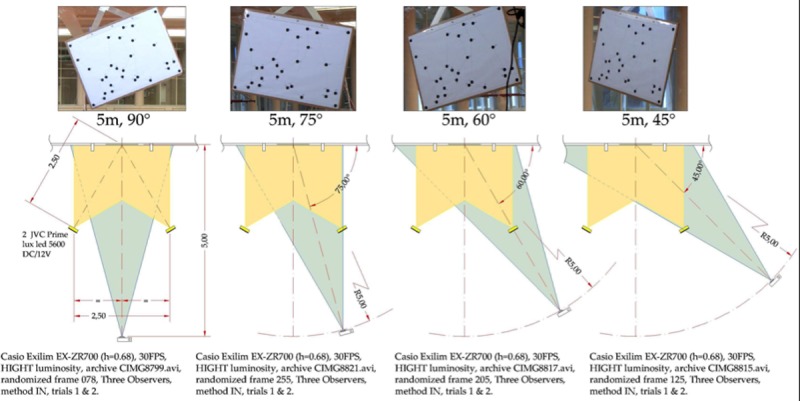
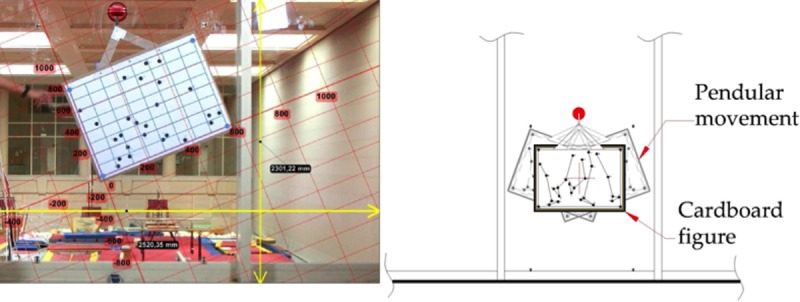
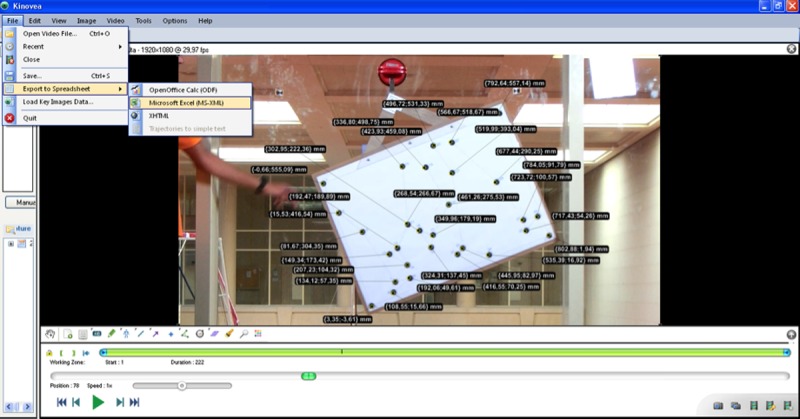
An objective analysis of the human movement can help both clinical assessment and sports performance. Kinovea is a free 2D motion analysis software that can be used to measure kinematic parameters. This low-cost technology has been used in sports sciences, as well as in the clinical and research fields. One interesting tool is that it can measure an object (or person) passing in front of the camera, taking into account the perspective between the camera and the recorded object. Although it has been validated as a tool to assess time-related variables, few studies assessed its validity compared to a Gold Standard; furthermore, its reliability in different perspectives has not been previously assessed. The main objective of this study is to determine the validity of the Kinovea software compared to AutoCAD, and its intra and inter-rater reliability in obtaining coordinates data; a second objective is to compare their results at 4 different perspectives (90°, 75°, 60° and 45°) and to assess the inter and intra rater reliability at each perspective. For this purpose, a wire structure figure in the shape of a human lower limb was designed and measured in AutoCAD; it was then recorded during a pendular motion with a video-camera placed at distance of 5 m and analyzed with Kinovea in the 4 perspectives (90°, 75°, 60° and 45°). Each frame was examined by three observers who made two attempts. A multiple approach was applied involving the analysis of the systematic error, with a two-way ANOVA 2x4; the relative reliability with Intraclass Correlation Coefficient (ICC) and the Coefficient of Variance (CV) (95% confidence interval); and the absolute reliability with the Standard Error (SE). The results indicate that the Kinovea software is a valid and reliable tool that is able to measure accurately at distances up to 5 m from the object and at an angle range of 90°-45°. Nevertheless, for optimum results an angle of 90° is suggested.
Overview
The claims and statistics of this paper haven’t been checked yet.
Run the check — free, no account needed. It reads the open-access text and checks the sources it cites.
Integrity signals
Registry
Cites
Statistics
Figures
Verification
Claims the paper makes
The claims and statistics of this paper haven’t been checked yet.
Run the check — free, no account needed. It reads the open-access text and checks the sources it cites.
Claims other papers make about this one
Each is checked against this paper’s own text: does it say what the citing paper says it does?
The cited source says what the claim attributes to it.
In the citing paper
“The validity and reliability of the Kinovea software was previously studied (34–36).”
From Kinematic analysis of the back squat at different load intensities in powerlifters and weightlifters (2024) · cites this paper as [35]
The check wasn’t confident either way, so it gives no verdict — never disputed.
In the citing paper
“positioning the head near the edges of the camera’s field of view may have increased errors due to parallax or spherical lens distortion compared to the segments located closer to the center of the frame (e.g., pelvis and knee) [48,57].”
From Intra-Rater and Test–Retest Reliability of Kinovea for the Kinematic Analysis of Squatting in Healthy Active Women (2026) · cites this paper as [48]
Experimental — accuracy not yet measured
Self-check
Percentages, sums and reported differences re-computed from the paper’s own numbers.
The self-check needs the paper’s full text.
Citations
Cites
QUANTIFYING TEST-RETEST RELIABILITY USING THE INTRACLASS CORRELATION COEFFICIENT AND THE SEM
Weir, J. P. (2005) · The Journal of Strength and Conditioning Research · doi:10.1519/15184.1 · Cited by 4,864
Measures of Reliability in Sports Medicine and Science
Hopkins, W. G. (2000) · Sports Medicine · doi:10.2165/00007256-200030010-00001 · Cited by 4,635
Atkinson, G., & Nevill, A. M. (1998) · Sports Medicine · doi:10.2165/00007256-199826040-00002 · Cited by 3,817
Balsalobre‐Fernández, C., Tejero‐González, C. M., del Campo-Vecino, J., & Bavaresco, N. (2013) · The Journal of Strength and Conditioning Research · doi:10.1519/jsc.0b013e318299a52e · Cited by 242
The Reliability of Three Devices Used for Measuring Vertical Jump Height
Nuzzo, J. L., Anning, J. H., & Scharfenberg, J. M. (2011) · The Journal of Strength and Conditioning Research · doi:10.1519/jsc.0b013e3181fee650 · Cited by 220
Mentiplay, B. F., Perraton, L. G., Bower, K. J., Pua, Y., McGaw, R., Heywood, S. E., & Clark, R. A. (2015) · Journal of Biomechanics · doi:10.1016/j.jbiomech.2015.05.021 · Cited by 196
Reliability of Ankle Isometric, Isotonic, and Isokinetic Strength and Power Testing in Older Women
Webber, S. C., & Porter, M. M. (2010) · Physical Therapy · doi:10.2522/ptj.20090394 · Cited by 155
Validity of Two Methods for Estimation of Vertical Jump Height
Dias, J. A., Pupo, J. D., dos Reis, D. C., Borges, L. R. A. P., dos Santos, S. G., Moro, A. R. P., & Borges, N. B. (2011) · The Journal of Strength and Conditioning Research · doi:10.1519/jsc.0b013e3181e73f6e · Cited by 125
Thewlis, D., Bishop, C., Daniell, N., & Paul, G. E. (2013) · Journal of Applied Biomechanics · doi:10.1123/jab.29.1.112 · Cited by 123
Match analysis of elite players during paddle tennis competition
Torres‐Luque, G., Ramirez, A., Cabello‐Manrique, D., Nikolaidis, P. Τ., & Alvero‐Cruz, J. R. (2015) · International Journal of Performance Analysis in Sport · doi:10.1080/24748668.2015.11868857 · Cited by 121
Research works printed but not linked: 3
- G Ramon Suarez, 2016, Evaluation scale of visual and auditive action-reaction times in youth karate athletes of Antioquia, Colombia, Viref Rev Educ Fis, 5, 1
- JP Rebolledo Uribe, 2012, Occlusal plane inclination in children between 9 and 10 years of age with postural asymmetry. A study on the frontal plane, Rev Fac Odontol Univ Antioquia, 24, 76
- M Eltoukhy, 2012, Evaluation of the performance of digital video analysis of human motion: Dartfish tracking system, Int J Sci Eng Res, 3, 1
Cited by
Sorted by citations
Roggio, F., Trovato, B., Sortino, M., & Musumeci, G. (2024) · Heliyon · doi:10.1016/j.heliyon.2024.e39977 · Cited by 166
Kathuria, A., & Vedagiri, P. (2019) · Accident Analysis & Prevention · doi:10.1016/j.aap.2019.105316 · Cited by 135
Pueo, B., Penichet-Tomás, A., & Jiménez-Olmedo, J. M. (2020) · Physiology & Behavior · doi:10.1016/j.physbeh.2020.113144 · Cited by 92
Photomechanical Crystals as Light-Activated Organic Soft Microrobots
Tahir, I., Ahmed, E., Karothu, D. P., Fsehaye, F., Halabi, J. M., & Naumov, P. (2024) · Journal of the American Chemical Society · doi:10.1021/jacs.4c08320 · Cited by 79
Analisis kondisi fisik menggunakan software Kinovea pada atlet taekwondo Dojang Mahameru Surakarta
Jariono, G., Subekti, N., Indarto, P., Hendarto, S., Nugroho, H., & Fachrezzy, F. (2020) · TRANSFORMASI Jurnal Pengabdian Masyarakat · doi:10.20414/transformasi.v16i2.2635 · Cited by 77
Metadata
- Authors
- Puig-Diví, A., Escalona-Marfil, C., Padullés-Riu, J. M., Busquets, A., Padullés-Chando, X., & Marcos-Ruiz, D.
- Affiliations
- Universitat Ramon Llull (ES)
- Institut Nacional d'Educació Física de Catalunya (ES)
- Universitat de Girona (ES)
- Venue
- PLoS ONE
- Publisher
- Public Library of Science (PLoS)
- Published
- 2019-06-05
- Volume
- 14
- Issue
- 6
- Pages
- e0216448
- ISSN
- 1932-6203 (ISSN-L)
- PMC
- PMC6550386
- OpenAlex
- W2948315428
- Cited by
- 434
- References
- 39
- Citations by year
- 2026: 69 · 2025: 80 · 2024: 69 · 2023: 70 · 2022: 65 · 2021: 47 · 2020: 31 · 2019: 3
- FWCI
- 24.42
- Type
- journal article
- Language
- en
- Open access
- gold
- doi.org
- Licence
- Locations
- PLoS ONE (publishedVersion, cc-by)
- PubMed Central (publishedVersion, cc-by)
- PubMed (publishedVersion)
- LA Referencia (Red Federada de Repositorios Institucionales de Publicaciones Científicas) (acceptedVersion, cc-by)
- Universitat de Girona Digital Repository (Universitat de Girona) (acceptedVersion, cc-by)
- RePEc: Research Papers in Economics (submittedVersion)
- DOAJ (DOAJ: Directory of Open Access Journals) (submittedVersion, cc-by-sa)
- Universitat de Girona Digital Repository (Universitat de Girona) (submittedVersion, cc-by)
- Figshare (submittedVersion, cc-by)
- RECERCAT (Consorci de Serveis Universitaris de Catalunya) (submittedVersion, cc-by)
- Funders
- Institut Nacional d'Educacio Fisica de Catalunya, Generalitat de Catalunya
- Topics
- Social Sciences › Decision Sciences › Statistics, Probability and Uncertainty › Reliability and Agreement in Measurement
- Physical Sciences › Engineering › Biomedical Engineering › Sports Dynamics and Biomechanics
- Physical Sciences › Engineering › Biomedical Engineering › Lower Extremity Biomechanics and Pathologies
- Keywords
- Kinovea, video-based motion analysis, measurement validity, inter-rater reliability, intra-rater reliability, camera angles, coordinate measurement, pendulum motion, lower limb kinematics, systematic errors
- MeSH terms
- Biomechanical Phenomena, Gait, Humans, Movement, Software, Reproducibility of Results, Range of Motion, Articular
About these checks
Registry, retraction, Cites and statistics results are computed, not judged, with one exception: a printed reference that no index lists is read once by a model before it counts as a citation error. Claims are extracted by a model and kept only when their quote appears verbatim in the text; each cited source is then checked, with a model’s help, for whether it says what the claim relies on. Those verdicts can be wrong — read the claim’s quote and the cited source before relying on one.
Statistics and arithmetic are recomputed, not judged.
Confidence bands are shown only for fields calibrated on our annotated test set. None is calibrated yet, so no band is shown.
What counts as a claim ›How we measure confidence ›How we check this ›
Are you an author, or do you see a problem with this page? Request a review
