

The DOI matches its Crossref record; 42 of the 42 references it cites were found in a registry or an index.
Prevalence of anemia and its associated factors among children under five years of age attending at Guguftu health center, South Wollo, Northeast Ethiopia
Open accessAbstract
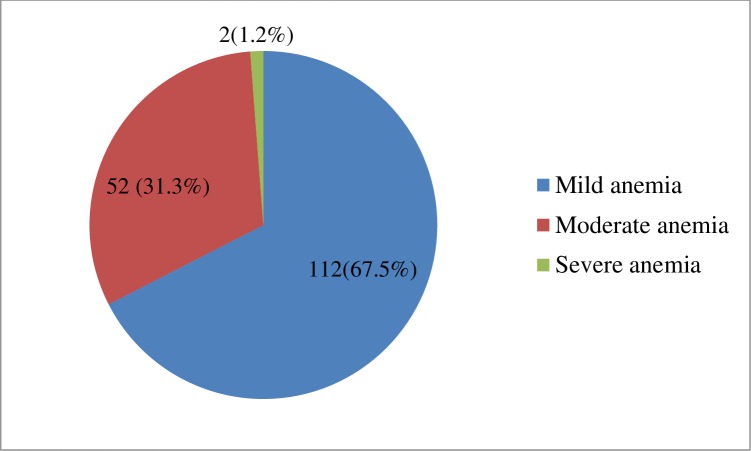
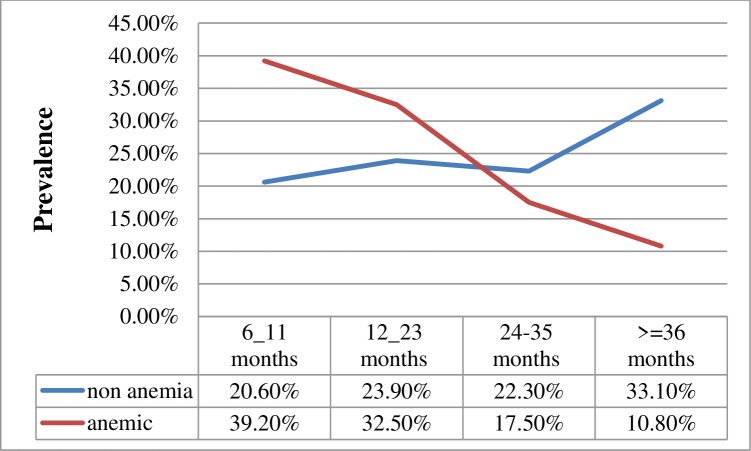
BACKGROUND: Anemia during childhood adversely affects mental, physical and social development of the children. This study is aimed to assess the prevalence of anemia and its associated factors among children less than five years of age in Guguftu, South Wollo, Northeast Ethiopia. METHOD: A cross-sectional health facility based study was conducted among 404 children aged 6 to 59 months. Systematic random sampling technique was used to include the participants. Pretested and structured questionnaires were used to collect socioeconomic and demographic characteristics of the family and child. Data on nutritional status, capillary blood and stool samples were collected from each child. Multivariate logistic regression was used to calculate adjusted odds ratios and the corresponding 95% confidence intervals. RESULT: The overall prevalence of anemia was 41.1% (95% CI;36.6% - 45.8%). Of the anemic under five children, 112 (67.5%) had mild anemia, 52(31.3%) had moderate anemia, and 2(1.2%) had severe anemia. Children who were in the age group of 6-11(AOR = 4.52; 95% CI: 1.67-12.34) and 12-23 (AOR = 2.79; 95% CI: 1.04-7.51) months, living in an urban (AOR = 1.83; 95% CI: 1.05-3.18), with no formal education mothers (AOR = 7.05; 95% CI: 2.93-17.01) and primary education mothers (AOR = 3.26; 95% CI: 1.29-8.24), with a family monthly income of <750 ETB(AOR = 5.19; 95% CI: 1.24-21.75) and 750-1500 ETB(AOR = 5.89; 95% CI: 1.45-23.98), with early (<6 months) introduction of complementary foods (AOR = 3.53; 95% CI: 1.23-10.18), Underweight (AOR = 2.11; 95% CI: 1.21-3.69) were more likely to become anemic. CONCLUSION: This study has revealed that the prevalence of anemia in children less than five years is high and a severe public health problem in the study area. Therefore, the policymakers should make a strategy that can reduce poverty and increase the awareness of women on breastfeeding, nutrition, and other associated factors to reduce anemia.
Overview
The claims and statistics of this paper haven’t been checked yet.
Run the check — free, no account needed. It reads the open-access text and checks the sources it cites.
Integrity signals
Registry
Cites
Statistics
Figures
Verification
Claims the paper makes
The claims and statistics of this paper haven’t been checked yet.
Run the check — free, no account needed. It reads the open-access text and checks the sources it cites.
Claims other papers make about this one
Each is checked against this paper’s own text: does it say what the citing paper says it does?
The cited source says what the claim attributes to it.
In the citing paper
“According to different studies, some of the factors for the high prevalence of anemia in Ethiopia were age, residency, maternal educational status, family income, early initiation of complementary food, underweight [9], stunting [10], and parasite infection [11].”
From Prevalence of Anemia and Its Associated Factors Among 6–59‐Month‐Old Children in Ayder Comprehensive Specialized Referral Hospital, Northern Ethiopia (2026) · cites this paper as [9]
Self-check
Percentages, sums and reported differences re-computed from the paper’s own numbers.
The self-check needs the paper’s full text.
Citations
Cites
National Committee for Clinical Laboratory Standards
Bruck, E. (1980) · PEDIATRICS · doi:10.1542/peds.65.1.187 · Cited by 14,736
Ethiopia demographic and health survey, 2000
Central Statistical Agency, & Ethiopia (2017) · Cited by 3,873
de Onís, M., Onyango, A. W., Borghi, E., Siyam, A., Pinol, A., Garza, C., Martines, J., Martorell, R., Victora, C. G., Bhan, M. K., et al. (2006) · (2006) · Cited by 3,401
Worldwide prevalence of anaemia, WHO Vitamin and Mineral Nutrition Information System, 1993–2005
McLean, E., Cogswell, M., Egli, I., Wojdyla, D., & de Benoist, B. (2009) · Public Health Nutrition · doi:10.1017/s1368980008002401 · Cited by 2,734
Lopez, A., Cacoub, P., Macdougall, I. C., & Peyrin‐Biroulet, L. (2015) · The Lancet · doi:10.1016/s0140-6736(15)60865-0 · Cited by 1,603
Guidelines on food fortification with micronutrients
Allen, L. H. (2006) · Cited by 1,562
Worldwide prevalence of anaemia 1993-2005: WHO global database on anaemia.
de Benoist, B., McLean, E., Egll, I., & Cogswell, M. E. (2008) · Cited by 1,543
Haas, J. D., & Brownlie, T. (2001) · The Journal of Nutrition · doi:10.1093/jn/131.2.676s · Cited by 1,186
Iron and Its Relation to Immunity and Infectious Disease
Oppenheimer, S. J. (2001) · The Journal of Nutrition · doi:10.1093/jn/131.2.616s · Cited by 695
Iron Deficiency and Child Development
Lozoff, B. (2007) · Food and Nutrition Bulletin · doi:10.1177/15648265070284s409 · Cited by 472
Research works printed but not linked: 1
- TG Novaes, 2017, Prevalenceand factors associated with anemia in children enrolled in daycare centers: A Hierarchical Analysis, Revista Paulista de Pediatria, 35, 281
Cited by
Sorted by citations
Djuardi, Y., Lazarus, G., Stefanie, D., Fahmida, U., Ariawan, I., & Supali, T. (2021) · PLoS neglected tropical diseases · doi:10.1371/journal.pntd.0009506 · Cited by 66
Kebede, D., Getaneh, F., Endalamaw, K., Belay, T., & Fenta, A. (2021) · BMC Pediatrics · doi:10.1186/s12887-021-03011-5 · Cited by 57
Tadesse, S. E., Zerga, A. A., Mekonnen, T. C., Tadesse, A. W., Hussien, F. M., Wasihun, Y., Yalew, M., & Ayele, F. Y. (2022) · Anemia · doi:10.1155/2022/1382940 · Cited by 41
Dietary Determinants of Anemia in Children Aged 6–36 Months: A Cross-Sectional Study in Indonesia
Sunardi, D., Bardosono, S., Basrowi, R. W., Wasito, E., & Vandenplas, Y. (2021) · Nutrients · doi:10.3390/nu13072397 · Cited by 41
Risk factors of anemia among preschool children in Ethiopia: a Bayesian geo-statistical model
Endris, B. S., Dinant, G., Gebreyesus, S. H., & Spigt, M. (2022) · BMC Nutrition · doi:10.1186/s40795-021-00495-3 · Cited by 38
Metadata
- Authors
- Gebreweld, A., Ali, N., Ali, R., & Fisha, T.
- Affiliations
- Wollo University (ET)
- Corresponding author
- Gebreweld, Angesom
- ORCID
- Gebreweld, Angesom
- Venue
- PLOS ONE
- Publisher
- Public Library of Science (PLoS)
- Published
- 2019-07-05
- Volume
- 14
- Issue
- 7
- Pages
- e0218961
- ISSN
- 1932-6203 (ISSN-L)
- PMC
- PMC6611584
- OpenAlex
- W2953963245
- Cited by
- 128
- References
- 42
- Citations by year
- 2026: 8 · 2025: 8 · 2024: 29 · 2023: 34 · 2022: 19 · 2021: 21 · 2020: 9
- FWCI
- 9.32
- Type
- journal article
- Language
- en
- Open access
- gold
- doi.org
- Licence
- Locations
- PLoS ONE (publishedVersion, cc-by)
- Europe PMC (PubMed Central) (publishedVersion, cc-by)
- PubMed Central (publishedVersion, cc-by)
- PubMed (publishedVersion)
- RePEc: Research Papers in Economics (submittedVersion)
- DOAJ (DOAJ: Directory of Open Access Journals) (submittedVersion, cc-by-sa)
- Figshare (submittedVersion, cc-by)
- Topics
- Health Sciences › Nursing › Nutrition and Dietetics › Child Nutrition and Water Access
- Health Sciences › Medicine › Hematology › Iron Metabolism and Disorders
- Health Sciences › Medicine › Pediatrics, Perinatology and Child Health › Public Health and Nutrition
- Keywords
- childhood anemia, children under five, anemia prevalence, risk factors, maternal education, maternal employment, household income, complementary feeding, anemia severity, deworming coverage, deworming frequency, deworming treatment, deworming side effects
- MeSH terms
- Anemia, Child, Preschool, Cross-Sectional Studies, Ethiopia, Humans, Infant, Nutritional Status, Surveys and Questionnaires, Risk Factors, Socioeconomic Factors, Prevalence, Risk Assessment
About these checks
Registry, retraction, Cites and statistics results are computed, not judged, with one exception: a printed reference that no index lists is read once by a model before it counts as a citation error. Claims are extracted by a model and kept only when their quote appears verbatim in the text; each cited source is then checked, with a model’s help, for whether it says what the claim relies on. Those verdicts can be wrong — read the claim’s quote and the cited source before relying on one.
Statistics and arithmetic are recomputed, not judged.
Confidence bands are shown only for fields calibrated on our annotated test set. None is calibrated yet, so no band is shown.
What counts as a claim ›How we measure confidence ›How we check this ›
Are you an author, or do you see a problem with this page? Request a review
