

Hate speech detection: Challenges and solutions
Open accessThe DOI matches its Crossref record; 36 of the 36 references it cites were found in a registry or an index.
Abstract
As online content continues to grow, so does the spread of hate speech. We identify and examine challenges faced by online automatic approaches for hate speech detection in text. Among these difficulties are subtleties in language, differing definitions on what constitutes hate speech, and limitations of data availability for training and testing of these systems. Furthermore, many recent approaches suffer from an interpretability problem-that is, it can be difficult to understand why the systems make the decisions that they do. We propose a multi-view SVM approach that achieves near state-of-the-art performance, while being simpler and producing more easily interpretable decisions than neural methods. We also discuss both technical and practical challenges that remain for this task.
Overview
The claims and statistics of this paper haven’t been checked yet.
Free: it reads the open-access text and checks the first 5 claims that cite a source we can check. Create a free account to check every claim.
Integrity signals
Registry
Cites
Statistics
Figures
Verification
Claims the paper makes
The claims and statistics of this paper haven’t been checked yet.
Free: it reads the open-access text and checks the first 5 claims that cite a source we can check. Create a free account to check every claim.
Claims other papers make about this one
Each is checked against this paper’s own text: does it say what the citing paper says it does?
The cited source says what the claim attributes to it.
In the citing paper
“Detecting hate speech is a challenging endeavour as there are several definitional conflicts and variances.”
From Misogynoir: challenges in detecting intersectional hate (2022) · cites this paper as MacAvaney et al. 2019
The cited source says what the claim attributes to it.
In the citing paper
“According to(MacAvaney etal. 2019), these opposing definitions complicate the assessment of hate speech systems, resulting in datasets derived from disparate sources and capturing disparate information.”
From Misogynoir: challenges in detecting intersectional hate (2022) · cites this paper as MacAvaney et al. 2019
Self-check
Percentages, sums and reported differences re-computed from the paper’s own numbers.
The self-check needs the paper’s full text.
Citations
Cites
BERT: Pre-training of Deep Bidirectional Transformers for Language Understanding
Devlin, J., Chang, M.-W., Lee, K., & Toutanova, K. (2018) · arXiv · doi:10.48550/arxiv.1810.04805 · Cited by 73,173 · cited 13×
“BERT is a recent transformer-based pre-trained contextualized embedding model extendable to a classification model with an additional output layer.”
BackgroundMethodInfluentialScikit-learn: Machine Learning in Python
Pedregosa, F., Varoquaux, G., Gramfort, A., Michel, V., Thirion, B., Grisel, O., Blondel, M., Müller, A., Nothman, J., Louppe, G., et al. (2012) · arXiv · doi:10.48550/arxiv.1201.0490 · Cited by 71,016
Convolutional Neural Networks for Sentence Classification
Kim, Y. (2014) · Proceedings of the 2014 Conference on Empirical Methods in Natural Language Processing (EMNLP) · doi:10.3115/v1/d14-1181 · Cited by 14,831 · cited 1×
“Their network structure is similar to the one proposed by [30], with convolutions of length 3 pooled over the entire document length.”
BackgroundA vector space model for automatic indexing
Salton, G., Wong, A., & Yang, C. S. (1975) · Communications of the ACM · doi:10.1145/361219.361220 · Cited by 7,521 · cited 1×
“In this setting, there are various ways to assign weights to the terms that may be more important, such as TF-IDF [23].”
BackgroundBag of Tricks for Efficient Text Classification
Joulin, A., Grave, E., Bojanowski, P., & Mikolov, T. (2017) · Proceedings of the 15th Conference of the European Chapter of the Association for Computational Linguistics: Volume 2, Short Papers · doi:10.18653/v1/e17-2068 · Cited by 4,545
Bag of Tricks for Efficient Text Classification
Joulin, A., Grave, E., Bojanowski, P., & Mikolov, T. (2016) · arXiv · doi:10.48550/arxiv.1607.01759 · Cited by 4,542 · cited 1×
“FastText [32].”
Popular Ensemble Methods: An Empirical Study
Opitz, D., & Maclin, R. (1999) · Journal of Artificial Intelligence Research · doi:10.1613/jair.614 · Cited by 2,953 · cited 1×
“Combining machine learning classifiers is not a new concept [35].”
BackgroundAutomated Hate Speech Detection and the Problem of Offensive Language
Davidson, T., Warmsley, D., Macy, M., & Weber, I. (2017) · Proceedings of the International AAAI Conference on Web and Social Media · doi:10.1609/icwsm.v11i1.14955 · Cited by 2,610
Jain, S., & Wallace, B. (2019) · Conference of the North American Chapter of the Association for Computational Linguistics: Human Language Technologies (NAACL-HLT) · doi:10.18653/v1/n19-1357 · Cited by 1,987 · cited 2×
“These observations are in line with prior work that has found attention signals to be noisy and not necessarily indicative of term importance [39, 40].”
ResultHateful Symbols or Hateful People? Predictive Features for Hate Speech Detection on Twitter
Waseem, Z., & Hovy, D. (2016) · Proceedings of the NAACL Student Research Workshop · doi:10.18653/v1/n16-2013 · Cited by 1,655 · cited 3×
“Waseem and Hovy also provide a dataset from Twitter, consisting of 16,914 tweets labeled as racist, sexist, or neither [17].”
BackgroundMethodInfluentialA Survey on Automatic Detection of Hate Speech in Text
Fortuna, P., & Nunes, S. (2019) · ACM Computing Surveys · doi:10.1145/3232676 · Cited by 1,241 · cited 1×
“’s definition is based on an analysis of the following characteristics from other definitions [8]:”
BackgroundMulti-view learning overview: Recent progress and new challenges
Zhao, J., Xie, X., Xu, X., & Sun, S. (2017) · Information Fusion · doi:10.1016/j.inffus.2017.02.007 · Cited by 1,002 · cited 2×
“It applies a multiple-view stacked Support Vector Machine (mSVM) [34].”
BackgroundMethodSerrano, S., & Smith, N. A. (2019) · Proceedings of the 57th Annual Meeting of the Association for Computational Linguistics · doi:10.18653/v1/p19-1282 · Cited by 690
Detecting Hate Speech on Twitter Using a Convolution-GRU Based Deep Neural Network
Zhang, Z., Robinson, D., & Tepper, J. (2018) · Lecture Notes in Computer Science · doi:10.1007/978-3-319-93417-4_48 · Cited by 638
Are You a Racist or Am I Seeing Things? Annotator Influence on Hate Speech Detection on Twitter
Waseem, Z. (2016) · Proceedings of the First Workshop on NLP and Computational Social Science · doi:10.18653/v1/w16-5618 · Cited by 569 · cited 2×
“In a second paper, Waseem creates another dataset by sampling a new set of tweets from the 136,000 tweet corpus [18].”
BackgroundInformation Retrieval: Algorithms and Heuristics
Grossman, D. A., & Frieder, O. (1998) · The Kluwer International Series in Engineering and Computer Science · doi:10.1007/978-1-4615-5539-1 · Cited by 537
Self-citationBenchmarking Aggression Identification in Social Media.
Kumar, R., Ojha, A. K., Malmasi, S., & Zampieri, M. (2018) · International Conference on Computational Linguistics · Cited by 474
Jain, S., & Wallace, B. (2019) · arXiv (Cornell University) · doi:10.48550/arxiv.1902.10186 · Cited by 467 · cited 2×
“These observations are in line with prior work that has found attention signals to be noisy and not necessarily indicative of term importance [39, 40].”
ResultHate Speech Dataset from a White Supremacy Forum
de Gibert, O., Perez, N., García-Pablos, A., & Cuadros, M. (2018) · Proceedings of the 2nd Workshop on Abusive Language Online (ALW2) · doi:10.18653/v1/w18-5102 · Cited by 425 · cited 6×
“73 [14]; our approach easily outperforms this method.”
BackgroundMethodInfluentialA Measurement Study of Hate Speech in Social Media
Mondal, M., Silva, L. A., & Benevenuto, F. (2017) · Proceedings of the 28th ACM Conference on Hypertext and Social Media · doi:10.1145/3078714.3078723 · Cited by 357 · cited 1×
“Due to the societal concern and how widespread hate speech is becoming on the Internet [7], there is strong motivation to study automatic detection of hate speech.”
BackgroundDeClarE: Debunking Fake News and False Claims using Evidence-Aware Deep Learning
Popat, K., Mukherjee, S., Yates, A., & Weikum, G. (2018) · Proceedings of the 2018 Conference on Empirical Methods in Natural Language Processing · doi:10.18653/v1/d18-1003 · Cited by 315 · cited 1×
“verification—another difficult task [15].”
Grossman, D. A., & Frieder, O. (2004) · Springer eBooks · doi:10.1007/978-1-4020-3005-5 · Cited by 228
Self-citationAroyehun, S. T., & Gelbukh, A. F. (2018) · International Conference on Computational Linguistics · Cited by 173
Measuring the Reliability of Hate Speech Annotations: The Case of the European Refugee Crisis
Roß, B., Rist, M., Carbonell, G., Cabrera, B., Kurowsky, N., & Wojatzki, M. (2016) · DuEPublico (University of Duisburg-Essen) · doi:10.17185/duepublico/42132 · Cited by 172 · cited 5×
“created a Twitter dataset in German for the European refugee crisis [11].”
BackgroundInfluentialImproving Hate Speech Detection with Deep Learning Ensembles
Zimmerman, S., Kruschwitz, U., & Fox, C. (2018) · Language Resources and Evaluation Conference (LREC) · doi:10.63317/23pfnoj4u7xi · Cited by 149 · cited 2×
“propose an ensemble approach, which combines the decisions of ten convolutional neural networks with different weight initializations [10].”
BackgroundResultUnsupervised Neural Machine Translation with Weight Sharing
Yang, Z. C., Chen, W., Wang, F., & Xu, B. (2018) · Proceedings of the conference - Association for Computational Linguistics. Meeting · doi:10.18653/v1/p18-1005 · Cited by 139 · cited 1×
“, assigning a vector to a word, such as word2vec [25], are common when applying deep learning methods in natural language processing and text mining [26, 27].”
BackgroundLSTMs Can Learn Syntax-Sensitive Dependencies Well, But Modeling Structure Makes Them Better
Kuncoro, A., Dyer, C., Hale, J., Yogatama, D., Clark, S., & Blunsom, P. (2018) · Proceedings of the 56th Annual Meeting of the Association for Computational Linguistics (Volume 1: Long Papers) · doi:10.18653/v1/p18-1132 · Cited by 137 · cited 1×
“Some deep learning architectures, such as recurrent and transformer neural networks, challenge the bag-of-words assumption by modeling the ordering of the words by processing over a sequence of word embeddings [28].”
BackgroundChand, N., Mishra, P., Krishna, C. R., Pilli, E. S., & Govil, M. C. (2016) · International Conference on Advances in Computing, Communication & Automation (ICACCA) · doi:10.1109/icacca.2016.7578859 · Cited by 111 · cited 1×
“Previous efforts have shown that combining SVM with different classifiers provides improvements to various data mining tasks and text classification [36, 37].”
BackgroundProceedings of the First Workshop on Trolling, Aggression and Cyberbullying (TRAC-2018)
Kumar, R., Ojha, A. K., Zampieri, M., & Malmasi, S. (2018) · Cited by 108
Metaphor Identification in Large Texts Corpora
Neuman, Y., Assaf, D., Cohen, Y., Last, M., Argamon, S., Howard, N., & Frieder, O. (2013) · PLoS ONE · doi:10.1371/journal.pone.0062343 · Cited by 106
Self-citationWebis: An Ensemble for Twitter Sentiment Detection
Hagen, M., Potthast, M., Büchner, M., & Stein, B. (2015) · International Workshop on Semantic Evaluation (SemEval) · doi:10.18653/v1/s15-2097 · Cited by 96 · cited 1×
“The results of each model are combined by averaging the scores, akin to [31].”
MethodBoosting SVM classifiers by ensemble
Dong, Y.-S., & Han, K.-S. (2005) · International World Wide Web Conference (WWW) · doi:10.1145/1062745.1062874 · Cited by 35 · cited 1×
“Previous efforts have shown that combining SVM with different classifiers provides improvements to various data mining tasks and text classification [36, 37].”
BackgroundAbdullah, A., Veltkamp, R. C., & Wiering, M. (2009) · International Joint Conference on Neural Networks (IJCNN) · doi:10.1109/ijcnn.2009.5178743 · Cited by 32 · cited 1×
“Combining multiple SVMs (mSVMs) has also been proven to be an effective approach in image processing tasks for reducing the large dimensionality problem [38].”
MethodVisualizing Attention in Transformer-Based Language Representation Models
Vig, J. (2019) · arXiv (Cornell University) · doi:10.48550/arxiv.1904.02679 · Cited by 27 · cited 1×
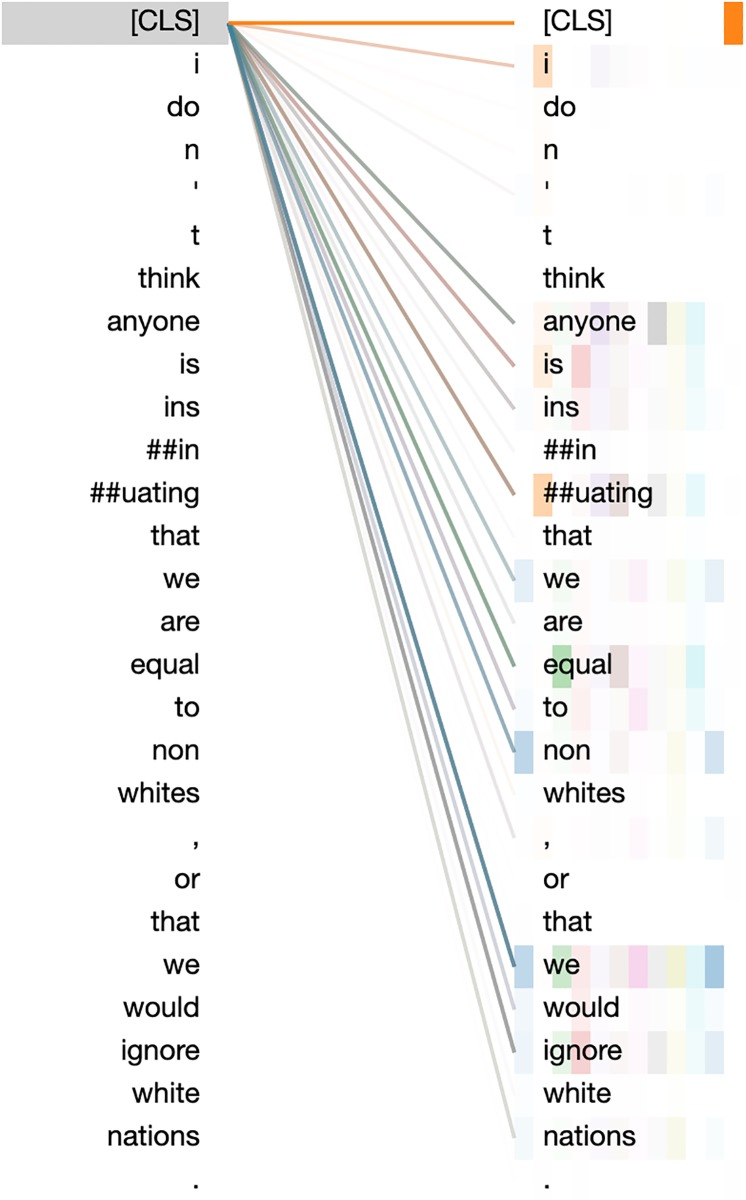
“We present attention visualizations from BertViz [43] for the trained BERT model on the mis-classified forum post “I don’t think anyone is insinuating that we are equal to non whites, or that we would ignore white nations.””
MethodCyberbullying Detection Task: the EBSI-LIA-UNAM System (ELU) at COLING’18 TRAC-1
Arroyo‐Fernández, I., Forest, D., Torres‐Moreno, J., Carrasco-Ruiz, M., Legeleux, T., & Joannette, K. (2018) · PolyPublie (École Polytechnique de Montréal) · Cited by 21
The Ongoing Challenge to Define Free Speech
Wermiel, S. J. (2018) · bepress Legal Repository · Cited by 10
Research works printed but not linked: 3
- JT Nockleby, 2000, Hate Speech, Encyclopedia of the American Constitution, 3, 1277
- Mikolov T, Sutskever I, Chen K, Corrado GS, Dean J. Distributed Representations of Words and Phrases and their Compositionality. In: Burges CJC, Bottou L, Welling M, Ghahramani Z, Weinberger KQ, editors. Advances in Neural Information Processing Systems 26. Curran Associates, Inc.; 2013. p. 3111–3119.
- Waseem Z. Are You a Racist or Am I Seeing Things? Annotator Influence on Hate Speech Detection on Twitter. In: NLP+CSS @ EMNLP; 2016. · DOI · Paper page
Cited by
Internet, social media and online hate speech. Systematic review
Castaño-Pulgarín, S. A., Suárez-Betancur, N., Vega, L. M. T., & López, H. M. H. (2021) · Aggression and Violent Behavior · doi:10.1016/j.avb.2021.101608 · Cited by 395
Developing an online hate classifier for multiple social media platforms
Salminen, J., Hopf, M., Chowdhury, S. A., Jung, S.-G., Almerekhi, H., & Jansen, B. J. (2020) · Human-centric Computing and Information Sciences · doi:10.1186/s13673-019-0205-6 · Cited by 286
ToxiGen: A Large-Scale Machine-Generated Dataset for Adversarial and Implicit Hate Speech Detection
Hartvigsen, T., Gabriel, S., Palangi, H., Sap, M., Ray, D., & Kamar, E. (2022) · Proceedings of the 60th Annual Meeting of the Association for Computational Linguistics (Volume 1: Long Papers) · doi:10.18653/v1/2022.acl-long.234 · Cited by 279
Hate speech detection and racial bias mitigation in social media based on BERT model
Mozafari, M., Farahbakhsh, R., & Crespi, N. (2020) · PLOS ONE · doi:10.1371/journal.pone.0237861 · Cited by 260
“Furthermore, using specific hateful keywords in training data results in many false negatives related to the hateful samples, which are not containing those keywords [4, 13].”
BackgroundMethodResultInfluentialDetecting weak and strong Islamophobic hate speech on social media
Vidgen, B., & Yasseri, T. (2020) · Journal of Information Technology & Politics · doi:10.1080/19331681.2019.1702607 · Cited by 172
Metadata
- Authors
- MacAvaney, S., Yao, H.-R., Yang, E., Russell, K., Goharian, N., & Frieder, O.
- Affiliations
- Georgetown University (US)
- Corresponding author
- MacAvaney, Sean
- Venue
- PLOS ONE
- Publisher
- Public Library of Science (PLoS)
- Published
- 2019-08-20
- Volume
- 14
- Issue
- 8
- Pages
- e0221152
- ISSN
- 1932-6203 (ISSN-L)
- PMC
- PMC6701757
- OpenAlex
- W2969662548
- Cited by
- 566
- References
- 36
- Citations by year
- 2026: 33 · 2025: 79 · 2024: 86 · 2023: 116 · 2022: 103 · 2021: 104 · 2020: 42 · 2019: 3
- FWCI
- 28.43
- Type
- journal article
- Language
- en
- Open access
- gold
- doi.org
- Licence
- Locations
- PLoS ONE (publishedVersion, cc-by)
- Europe PMC (PubMed Central) (publishedVersion, cc-by)
- PubMed Central (publishedVersion, cc-by)
- PubMed (publishedVersion)
- DOAJ (DOAJ: Directory of Open Access Journals) (submittedVersion, cc-by-sa)
- Figshare (submittedVersion, cc-by)
- Topics
- Physical Sciences › Computer Science › Artificial Intelligence › Hate Speech and Cyberbullying Detection
- Physical Sciences › Computer Science › Artificial Intelligence › Sentiment Analysis and Opinion Mining
- Social Sciences › Sociology and Political Science › Misinformation and Its Impacts
- Keywords
- hate speech detection, online texts, interpretability, model interpretability, definition of hate speech, limited training data
- MeSH terms
- Machine Learning, Hate, Humans, Language, Violence, Data Mining, Social Media, Datasets as Topic
About these checks
Registry, retraction, Cites and statistics results are computed, not judged, with one exception: a printed reference that no index lists is read once by a model before it counts as a citation error. Claims are extracted by a model and kept only when their quote appears verbatim in the text; each cited source is then checked, with a model’s help, for whether it says what the claim relies on. Those verdicts can be wrong — read the claim’s quote and the cited source before relying on one.
Statistics and arithmetic are recomputed, not judged.
Confidence bands are shown only for fields calibrated on our annotated test set. None is calibrated yet, so no band is shown.
What counts as a claim ›How we measure confidence ›How we check this ›
Are you an author, or do you see a problem with this page? Request a review
Data sources
Bibliographic data: Semantic Scholar, OpenAlex, Crossref.
Contains information from the Semantic Scholar Academic Graph Datasets, made available under the ODC Attribution License (ODC-BY 1.0).
Semantic Scholar’s data is described in: Kinney, R., et al. (2023). The Semantic Scholar Open Data Platform. arXiv:2301.10140.
