

Ancient Technology and Punctuated Change: Detecting the Emergence of the Edomite Kingdom in the Southern Levant.
Open accessThe DOI matches its Crossref record; 40 of the 43 references it cites were found in a registry or an index.
Abstract
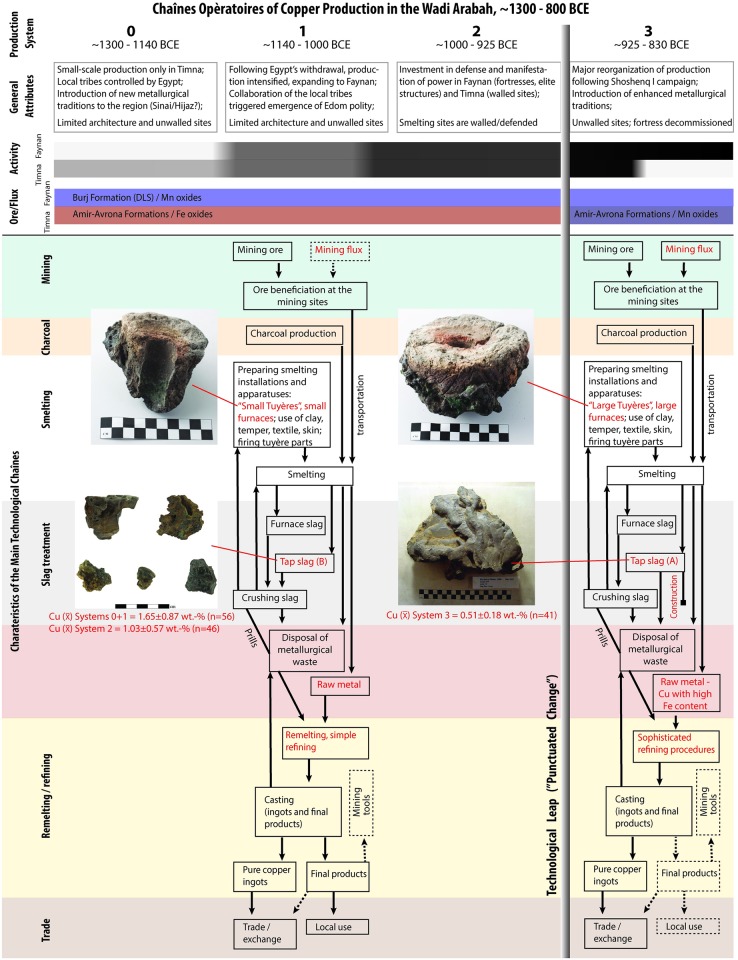
While the punctuated equilibrium model has been employed in paleontological and archaeological research, it has rarely been applied for technological and social evolution in the Holocene. Using metallurgical technologies from the Wadi Arabah (Jordan/Israel) as a case study, we demonstrate a gradual technological development (13th-10th c. BCE) followed by a human agency-triggered punctuated "leap" (late-10th c. BCE) simultaneously across the entire region (an area of ~2000 km2). Here, we present an unparalleled, diachronic archaeometallurgical dataset focusing on elemental analysis of dozens of well-dated slag samples. Based on the results, we suggest punctuated equilibrium provides an innovative theoretical model for exploring ancient technological changes in relation to larger sociopolitical conditions-in the case at hand the emergence of biblical Edom-, exemplifying its potential for more general cross-cultural applications.
Overview
The claims and statistics of this paper haven’t been checked yet.
Free: it reads the open-access text and checks the first 5 claims that cite a source we can check. Create a free account to check every claim.
Integrity signals
Registry
Cites
Statistics
Figures
Verification
Claims the paper makes
The claims and statistics of this paper haven’t been checked yet.
Free: it reads the open-access text and checks the first 5 claims that cite a source we can check. Create a free account to check every claim.
Claims other papers make about this one
Each is checked against this paper’s own text: does it say what the citing paper says it does?
The source backs part of the claim, not all of it — or backs it for a different population, condition or comparison.
In the citing paper
“which is tightly dated by radiocarbon to the late 11th–early 10th centuries BCE”
From Early evidence of royal purple dyed textile from Timna Valley (Israel) (2021) · cites this paper as [66]
Experimental — accuracy not yet measured
Self-check
Percentages, sums and reported differences re-computed from the paper’s own numbers.
The self-check needs the paper’s full text.
Citations
Cites
Punctuated equilibria: an alternative to phyletic gradualism
Eldredge, N., Gould, S. J., & Schöpf, T. J. M. (1972) · Cited by 3,257
Punctuated equilibria: the tempo and mode of evolution reconsidered
Gould, S. J., & Eldredge, N. (1977) · Paleobiology · doi:10.1017/s0094837300005224 · Cited by 2,659 · cited 1×
“Proposed as an alternative to phyletic gradualism, the Darwinian process entailing new species evolving through gradual and steady transformations, punctuated equilibrium suggests biological evolution is characterized by rare, rapid, and episodic events of speciation (cladogenesis) [12, 13].”
BackgroundPunctuated equilibrium comes of age
Gould, S. J., & Eldredge, N. (1993) · Nature · doi:10.1038/366223a0 · Cited by 957 · cited 1×
“, [14], often complementing phyletic gradualism based on the recognition of stasis as a meaningful and predominant pattern within the history of species [15].”
BackgroundSocial Anthropology of Technology
Pfaffenberger, B. (1992) · Annual Review of Anthropology · doi:10.1146/annurev.an.21.100192.002423 · Cited by 655 · cited 1×
“This assumption should be treated with caution in the study of technological trajectories in human societies [40], as discrete cases within the longue durée of a given region can easily deviate from a unilinear development model [41].”
Background1177 B.C.: The Year Civilization Collapsed
Cline, E. H. (2014) · doi:10.1515/9781400849987 · Cited by 452
Tylecote, R. F. (1977) · British Corrosion Journal · doi:10.1179/bcj.1977.12.3.137 · Cited by 386
Evolutionary Theory and Archaeology
DUNNELL, R. C. (1980) · Advances in Archaeological Method and Theory · doi:10.1016/b978-0-12-003103-0.50007-1 · Cited by 365 · cited 2×
“Traditionally, this theoretical borrowing was archaeologically applied to cultural phenomena in place of biological species, using evolutionary models to interpret/understand developments in material culture and social complexity [16].”
BackgroundInfluentialThe Archaeometallurgy of Copper: Evidence from Faynan, Jordan
(2007) · Natural Science in Archaeology · doi:10.1007/978-3-540-72238-0 · Cited by 212
Development of metallurgy in Eurasia
Roberts, B. W., Thornton, C. P., & Pigott, V. C. (2009) · Antiquity · doi:10.1017/s0003598x00099312 · Cited by 192
The Third Intermediate Period in Egypt (1100-650 BC)
Mueller, D., & Kitchen, K. A. (1975) · Journal of the American Research Center in Egypt · doi:10.2307/40000028 · Cited by 177
Research works printed but not linked: 7
- Ben-Yosef E. The Central Timna Valley Project: Research Design and Preliminary Results In: Ben-Yosef E, editor. Mining for Ancient Copper: Essays in Memory of Beno Rothenberg. Tel Aviv: The Institute of Archaeology of Tel Aviv University; 2018 p. 28– 63.
- Rothenberg B, editor. The Ancient Metallurgy of Copper: Archaeology—Experiment—Theory. London: Institute of Archaeology, University College, London; 1990.
- Charlton MF, Shennan SJ, Rehren T, Crew P. Evolutionary analysis of ironmaking slag In: Humpris J, Rehren T, editors. The World of Iron. London: Archetype; 2013 p. 288– 95.
- Ben-Yosef E, Sergi O. The Destruction of Gath by Hazael and the Arabah Copper Industry: A Reassessment In: Shai I, Chadwick JR, Hitchcock L, Dagan A, McKinny C, Uziel J, editors. Tell it in Gath Studies in the History and Archaeology of Israel Essays in Honor of Aren M Maeir on the Occasion of his Sixtieth Birthday. Ägypten und Altes Testament Münster: Zaphon; 2018 p. 461– 80.
- Ben-Yosef E. A False Contrast? On the Possibility of an Early Iron Age Nomadic Monarchy in the Arabah (Early Edom) and Its Implications to the Study of Ancient Israel In: Lipschits O, Sergi O, Koch I, editors. From Nomadism to Monarchy? “The Archaeology of the Settlement Period” Thirty Years Later. Winona Lake: Eisenbrauns; forthcoming.
- Stein GJ. Rethinking World-Systems: Diasporas, Colonies, and Interaction in Uruk Mesopotamia. Tuscon: The University of Arizona Press; 1999.
- Cavanagh M. Sustainability of an Industry on the Fringe: A Dendroarchaeological Investigation into Fuel Sources at the Iron Age Copper Smelting Sites of the Timna Valley [MA thesis]. Tel Aviv: Tel Aviv University; 2016.
Cited by
Early evidence of royal purple dyed textile from Timna Valley (Israel)
Sukenik, N., Iluz, D., Amar, Z., Varvak, A., Shamir, O., & Ben-Yosef, E. (2021) · PLOS ONE · doi:10.1371/journal.pone.0245897 · Cited by 40
“These include a dozen of radiocarbon dates from short-lived materials (mostly date seeds [64]), the study of pottery typology [65] and other considerations [66].”
BackgroundSelf-citationLiss, B., Levy, T. E., & Day, J. M. D. (2020) · Journal of Archaeological Science · doi:10.1016/j.jas.2020.105227 · Cited by 29
Self-citationDirect evidence for the co-manufacturing of early iron and copper-alloy artifacts in the Caucasus
Erb‐Satullo, N. L., Jachvliani, D., Kakhiani, K., & Newman, R. (2020) · Journal of Archaeological Science · doi:10.1016/j.jas.2020.105220 · Cited by 29
Cavanagh, M., Ben‐Yosef, E., & Langgut, D. (2022) · Scientific Reports · doi:10.1038/s41598-022-18940-z · Cited by 28
Self-citationEvian, S. B., Yagel, O. A., Harlavan, Y., Seri, H., Lewinsky, J., & Ben‐Yosef, E. (2021) · Journal of Archaeological Science Reports · doi:10.1016/j.jasrep.2021.103025 · Cited by 39
Self-citation
Metadata
- Authors
- Ben-Yosef, E., Liss, B., Yagel, O. A., Tirosh, O., Najjar, M., & Levy, T. E.
- Affiliations
- University of California San Diego (US)
- Tel Aviv University (IL)
- Hebrew University of Jerusalem (IL)
- Venue
- PLoS ONE
- Publisher
- Public Library of Science (PLoS)
- Published
- 2019-09-18
- Volume
- 14
- Issue
- 9
- Pages
- e0221967
- ISSN
- 1932-6203 (ISSN-L)
- PMC
- PMC6750566
- OpenAlex
- W2974465963
- Cited by
- 49
- References
- 43
- Citations by year
- 2026: 7 · 2025: 3 · 2024: 8 · 2023: 16 · 2022: 5 · 2021: 5 · 2020: 5
- FWCI
- 11.22
- Type
- journal article
- Language
- en
- Open access
- gold
- doi.org
- Licence
- Locations
- PLoS ONE (publishedVersion, cc-by)
- PubMed Central (publishedVersion, cc-by)
- PubMed (publishedVersion)
- DOAJ (DOAJ: Directory of Open Access Journals) (submittedVersion, cc-by-sa)
- eScholarship (California Digital Library) (submittedVersion)
- Figshare (submittedVersion, cc-by)
- Funders
- Israel Science Foundation (1880/17)
- Topics
- Social Sciences › Archeology › Metallurgy and Cultural Artifacts
- Social Sciences › Arts and Humanities › Religious studies › Biblical Studies and Interpretation
- Social Sciences › Archeology › Archaeology and ancient environmental studies
- Keywords
- punctuated equilibrium, ancient metallurgy, slag analysis, archaeometallurgy, technological change, social and political change, human agency, Bronze Age, Southern Levant, elemental analysis
- MeSH terms
- Archaeology, Copper, Humans, Israel, Jordan, Metallurgy, Models, Theoretical, Paleontology, History, Ancient
About these checks
Registry, retraction, Cites and statistics results are computed, not judged, with one exception: a printed reference that no index lists is read once by a model before it counts as a citation error. Claims are extracted by a model and kept only when their quote appears verbatim in the text; each cited source is then checked, with a model’s help, for whether it says what the claim relies on. Those verdicts can be wrong — read the claim’s quote and the cited source before relying on one.
Statistics and arithmetic are recomputed, not judged.
Confidence bands are shown only for fields calibrated on our annotated test set. None is calibrated yet, so no band is shown.
What counts as a claim ›How we measure confidence ›How we check this ›
Are you an author, or do you see a problem with this page? Request a review
How to cite
Cite CoChat for the checks on this page, and the paper for its own findings.
- This page
- CoChat. (2026). Citation check: Ancient Technology and Punctuated Change: Detecting the Emergence of the Edomite Kingdom in the Southern Levant. https://app.cochat.ai/papers/10.1371/journal.pone.0221967
- The paper
- Ben-Yosef, E., Liss, B., Yagel, O. A., Tirosh, O., Najjar, M., & Levy, T. E. (2019). Ancient Technology and Punctuated Change: Detecting the Emergence of the Edomite Kingdom in the Southern Levant. PLoS ONE. https://doi.org/10.1371/journal.pone.0221967
Data sources
Bibliographic data: Semantic Scholar, OpenAlex, Crossref.
Contains information from the Semantic Scholar Academic Graph Datasets, made available under the ODC Attribution License (ODC-BY 1.0).
Semantic Scholar’s data is described in: Kinney, R., et al. (2023). The Semantic Scholar Open Data Platform. arXiv:2301.10140.
