

Affirmative citation bias in scientific myth debunking: A three-in-one case study
Open accessThe DOI matches its Crossref record; 31 of the 31 references it cites were found in a registry or an index.
Abstract
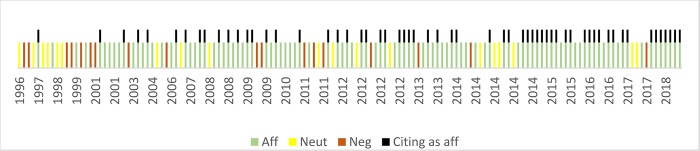
Several uncorroborated, false, or misinterpreted conceptions have for years been widely distributed in academic publications, thus becoming scientific myths. How can such misconceptions persist and proliferate within the inimical environment of academic criticism? Examining 613 articles we demonstrate that the reception of three myth-exposing publications is skewed by an 'affirmative citation bias': The vast majority of articles citing the critical article will affirm the idea criticized. 468 affirmed the myth, 105 were neutral, while 40 took a negative stance. Once misconceptions proliferate wide and long enough, criticizing them not only becomes increasingly difficult, efforts may even contribute to the continued spreading of the myths.
Overview
The claims and statistics of this paper haven’t been checked yet.
Free: it reads the open-access text and checks the first 5 claims that cite a source we can check. Create a free account to check every claim.
Integrity signals
Registry
Cites
Statistics
Figures


Verification
Claims the paper makes
The claims and statistics of this paper haven’t been checked yet.
Free: it reads the open-access text and checks the first 5 claims that cite a source we can check. Create a free account to check every claim.
Claims other papers make about this one
Each is checked against this paper’s own text: does it say what the citing paper says it does?
The cited source says what the claim attributes to it.
In the citing paper
“Indeed, Letrud and Hernes recently documented many cases where people were citing reports for the opposite conclusions the original authors made ( 15 ) .”
From scite: a smart citation index that displays the context of citations and classifies their intent using deep learning (2021) · cites this paper as [15]
Self-check
Percentages, sums and reported differences re-computed from the paper’s own numbers.
The self-check needs the paper’s full text.
Citations
Cites
Why Most Published Research Findings Are False
Ioannidis, J. P. A. (2005) · PLoS Medicine · doi:10.1371/journal.pmed.0020124 · Cited by 10,505
Why Most Published Research Findings Are False
Ioannidis, J. P. A. (2005) · CHANCE · doi:10.1080/09332480.2005.10722754 · Cited by 4,702
The Hawthorne effect: A reconsideration of the methodological artifact.
Adair, J. G. (1984) · Journal of Applied Psychology · doi:10.1037/0021-9010.69.2.334 · Cited by 1,095
The Hawthorne Experiments: First Statistical Interpretation
Franke, R. H., & Kaul, J. D. (1978) · American Sociological Review · doi:10.2307/2094540 · Cited by 648
Wickström (2000) · doi:10.5271/sjweh.555 · Cited by 526
How citation distortions create unfounded authority: analysis of a citation network
Greenberg, S. A. (2009) · BMJ · doi:10.1136/bmj.b2680 · Cited by 499
Yerkes-Dodson: A Law for all Seasons
Teigen, K. H. (1994) · Theory & Psychology · doi:10.1177/0959354394044004 · Cited by 499
Stop propagating the learning styles myth
Kirschner, P. A. (2017) · Computers & Education · doi:10.1016/j.compedu.2016.12.006 · Cited by 459
(1992) · American Journal of Sociology · doi:10.1086/230046 · Cited by 406
Riener, C., & Willingham, D. (2010) · Change: The Magazine of Higher Learning · doi:10.1080/00091383.2010.503139 · Cited by 299
Research works printed but not linked: 2
- Teigen KH. En artikkel for alle årstider [An article for all seasons]. Psykologitidsskriftet. 2017; 55(5): 472– 7.
- Busse R, Warner M. The legacy of the hawthorne experiments: A critical analysis of the human relations school of though. History of Economic Ideas. 2017; 25(2): 91– 114.
Cited by
Green and sustainable AI research: an integrated thematic and topic modeling analysis
Raman, R., Pattnaik, D., Lathabai, H. H., Kumar, C., Govindan, K., & Nedungadi, P. (2024) · Journal of Big Data · doi:10.1186/s40537-024-00920-x · Cited by 145
Raman, R., Kowalski, R. M., Achuthan, K., Iyer, A., & Nedungadi, P. (2025) · Scientific Reports · doi:10.1038/s41598-025-92190-7 · Cited by 170
Integrating sustainability into cybersecurity: insights from machine learning based topic modeling
Achuthan, K., Sankaran, S., Roy, S., & Raghu Raman, R. (2025) · Discover Sustainability · doi:10.1007/s43621-024-00754-w · Cited by 88
Raman, R., Gunasekar, S., Deepa, K., & Nedungadi, P. (2024) · Sustainability · doi:10.3390/su16219144 · Cited by 72
Rewardlessness in orchids: how frequent and how rewardless?
Shrestha, M. R., Dyer, A. G., Dorin, A., Ren, Z., & Burd, M. (2020) · Plant Biology · doi:10.1111/plb.13113 · Cited by 52
Mapping biomimicry research to sustainable development goals
Raman, R., Sreenivasan, A., Suresh, M., & Nedungadi, P. (2024) · Scientific Reports · doi:10.1038/s41598-024-69230-9 · Cited by 52
Exploring Sustainable Development Goal Research Trajectories in Small Island Developing States
Raman, R., Filho, W. L., Martin, H. G., Ray, S., Das, D., & Nedungadi, P. (2024) · Sustainability · doi:10.3390/su16177463 · Cited by 56
Quaquebeke, N. V., Tonidandel, S., & Banks, G. C. (2025) · The Leadership Quarterly · doi:10.1016/j.leaqua.2025.101895 · Cited by 61
Positionality in Public Service Interpreting Research
Mellinger, C. D. (2020) · FITISPos-International Journal · doi:10.37536/fitispos-ij.2020.7.1.250 · Cited by 41
Mapping Metaverse Research to the Sustainable Development Goal of Good Health and Well-Being
Raman, R., Hughes, L., Mandal, S., Das, P., & Nedungadi, P. (2024) · IEEE Access · doi:10.1109/access.2024.3502171 · Cited by 35
Mapping research in the Journal of Innovation & Knowledge to sustainable development goals
Raman, R., Pattnaik, D., Achuthan, K., Hughes, L., Al-Busaidi, A. S., Dwivedi, Y. K., Ramesh, M. V., & Nedungadi, P. (2024) · Journal of Innovation & Knowledge · doi:10.1016/j.jik.2024.100538 · Cited by 38
Nicholson, J. M., Mordaunt, M., Lopez, P., Uppala, A., Rosati, D., Rodrigues, N. P., Grabitz, P., & Rife, S. C. (2021) · bioRxiv (published in Quantitative Science Studies) · doi:10.1101/2021.03.15.435418 · Cited by 202
Cantrell, A. J., Booth, A., & Chambers, D. (2022) · Health Information & Libraries Journal · doi:10.1111/hir.12428 · Cited by 27
Bestiary of Questionable Research Practices in Psychology
Nagy, T., Hergert, J., Elsherif, M. M., Wallrich, L., Schmidt, K., Waltzer, T., Payne, J. W., Gjoneska, B., Seetahul, Y., Wang, Y. A., et al. (2025) · Advances in Methods and Practices in Psychological Science · doi:10.1177/25152459251348431 · Cited by 37
Novel predictions arise from contradictions
Yanai, I., & Lercher, M. J. (2021) · Genome biology · doi:10.1186/s13059-021-02371-6 · Cited by 21
Seeing beyond the frames we inherit: A challenge to tenacious conservation narratives
Chignell, S. M., & Satterfield, T. A. (2023) · People and Nature · doi:10.1002/pan3.10550 · Cited by 19
A simulation-based analysis of the impact of rhetorical citations in science
Bao, H., & Teplitskiy, M. (2024) · Nature Communications · doi:10.1038/s41467-023-44249-0 · Cited by 23
Raman, R., Santhanagopalan, D., Dénes, D. L., Nedungadi, P., Ramakrishna, S., & Achuthan, K. (2025) · Journal of Energy Storage · doi:10.1016/j.est.2025.116910 · Cited by 14
Enabling Flexible, Resilient, and Sustainable Supply Chains through Metaverse Technologies
Raghu Raman, R., Gunasekaran, A., & Suresh, M. (2026) · Global Journal of Flexible Systems Management · doi:10.1007/s40171-026-00490-2 · Cited by 12
Embracing unpopular ideas: Introduction to the special section on heterodox issues in psychology.
Lilienfeld, S. O. (2020) · Archives of Scientific Psychology · doi:10.1037/arc0000072 · Cited by 8
High-cited favorable studies for COVID-19 treatments ineffective in large trials
Ioannidis, J. P. A. (2022) · Journal of Clinical Epidemiology · doi:10.1016/j.jclinepi.2022.04.001 · Cited by 7
Schweinsberg, M., Thau, S., & Pillutla, M. M. (2023) · Perspectives on Psychological Science · doi:10.1177/17456916221144990 · Cited by 16
Nedungadi, P., Onyancha, O. B., Filho, W. L., & Raghu Raman, R. (2025) · Discover Sustainability · doi:10.1007/s43621-025-01792-8 · Cited by 9
Sándor, K., Könnyű, B., & Miklósi, Á. (2021) · Scientific Reports · doi:10.1038/s41598-021-95384-x · Cited by 5
Text and Team: What Article Metadata Characteristics Drive Citations in Software Engineering?
Graf‐Vlachy, L., Graziotin, D., & Wagner, S. (2022) · International Conference on Evaluation and Assessment in Software Engineering (EASE) · doi:10.1145/3530019.3530022 · Cited by 5
On author self-citations as carriers of scientific topic structure information
Donner, P., & Henneken, E. A. (2025) · Quantitative Science Studies · doi:10.1162/qss_a_00357 · Cited by 2
Incorrigible Science and Doctrinal Pseudoscience
Letrud, K. (2022) · International Studies in the Philosophy of Science · doi:10.1080/02698595.2023.2218264 · Cited by 2
Self-citationRed imported fire ant Solenopsis invicta buren workers do not have ovaries
Hoffmann, B. D., Pettit, M., & Ghodke, A. B. (2024) · Insectes Sociaux · doi:10.1007/s00040-024-00951-w · Cited by 2
Reliability of references to scientific publications: Where myths and inaccuracies originate
Бобров, Л. К. (2022) · Scientific and Technical Libraries · doi:10.33186/1027-3689-2022-5-47-65 · Cited by 2
Bissonette, J. A. (2021) · Wildlife Society Bulletin · doi:10.1002/wsb.1201 · Cited by 3
Bianchi, C. N., Natale, A. D., Abaunza, P., Fonteneau, A., Manzella, G. M. R., Ragonese, S., Tserpes, G., & Lutcavage, M. E. (2025) · Estuarine Coastal and Shelf Science · doi:10.1016/j.ecss.2025.109184 · Cited by 1
The ear of the beholder: Does listener introversion predict perceptions of being heard?
Winchester, C. C., Wanberg, C. R., Kammeyer‐Mueller, J. D., & Campbell, E. M. (2026) · Journal of Vocational Behavior · doi:10.1016/j.jvb.2025.104206 · Cited by 1
Pozitivist-Ampirik Araştırmalarda İnsan: Yanıltmacanın Dünü, Bugünü ve Yarını - 2
Yüksel, A. (2020) · Seyahat ve Otel İşletmeciliği Dergisi · doi:10.24010/soid.720112 · Cited by 1
Anwar, C. M. (2022) · Tourism Critiques Practice and Theory · doi:10.1108/trc-03-2022-0004 · Cited by 2
Multifaceted roles of SAMHD1 in cancerPreprint
McLaughlin, K.-M., Cinatl, J. J., Wass, M. N., & Michaelis, M. (2021) · bioRxiv (Cold Spring Harbor Laboratory) · doi:10.1101/2021.07.03.451003 · Cited by 1
Vallesi, A. (2025) · Frontiers in Psychology · doi:10.3389/fpsyg.2025.1581160 · Cited by 1
Donner, P. (2023) · International Conference on Science, Technology and Innovation Indicators (STI) · doi:10.55835/643fed628e529cfebf33f797
Metadata
- Authors
- Letrud, K., & Hernes, S.
- Affiliations
- University of Inland Norway (NO)
- Corresponding author
- Letrud, Kåre
- Venue
- PLOS ONE
- Publisher
- Public Library of Science (PLoS)
- Published
- 2019-09-09
- Volume
- 14
- Issue
- 9
- Pages
- e0222213
- ISSN
- 1932-6203 (ISSN-L)
- PMC
- PMC6733478
- OpenAlex
- W2972668757
- Cited by
- 37
- References
- 31
- Citations by year
- 2026: 2 · 2025: 9 · 2024: 8 · 2023: 3 · 2022: 6 · 2021: 5 · 2020: 4
- FWCI
- 2.51
- Type
- journal article
- Language
- en
- Open access
- gold
- doi.org
- Licence
- Locations
- PLoS ONE (publishedVersion, cc-by)
- Europe PMC (PubMed Central) (publishedVersion, cc-by)
- PubMed Central (publishedVersion, cc-by)
- PubMed (publishedVersion)
- RePEc: Research Papers in Economics (submittedVersion)
- NORA - Norwegian Open Research Archives (submittedVersion, cc-by)
- DOAJ (DOAJ: Directory of Open Access Journals) (submittedVersion, cc-by-sa)
- Topics
- Social Sciences › Library and Information Sciences › scientometrics and bibliometrics research
- Social Sciences › Library and Information Sciences › Academic Publishing and Open Access
- Social Sciences › Sociology and Political Science › Misinformation and Its Impacts
- Keywords
- scientific myths, myth debunking, citation bias, citation patterns, science misconceptions, persistence of misconceptions, academic criticism
- MeSH terms
- Humans, Publications, Bibliometrics
About these checks
Registry, retraction, Cites and statistics results are computed, not judged, with one exception: a printed reference that no index lists is read once by a model before it counts as a citation error. Claims are extracted by a model and kept only when their quote appears verbatim in the text; each cited source is then checked, with a model’s help, for whether it says what the claim relies on. Those verdicts can be wrong — read the claim’s quote and the cited source before relying on one.
Statistics and arithmetic are recomputed, not judged.
Confidence bands are shown only for fields calibrated on our annotated test set. None is calibrated yet, so no band is shown.
What counts as a claim ›How we measure confidence ›How we check this ›
Are you an author, or do you see a problem with this page? Request a review
Data sources
Bibliographic data: Semantic Scholar, OpenAlex, Crossref.
Contains information from the Semantic Scholar Academic Graph Datasets, made available under the ODC Attribution License (ODC-BY 1.0).
Semantic Scholar’s data is described in: Kinney, R., et al. (2023). The Semantic Scholar Open Data Platform. arXiv:2301.10140.
