

The DOI matches its Crossref record; 36 of the 39 references it cites were found in a registry or an index.
A brief diet intervention can reduce symptoms of depression in young adults—a randomised controlled trial
Open accessAbstract
There is strong epidemiological evidence that poor diet is associated with depression. The reverse has also been shown, namely that eating a healthy diet rich in fruit, vegetables, fish and lean meat, is associated with reduced risk of depression. To date, only one randomised controlled trial (RCT) has been conducted with elevated depression symptoms being an inclusion criterion, with results showing that a diet intervention can reduce clinical levels of depression. No such RCTs have been performed in young adults. Young adults with elevated levels of depression symptoms and who habitually consume a poor diet were randomly allocated to a brief 3-week diet intervention (Diet Group) or a habitual diet control group (Control Group). The primary and secondary outcome measures assessed at baseline and after the intervention included symptoms of depression (Centre for Epidemiological Studies Depression Scale; CESD-R; and Depression Anxiety and Stress Scale- 21 depression subscale; DASS-21-D), current mood (Profile of Mood States), self-efficacy (New General Self-Efficacy Scale) and memory (Hopkins Verbal Learning Test). Diet compliance was measured via self-report questionnaires and spectrophotometry. One-hundred-and-one individuals were enrolled in the study and randomly assigned to the Diet Group or the Control Group. Upon completion of the study, there was complete data for 38 individuals in each group. There was good compliance with the diet intervention recommendations assessed using self-report and spectrophotometry. The Diet group had significantly lower self-reported depression symptoms than the Control Group on the CESD-R (p = 0.007, Cohen's d = 0.65) and DASS-21 depression subscale (p = 0.002, Cohen's d = 0.75) controlling for baseline scores on these scales. Reduced DASS-21 depression subscale scores were maintained on follow up phone call 3 months later (p = .009). These results are the first to show that young adults with elevated depression symptoms can engage in and adhere to a diet intervention, and that this can reduce symptoms of depression. The findings provide justification for future research into the duration of these benefits, the impacts of varying diet composition, and their biological basis.
Overview
The claims and statistics of this paper haven’t been checked yet.
Run the check — free, no account needed. It reads the open-access text and checks the sources it cites.
Integrity signals
Registry
Cites
Statistics
Figures
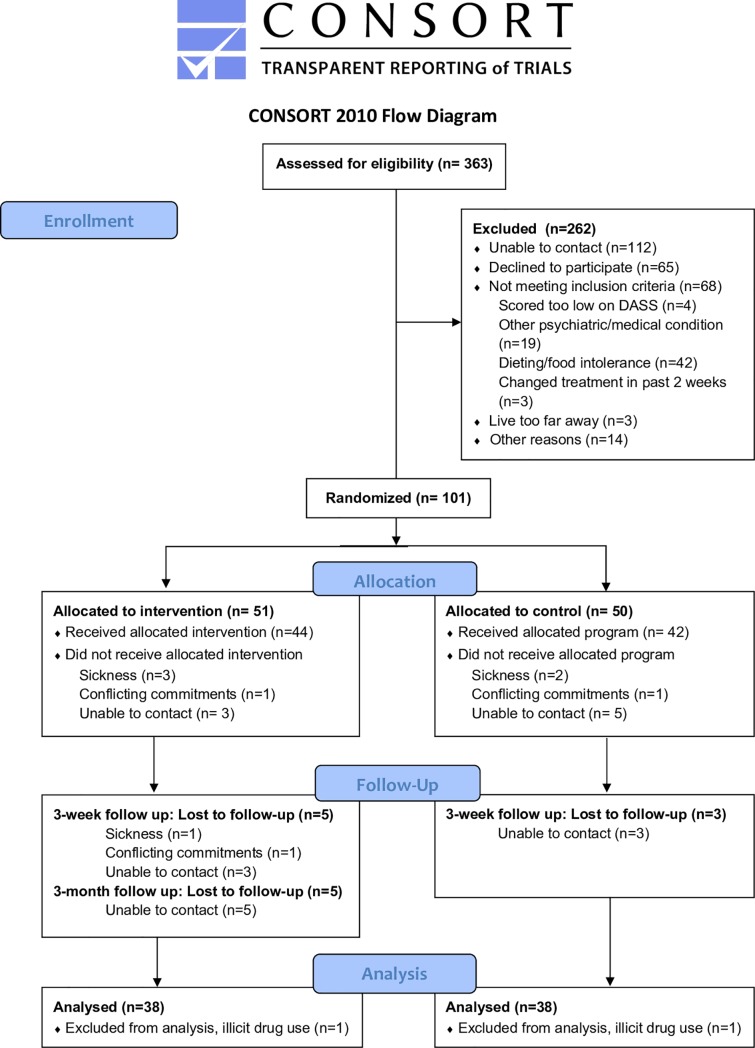
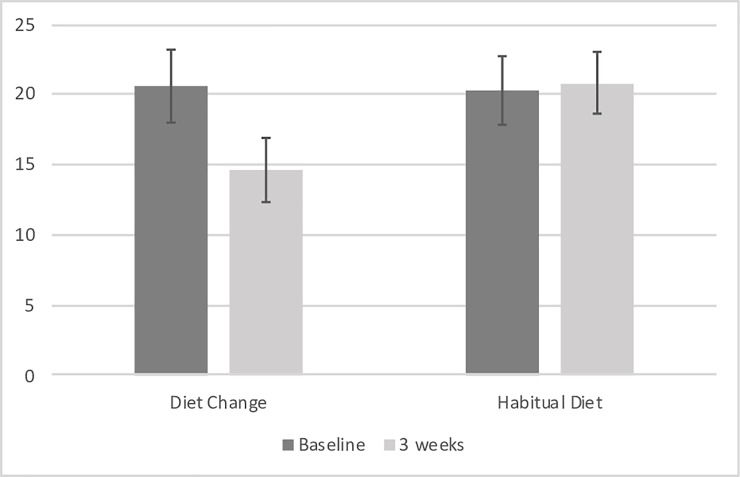
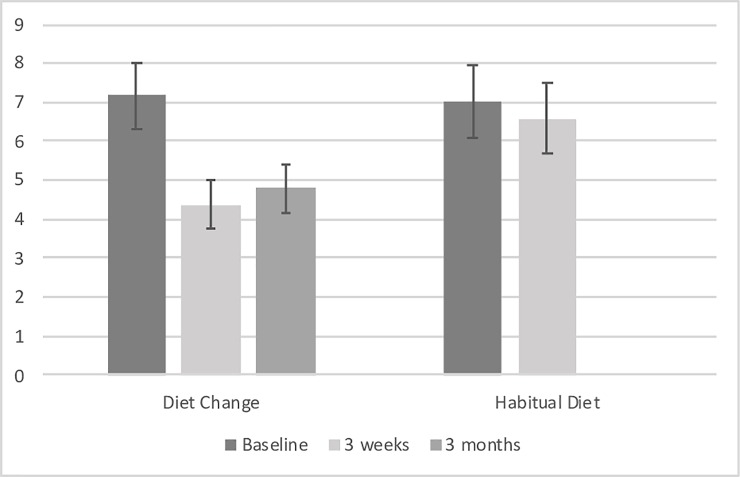
Verification
Claims the paper makes
The claims and statistics of this paper haven’t been checked yet.
Run the check — free, no account needed. It reads the open-access text and checks the sources it cites.
Claims other papers make about this one
Each is checked against this paper’s own text: does it say what the citing paper says it does?
The source backs part of the claim, not all of it — or backs it for a different population, condition or comparison.
In the citing paper
“several recent RCTs (not captured in our meta-review) have reported significant improvements in clinical depression from Mediterranean diet interventions, observing moderately large positive effects 102-104 .”
From A meta-review of "lifestyle psychiatry": the role of exercise, smoking, diet and sleep in the prevention and treatment of mental disorders (2020) · cites this paper as [102]
Experimental — accuracy not yet measuredIn the citing paper
“While there is existing evidence from clinical interventions showing improvements in depression and anxiety symptoms following dietary manipulation (199, 311, 326), these studies have not, to date, collected gut microbiota data.”
From Diet and the Microbiota–Gut–Brain Axis: Sowing the Seeds of Good Mental Health (2021) · cites this paper as [326]
In the citing paper
“On the other hand, several recent smaller trials in individuals with current depression observed moderately large improvements from interventions based on the Mediterranean diet.35 36 37”
From Food and mood: How do diet and nutrition affect mental wellbeing? (2020) · cites this paper as [35]
Self-check
Percentages, sums and reported differences re-computed from the paper’s own numbers.
The self-check needs the paper’s full text.
Citations
Cites
Statistical Power Analysis for the Behavioral Sciences
Muller, K. E., & Cohen, J. (1989) · Technometrics · doi:10.2307/1270020 · Cited by 99,603
The CES-D Scale: A Self-Report Depression Scale for Research in the General Population
Radloff, L. S. (1977) · Applied Psychological Measurement · doi:10.1177/014662167700100306 · Cited by 53,267
International physical activity questionnaire: 12-country reliability and validity
CRAIG, C. L., MARSHALL, A. L., SJ??STR??M, M., BAUMAN, A. E., BOOTH, M. L., AINSWORTH, B. E., PRATT, M., EKELUND, U., YNGVE, A., SALLIS, J. F., et al. (2003) · Medicine & Science in Sports & Exercise · doi:10.1249/01.mss.0000078924.61453.fb · Cited by 21,619
Kessler, R. C., Berglund, P., Demler, O., Jin, R., Merikangas, K. R., & Walters, E. E. (2005) · Archives of General Psychiatry · doi:10.1001/archpsyc.62.6.593 · Cited by 20,391
Jacobson, N. S., & Truax, P. (1991) · Journal of Consulting and Clinical Psychology · doi:10.1037/0022-006x.59.1.12 · Cited by 7,770
Validation of a New General Self-Efficacy Scale
Chen, G., Gully, S. M., & Eden, D. (2001) · Organizational Research Methods · doi:10.1177/109442810141004 · Cited by 3,542
Intention-to-treat concept: A review
Gupta, S. (2011) · Perspectives in Clinical Research · doi:10.4103/2229-3485.83221 · Cited by 1,921
The Use of Psychological Testing for Treatment Planning and Outcomes Assessment
(2004) · doi:10.4324/9781410610614 · Cited by 1,503
The nutrition transition: new trends in the global diet
Drewnowski, A., & Popkin, B. M. (2009) · Nutrition Reviews · doi:10.1111/j.1753-4887.1997.tb01593.x · Cited by 1,440
Jacka, F. N., O’Neil, A., Opie, R., Itsiopoulos, C., Cotton, S., Mohebbi, M., Castle, D., Dash, S., Mihalopoulos, C., Chatterton, M. L., et al. (2017) · BMC Medicine · doi:10.1186/s12916-017-0791-y · Cited by 1,093
Research works printed but not linked: 8
- JS Lai, 2013, Systematic Review and Meta-Analysis of Dietary Patterns and Depression: Observational Studies, Ann Nutr Metab, 63, 428
- S Lovibond, 1995, Manual for the Depression Anxiety and Stress Scales
- 2003, Dietary Guidelines for Australian Adults. A guide to healthy eating
- J Brandt, 1991, Hopkins Verbal Learning Test-Revised (HVLT-R)
- C Randolph, 1999, RBANS Repeatable Battery for the Assessment of Neuropsychological Status: Manual
- D Wechsler, 2008, WAIS-IV: Wechsler Adult Intelligence Scale
- DE Moul, 2002, Preliminary study of the test-retest reliability and concurrent validities of the Pittsburgh Insomnia Rating Scale (PIRS), Sleep, 25, A246
- G Hendrie, 2016, CSIRO Healthy Diet Score
Cited by
Sorted by citations
Firth, J., Solmi, M., Wootton, R. E., Vancampfort, D., Schuch, F. B., Hoare, E., Gilbody, S., Torous, J., Teasdale, S. B., Jackson, S. E., et al. (2020) · World Psychiatry · doi:10.1002/wps.20773 · Cited by 1,242
Diet and depression: Exploring the biological mechanisms of action
Marx, W., Lane, M., Hockey, M., Aslam, H., Berk, M., Walder, K., Borsini, A., Firth, J., Pariante, C. M., Berding, K., et al. (2021) · Molecular Psychiatry · doi:10.1038/s41380-020-00925-x · Cited by 685
Molecular pathways of major depressive disorder converge on the synapse
Fries, G. R., Saldana, V. A., Finnstein, J., & Rein, T. (2023) · Molecular Psychiatry · doi:10.1038/s41380-022-01806-1 · Cited by 504
Food and mood: How do diet and nutrition affect mental wellbeing?
Firth, J., Gangwisch, J. E., Borsini, A., Wootton, R. E., & Mayer, E. A. (2020) · BMJ · doi:10.1136/bmj.m2382 · Cited by 475
Diet and the Microbiota–Gut–Brain Axis: Sowing the Seeds of Good Mental Health
Berding, K., Vlckova, K., Marx, W., Schellekens, H., Stanton, C., Clarke, G., Jacka, F., Dinan, T. G., & Cryan, J. F. (2021) · Advances in Nutrition · doi:10.1093/advances/nmaa181 · Cited by 451
Metadata
- Authors
- Francis, H. M., Stevenson, R. J., Chambers, J. R., Gupta, D., Newey, B., & Lim, C. K.
- Affiliations
- Macquarie University (AU)
- Corresponding author
- Francis, Heather M.
- Venue
- PLOS ONE
- Publisher
- Public Library of Science (PLoS)
- Published
- 2019-10-09
- Volume
- 14
- Issue
- 10
- Pages
- e0222768
- ISSN
- 1932-6203 (ISSN-L)
- PMC
- PMC6784975
- OpenAlex
- W2980066052
- Cited by
- 277
- References
- 39
- Citations by year
- 2026: 19 · 2025: 57 · 2024: 51 · 2023: 43 · 2022: 47 · 2021: 37 · 2020: 23
- FWCI
- 24.63
- Type
- journal article
- Language
- en
- Open access
- gold
- doi.org
- Licence
- Locations
- PLoS ONE (publishedVersion, cc-by)
- PubMed Central (publishedVersion, cc-by)
- PubMed (publishedVersion)
- DOAJ (DOAJ: Directory of Open Access Journals) (submittedVersion, cc-by-sa)
- Figshare (submittedVersion, cc-by)
- Funders
- Society for Mental Health Research (Project Grant 2016)
- Topics
- Health Sciences › Medicine › Public Health, Environmental and Occupational Health › Nutritional Studies and Diet
- Health Sciences › Nursing › Nutrition and Dietetics › Nutrition, Health and Food Behavior
- Social Sciences › Psychology › Clinical Psychology › Eating Disorders and Behaviors
- Keywords
- depression, dietary intervention, young adults, depressive symptoms, dietary adherence, mood, self-efficacy, memory, healthy eating
- MeSH terms
- Adult, Depression, Diet, Female, Follow-Up Studies, Health Planning Guidelines, Humans, Male, Patient Compliance, Outcome Assessment, Health Care, Young Adult, Intention to Treat Analysis
About these checks
Registry, retraction, Cites and statistics results are computed, not judged, with one exception: a printed reference that no index lists is read once by a model before it counts as a citation error. Claims are extracted by a model and kept only when their quote appears verbatim in the text; each cited source is then checked, with a model’s help, for whether it says what the claim relies on. Those verdicts can be wrong — read the claim’s quote and the cited source before relying on one.
Statistics and arithmetic are recomputed, not judged.
Confidence bands are shown only for fields calibrated on our annotated test set. None is calibrated yet, so no band is shown.
What counts as a claim ›How we measure confidence ›How we check this ›
Are you an author, or do you see a problem with this page? Request a review
