

The DOI matches its Crossref record; 66 of the 68 references it cites were found in a registry or an index, and 1 are not checked yet.
Evaluation of various methods of selection of B. subtilis strains capable of secreting surface-active compounds
Open accessAbstract
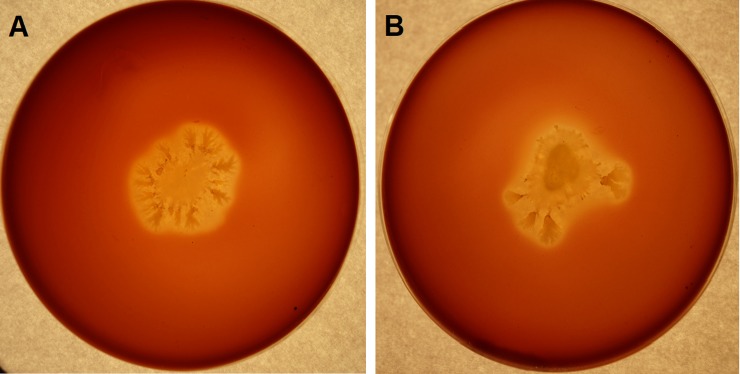
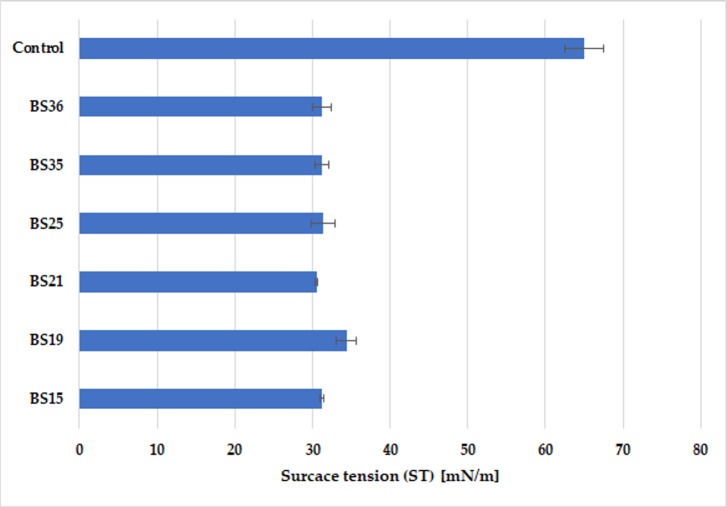
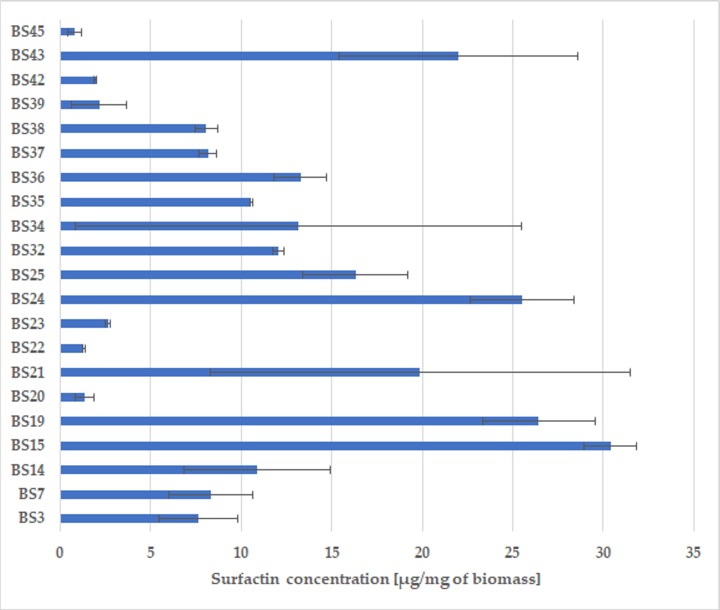
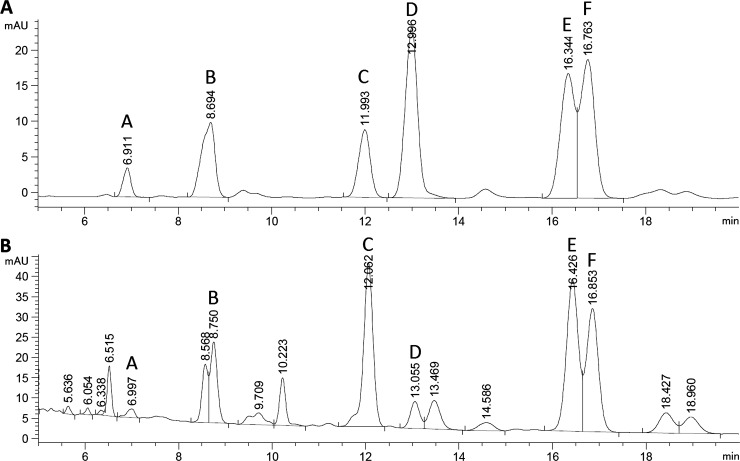
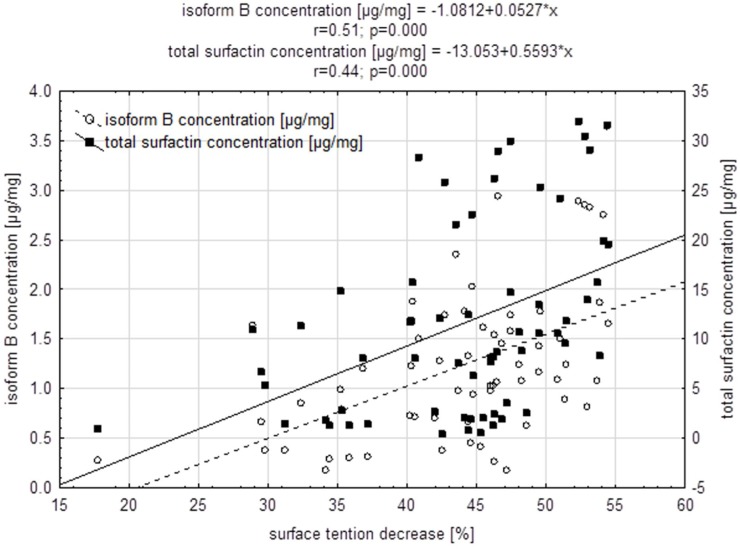
The aim of the study was the evaluation of a three-step method for the selection of bacterial strains capable of producing surfactin. The procedure consisted of the following steps: 1.blood agar test, 2. measurement of the surface tension (ST) of the medium using the du Nouy method before and after submerged culture, 3. qualitative and quantitative assessment of surfactin by HPLC. Forty five Bacillus subtilis natto strains producing haemolysis zones (≥3mm) were selected. Nineten of them reduced ST of the medium to ≤ 40 mN/m; in six cases, the reduction was as much as 50%. All indicated strains produced surfactin. Positive correlations (p <0.5) between the percentage reduction of ST of the medium and surfactin concentration (r = 0.44), indicate that this parameter is determinant of the ability to synthesize this compound. The blood agar test has been shown to be useful only as a pre-selection criterion for surfactin producers (18 strains selected by this method reduced ST by only ≤30%). The proposed selection strategy proved effective and made it possible to select the BS15 strain that reduced the ST of the medium to 30.56 ± 0.15 mN/m and simultaneously provided a high concentration of surfactin compared to other strains.
Overview
The claims and statistics of this paper haven’t been checked yet.
Run the check — free, no account needed. It reads the open-access text and checks the sources it cites.
Integrity signals
Registry
Cites
Statistics
Figures
Verification
Claims the paper makes
The claims and statistics of this paper haven’t been checked yet.
Run the check — free, no account needed. It reads the open-access text and checks the sources it cites.
Self-check
Percentages, sums and reported differences re-computed from the paper’s own numbers.
The self-check needs the paper’s full text.
Citations
Cites
Potential commercial applications of microbial surfactants
Banat, I. M., Makkar, R. S., & Cameotra, S. S. (2000) · Applied Microbiology and Biotechnology · doi:10.1007/s002530051648 · Cited by 1,597
Biosurfactants: Multifunctional Biomolecules of the 21st Century
Santos, D., Rufino, R. D., Luna, J. M. D., dos Santos, V. A., & Sarubbo, L. A. (2016) · International Journal of Molecular Sciences · doi:10.3390/ijms17030401 · Cited by 1,138
Comparison of methods to detect biosurfactant production by diverse microorganisms
Youssef, N. H., Duncan, K. E., Nagle, D. P., Savage, K. N., Knapp, R. M., & McInerney, M. J. (2003) · Journal of Microbiological Methods · doi:10.1016/j.mimet.2003.11.001 · Cited by 931
Recent trends in the biochemistry of surfactin
PEYPOUX, F., Bonmatin, J. M., & Wallach, J. (1999) · Applied Microbiology and Biotechnology · doi:10.1007/s002530051432 · Cited by 818
Towards commercial production of microbial surfactants
Mukherjee, S., Das, P., & Sen, R. (2006) · Trends in Biotechnology · doi:10.1016/j.tibtech.2006.09.005 · Cited by 766
Advances in Experimental Medicine and Biology
Berry, C. L. (1973) · Journal of Medical Genetics · doi:10.1136/jmg.10.4.401-a · Cited by 668
Cooper, D. G., Macdonald, C. R., Duff, S. J. B., & Kosaric, N. (1981) · Applied and Environmental Microbiology · doi:10.1128/aem.42.3.408-412.1981 · Cited by 591
Nitschke, M., & Pastore, G. M. (2006) · Bioresource Technology · doi:10.1016/j.biortech.2005.02.044 · Cited by 479
Surfactants in the Environment
Ivanković, T., & Hrenović, J. (2010) · Archives of Industrial Hygiene and Toxicology · doi:10.2478/10004-1254-61-2010-1943 · Cited by 477
Cost effective technologies and renewable substrates for biosurfactants’ production
Banat, I. M., Satpute, S. K., Cameotra, S. S., Patil, R., & Nyayanit, N. V. (2014) · Frontiers in Microbiology · doi:10.3389/fmicb.2014.00697 · Cited by 461
Research works printed but not linked: 4
- Acmite Market Intelligence Market Report: World Surfactant Market. Archived from the original on April 2016. 4th edition.
- HB Sobrinho, 2014, Biosurfactants: classification, properties and environmental applications, Biotechnology, 11, 1
- K Czaczyk, 2007, The effect of environmental factors influencing lipopeptide biosurfactants biosynthesis by Bacillus spp, Food. Science. Technology. Quality, 1, 140
- R Dhiman, 2016, Biosurfactants and their screening methods, Res J Recent Sci, 5, 39
Cited by
Sorted by citations
Markam, S. S., Raj, A., Kumar, A., & Khan, M. L. (2024) · Current Research in Microbial Sciences · doi:10.1016/j.crmicr.2024.100266 · Cited by 57
Koim-Puchowska, B., Kłosowski, G., Dróżdż-Afelt, J. M., Mikulski, D., & Zielińska, A. (2021) · Molecules · doi:10.3390/molecules26102985 · Cited by 34
“The biomass was dried to a constant mass using a weighting dryer (RADWAG WPS-30S, Radwag, Radom, Poland) at 105 ◦C and 20 s sampling time [60].”
MethodSelf-citationHeidi Schalchli, S., Lamilla, C., Rubilar, O., Briceño, G. E., Gallardo, F., Durán, N., Huenchupán, A., & Diez, M. C. (2023) · Journal of environmental chemical engineering · doi:10.1016/j.jece.2023.111572 · Cited by 32
Mendoza, I. C., Villavicencio-Vásquez, M., Aguayo, P., Montoya, D. C., Plaza, L., Romero-Peña, M., Marqués, A. M., & Coronel-León, J. (2022) · Microorganisms · doi:10.3390/microorganisms10081518 · Cited by 27
Malakar, C., Barman, D., Kalita, M. C., & Deka, S. (2023) · Journal of Basic Microbiology · doi:10.1002/jobm.202200608 · Cited by 16
Wahab, Z. H. A., & Al‐Sahlany, S. T. G. (2025) · Bacteria · doi:10.3390/bacteria4040049 · Cited by 14
Surfactin production in the bioreactor: Emphasis on magnetic nanoparticles application
Modabber, G., Sepahi, A. A., Yazdian, F. A., & Rashedi, H. (2020) · Engineering in Life Sciences · doi:10.1002/elsc.201900163 · Cited by 12
Modabber, G., Sepahi, A. A., Yazdian, F. A., & Rashedi, H. (2022) · Journal of Surfactants and Detergents · doi:10.1002/jsde.12626 · Cited by 8
Microbial Biosurfactant Screening: Diversity in Assessment Methods
Sohail, R., & Jamil, N. (2023) · Postępy Mikrobiologii - Advancements of Microbiology · doi:10.2478/am-2023-0013 · Cited by 7
Carvalho, F. S., Tarabal, V. S., Lívio, D. F., da Cruz, L. F., Monteiro, A. P. F., Parreira, A. G., Guimarães, P. P. G., Scheuermann, K., Chagas, R. C. R., da Silva, J. A., et al. (2024) · Archives of Microbiology · doi:10.1007/s00203-024-04078-1 · Cited by 5
Abreu, L. D. P. S., Berbert, P. A., Teodoro, C. E. D. S., & Martinazzo, A. P. (2022) · Revista de Ciências Ambientais · doi:10.18316/rca.v16i1.8339 · Cited by 5
Crops biological protection: Phytopathogens growth inhibition by the entomopathogens
Melkumyan, M., Babayan, B., Grigoryan, A. M., & Yesayan, A. (2024) · Bioactive Compounds in Health and Disease · doi:10.31989/bchd.v7i8.1427 · Cited by 4
Bacillus subtilis 6S-1 RNA regulates transcription of genes related to surfactin biosynthesis
Трефилов, В. С., Lindin, E. Y., Elkina, D. A., Zvereva, M. I., Alferova, V. A., Schlüter, M. A. C., Hartmann, R. K., Kubareva, E. A., & Burenina, O. Y. (2025) · Biochimie · doi:10.1016/j.biochi.2025.08.008 · Cited by 3
Bacillus subtilis Genome Reduction Improves Surfactin Production
Zocca, V. F. B., Barban, F. D. O., Kundlatsch, G. E., Tavares, L. F., Picheli, F. P., Moura, A. C. D. S., & Pedrolli, D. B. (2025) · Fermentation · doi:10.3390/fermentation11090508 · Cited by 3
Ramírez-Martínez, J., Velázquez-Robledo, R., Hernández‐Morales, A., Arvizu‐Gómez, J. L., Campos‐Guillén, J., Amaro-Reyes, A., Medina, M. D. D., Arvizu‐Medrano, S. M., Hernández‐Iturriaga, M., Jiménez-Mu, J. A., et al. (2026) · Journal of Plant Pathology · doi:10.1007/s42161-026-02175-2 · Cited by 1
Alzahran, N. H., & Mohamed, E. A. (2020) · Archives of Biotechnology and Biomedicine · doi:10.29328/journal.abb.1001018 · Cited by 1
Production and Characterization of Biosurfactants from Mangrove-Associated Microorganisms
Uma, G., Citarasu, T., Immanuel, G., Anusha, J. R., & Nisha, S. J. (2025) · Springer eBooks · doi:10.1007/978-981-96-2602-1_17 · Cited by 1
Microbiologically produced surfactin as a factor limiting the use of pesticide against cereal pestsPreprint
Koim-Puchowska, B. B., Lamparski, R., & Dróżdż-Afelt, J. M. (2024) · Research Square · doi:10.21203/rs.3.rs-3908864/v1 · Cited by 1
Self-citationBioemulsifier-Producing Bacillus subtilis from Railway SoilPreprint
Benoit, T. G. (2021) · Preprints.org · doi:10.20944/preprints202109.0241.v1
Establishment of a quality index of surfactin production during cheonggukjang fermentation
Ji, C.-G., Hong, J. H., & Lee, S.-H. (2023) · Korean Journal of Food Preservation · doi:10.11002/kjfp.2023.30.2.311
Bacillus törzsek lipopeptid termelésének elemzése HPLC-MS módszerekkel
Bartal, A. (2024) · SZTE Repository of Dissertations (University of Szeged) · doi:10.14232/phd.11864
Szendi, R., Szilágyi, E., Szarvas, M. M., Kovács-Forgács, I. N., Homoki, J. R., Pesti‐Asbóth, G., Szöllősi, E., Fazekas, M. É., Cziáky, Z., Lukács, J., et al. (2026) · Biomedicines · doi:10.3390/biomedicines14020293
Xie, S.-H., Jiang, Z.-B., Ye, X.-P., Tang, Z., Xia, W.-Q., Chen, S.-Q., Zhou, Y., Shen, H.-Y., Zhu, Q., & Shi, L. (2026) · Food Bioscience · doi:10.1016/j.fbio.2026.109584
Metadata
- Authors
- Koim-Puchowska, B., Kłosowski, G., Mikulski, D., & Menka, A.
- Affiliations
- Kazimierz Wielki University in Bydgoszcz (PL)
- Corresponding author
- Kłosowski, Grzegorz
- Venue
- PLOS ONE
- Publisher
- Public Library of Science (PLoS)
- Published
- 2019-11-12
- Volume
- 14
- Issue
- 11
- Pages
- e0225108
- ISSN
- 1932-6203 (ISSN-L)
- PMC
- PMC6850892
- OpenAlex
- W2986642697
- Cited by
- 23
- References
- 67
- Citations by year
- 2026: 3 · 2025: 4 · 2024: 5 · 2023: 4 · 2022: 3 · 2021: 2 · 2020: 2
- FWCI
- 0.52
- Type
- journal article
- Language
- en
- Open access
- gold
- doi.org
- Licence
- Locations
- PLoS ONE (publishedVersion, cc-by)
- Europe PMC (PubMed Central) (publishedVersion, cc-by)
- PubMed Central (publishedVersion, cc-by)
- PubMed (publishedVersion)
- DOAJ (DOAJ: Directory of Open Access Journals) (submittedVersion, cc-by-sa)
- Funders
- Ministerstwo Nauki i Szkolnictwa Wyższego (Grant No. 008/RID/2018/19)
- Topics
- Physical Sciences › Environmental Science › Pollution › Microbial bioremediation and biosurfactants
- Physical Sciences › Chemistry › Physical and Theoretical Chemistry › Surfactants and Colloidal Systems
- Life Sciences › Biochemistry, Genetics and Molecular Biology › Biotechnology › Enzyme Production and Characterization
- Keywords
- Bacillus natto, surfactin, bacterial strain selection, surface tension reduction, hemolysis, submerged culture, biosurfactant production
- MeSH terms
- Bacillus subtilis, Hemolysis, Phenotype, Surface-Active Agents
About these checks
Registry, retraction, Cites and statistics results are computed, not judged, with one exception: a printed reference that no index lists is read once by a model before it counts as a citation error. Claims are extracted by a model and kept only when their quote appears verbatim in the text; each cited source is then checked, with a model’s help, for whether it says what the claim relies on. Those verdicts can be wrong — read the claim’s quote and the cited source before relying on one.
Statistics and arithmetic are recomputed, not judged.
Confidence bands are shown only for fields calibrated on our annotated test set. None is calibrated yet, so no band is shown.
What counts as a claim ›How we measure confidence ›How we check this ›
Are you an author, or do you see a problem with this page? Request a review
