

Drug induced liver injury is associated with high mortality—A study from a tertiary care hospital in Pakistan
Open accessThe DOI matches its Crossref record; 33 of the 33 references it cites were found in a registry or an index.
Abstract
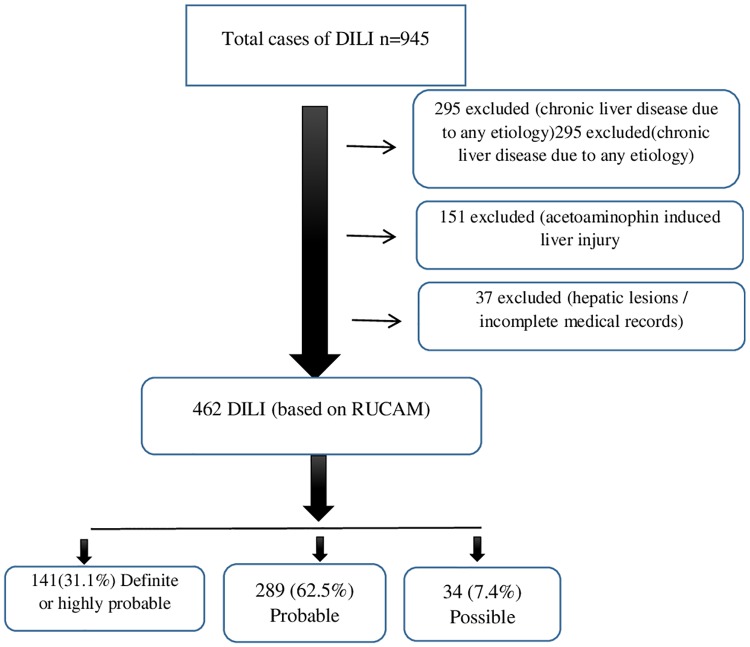
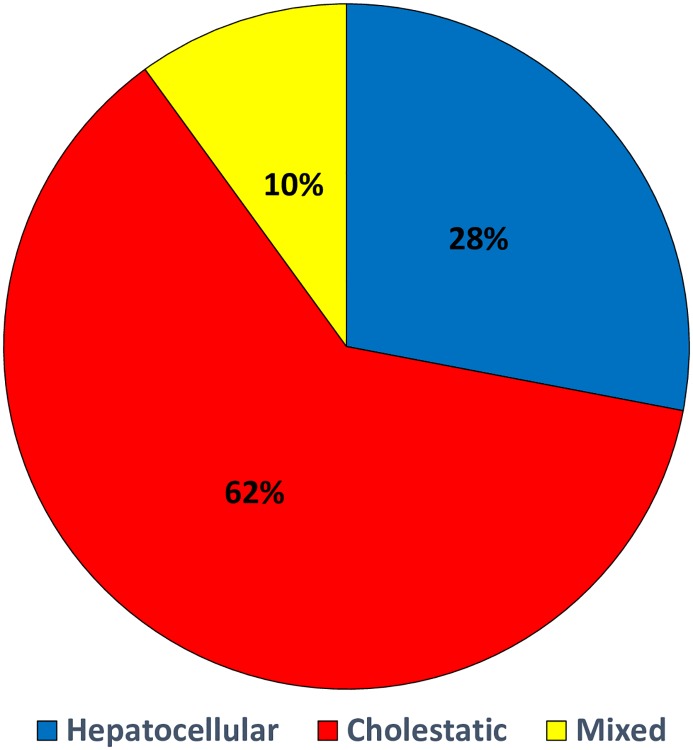
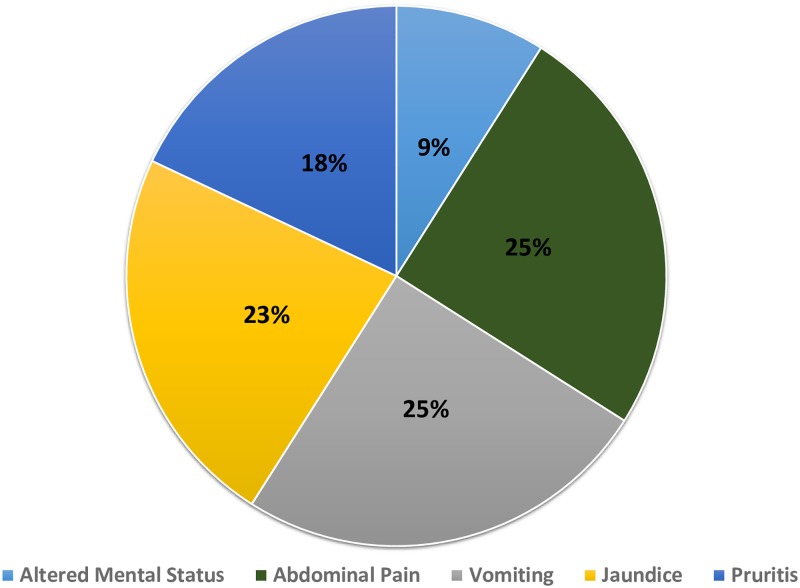
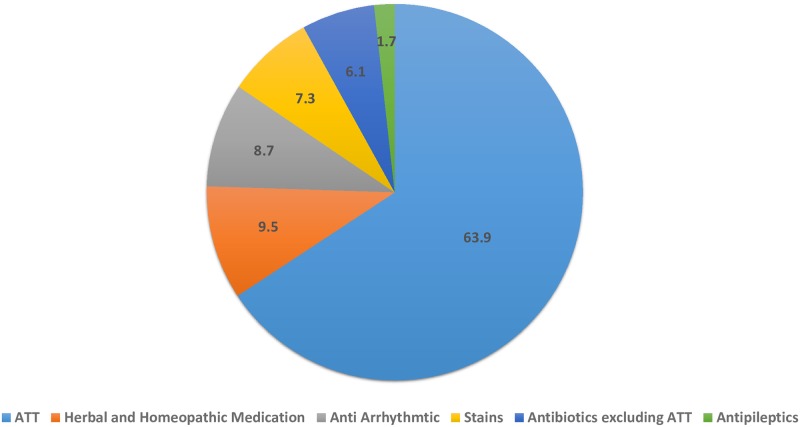
BACKGROUND AND AIM: In light of few established drug induced liver injury (DILI) registries, this study aims to evaluate the clinical spectrum and predictors of mortality and morbidity of hospitalized patients with suspected DILI. PATIENTS AND METHODS: DILI cases were identified and categorized on basis of COIMS/RUCAM score and the exclusion of other liver diseases. Clinical and laboratory parameters were analyzed to identify the predictors of morbidity (prolonged hospital stay > 5 days) and mortality. RESULTS: Out of 462 patients, there were 264 (57.6%) males and the mean age of the cohort was 50.83 years (range: 20-94 years). DILI was classified as definite or highly probable in 31.1%, probable in 62.5%, and possible in 7.4% of cases. Pattern of liver injury was hepatocellular in 25.1%, cholestatic in 56.17%, and mixed in 18.72% of patients. Anti-tuberculosis drugs (ATDs) were found to be the most common category of drugs causing DILI, in 295 (63.9%) patients. Clinically, encephalopathy was present in 21.6% patients; other presenting symptoms included abdominal pain (57.1%), vomiting (57.1%), jaundice (54.1%) and pruritus (42.3%). In-hospital mortality was 26.5% and prolonged hospital stay (> 5 days) was observed in 35.93% of patients. Mortality was significantly greater in patients with encephalopathy, male gender, hepatocellular pattern of DILI, increased INR and use of ventilator support. CONCLUSION: In our study, the most frequent cause of DILI in hospitalized patients was ATDs. More than a quarter of patients died during hospital stay. A close control of clinical and biochemical parameters are required to prevent and monitor DILI, especially in patients taking ATDs in our region.
Overview
The claims and statistics of this paper haven’t been checked yet.
Free: it reads the open-access text and checks the first 5 claims that cite a source we can check. Create a free account to check every claim.
Integrity signals
Registry
Cites
Statistics
Figures
Verification
Claims the paper makes
The claims and statistics of this paper haven’t been checked yet.
Free: it reads the open-access text and checks the first 5 claims that cite a source we can check. Create a free account to check every claim.
Claims other papers make about this one
Each is checked against this paper’s own text: does it say what the citing paper says it does?
The cited source doesn’t support the claim as written.
In the citing paper
“Overall, paracetamol accounted for a weighted mean of 55.7% (range 50.0-77.8%) of severe acute liver injury (ALI) and/or ALF [201-208] and 7.3% (range 1.2-29.2%) of drug-induced liver injury (DILI) [209-219] (see Figure 7).”
From Paracetamol (acetaminophen) overdose and hepatotoxicity: mechanism, treatment, prevention measures, and estimates of burden of disease (2023) · cites this paper as [215]
Checked by a reasoning model — may be wrong.
Experimental — accuracy not yet measuredIn the citing paper
“The country with the highest percentage of DILI cases caused by paracetamol was the U.S.A at almost 30% [217] followed by Pakistan at 16% [215].”
From Paracetamol (acetaminophen) overdose and hepatotoxicity: mechanism, treatment, prevention measures, and estimates of burden of disease (2023) · cites this paper as [215]
Self-check
Percentages, sums and reported differences re-computed from the paper’s own numbers.
The self-check needs the paper’s full text.
Citations
Cites
Ostapowicz, G., Fontana, R. J., Schiødt, F. V., Larson, A., Davern, T. J., Han, S. H. B., McCashland, T. M., Shakil, A. O., Hay, J. E., Hynan, L., et al. (2002) · Annals of Internal Medicine · doi:10.7326/0003-4819-137-12-200212170-00007 · Cited by 2,227 · cited 3×
“In the United States, DILI accounts for nearly 10% of the total cases of acute hepatitis, 5% of all hospital admissions, and 50% of all cases of acute liver failures [5].”
BackgroundInfluentialDanan, G., & Benichou, C. (1993) · Journal of Clinical Epidemiology · doi:10.1016/0895-4356(93)90101-6 · Cited by 1,481
Features and outcomes of 899 patients with drug-induced liver injury: the DILIN Prospective Study
Chalasani, N., Bonkovsky, H. L., Fontana, R., Lee, W., Stolz, A., Talwalkar, J., Reddy, K. R., Watkins, P. B., Navarro, V., Barnhart, H., et al. (2015) · Gastroenterology · doi:10.1053/j.gastro.2015.03.006 · Cited by 925 · cited 5×
“One important finding from this study is that the order and frequency of drugs associated with DILI is different from the list provided in the report from the Drug Induced Liver Injury Network (DILIN) and the Spanish Registry [13, 14].”
BackgroundResultInfluentialBjörnsson, E. S., Bergmann, O. M., Björnsson, H. K., Kvaran, R. B., & Olafsson, S. (2013) · Gastroenterology · doi:10.1053/j.gastro.2013.02.006 · Cited by 865 · cited 1×
“Other common drug groups include non-steroidal anti-inflammatory drugs (NSAIDs) [10, 14], herbal and dietary supplements (HDS) [15] and rarely statins [13, 16, 17].”
BackgroundACG Clinical Guideline: the diagnosis and management of idiosyncratic drug-induced liver injury
Chalasani, N. P., Hayashi, P. H., Bonkovsky, H. L., Navarro, V. J., Lee, W. M., & Fontana, R. J. (2014) · American Journal of Gastroenterology · doi:10.1038/ajg.2014.131 · Cited by 860
ANDRADE, R., LUCENA, M., FERNANDEZ, M., PELAEZ, G., PACHKORIA, K., GARCIARUIZ, E., GARCIAMUNOZ, B., GONZALEZGRANDE, R., PIZARRO, A., & DURAN, J. (2005) · Gastroenterology · doi:10.1016/j.gastro.2005.05.006 · Cited by 856 · cited 7×
“One important finding from this study is that the order and frequency of drugs associated with DILI is different from the list provided in the report from the Drug Induced Liver Injury Network (DILIN) and the Spanish Registry [13, 14].”
BackgroundResultInfluentialChalasani, N., Fontana, R. J., Bonkovsky, H. L., Watkins, P. B., Davern, T., Serrano, J., Yang, H., & Rochon, J. (2008) · Gastroenterology · doi:10.1053/j.gastro.2008.09.011 · Cited by 755
Incidence of drug-induced hepatic injuries: A French population-based study
Sgro, C., Clinard, F., Ouazir, K., Chanay, H., Allard, C., Guilleminet, C., Lenoir, C., Lemoine, A., & Hillon, P. (2002) · Hepatology · doi:10.1053/jhep.2002.34857 · Cited by 716
Drug-induced liver injury—types and phenotypes
Hoofnagle, J. H., & Björnsson, E. S. (2019) · New England Journal of Medicine · doi:10.1056/nejmra1816149 · Cited by 652
Outcome and prognostic markers in severe drug‐induced liver disease†
Björnsson, E., & Olsson, R. (2005) · Hepatology · doi:10.1002/hep.20800 · Cited by 524 · cited 1×
“The Spanish registry and a Swedish study have described the hepatocellular pattern of damage as the most common form of liver injury associated with high incidence of liver transplantation or death if patient with jaundice [14, 27].”
Background
Cited by
Chidiac, A. S., Buckley, N. A., Noghrehchi, F., & Cairns, R. (2023) · Expert Opinion on Drug Metabolism & Toxicology · doi:10.1080/17425255.2023.2223959 · Cited by 215
Teschke, R., & Danan, G. (2020) · Medicines · doi:10.3390/medicines7100062 · Cited by 77
Drug‐Induced Liver Injury: Clinical Evidence of N‐Acetyl Cysteine Protective Effects
Ntamo, Y., Ziqubu, K., Chellan, N., Nkambule, B. B., Nyambuya, T. M., Mazibuko-Mbeje, S. E., Gabuza, K., Marcheggiani, F., Tiano, L., & Dludla, P. V. (2021) · Oxidative Medicine and Cellular Longevity · doi:10.1155/2021/3320325 · Cited by 82
Bessone, F., García-Cortés, M., Medina-Caliz, I., Hernandez, N., Parana, R., Mendizabal, M., Schinoni, M. I., Ridruejo, E., Nunes, V., Peralta, M., et al. (2022) · Clinical Gastroenterology and Hepatology · doi:10.1016/j.cgh.2021.01.011 · Cited by 60
Mitochondrial Dynamics in Drug-Induced Liver Injury
Ramachandran, A., Umbaugh, D. S., & Jaeschke, H. (2021) · Livers · doi:10.3390/livers1030010 · Cited by 36
“DILI is associated with high mortality, especially in developing countries [2], and is a common cause for withdrawal of drugs from the market rendering it very important for pharmaceutical companies involved in drug development [3].”
BackgroundKhan, M. Z. I., Ren, J.-N., Cao, C., Ye, H.-Y.-X., Wang, H., Guo, Y.-M., Yang, J., & Chen, J. (2024) · Frontiers in Pharmacology · doi:10.3389/fphar.2024.1441587 · Cited by 34
Drug-induced cholestasis: causative agents and challenges in diagnosis and management
Pinazo-Bandera, J. M., Toro-Ortiz, J. P., Andrade, R. J., & García‐Cortés, M. (2023) · Exploration of Digestive Diseases · doi:10.37349/edd.2023.00027 · Cited by 16
Teschke, R. (2025) · Livers · doi:10.3390/livers5010008 · Cited by 13
“…was 55.00 ± 18.35 years in RUCAM-based iDILI cases [5]; (11) gender, where the proportion of males was 73.4% in RUCAM-based iDILI cases [5]; and (12) mortality, which was high in a single RUCAM-based cohort, with 26.4%, but this substantially outnumbered the published results of other studies [41].”
InfluentialHepatocurative and Histopathological Evaluations in Albino Rats Exposed to Vitex Doniana Alkaloids
(2022) · Letters in Applied NanoBioScience · doi:10.33263/lianbs122.056 · Cited by 10
Liu, S., Zhou, Y., Wang, Y., Li, C. B., Wang, W., Xu, L., Liu, P., Hu, Q. H., & Wen, Y. (2022) · Frontiers in Medicine · doi:10.3389/fmed.2022.817370 · Cited by 8
“Although liver tests abnormalities were generally reversible within 4–6 weeks of discontinuation of the offending drugs, DILI caused by ATD was associated with high mortality (25).”
BackgroundHistory and Evolution of Innovations in Clinical Pharmacology
Lesko, L. J., & van der Graaf, P. H. (2025) · Clinical Pharmacology & Therapeutics · doi:10.1002/cpt.70048 · Cited by 9
Mohammed, R. A., & Al-Shawi, N. N. (2025) · Toxicology Reports · doi:10.1016/j.toxrep.2025.102120 · Cited by 6
“Drug-induced hepatotoxicity is therefore a common and serious clinical problem, contributing to approximately 10 % of acute hepatitis cases and a significant fraction of acute liver failure incidents [3].”
Zimmermann, A., Scheffschick, A., Hänsel, R., Borchardt, H., Liu, J. L., Ehnert, S., Schicht, G., Seidemann, L., Aigner, A. M., Schiffmann, S., et al. (2024) · Archives of Toxicology · doi:10.1007/s00204-024-03943-8 · Cited by 3
“In so-called drug-induced liver injury (DILI), drug side effects lead to liver damage that may result in hospitalization or even death (Andrade et al. 2019; Abid et al. 2020).”
Ullah, K., Parekh, A.-D. E., Shaikh, O. A., Khan, M., & Ochani, S. (2023) · Irish Journal of Medical Science (1971 -) · doi:10.1007/s11845-023-03334-5 · Cited by 2
Cefdinir-Induced Liver Injury: A Case Report
Ashfaq, M. A., Malik, H. Z., Patel, L., & Moreno, C. (2025) · Cureus · doi:10.7759/cureus.81523 · Cited by 1
Iqram, T., Begum, D., Hossain, F., Fatema, K., Halder, S., Akter, K., & Siddique, M. A. A. (2025) · Eastern Medical College Journal · doi:10.3329/emcj.v10i1.82520 · Cited by 1
Drug-induced hepatotoxicity among critically ill patients in the intensive care unit
Gül, F., & ÜNDER, D. (2025) · Türk yoğun bakım derneği dergisi/Türk yoğun bakım dergisi · doi:10.63729/tjic.2025.676 · Cited by 1
Drug Induced Hepatotoxicity – An Ongoing Challenge
Fatima, M., & Zaidi, S. (2020) · Journal of Bahria University Medical and Dental College · doi:10.51985/jbumdc2020007 · Cited by 2
Effectiveness of resveratrol as a hepatoprotector in a rat model of paracetamol-induced liver injury
Dezena, R. M. B., Schiavon, S., Landi, M. A., da Silva, G. H., & Gonçalves, G. M. S. (2023) · Journal of Health & Biological Sciences · doi:10.12662/2317-3076jhbs.v11i1.4655.p1-9.2023 · Cited by 1
Drug-induced liver injury and hospitalisation in Pakistan
(2020) · Reactions Weekly · doi:10.1007/s40278-020-77668-z
Effects of Vitamin D on the Histomorphology of Norethisterone-Induced Hepatosteatosis in Female Rats
Tabassum, A., Kiani, M. R. B., Zahid, A., Rashid, S., Umbreen, F., & Zakria, I. (2022) · Pakistan Armed Forces Medical Journal · doi:10.51253/pafmj.v72i5.8658
Drugs Induced Liver Injury: Are We Serious
Khan, J. U. A., Ahmad, M., & Mehmood, S. (2025) · Annals of King Edward Medical University · doi:10.21649/akemu.v31i3.6042
Ramos Silva, O. A. (2023) · El Repositorio Academico Digital de la UANL (Universidad Autónoma de Nuevo León)
Langermans, A. P., Kom, I. Y., de Lange, D. W., de Keizer, N. F., Klopotowska, J. E., & RESCUE Study group (2026) · British Journal of Clinical Pharmacology · doi:10.1002/bcp.70610
Sajid, M., Shaikh, S. S., Siddiqui, S., Asim, S. A., & Farooqui, W. A. (2026) · Journal of College of Physicians And Surgeons Pakistan · doi:10.29271/jcpsp.2026.09.1164
Metadata
- Authors
- Abid, A., Subhani, F., Kayani, F., Awan, S., & Abid, S.
- Affiliations
- Aga Khan University (PK)
- Corresponding author
- Abid, Shahab
- Venue
- PLOS ONE
- Publisher
- Public Library of Science (PLoS)
- Published
- 2020-04-10
- Volume
- 15
- Issue
- 4
- Pages
- e0231398
- ISSN
- 1932-6203 (ISSN-L)
- PMC
- PMC7148123
- OpenAlex
- W3016018703
- Cited by
- 22
- References
- 32
- Citations by year
- 2026: 1 · 2025: 6 · 2024: 2 · 2023: 4 · 2022: 3 · 2021: 3 · 2020: 3
- FWCI
- 2.87
- Type
- journal article
- Language
- en
- Open access
- gold
- doi.org
- Licence
- Locations
- PLoS ONE (publishedVersion, cc-by)
- PubMed Central (publishedVersion, cc-by)
- PubMed (publishedVersion)
- eCommons - AKU (Aga Khan University) (submittedVersion, cc-by)
- DOAJ (DOAJ: Directory of Open Access Journals) (submittedVersion, cc-by-sa)
- Topics
- Life Sciences › Pharmacology, Toxicology and Pharmaceutics › Pharmacology › Drug-Induced Hepatotoxicity and Protection
- Life Sciences › Pharmacology, Toxicology and Pharmaceutics › Toxicology › Pharmacovigilance and Adverse Drug Reactions
- Health Sciences › Medicine › Hepatology › Liver physiology and pathology
- Keywords
- drug-induced liver injury, mortality, antitubercular agents, hepatotoxicity, cholestatic liver injury, hepatocyte injury, encephalopathy, prolonged hospital stay, mortality risk factors, international normalized ratio, ventilator support, hospitalized patients
- MeSH terms
- Adult, Aged, Aged, 80 and over, Female, Humans, Length of Stay, Male, Middle Aged, Pakistan, Comorbidity, Chemical and Drug Induced Liver Injury, Tertiary Care Centers
About these checks
Registry, retraction, Cites and statistics results are computed, not judged, with one exception: a printed reference that no index lists is read once by a model before it counts as a citation error. Claims are extracted by a model and kept only when their quote appears verbatim in the text; each cited source is then checked, with a model’s help, for whether it says what the claim relies on. Those verdicts can be wrong — read the claim’s quote and the cited source before relying on one.
Statistics and arithmetic are recomputed, not judged.
Confidence bands are shown only for fields calibrated on our annotated test set. None is calibrated yet, so no band is shown.
What counts as a claim ›How we measure confidence ›How we check this ›
Are you an author, or do you see a problem with this page? Request a review
Data sources
Bibliographic data: Semantic Scholar, OpenAlex, Crossref.
Contains information from the Semantic Scholar Academic Graph Datasets, made available under the ODC Attribution License (ODC-BY 1.0).
Semantic Scholar’s data is described in: Kinney, R., et al. (2023). The Semantic Scholar Open Data Platform. arXiv:2301.10140.
