

Consumer-based actions to reduce plastic pollution in rivers: A multi-criteria decision analysis approach
Open accessThe DOI matches its Crossref record; 42 of the 43 references it cites were found in a registry or an index.
Abstract
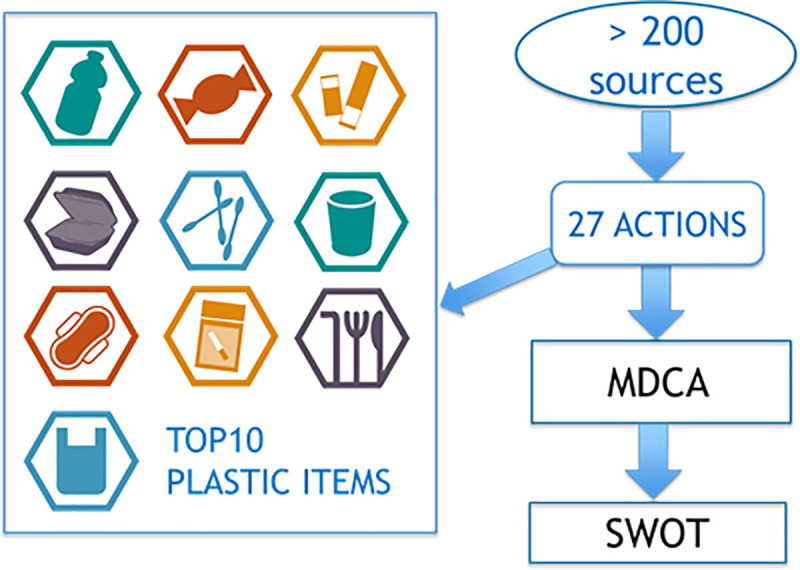
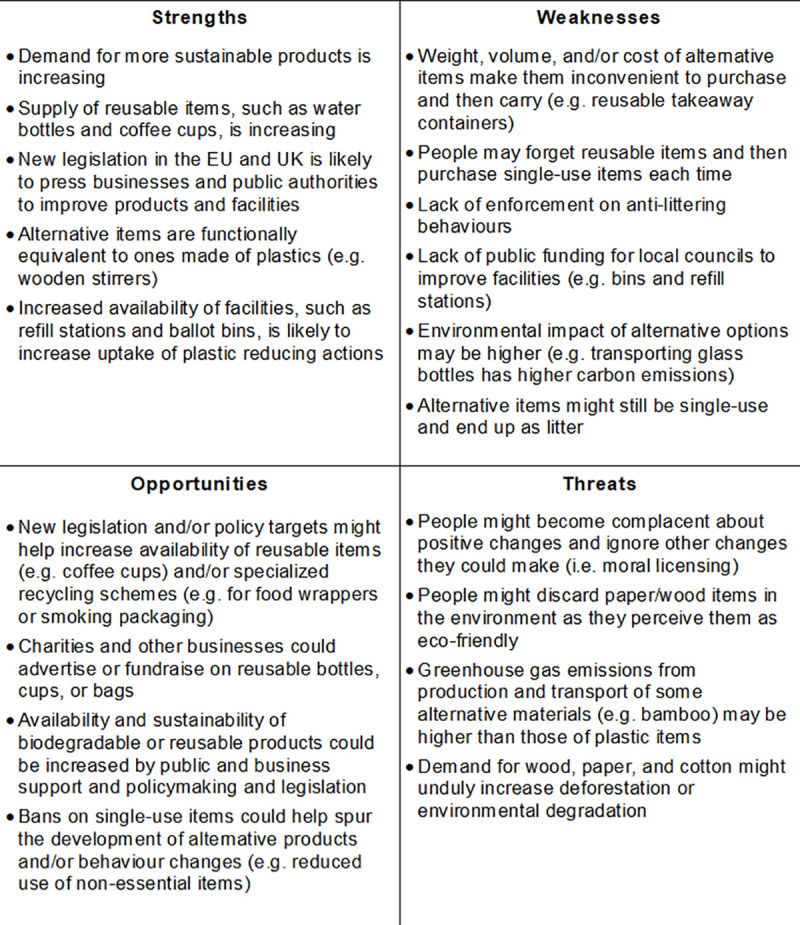
The use and management of single use plastics is a major area of concern for the public, regulatory and business worlds. Focusing on the most commonly occurring consumer plastic items present in European freshwater environments, we identified and evaluated consumer-based actions with respect to their direct or indirect potential to reduce macroplastic pollution in freshwater environments. As the main end users of these items, concerned consumers are faced with a bewildering array of choices to reduce their plastics footprint, notably through recycling or using reusable items. Using a Multi-Criteria Decision Analysis approach, we explored the effectiveness of 27 plastic reduction actions with respect to their feasibility, economic impacts, environmental impacts, unintended social/environmental impacts, potential scale of change and evidence of impact. The top ranked consumer-based actions were identified as: using wooden or reusable cutlery; switching to reusable water bottles; using wooden or reusable stirrers; using plastic free cotton-buds; and using refill detergent/ shampoo bottles. We examined the feasibility of top-ranked actions using a SWOT analysis (Strengths, Weaknesses, Opportunities and Threats) to explore the complexities inherent in their implementation for consumers, businesses, and government to reduce the presence of plastic in the environment.
Overview
The claims and statistics of this paper haven’t been checked yet.
Free: it reads the open-access text and checks the first 5 claims that cite a source we can check. Create a free account to check every claim.
Integrity signals
Registry
Cites
Statistics
Figures
Verification
Claims the paper makes
The claims and statistics of this paper haven’t been checked yet.
Free: it reads the open-access text and checks the first 5 claims that cite a source we can check. Create a free account to check every claim.
Claims other papers make about this one
Each is checked against this paper’s own text: does it say what the citing paper says it does?
The source backs part of the claim, not all of it — or backs it for a different population, condition or comparison.
In the citing paper
“Plastic waste poses significant environmental and human health risks [1–5].”
From The impact of mortality salience and explicit self-esteem on plastic reduction intention: A moderated mediation model (2025) · cites this paper as [2]
Experimental — accuracy not yet measured
Self-check
Percentages, sums and reported differences re-computed from the paper’s own numbers.
The self-check needs the paper’s full text.
Citations
Cites
Plastic waste inputs from land into the ocean
Jambeck, J. R., Geyer, R., Wilcox, C., Siegler, T. R., Perryman, M., Andrady, A., Narayan, R., & Law, K. L. (2015) · Science · doi:10.1126/science.1260352 · Cited by 13,163 · cited 1×
“7 million tonnes of plastic waste ends up in the ocean annually [3], the majority of which has land-based origins and is transported primarily by rivers [4, 5].”
BackgroundThe Dynamics of Social Practice: Everyday Life and How it Changes
Shove, E., Pantzar, M., & Watson, M. (2012) · SAGE Publications Ltd eBooks · doi:10.4135/9781446250655 · Cited by 3,768
Multiple Criteria Decision Analysis: An Integrated Approach
Belton, V., & Stewart, T. J. (2001) · CERN Document Server (European Organization for Nuclear Research) · Cited by 2,724
Multiple Criteria Decision Analysis
Belton, V., & Stewart, T. J. (2002) · doi:10.1007/978-1-4615-1495-4 · Cited by 2,659 · cited 1×
“Multi-criteria decision analysis is an analytical method used to evaluate alternative decision options based on a set of common criteria [28, 29] and can be used to handle incomplete and uncertain information in a robust and flexible manner [30, 31].”
MethodGifford, R., & Nilsson, A. (2014) · International Journal of Psychology · doi:10.1002/ijop.12034 · Cited by 1,964 · cited 1×
“The path from awareness raising to action can be tortuous, with psychological and practical barriers that often block widespread behaviour change in our societies [55].”
BackgroundExport of Plastic Debris by Rivers into the Sea
Schmidt, C., Krauth, T., & Wagner, S. (2017) · Environmental Science & Technology · doi:10.1021/acs.est.7b02368 · Cited by 1,418
Multi-criteria decision analysis in environmental sciences: Ten years of applications and trends
Huang, I. B., Keisler, J., & Linkov, I. (2011) · Science of The Total Environment · doi:10.1016/j.scitotenv.2011.06.022 · Cited by 1,282 · cited 1×
“Multi-criteria decision analysis is an analytical method used to evaluate alternative decision options based on a set of common criteria [28, 29] and can be used to handle incomplete and uncertain information in a robust and flexible manner [30, 31].”
MethodBiodegradation of bioplastics in natural environments
Emadian, S. M., Onay, T. T., & Demirel, B. (2017) · Waste Management · doi:10.1016/j.wasman.2016.10.006 · Cited by 1,168 · cited 1×
“plastic materials produced from renewable biomass sources, such as vegetable fats and oils, corn starch, and recycled food waste) from our analysis of possible actions, as benefits and environmental costs of these materials have yet to be fully determined [46].”
BackgroundSWOT analysis: It's time for a product recall
Hill, T., & Westbrook, R. (1997) · Long Range Planning · doi:10.1016/s0024-6301(96)00095-7 · Cited by 1,047
Global ecological, social and economic impacts of marine plastic
Beaumont, N. J., Aanesen, M., Austen, M. C., Börger, T., Clark, J. R., Cole, M., Hooper, T., Lindeque, P. K., Pascoe, C., & Wyles, K. J. (2019) · Marine Pollution Bulletin · doi:10.1016/j.marpolbul.2019.03.022 · Cited by 995 · cited 1×
“Managing plastic pollution has become a major international environmental priority [1] due to observed and estimated damage that plastics can cause to aquatic wildlife and ecosystems (both freshwater and marine) [2].”
Background
Research works printed but not linked: 8
- McCallum W. How to Give Up Plastic: A Guide to Changing the World, One Plastic Bottle at a Time. From the Head of Oceans at Greenpeace and spokesperson for their anti-plastic campaign. Penguin UK; 2018 5 24.
- Elliott T., Elliott L., 2018 Plastics Consumption and Waste Management 15. Available from: http://www.eunomia.co.uk/reports-tools/a-plastic-future-plastics-consumption-and-waste-management-in-the-uk/.
- European Parliament (2019). Directive (EU) 2019/904 of the European Parliament and of the Council of 5 June 2019 on the reduction of the impact of certain plastic products on the environment.
- Bhagat S, Bhardawaj A, Mittal P, Chandak P, Akhtar M, Sharma P. Evaluating plastic waste disposal options in Delhi using multi criteria decision analysis. Institute of Integrative Omics and Applied Biotechnology. 2016; 7(11): 25– 35.
- Humphrey A.S. (2005). SWOT analysis. Long Range Planning, 30, 46– 52.
- Edwards C. and Fry J. (2011). Evidence: Life Cycle Assessment of Supermarket Carrier Bags. Bristol: Environment Agency, Government of UK.
- UNEP. SINGLE-USE PLASTICS: A Roadmap for Sustainability, 2018, 104 pp.
- Keetley A. Plastic Game Changer. Less Plastic, 2019, 143 pp.
Cited by
Plastic waste associated with the COVID-19 pandemic: Crisis or opportunity?
Khoo, K. S., Ho, L. Y., Lim, H. R., Leong, H. Y., & Chew, K. W. (2021) · Journal of Hazardous Materials · doi:10.1016/j.jhazmat.2021.126108 · Cited by 201
Global producer responsibility for plastic pollution
Cowger, W., Willis, K. A., Bullock, S., Conlon, K., Emmanuel, J., Erdle, L. M., Eriksen, M., Farrelly, T. A., Hardesty, B. D., Kerge, K., et al. (2024) · Science Advances · doi:10.1126/sciadv.adj8275 · Cited by 185
“In the past, the discourse on solutions to plastic pollution has largely focused on consumer-based actions and waste management infrastructure instead of producer responsibility ( 30 , 31 ).”
BackgroundGalati, A., Alaimo, L. S., Ciaccio, T., Vrontis, D., & Fiore, M. (2021) · Resources Conservation and Recycling · doi:10.1016/j.resconrec.2021.106060 · Cited by 90
Investigation of ecological risk of microplastics in peatland areas: A case study in Vietnam
Nguyen, M., Lin, C., Hung, N. T. Q., Hoang, H.-G., Vo, D. N., & Tran, .-T. (2022) · Environmental Research · doi:10.1016/j.envres.2022.115190 · Cited by 73
Wang, W., Mo, T., & Wang, Y. (2021) · Resources Conservation and Recycling · doi:10.1016/j.resconrec.2021.106111 · Cited by 71
Cowan, E., Booth, A. M., Misund, A. U., Klun, K., Rotter, A., & Tiller, R. G. (2021) · Environments · doi:10.3390/environments8080081 · Cited by 73
“Establishing a plastic bottle collection system worldwide was also deemed to be important for reducing plastic litter in the ocean [82].”
BackgroundResidents’ waste management practices in a developing country: A social practice theory analysis
Nguyen, A. T., Nguyen, N. H., Phung, P. T., & Yến-Khanh, N. (2023) · Environmental Challenges · doi:10.1016/j.envc.2023.100770 · Cited by 77
Ali, S. M., Ahmed, S., Ahmed, H. N., Sharmin, A., & Rahman, R. (2021) · Journal of Cleaner Production · doi:10.1016/j.jclepro.2021.130327 · Cited by 61
Consumer Awareness of Plastic: an Overview of Different Research Areas
de Sousa, F. D. B. (2023) · Circular Economy and Sustainability · doi:10.1007/s43615-023-00263-4 · Cited by 65
“As stated before, consumers may not want to put information into practice on individual actions relative to environmental and economic benefits [17].”
InfluentialWinton, D. J., Marazzi, L., & Loiselle, S. (2022) · The Science of The Total Environment · doi:10.1016/j.scitotenv.2022.157672 · Cited by 40
Self-citationMicrofiber releasing into urban rivers from face masks during COVID-19
Wang, F., Wu, H., Li, J., Liu, J., Xu, Q., & An, L. (2022) · Journal of Environmental Management · doi:10.1016/j.jenvman.2022.115741 · Cited by 38
A comprehensive review on the production of alternative fuel through medical plastic waste
Kumar, A., Pali, H. S., & Kumar, M. (2022) · Sustainable Energy Technologies and Assessments · doi:10.1016/j.seta.2022.102924 · Cited by 50
Ocean plastic pollution: a human and biodiversity loop
Ayassamy, P. (2025) · Environmental Geochemistry and Health · doi:10.1007/s10653-025-02373-4 · Cited by 36
“Many authors concur that improper plastic disposal is a major contributor to pollution, positioning consumers as pivotal actors in this crisis (Jacobsen et al., 2022; Marazzi et al., 2020).”
Strengthening global plastic policy with systems analysis
Brooks, A. L., & Havas, V. (2025) · Nature Sustainability · doi:10.1038/s41893-025-01554-4 · Cited by 29
Multicriteria Decision Analysis Addressing Marine and Terrestrial Plastic Waste Management: A Review
dos Santos, M. R., Dias, L. C., Cunha, M. D. C., & Marques, J. (2022) · Frontiers in Marine Science · doi:10.3389/fmars.2021.747712 · Cited by 31
Rietz, S. D., & Kremel, A. (2023) · Circular Economy and Sustainability · doi:10.1007/s43615-023-00290-1 · Cited by 38
“For example, Marazzi et al. [29] discuss the environmental consequences of consumers adopting compostable food packaging.”
InfluentialMakarchev, N., Xiao, C., Yao, B., Zhang, Y., Tao, X., & Le, D. A. (2022) · Environmental Science & Policy · doi:10.1016/j.envsci.2022.07.015 · Cited by 27
Enhancing consumption responsibility to address global plastic pollution
Cai, W., Tremblay, L. A., & An, L. (2022) · Marine Pollution Bulletin · doi:10.1016/j.marpolbul.2022.114089 · Cited by 22
Cigarette butts in Vietnam's marine environments: From pollution to solutions and prospects
Thuan, P. M., Nguyen, M., Lin, C., Rangel-Buitrago, N. G., Galgani, F., Chang, S. W., & Nguyen, D. D. (2024) · The Science of The Total Environment · doi:10.1016/j.scitotenv.2024.177484 · Cited by 17
Nuojua, S., Cracknell, D., Heske, A., Pahl, S., Wyles, K. J., & Thompson, R. C. (2024) · Conservation Science and Practice · doi:10.1111/csp2.13174 · Cited by 27
“…on behavioral strategies to reduce plastic pollution have focused primarily on consumer action in regard to particular single-use plastic items (Marazzi et al., 2020), specific interventions (e.g., takeaway cups and water fountains; Tudor & Williams, 2021), or on behaviors related to policy…”
Edoria, T. J. P., Pabilonia, J. P. A., Palapar, J. A. M., Quiambao, C. D. E., Gue, I. H. V., Rith, M., & Sy, A. M. T. (2023) · Cleaner and Responsible Consumption · doi:10.1016/j.clrc.2023.100118 · Cited by 19
Ramya, L., Thilagasree, C. S., Jayakumar, T., Peter, A. K., Akhir, E. A. P., Феррара, М., & Ahmadian, A. (2024) · Scientific Reports · doi:10.1038/s41598-024-73180-7 · Cited by 12
“Marazzi et al. 38 , work hard to investigate the pollution of plastic waste reduction in rivers by using one of the methods in MCDM techniques, the SWOT method.”
MethodReis, S. N., & Aldridge, D. C. (2024) · ACS ES&T Water · doi:10.1021/acsestwater.4c00595 · Cited by 12
Caminiti, C., Diodati, F., Puntoni, M., Balan, D. G., & Maglietta, G. (2025) · International Journal of Environmental Research and Public Health · doi:10.3390/ijerph22020177 · Cited by 15
“Similarly, it is necessary to understand the level of public awareness of possible actions that people can take at an individual level to counter such risks [13].”
A behavioural risk perspective to plastic waste management: insights from Nigerian SMEs
Tyllianakis, E., Kolade, O., Ambituuni, A., Ogunde, O., Oyinlola, M. A., & Abolfathi, S. (2025) · Journal of Cleaner Production · doi:10.1016/j.jclepro.2025.147086 · Cited by 15
“Effectiveness in reducing plastic waste depends on a) actions involving new technology (Marazzi et al., 2020; Ferronato et al., 2024), b) engagement with suppliers (Moshood et al., 2022), c) investments around adopting circular economy strategies (Chitaka et al., 2022) as well as d) ease of funding…”
Open source IoT-based collection bin applied to local plastic recycling
Gabriel, A., & Sanchez, F. A. C. (2022) · HardwareX · doi:10.1016/j.ohx.2022.e00389 · Cited by 13
“Unfortunately, the individual’s behavior and lack of sufficient facilities are, among others, key factors that impact the high volume of plastic litter in the environment [13].”
BackgroundAstolfi, M. L., Castellani, F., Avino, P., Antonucci, A., Canepari, S., Protano, C., & Vitali, M. (2021) · Separations · doi:10.3390/separations8080126 · Cited by 9
“For these reasons, reusable water bottles, as possible alternative to single-use plastic bottles, are growing in popularity in recent years because they appear environmentally friendly [3], economic as refillable multiple times, and socially”
BackgroundAndo, Y., Yokoi, H., Masuda, H., & Asari, M. (2023) · Journal of Cleaner Production · doi:10.1016/j.jclepro.2023.138234 · Cited by 9
An Explorative Study on Packaging-Saving Consumer Practices in the Fast-Moving Consumer Goods Sector
Habermehl, T., Decker, T., & Menrad, K. (2024) · Sustainability · doi:10.3390/su16229983 · Cited by 10
Senerth, E., Whaley, P., Akl, E. A., Beverly, B., Alonso‐Coello, P., Jalil, E., Khattar, J., Palmer, N. R., Rooney, A. A., Schünemann, H. J., et al. (2024) · Environment International · doi:10.1016/j.envint.2024.109209 · Cited by 10
Rodríguez, Y., Vandeperre, F., Duncan, E. M., Machete, M., & Pham, C. K. (2025) · The Science of The Total Environment · doi:10.1016/j.scitotenv.2025.178950 · Cited by 6
Baechler, B. R., Granek, E. F., Carlin-Morgan, K., Smith, T. E., & Nielsen‐Pincus, M. (2020) · Journal of Interpretation Research · doi:10.1177/10925872211021183 · Cited by 6
“Individual and larger-scale actions to reduce plastic pollution can result from increased public awareness (Marazzi et al., 2020; Vince & Stoett, 2018); for example, recent educational programming in Europe, Australia, and Chile successfully fostered a sense”
BackgroundHuman Behavior and Marine Plastic Pollution
Nuojua, S., Cracknell, D., & Pahl, S. (2022) · Wiley eBooks · doi:10.1002/9781119768432.ch15 · Cited by 9
Theoretical Approaches to Plastic Waste Regulation in Nigeria
Uche, O. L. (2023) · Beijing Law Review · doi:10.4236/blr.2023.144118 · Cited by 7
Latugan, P., Carabacan, J. J., Bonicillo, G., Cayog, J., Eyawa, M. Q., Cairel, M. T., & Ngohayon, J. M. (2024) · Nature Environment and Pollution Technology · doi:10.46488/nept.2024.v23i01.024 · Cited by 5
Suminar, J. R., Hafiar, H., Amin, K., & Prastowo, A. A. (2024) · Frontiers in Communication · doi:10.3389/fcomm.2024.1461609 · Cited by 31
Irvin, K. S., Potgieter, J. H., Liauw, C. M., Sparkes, R. B., & Potgieter-Vermaak, S. S. (2022) · Journal of Applied Polymer Science · doi:10.1002/app.52372 · Cited by 5
Grassin, J. B., & Dijkstra, H. (2023) · Waste Management & Research The Journal for a Sustainable Circular Economy · doi:10.1177/0734242x231180648 · Cited by 6
“…(2) identifying relevant criteria for the problem context, (3) assigning weights related to the importance of each criteria, (4) scoring the strategies based on the criteria, (5) calculating a final ranking and (6) conducting sensitivity analysis and communicating results (Marazzi et al., 2020).”
BackgroundRudolf, J., & Udovč, A. (2022) · Sustainability · doi:10.3390/su14020785 · Cited by 5
From Linear to Circular: Consumer Perspectives on Breaking Free from Single-Use Plastics in Taiwan
Ferdin, A. E. J., Inman, M. L., & Chook, J. W. (2025) · Circular Economy and Sustainability · doi:10.1007/s43615-025-00542-2 · Cited by 6
“In this way, businesses not only change their practices but also influence consumer behaviour to reduce waste generation in the first place [62].”
Food Quality and Safety: Advances in Analytical Methods and Applications
Sorbo, A., Zoani, C., & Passeri, D. (2023) · Separations · doi:10.3390/separations10050315 · Cited by 7
Chiucchi, M. S., Cioli, A., & Guidi, M. (2025) · Measuring Business Excellence · doi:10.1108/mbe-09-2024-0148 · Cited by 5
Chiu, H.-L., Wang, K.-J., & Wang, T.-H. (2025) · PLOS ONE · doi:10.1371/journal.pone.0320059 · Cited by 2
Olubodun, I. E., & Agbaje, Y. T. (2021) · MANAGEMENT AND ECONOMICS REVIEW · doi:10.24818/mer/2021.06-02 · Cited by 5
“suggested that government needs to make stewardship action part of licensing requirement before business can start operation or permit new product launch (Marazzi et al., 2020).”
BackgroundInfluentialEffectiveness of citizen inquiry approach in promoting environmental knowledge of young people
Obakhavbaye, M. (2024) · Academia Environmental Sciences and Sustainability · doi:10.20935/acadenvsci7341 · Cited by 5
Just around the river bend: the fate of plastic bottle pollution in the Thames Estuary
Savage, J. M., Chamberlain, A., Koldewey, H. J., Llewellyn, F., Marten, K., McConville, A. J., Morritt, D., Young, S. L., & Benson, T. (2025) · Marine Pollution Bulletin · doi:10.1016/j.marpolbul.2025.118453 · Cited by 3
Generation, Assessment, and Mitigation of Microplastics
Hafeez, A., Saleem, A., & Shaker, K. (2023) · Textile science and clothing technology · doi:10.1007/978-3-031-49479-6_10 · Cited by 3
Rinasti, A. N., Gunasekara, K. H., Winijkul, E., Ninsawat, S., & Koottatep, T. (2022) · Springer geography · doi:10.1007/978-3-031-16217-6_5 · Cited by 2
Sanderson, E. W., Sanderson, E. W., & McClennen, C. (2022) · doi:10.19121/2022.report.43990
Blue Seas: Freeing the Seas from Plastics
Heger, M., Vashold, L., Palacios, A., Alahmadi, M., Bromhead, M.-A., & Acerbi, M. (2022) · World Bank, Washington, DC eBooks · doi:10.1596/978-1-4648-1812-7_ch4
ASSOCIAÇÃO DAS VARIÁVEIS SOCIODEMOGRÁFICAS COM O RISCO DE EXPOSIÇÃO AOS DEFENSIVOS AGRÍCOLAS
Simon, P. C., Cecatto, A. P., da Costa, A. R., Câmera, J. N., & Cattaneo, R. (2022) · doi:10.22533/at.ed.0232209098
Reis, C. D. O., de Morais, M. L. V., Kasemodel, M. C., & Romão, É. L. (2022) · doi:10.22533/at.ed.0232209092
POLÍTICAS PÚBLICAS E GOVERNANÇA DAS ÁGUAS NA AMAZÔNIA NORTE MATOGROSSENSE
Henrique, V. H. D. O., & Bampi, A. C. (2022) · doi:10.22533/at.ed.0232209093
CONCEPÇÕES E PRÁTICAS DA EDUCAÇÃO AMBIENTAL EM ESCOLAS DE TEMPO INTEGRAL EM FEIRA DE SANTANA, BAHIA
Paixão, M. D. F. M., Brito, S. M. D. O., & Leite, I. F. (2022) · doi:10.22533/at.ed.02322090912
Rocha, A. C., & Bassanelli, H. R. (2022) · doi:10.22533/at.ed.0232209095
ANALISE DA VIABILIDADE DE OBRAS SUSTENTÁVEIS
Júnior, A. D. S. M., & Ribeiro, K. A. (2022) · doi:10.22533/at.ed.0232209097
da Rocha, A. L., Pereira, C. D. A., & Hoehne, L. (2022) · doi:10.22533/at.ed.0232209094
Fantinelli, J. T., & Oliveira, J. D. Q. (2022) · doi:10.22533/at.ed.02322090913
BAMBU, A MADEIRA DO FUTURO: DIMENSÕES ESTRATÉGICAS NA PRODUÇÃO DE MÓVEIS SUSTENTÁVEIS
Carneiro, R. R., & Pereira, M. A. D. R. (2022) · doi:10.22533/at.ed.02322090910
MAPEAMENTO DAS ÁREAS DE USO RESTRITO– AUR, NO MACIÇO RESIDUAL DA SERRA DA MERUOCA, NO CEARÁ
de Oliveira, U. C., Teixeira, L. F. D. C., Soares, F. F., de Albuquerque, C. C., & Mendonça, P. S. (2022) · doi:10.22533/at.ed.0232209096
EXPERIÊNCIA DE FORMAÇÃO DE PROFESSORES: A HORTA ESCOLAR COMO FERRAMENTA PEDAGÓGICA
Barcelos, M. A. S., & da Rocha, J. M. (2022) · doi:10.22533/at.ed.02322090911
SIGNIFICADO DO ESTUDO DE IMPACTO AMBIENTAL (EIS): O DIREITO AMBIENTAL COMO FUNDAMENTO À VIDA SOCIAL
Correia, A. D. S., & de Almeida, P. L. (2022) · doi:10.22533/at.ed.0232209091
LIXO ELETRÔNICO: CONTAMINANTE AMBIENTAL EM CRESCIMENTO ACELERADO
Almeida, L. M., Camilo-Cotrim, C. F., Silva, J. A. D. P., & Lima, G. G. (2022) · doi:10.22533/at.ed.0232209099
Kittu, D., Chellamuthu, L., & Sivapushani, A. (2023) · D Y Patil Journal of Health Sciences · doi:10.4103/dypj.dypj_64_22
Ayorinde, T., Collom, C., Obiako, P., Kayastha, R., Sivapalan, V., Hockaday, W. C., Zhang, Z., & Sayes, C. M. (2024) · SSRN Electronic Journal · doi:10.2139/ssrn.4873312
Measuring Attitudes Toward Plastics: A Cross-Cultural Adaptation and Patient Evaluation Study
Diodati, F., Balan, D. G., Libralato, G., Manfra, L., Vanelli, V., Puntoni, M., & Caminiti, C. (2025) · International Journal of Environmental Research and Public Health · doi:10.3390/ijerph22121857
“Yet, rational use of plastics and appropriate waste disposal are essential, and individual behaviors are a key driver of plastic litter generation [11,12].”
Public Awareness and Behaviour Change: Critical for Mitigating Plastic Risks
Reshi, S. N., Qureshi, N. W., MOHAMMAD, T., & MUKHERJEE, S. (2026) · Springer eBooks · doi:10.1007/978-3-032-17411-6_16
Breaking Free from Single-Use: Consumer Journeys and Perceptions in Packaging-Free Shopping
Romanillos, E. J., Boztepe, S., Williams, H., & Wever, R. (2026) · Journal of Food Products Marketing · doi:10.1080/10454446.2026.2656150
“Packaging-free initiatives have emerged in response to the growing environmental concerns surrounding single-use packaging, particularly plastics, which have been highlighted as a significant contributor to global pollution (Geyer et al., 2017; Marazzi et al., 2020).”
Ögel, İ. Y., Aytekin, A., & Ecer, F. (2026) · Journal of Cleaner Production · doi:10.1016/j.jclepro.2026.148399
Çevresel açıdan sorumlu gıda seçimleri: Gastronomi öğrencileri üzerine bir araştırma
Ozturk, S. B., & Aymankuy, Ş. Y. (2026) · Balıkesir Üniversitesi Sosyal Bilimler Enstitüsü Dergisi · doi:10.31795/baunsobed.1646522
Impacts of water pollution on biodiversity and nature and policies for controlling water pollution
Ogidi, O. I., Tarinimi, T. J.-H., Orlu, H. A., & Oyaseiye, P. E. (2026) · Elsevier eBooks · doi:10.1016/b978-0-443-36414-3.00002-0
Metadata
- Authors
- Marazzi, L., Loiselle, S., Anderson, L. G., Rocliffe, S., & Winton, D. J.
- Affiliations
- Earthwatch Europe (GB)
- University of Siena (IT)
- University of Exeter (GB)
- Corresponding author
- Marazzi, Luca
- Venue
- PLOS ONE
- Publisher
- Public Library of Science (PLoS)
- Published
- 2020-08-14
- Volume
- 15
- Issue
- 8
- Pages
- e0236410
- ISSN
- 1932-6203 (ISSN-L)
- PMC
- PMC7428181
- OpenAlex
- W3049053171
- Cited by
- 73
- References
- 43
- Citations by year
- 2026: 6 · 2025: 10 · 2024: 11 · 2023: 10 · 2022: 28 · 2021: 7 · 2020: 1
- FWCI
- 2.84
- Type
- journal article
- Language
- en
- Open access
- gold
- doi.org
- Licence
- Locations
- PLoS ONE (publishedVersion, cc-by)
- PubMed Central (publishedVersion, cc-by)
- PubMed (publishedVersion)
- Research Space (acceptedVersion)
- RePEc: Research Papers in Economics (submittedVersion)
- DOAJ (DOAJ: Directory of Open Access Journals) (submittedVersion, cc-by-sa)
- Use Siena air (University of Siena) (submittedVersion, other-oa)
- Funders
- Earthwatch Institute
- Topics
- Physical Sciences › Environmental Science › Pollution › Microplastics and Plastic Pollution
- Physical Sciences › Environmental Science › Waste Management and Disposal › Waste Management and Recycling
- Physical Sciences › Environmental Science › Management, Monitoring, Policy and Law › Pro-Environmental Behavior and Attitudes
- Keywords
- plastic pollution, macroplastics, single-use plastics, consumer behavior, freshwater ecosystems, rivers, reusable products, plastic recycling, cutlery, cotton buds, SWOT analysis, multi-criteria decision making
- MeSH terms
- Consumer Behavior, Decision Support Techniques, Environmental Monitoring, Environmental Pollution, Humans, Plastics, Waste Products, Water Pollutants, Chemical, Rivers, Recycling
About these checks
Registry, retraction, Cites and statistics results are computed, not judged, with one exception: a printed reference that no index lists is read once by a model before it counts as a citation error. Claims are extracted by a model and kept only when their quote appears verbatim in the text; each cited source is then checked, with a model’s help, for whether it says what the claim relies on. Those verdicts can be wrong — read the claim’s quote and the cited source before relying on one.
Statistics and arithmetic are recomputed, not judged.
Confidence bands are shown only for fields calibrated on our annotated test set. None is calibrated yet, so no band is shown.
What counts as a claim ›How we measure confidence ›How we check this ›
Are you an author, or do you see a problem with this page? Request a review
Data sources
Bibliographic data: Semantic Scholar, OpenAlex, Crossref.
Contains information from the Semantic Scholar Academic Graph Datasets, made available under the ODC Attribution License (ODC-BY 1.0).
Semantic Scholar’s data is described in: Kinney, R., et al. (2023). The Semantic Scholar Open Data Platform. arXiv:2301.10140.
