

Traditional Indigenous medicine in North America: A scoping review
Open accessThe DOI matches its Crossref record; 84 of the 86 references it cites were found in a registry or an index.
Abstract
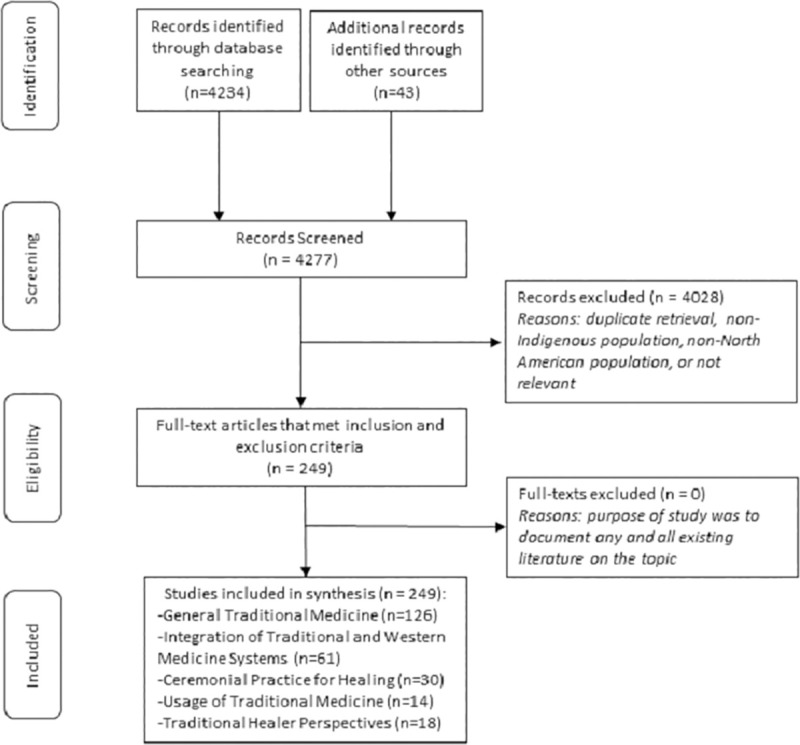
BACKGROUND: Despite the documented continued use of traditional healing methods, modalities and its associated practitioners by Indigenous groups across North America, it is presumed that widespread knowledge is elusive amongst most Western trained health professionals and systems. This despite that the approximately 7.5 million Indigenous peoples who currently reside in Canada and the United States (US) are most often served by Western systems of medicine. A state of the literature is currently needed in this area to provide an accessible resource tool for medical practitioners, scholars, and communities to better understand Indigenous traditional medicine in the context of current clinical care delivery and future policy making. METHODS: A systematic search of multiple databases was performed utilizing an established scoping review framework. A consequent title and abstract review of articles published on traditional Indigenous medicine in the North American context was completed. FINDINGS: Of the 4,277 published studies identified, 249 met the inclusion criteria divided into the following five categorical themes: General traditional medicine, integration of traditional and Western medicine systems, ceremonial practice for healing, usage of traditional medicine, and traditional healer perspectives. CONCLUSIONS: This scoping review was an attempt to catalogue the wide array of published research in the peer-reviewed and online grey literature on traditional Indigenous medicine in North America in order to provide an accessible database for medical practitioners, scholars, and communities to better inform practice, policymaking, and research in Indigenous communities.
Overview
The claims and statistics of this paper haven’t been checked yet.
Free: it reads the open-access text and checks the first 5 claims that cite a source we can check. Create a free account to check every claim.
Integrity signals
Registry
Cites
Statistics
Figures
Verification
Claims the paper makes
The claims and statistics of this paper haven’t been checked yet.
Free: it reads the open-access text and checks the first 5 claims that cite a source we can check. Create a free account to check every claim.
Claims other papers make about this one
Each is checked against this paper’s own text: does it say what the citing paper says it does?
The source backs part of the claim, not all of it — or backs it for a different population, condition or comparison.
In the citing paper
“Along with a clear disconnect between Western and Indigenous approaches to mental health and wellbeing, the Western approaches adopted within government-funded programs embed in a history of colonialism, institutional racism, systemic barriers, and inequitable policies and practices that continue to affect Indigenous communities (13, 14).”
From Informing care pathways and policies for children and youth with Indigenous perspectives to advance Canada's National Autism Strategy (2022) · cites this paper as [14]
Experimental — accuracy not yet measuredThe source backs part of the claim, not all of it — or backs it for a different population, condition or comparison.
In the citing paper
“Specifically, supports and services available to Indigenous communities do not address Indigenous Ways of Knowing, the process of observing, discussing, and making sense of new information traditionally used among Indigenous Peoples (14, 15).”
From Informing care pathways and policies for children and youth with Indigenous perspectives to advance Canada's National Autism Strategy (2022) · cites this paper as [14]
Experimental — accuracy not yet measuredThe source backs part of the claim, not all of it — or backs it for a different population, condition or comparison.
In the citing paper
“This can be seen in terms of a misalignment of conceptualization of autism, underdiagnosis, and supports and systems that fail to acknowledge and implement Indigenous ways of knowing (14).”
From Informing care pathways and policies for children and youth with Indigenous perspectives to advance Canada's National Autism Strategy (2022) · cites this paper as [14]
Experimental — accuracy not yet measured
Self-check
Percentages, sums and reported differences re-computed from the paper’s own numbers.
The self-check needs the paper’s full text.
Citations
Cites
Scoping studies: towards a methodological framework
Arksey, H., & O'Malley, L. (2005) · International Journal of Social Research Methodology · doi:10.1080/1364557032000119616 · Cited by 36,742
Scoping studies: advancing the methodology
Levac, D., Colquhoun, H., & O'Brien, K. K. (2010) · Implementation Science · doi:10.1186/1748-5908-5-69 · Cited by 15,268
A scoping review of scoping reviews: advancing the approach and enhancing the consistency
Pham, M. T., Rajić, A., Greig, J. D., Sargeant, J. M., Papadopoulos, A., & McEwen, S. A. (2014) · Research Synthesis Methods · doi:10.1002/jrsm.1123 · Cited by 3,078
(2009) · Cited by 2,537
Daudt, H. M., van Mossel, C., & Scott, S. J. (2013) · BMC Medical Research Methodology · doi:10.1186/1471-2288-13-48 · Cited by 1,891 · cited 2×
“…medicine in the North American context by identifying the types and sources of evidence available, and b. to provide an evidence-informed resource guide for medical practitioners, scholars, and communities to better inform “practice, policymaking, and research [26]” in Indigenous communities.”
United Nations Declaration on the Rights of Indigenous Peoples
(2007) · International Journal of Cultural Property · doi:10.1017/s0940739107070270 · Cited by 1,334
(2009) · doi:10.1177/160940690900800103 · Cited by 620
Cultural interventions to treat addictions in Indigenous populations: findings from a scoping study
Rowan, M., Poole, N., Shea, B., Gone, J. P., Mykota, D., Farag, M., Hopkins, C., Hall, L., Mushquash, C., & Dell, C. (2014) · Substance Abuse Treatment, Prevention, and Policy · doi:10.1186/1747-597x-9-34 · Cited by 210
Healing through language: Positive physical health effects of indigenous language use
Whalen, D. H., Moss, M., & Baldwin, D. (2016) · F1000Research · doi:10.12688/f1000research.8656.1 · Cited by 198
UN Declaration on the Rights of Indigenous Peoples
Stephens, C., Porter, J., Nettleton, C., & Willis, R. (2007) · The Lancet · doi:10.1016/s0140-6736(07)61742-5 · Cited by 168 · cited 1×
“…develop their traditional medicines and health practices; in our support and development of [I]ndigenous peoples’ rights to appropriate health services; and most importantly in listening, and in supporting [I]ndigenous peoples’ self-determination over their health, wellbeing, and development” [12].”
Research works printed but not linked: 8
- Abbott R. International Centre for Trade and Sustainable Development. The Beijing Declaration: a landmark for traditional medicine. Bridges [Internet]. 3 30, 2009; 13, no. 1 Available from: Available from: https://www.ictsd.org/bridges-news/bridges/news/the-beijing-declaration-a-landmark-for-traditional-medicine. Accessed January 21, 2019.
- Mugabe J. In: Ramcharan R, Sinjela M. Int J Minor Group Right. 2005; 12(1): 8.
- Hill LP (Gus). Understanding Indigenous Canadian traditional health and healing [dissertation]. Wilfred Laurier University, Faculty of Social Work; 2008. Available from: https://scholars.wlu.ca/cgi/viewcontent.cgi?referer = https://www.google.com/&httpsredir=1&article=2049&context=etd. Accessed January 21, 2019.
- Weber-Pillwax C. (2004). Indigenous researchers and Indigenous research methods: cultural influences or cultural determinants of research methods. Pimatisiwin: J Aboriginal Indigenous Community Health. 2004; 2(1): 78– 90.
- Hannes K. Chapter 4: Critical appraisal of qualitative research In: Noyes J, Booth A, Hannes K, Harden A, Harris J, Lewin S, et al, eds. Supplementary guidance for inclusion of qualitative research in Cochrane systematic reviews of interventions. Version 1 (updated 8 2011). Cochrane Collaboration Qualitative Methods Group, 2011. Available from: http://cqrmg.cochrane.org/supplemental-handbook-guidance.
- Gagnon Y. Physicians' attitudes toward collaboration with traditional healers. Native Studies Rev. 1989; 5(1).
- Manitowabi D, Shawande M. Negotiating the clinical integration of traditional Aboriginal medicine at Noojmowin Teg. Can J Native Stud. 2013; 33(1): 97– 124.
- Gonzales PC. Birth is a ceremony: story and formulas of thought in Indigenous medicine and Indigenous communications [PhD Thesis]. University of Wisconsin, Madison, 2007. ProQuest Dissertations Publishing, 3278871.
Cited by
Romanello, M., Walawender, M., Hsu, S.-C., Moskeland, A., Palmeiro-Silva, Y., Scamman, D., Ali, Z., Ameli, N., Angelova, D., Ayeb-Karlsson, S., et al. (2024) · The Lancet · doi:10.1016/s0140-6736(24)01822-1 · Cited by 897
“41,42 Despite Indigenous peoples’ knowledge often being neglected in these processes, it has an essential role in avoiding, reducing, and managing climate-related health threats, including by informing effective actions to safeguard the food security, natural resources (such as medicinal plants,…”
Celidwen, Y., Redvers, N., Githaiga, C., Calambás, J., Añaños, K., Chindoy, M. E., Vitale, R., Rojas, J. N., Mondragón, D., Rosalío, Y. V., et al. (2023) · The Lancet Regional Health - Americas · doi:10.1016/j.lana.2022.100410 · Cited by 142
Self-citationHerron, J. L., & Venner, K. L. (2023) · Journal of Racial and Ethnic Health Disparities · doi:10.1007/s40615-022-01250-5 · Cited by 35
“1 3 Data Extraction In line with Indigenous research methodologies [15, 16] and previous reviews incorporating Indigenous ways of knowing [17]–[18], data extraction in this review included culturally specific factors framed by the Indigenist Stress Coping model.”
MethodRedvers, N. (2021) · Frontiers in Public Health · doi:10.3389/fpubh.2021.678545 · Cited by 38
“Knowledge translation and intercultural dialogue between Western and Indigenous health systems (48, 49), as well as evolving scholarship (50, 51), expanding integrative health delivery systems (52–54), and discussions around the ethical basis for medical pluralism (55, 56) is on the rise.”
BackgroundSelf-citationDifferent Data Mining Approaches Based Medical Text Data
Xiao, W., Jing, L., Xu, Y., Zheng, S., Gan, Y., & Wen, C. (2021) · Journal of Healthcare Engineering · doi:10.1155/2021/1285167 · Cited by 28
“For example, the traditional North American indigenous medical literature mainly involves clinical efficacy evaluation and disease application, which is complicated in recording methods, leading to difficulty of data mining [74].”
BackgroundUpdates in Parkinson’s disease integrative therapies: an evidence-based review
Kola, S., & Subramanian, I. (2023) · Current Neurology and Neuroscience Reports · doi:10.1007/s11910-023-01312-z · Cited by 24
“Indigenous healing highlights the need for balance between the body, mind, spirit, nature, and land beneath us [81, 82].”
BackgroundClinical Study on Plant Galactagogue Worldwide in Promoting Women’s Lactation: a Scoping Review
Kwan, S. H., & Abdul‐Rahman, P. S. (2021) · Plant Foods for Human Nutrition · doi:10.1007/s11130-021-00901-y · Cited by 23
Indigenous Knowledge and Phytochemistry: Deciphering the Healing Power of Herbal Medicine
Jacob, D. E., Izah, S. C., Nеlson, I. U., & Daniel, K. S. (2024) · Reference series in phytochemistry · doi:10.1007/978-3-031-43199-9_66 · Cited by 39
Warne, D. K., Baker, T., Burson, M., Kelliher, A., Buffalo, M., Baines, J., Whalen, J., Archambault, M., Jinnett, K., Mohan, S., et al. (2025) · Frontiers in Health Services · doi:10.3389/frhs.2025.1469501 · Cited by 24
Joseph, G. (2024) · American Journal of Community Psychology · doi:10.1002/ajcp.12670 · Cited by 19
Gall, A., Butler, T., Lawler, S., & Garvey, G. (2021) · Australian and New Zealand Journal of Public Health · doi:10.1111/1753-6405.13120 · Cited by 25
Ijaz, N., & Carrie, H. (2023) · PLOS Global Public Health · doi:10.1371/journal.pgph.0001996 · Cited by 22
“therapy’s legal boundaries [28]; or, with respect to the wide range of traditional/Indigenous therapeutic practitioners who offer care within ethno-specific communities [29]; at times in collaboration with biomedical professionals [30].”
BackgroundCROSS-CULTURAL PERSPECTIVES ON PAIN: A COMPREHENSIVE REVIEW OF ANTHROPOLOGICAL RESEARCH
Okolo, C. A., Babawarun, O., & Olorunsogo, T. O. (2024) · International Journal of Applied Research in Social Sciences · doi:10.51594/ijarss.v6i3.888 · Cited by 27
Patient experience studies in the circumpolar region: a scoping review
Ingemann, C., Hansen, N. F., Hansen, N. L., Jensen, K. E., Larsen, C. V. L., & Chatwood, S. (2020) · BMJ Open · doi:10.1136/bmjopen-2020-042973 · Cited by 21
Brodie, T., Howard, N. J., Pearson, O. R., Canuto, K., & Brown, A. D. H. (2023) · Australian and New Zealand Journal of Public Health · doi:10.1016/j.anzjph.2023.100096 · Cited by 23
Traditional Medicinal Uses of Mosses
Benek, A., Canlı, K., & Altuner, E. M. (2022) · Anatolian Bryology · doi:10.26672/anatolianbryology.1061190 · Cited by 17
Berlowitz, I., Torres, E. G., Maake, C., Wolf, U., & Martin-Söelch, C. (2023) · Plants · doi:10.3390/plants12020346 · Cited by 22
Antony, C., Campbell, M., Côté, S., Bruno, G., Tinglin, C., & Lai, J. (2022) · Frontiers in Psychiatry · doi:10.3389/fpsyt.2022.916256 · Cited by 13
Wendimu, A., Tekalign, W., Bojago, E., & Abrham, Y. (2024) · Heliyon · doi:10.1016/j.heliyon.2024.e27528 · Cited by 17
“Six percent of the world ’ s population are indigenous peoples residing in 90 different countries [1].”
BackgroundRedvers, N., Wilkinson, M., & Fischer, C. (2022) · BMC Cancer · doi:10.1186/s12885-021-09119-2 · Cited by 14
“It is often not culturally appropriate to alter someone’s words in Indigenous research settings [15], so by having a study that utilized interview techniques as the data collection method, we were able to ensure our participants’ voices were heard, honored, and respected.”
BackgroundSelf-citationGagnon, V. S., Schelly, C., Lytle, W., Kliskey, A. D., Dale, V. H., Marshall, A., Rodríguez, L. F., Williams, P., Price, M. W., Redd, E. A., et al. (2022) · Socio-Ecological Practice Research · doi:10.1007/s42532-022-00110-0 · Cited by 15
“…knowledges may not appear when searching for food-energy-water systems (FEWS) nexus research, despite the clear relevance).1 This is also true for incorporation of Indigenous knowledges in health and medicine, where language presents a barrier to inclusion (Redvers and Blondin 2020, p. 5 of 21).”
BackgroundIndigenous Knowledge and Phytochemistry: Deciphering the Healing Power of Herbal Medicine
Jacob, D. E., Izah, S. C., Nеlson, I. U., & Daniel, K. S. (2023) · Reference series in phytochemistry · doi:10.1007/978-3-031-21973-3_66-1 · Cited by 21
Implementing a food first strategy can transform preventive healthcare
Yu, Z., Ke, L., Lu, T., Li, L., Gu, H., & Rao, P. (2024) · npj Science of Food · doi:10.1038/s41538-024-00297-4 · Cited by 13
“Across diverse cultures, indigenous healing traditions have revered speci fi c foods for their medicinal virtues, harnessing herbs, spices, and culinary techniques to alleviate ailments and promote vitality 4 – 6 .”
BackgroundGraham, K., Steel, A., & Wardle, J. (2022) · BMC Complementary Medicine and Therapies · doi:10.1186/s12906-022-03585-2 · Cited by 13
Adapting a Cancer Screening Education Program for Native American Women with Disabilities
Armin, J. S., Williamson, H. J., Begay, A. B., Etcitty, J., Attakai, A., Russell, K., & Baldwin, J. A. (2022) · International Journal of Environmental Research and Public Health · doi:10.3390/ijerph19159280 · Cited by 14
“, the World Health Organization) have acknowledged the importance of indigenous healing practices in Native American people’s lives and well-being [17].”
BackgroundPham, T. V., Pomerville, A., Burrage, R. L., & Gone, J. P. (2022) · Transcultural Psychiatry · doi:10.1177/13634615221076706 · Cited by 15
“Against long odds, Indigenous traditional medicine has improbably survived and even thrived in various tribal communities (Redvers & Blondin, 2020).”
Lewis, M. E., Wildcat, S., & Anderson, A. S. (2023) · International Journal of Environmental Research and Public Health · doi:10.3390/ijerph20206917 · Cited by 14
“Further, Indigenous people have their own effective systems of health and health beliefs that are critical for providers to respect and utilize in their practice [17,18].”
BackgroundStudents’ values in science education: a scoping review
Hill, J. L., DRIEL, J. H. V., Seah, W. T., & Kern, M. L. (2024) · Studies in Science Education · doi:10.1080/03057267.2024.2412456 · Cited by 25
Chowdhury, D., Tong, C., Lopez, K. J., Neiterman, E., & Stolee, P. (2024) · Frontiers in Public Health · doi:10.3389/fpubh.2024.1405851 · Cited by 12
Serchen, J., Mathew, S. M., Hilden, D. R., Southworth, M. B., Atiq, O. T., Mathew, S. M., Hilden, D. R., Beachy, M. W., Curry, W. A., Hollon, M. F., et al. (2022) · Annals of Internal Medicine · doi:10.7326/m22-1891 · Cited by 11
Botto, J.-M., Loffredo, L., Menon, G. K., Champy, P., & Hadji-Minaglou, F. (2025) · Cosmetics · doi:10.3390/cosmetics12020063 · Cited by 9
How Should Epidemiologists Respond to Data Genocide?
Echo‐Hawk, A., Locklear, S., McNally, S., Baker, L., & Gurule, S. (2025) · The AMA Journal of Ethic · doi:10.1001/amajethics.2025.44 · Cited by 13
Berlowitz, I., Pesantes, M. A., Palacios, C. C., Martin-Söelch, C., Wolf, U., & Maake, C. (2025) · PLOS Global Public Health · doi:10.1371/journal.pgph.0003912 · Cited by 15
Locklear, S., Hesketh, M., Begay, N., Brixey, J., Echo‐Hawk, A., & James, R. D. (2023) · Canadian Journal of Program Evaluation · doi:10.3138/cjpe.75518 · Cited by 12
Medicinal uses of the Asteraceae family in Zimbabwe: A historical and ecological perspective
Maroyi, A. (2023) · Ethnobotany Research and Applications · doi:10.32859/era.25.46.1-30 · Cited by 14
Importance of phytotherapy for oral health care and quality of life in adults: A scoping review
Shinkai, R. S. A., Azevedo, C. L., de Campos, T. T., Michel‐Crosato, E., & Biazevic, M. G. H. (2024) · Journal of Dental Sciences · doi:10.1016/j.jds.2024.01.002 · Cited by 14
“9,10 The adopted concept will guide diagnosis and treatment; thus, direct comparisons of interventions and outcomes may not be straightforward.”
BackgroundNavigating the Challenges of Integrating African Herbal Medicines: A Path to Universal Acceptance
Salau, A. K., Shehu, S., & Bakare-Odunola, M. T. (2024) · Fountain Journal of Natural and Applied Sciences · doi:10.53704/fujnas.v13i1.474 · Cited by 19
“The pervasive contempt and disdain directed at TM practitioners illustrate how deeply ingrained these negative attitudes are within contemporary medical practice (Che et al., 2017; Redvers & Blondin, 2020; Sifuna, 2022).”
BackgroundAsaaga, F. A., Tomude, E. S., Rahman, M., Shakeer, I., Ghotge, N. S., Burthe, S. J., Schäfer, S., Vanak, A. T., Purse, B. V., & Hoti, S. L. (2024) · BMC Complementary Medicine and Therapies · doi:10.1186/s12906-024-04553-8 · Cited by 7
“…broadly corroborate prior evidence on importance of TM for reducing the burden of zoonotic diseases in the sub-region [29, 54] and world-wide [9, 23], the limited sample of 106 studies we identified suggest that there is much to learn about TM interventions for controlling zoonotic diseases…”
BackgroundCarroll, D., Houndolo, M. M., George, A. B., & Redvers, N. (2025) · International Journal of Environmental Research and Public Health · doi:10.3390/ijerph22060886 · Cited by 9
“Due to varying regional definitions and interpretations of health and wellbeing-related knowledges within Indigenous communities [32,33], health and wellbeing-related TEK is interpreted broadly as any TEK that relates specifically to health and wellbeing knowledges or practices as defined by the…”
Self-citationLin, J. C., Toombs, E., Sanders, C., Sinoway, C., Amirault, M., Mushquash, C. J., Barkman, L., Deschamps, M., Young, M., Gauvin, H., et al. (2023) · PLoS ONE · doi:10.1371/journal.pone.0282484 · Cited by 12
Ambtman-Smith, V., Crawford, A. S., D'Hondt, J., Lindstone, W., Linklater, R., Longboat, D., & Richmond, C. A. M. (2024) · International Journal of Environmental Research and Public Health · doi:10.3390/ijerph21030282 · Cited by 11
Jin, L. L., Zheng, J. P., Honarvar, N. M., & Chen, X. M. (2020) · Traditional Medicine and Modern Medicine · doi:10.1142/s2575900020100023 · Cited by 7
Sachdev, R., Sivanushanthan, S., Ring, N., Lugossy, A.-M., & England, R. W. (2021) · Journal of Global Health · doi:10.7189/jogh.11.04073 · Cited by 7
Kurtz, D., Barry, J., Hutchinson, P., Olsen, K., Moar, D., McGregor, R., Terbasket, E., Camille, C., Vrtar-Huot, A., Cutts, M., et al. (2024) · AlterNative An International Journal of Indigenous Peoples · doi:10.1177/11771801241235415 · Cited by 12
“Indigenous Knowledges and healing practices have been passed down through generations since time immemorial (Redvers & Blondin, 2020; Robbins & Dewar, 2011), and continue to contribute to improving health outcomes.”
BackgroundRedvers, N., Lockhart, F., Zoe, J. B., Nashalik, R., McDonald, D., Norwegian, G., Hartmann‐Boyce, J., & Tonkin-Crine, S. K. (2024) · The Lancet Planetary Health · doi:10.1016/s2542-5196(24)00277-8 · Cited by 11
“Notably, it can be culturally inappropriate to alter the words of Indigenous Elders; 35 therefore, the original narratives shared within the sharing circle have been kept intact as much as possible within this Personal View.”
Self-citationA conceptual framework to improve climate-resilient health among Indigenous communities
Perera, C. D., Galappaththi, E. K., Zavaleta-Cortijo, C., Baird, T. D., & Kolivras, K. N. (2025) · Environmental Science & Policy · doi:10.1016/j.envsci.2025.104069 · Cited by 6
The North American Antiepileptic Drug Pregnancy Registry: A Canadian Subgroup Analysis
Hébert, J., Conant, S., Holmes, L. B., & Bui, E. (2022) · Canadian Journal of Neurological Sciences / Journal Canadien des Sciences Neurologiques · doi:10.1017/cjn.2022.3 · Cited by 5
Dayak Benawan Indigenous Futures: Tropical Rainforest Knowledge in Kalimantan, Indonesia
Niko, N. (2025) · eTropic electronic journal of studies in the tropics · doi:10.25120/etropic.24.1.2025.4144 · Cited by 11
“Indigenous communities have largely adapted to modern medical systems while continuing to practice traditional healing methods (Redvers & Blondin, 2020; Syafitri et al., 2024).”
Gumede, L., Nkosi, P. B., & Sibiya, M. N. (2023) · BMC Complementary Medicine and Therapies · doi:10.1186/s12906-023-04270-8 · Cited by 4
“Because non-disclosure is so common, it is necessary to create an inclusive healthcare system supported by AMPs who can interact with different patient types [56].”
BackgroundLewis, M. E., Blackmore, I., Kamaka, M. L., Wildcat, S., Anderson-Buettner, A. S., Modde, E., Myhra, L. L., Smith, J. B., & Stately, A. L. (2025) · International Journal of Environmental Research and Public Health · doi:10.3390/ijerph22030445 · Cited by 7
Community-Engaged Research to Address Health Disparities of Indigenous Women With Disabilities
Williamson, H. J., Armin, J. S., Stakely, E., Nasimi, B., Joseph, D. H., Meyers, J., & Baldwin, J. A. (2020) · Annals of International Occupational Therapy · doi:10.3928/24761222-20201202-02 · Cited by 4
“…from traditional Indigenous medicine, addressing health disparities among Indigenous communities will require taking a perspective that aligns with Indigenous beliefs about health and wellness rather than one that is based solely on Western ideas (Colomeda & Wenzel, 2000; Redvers & Blondin, 2020).”
BackgroundThomas, R. L., Gifford, W., Poudrier, J., Rheault, A., & Shallwani, S. M. (2023) · AlterNative An International Journal of Indigenous Peoples · doi:10.1177/11771801221145562 · Cited by 6
“…studies reveal increased use of traditional Indigenous healing methods—a holistic approach to healing that fosters physical, mental, and spiritual balance— alongside western medicine to address illness (Gall et al., 2018; Redvers & Blondin, 2020; Robbins & Dewar, 2011; Struthers & Eschiti, 2004).”
BackgroundAker, A. M., Serghides, L., Cotnam, J., Jackson, R., Robinson, M., Gauvin, H., Mushquash, C. J., Gesink, D., Amirault, M., & Benoit, A. C. (2023) · Journal of Behavioral Medicine · doi:10.1007/s10865-023-00391-0 · Cited by 6
“…ON, Canada 12 Canadian Aboriginal AIDS Network, Dartmouth, NS, Canada Keywords Stress · Intervention · Indigenous · Cortisol · Psychosocial intervention 1 3 Journal of Behavioral Medicine (2023) 46:594–608 in itself, healing at the individual and community level (Redvers & Blondin, 2020).”
BackgroundChandra, D. V., Yadav, P., & Raghuvanshi, V. (2023) · Preprints.org · doi:10.20944/preprints202308.1622.v1 · Cited by 4
Oral evidence of traditional use of Indigenous medicines: Toward recognition
Reardon-Smith, M. J., & Kowal, E. (2026) · Human Organization · doi:10.1080/00187259.2025.2596598 · Cited by 3
The Paradigm Shift of Using Natural Molecules Extracted from Northern Canada to Combat Malaria
Bourgeois, A., Lemos, J. A. S., Roucheray, S., Sergerie, A., & Richard, D. (2024) · Infectious Disease Reports · doi:10.3390/idr16040041 · Cited by 4
Velanovich, V. (2023) · Springer eBooks · doi:10.1007/978-3-031-30371-5_8 · Cited by 4
Black Cumin (Nigella sativa) Against Mycobacterium tuberculosis Strain H37RV And MDR-TB
Masri, M., Muthiadin, C., Masita, M., Cahyanto, T., Lianah, L., Rusny, R., & Tridesianti, S. (2021) · Elkawnie · doi:10.22373/ekw.v7i1.9335 · Cited by 4
“The use of traditional medicines, in general, is prioritized as an effort to maintain health (Redvers & Blondin, 2020).”
BackgroundHjelm, L. L., Francis, C. D., & Antolin, N. (2025) · Evaluation and Program Planning · doi:10.1016/j.evalprogplan.2025.102563 · Cited by 3
Thakur, R., MISHRA, A., & Vyas, M. (2026) · Journal of Integrative and Complementary Medicine · doi:10.1177/27683605261469679 · Cited by 2
Tinney, A., & Rice, E. (2023) · Journal of Midwifery & Women s Health · doi:10.1111/jmwh.13504 · Cited by 2
Rollando, R., Afthoni, M. H., Cesa, F. Y., Monica, E., & Wibawanty, N. A. (2022) · Jurnal Wiyata: Penelitian Sains dan Kesehatan · doi:10.56710/wiyata.v9i1.580 · Cited by 2
Donkin, L., Bidois-Putt, M.-C., Wilson, H., Hayward, P., & Chan, A. H. Y. (2023) · JMIR Formative Research · doi:10.2196/50385 · Cited by 3
“However, one of the reasons that traditional health care underserves indigenous communities is that the care delivery model is often driven by a Western or dominant cultural paradigm [17], which often does not fit with the values and worldview of the indigenous community [28,29].”
BackgroundChandra, V., Yadav, P., & Raghuvanshi, V. (2023) · Journal of Pharmaceutical Research · doi:10.33140/jpr.08.02.14 · Cited by 8
Herbal medicine in the modern age: The era of personalized precision
Aslam, M. S., & Kim, Y. J. (2025) · Journal of Chinese Integrative Medicine · doi:10.1016/j.joim.2025.08.005 · Cited by 4
An appraisal of the regulatory policies governing the use of herbal traditional medicine
Netzer, K., Balmith, M., & Flepisi, B. T. (2021) · Traditional Medicine Research · doi:10.53388/tmr20211013249 · Cited by 3
Parker, T., Kelley, A., Cooeyate, N. J., & Tsosie, N. T. (2022) · Journal of Primary Care & Community Health · doi:10.1177/21501319221144269 · Cited by 3
Koscielniak, A., Nedden, N. Z., Shergill, Y., Trudeau-Magiskan, T., Read, M., Benson, A., Ray, L., Smith, A., McEwen, V., Francis, P., et al. (2024) · Canadian Journal of Pain · doi:10.1080/24740527.2025.2469213 · Cited by 2
“50 There is extensive knowledge within Indigenous communities on traditional healing and medicines utilized to treat pain that are rarely recognized by Western HCPs. 51 This includes the use of plant medicine to treat the different dimensions of pain (e.g., it is common knowledge in Indigenous communities that willow…”
InfluentialAdaptive Multimodal and Multisensory Empathic Technologies for Enhanced Human CommunicationPreprint
Gîrju, R. (2021) · arXiv (Cornell University) · doi:10.48550/arxiv.2110.15054 · Cited by 2
“There is growing evidence showing that an integrative approach to healthcare has the potential to provide better interpersonal care to patients [1, 2, 3, 4] by engaging healthcare modalities along sensorial, cognitive, and emotional dimensions for a diversified personal experience.”
BackgroundGraham, K., Steel, A., & Wardle, J. (2023) · Complementary Therapies in Clinical Practice · doi:10.1016/j.ctcp.2023.101773 · Cited by 3
Quelch, J., Jackson, R., Toombs, E., Robinson, M., Serghides, L., Aker, A. M., Gauvin, H., Sinoway, C., Barkman, L., Mushquash, C. J., et al. (2023) · Health & Social Care in the Community · doi:10.1155/2023/9219287 · Cited by 1
My Grandma Said, "Bring Her to Me"
Hicks, E. C., & Liddell, J. L. (2023) · American Indian Culture and Research Journal · doi:10.17953/aicrj.46.2.hicks_liddell · Cited by 1
Role of Traditional and Alternative Medicine in Cancer Therapy
Kleebayoon, A., & Wiwanitkit, V. (2024) · Interdisciplinary cancer research · doi:10.1007/16833_2024_373 · Cited by 4
Enhancing Nursing Care through Cultural Competence: Focus on the Inupiat Community
Brown, N., Billingsley, L., Brown, D. D., & Agosta, L. J. (2024) · Journal of Transcultural Nursing · doi:10.1177/10436596241286261 · Cited by 1
“The blending of traditional Indigenous medicine with Western medical practices has been examined through a review that spanned multiple decades (Redvers & Blondin, 2020).”
Collins, S. P., Iles-Shih, M., & Clifasefi, S. L. (2024) · Journal of Substance Use and Addiction Treatment · doi:10.1016/j.josat.2025.209656 · Cited by 1
Woodbury, R. B., Beans, J. A., & Hiratsuka, V. Y. (2025) · Journal of Community Genetics · doi:10.1007/s12687-025-00779-2 · Cited by 1
Diverse bioactivity of traditional herb Achyranthes aspera in ethnomedicine
Dinakarkumar, Y., Ramakrishnan, G., Marimuthu, P., Priya, S. V., Kumar, S., & Mukkavilli, V. (2025) · Pharmacological Research - Natural Products · doi:10.1016/j.prenap.2025.100268 · Cited by 2
Tribally-affiliated syringe services programs in the United States: a brief report
Allen, S. T., Keane, E., Alexander, C., Day, S., Kebec, P., Medley, A., Johnson, F., Hughes, P., Barney, B., & Walls, M. L. (2025) · Harm Reduction Journal · doi:10.1186/s12954-025-01296-8 · Cited by 1
Outcomes for implementation of virtual mental health care for rural native veterans
Weber, M. C., Amspoker, A. B., Marchant‐Miros, K., Day, G., & Shore, J. H. (2026) · Journal of Behavioral Medicine · doi:10.1007/s10865-026-00676-0 · Cited by 1
“The American Indian and Alaska Native (AI/AN) population is diverse, encompassing a wide range of cultures and traditions (Redvers & Blondin, 2020 ).”
Crouch, M. C., Nadeau, M., Baukol, P., Kropp, F. B., Patten, C., Baez, M. S. E., Angelino, A. C., Kelliher, A., Shaw, J., & Vásquez, Á. (2026) · Journal of Substance Use and Addiction Treatment · doi:10.1016/j.josat.2026.210071 · Cited by 1
Unmasking Authenticity: Introducing the Integrative Neuroaffirming Framework for Theory and Practice
Pyland, C. P., & Tackett, A. R. (2026) · The Counseling Psychologist · doi:10.1177/00110000261462571 · Cited by 4
Integrative Strategies for American Indians
Kahn‐John, M. (2020) · Springer eBooks · doi:10.1007/978-3-030-60043-3_15 · Cited by 1
What social media analyses can tell us about Ghanaian women's concerns during pregnancy
Anto‐Ocrah, M., Valachovic, T., Lanning, J. W., Ghanem, A., Couturier, C., Hakizimana, C., Niyomugabo, C., Affan, N. J., Vempalli, H., & Kodam, R.-S. (2025) · Frontiers in Digital Health · doi:10.3389/fdgth.2025.1479392 · Cited by 1
An Introduction to Traditional Healing in American Indian and Alaska Native Communities
Calac, A. J., Baker, H. A., & Calac, D. J. (2025) · MedEdPORTAL · doi:10.15766/mep_2374-8265.11506 · Cited by 1
“7 However, they may not feel comfortable disclosing this information to their physician-led health care team due to medical mistrust, among other factors.”
Wang, Z., & Yang, B. (2022) · Springer eBooks · doi:10.1007/978-3-031-04998-9_1 · Cited by 1
Gumede, L., Nkosi, P. B., & Sibiya, N. (2023) · Research Square · doi:10.21203/rs.3.rs-2714768/v1 · Cited by 1
Whitley, M. D., Maiers, M., Gallego-Pérez, D. F., Boden-Albala, B. M., Coulter, I. D., & Herman, P. M. (2023) · Community Health Equity Research & Policy · doi:10.1177/2752535x231195522 · Cited by 1
“6,11 p 1562) ICTHP scholars have similarly argued that their providers should engage more with public health, both to strengthen their role within the healthcare system and to advance the common good.”
Gumede, L. (2022) · DUT Open Scholar (Durban University of Technology) · doi:10.51415/10321/4996 · Cited by 1
McVicker, S. A. M. (2020) · Alcoholism Treatment Quarterly · doi:10.1080/07347324.2020.1837045
Carfagnini, J., Harvey, A. R., Lizon, M. E., & McCarthy, J. (2022) · CAND Journal · doi:10.54434/candj.127 · Cited by 1
The Broader Mission of Naturopathic Medicine
Smith, F. (2022) · Springer eBooks · doi:10.1007/978-3-031-13388-6_13
Urban American Indian Experiences Living with Type 2 Diabetes Mellitus
Kambuga, E. E., & Arcelay-Rojas, Y. A. (2023) · Journal of Social Behavioral and Health Sciences · doi:10.5590/jsbhs.2023.17.1.08
The Journal ’s Historical “Indian Problem”
Calac, A. J., Gasca, L. R., & Swain, W. H. (2024) · New England Journal of Medicine · doi:10.1056/nejmc2401454
The Status of Child Health Care in an Indigenous People’s Community of a Mindanaon Province
Calva, J. C., & Batoto, R. B. (2024) · Journal of Health Research and Society · doi:10.34002/jhrs.v3i0.90
Larson, S., Bear, C. S., Olson, D., & Redvers, N. (2024) · PubMed Central · Cited by 6
Self-citationNasaruddin, K. A., Jubily, P. F., Othman, H. Y., Yaacob, N. C., & Robinson, F. (2024) · Malaysian Journal of Pharmacy · doi:10.52494/maljpharmv10102
Complete Lifestyle Medicine Intervention Program–Ontario: Implementation Protocol for a Rural Study
Patel, K., Allen, L. R., Boucher, K., Fedele, M., Fong, D., Kumar, S., Lavigne, D., Marin‐Couture, É., Partyka-Sitnik, M., Rietze, N., et al. (2024) · JMIR Research Protocols · doi:10.2196/59179 · Cited by 1
Civilization resilience: a new perspective for addressing climate change and health threats
Rashed, A., Rashed, T., El-Belqassy, M., & Rashed, H. (2024) · Elsevier eBooks · doi:10.1016/b978-0-443-29240-8.00006-7
Bimmoy, E. D. (2025) · Plant Science Today · doi:10.14719/pst.5894
“This is confirmed (16), who noted that traditional medicinal plants are a foremost component of indigenous medical systems worldwide (17).”
Metadata
- Authors
- Redvers, N., & Blondin, B.
- Affiliations
- University of North Dakota (US)
- Corresponding author
- Redvers, Nicole
- ORCID
- Redvers, Nicole
- Venue
- PLOS ONE
- Publisher
- Public Library of Science (PLoS)
- Published
- 2020-08-13
- Volume
- 15
- Issue
- 8
- Pages
- e0237531
- ISSN
- 1932-6203 (ISSN-L)
- PMC
- PMC7425891
- OpenAlex
- W3049032871
- Cited by
- 134
- References
- 86
- Citations by year
- 2026: 17 · 2025: 29 · 2024: 28 · 2023: 25 · 2022: 22 · 2021: 8 · 2020: 5
- FWCI
- 2.33
- Type
- journal article
- Language
- en
- Open access
- gold
- doi.org
- Licence
- Locations
- PLoS ONE (publishedVersion, cc-by)
- PubMed Central (publishedVersion, cc-by)
- PubMed (publishedVersion)
- DOAJ (DOAJ: Directory of Open Access Journals) (submittedVersion, cc-by-sa)
- Funders
- National Center for Complementary and Integrative Health
- Topics
- Social Sciences › Health › Indigenous Health, Education, and Rights
- Health Sciences › Medicine › Complementary and alternative medicine › Complementary and Alternative Medicine Studies
- Social Sciences › Anthropology › Indigenous Cultures and History
- Keywords
- indigenous healing practices, traditional healers, integration of traditional and Western medicine, Indigenous health, health policy, Indigenous peoples of North America, Canada, United States
- MeSH terms
- Delivery of Health Care, Humans, Medicine, Traditional, North America
About these checks
Registry, retraction, Cites and statistics results are computed, not judged, with one exception: a printed reference that no index lists is read once by a model before it counts as a citation error. Claims are extracted by a model and kept only when their quote appears verbatim in the text; each cited source is then checked, with a model’s help, for whether it says what the claim relies on. Those verdicts can be wrong — read the claim’s quote and the cited source before relying on one.
Statistics and arithmetic are recomputed, not judged.
Confidence bands are shown only for fields calibrated on our annotated test set. None is calibrated yet, so no band is shown.
What counts as a claim ›How we measure confidence ›How we check this ›
Are you an author, or do you see a problem with this page? Request a review
Data sources
Bibliographic data: Semantic Scholar, OpenAlex, Crossref.
Contains information from the Semantic Scholar Academic Graph Datasets, made available under the ODC Attribution License (ODC-BY 1.0).
Semantic Scholar’s data is described in: Kinney, R., et al. (2023). The Semantic Scholar Open Data Platform. arXiv:2301.10140.
