

The DOI matches its Crossref record; 49 of the 49 references it cites were found in a registry or an index.
Depression and anxiety among university students during the COVID-19 pandemic in Bangladesh: A web-based cross-sectional survey
Open accessAbstract
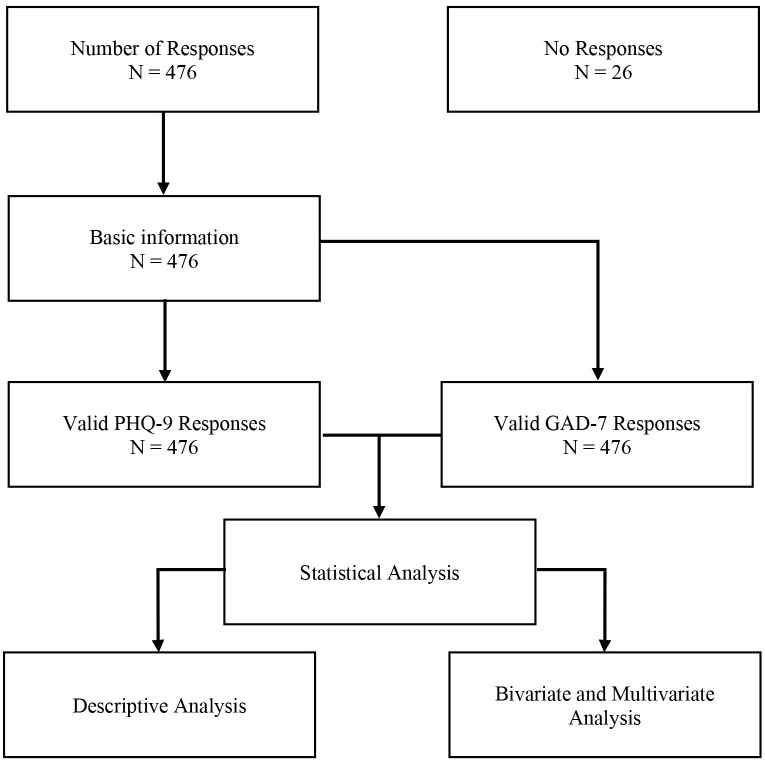
The purpose of this study was to investigate the prevalence of depression and anxiety among Bangladeshi university students during the COVID-19 pandemic. It also aimed at identifying the determinants of depression and anxiety. A total of 476 university students living in Bangladesh participated in this cross-sectional web-based survey. A standardized e-questionnaire was generated using the Google Form, and the link was shared through social media-Facebook. The information was analyzed in three consecutive levels, such as univariate, bivariate, and multivariate analysis. Students were experiencing heightened depression and anxiety. Around 15% of the students reportedly had moderately severe depression, whereas 18.1% were severely suffering from anxiety. The binary logistic regression suggests that older students have greater depression (OR = 2.886, 95% CI = 0.961-8.669). It is also evident that students who provided private tuition in the pre-pandemic period had depression (OR = 1.199, 95% CI = 0.736-1.952). It is expected that both the government and universities could work together to fix the academic delays and financial problems to reduce depression and anxiety among university students.
Overview
The claims and statistics of this paper haven’t been checked yet.
Run the check — free, no account needed. It reads the open-access text and checks the sources it cites.
Integrity signals
Registry
Cites
Statistics
Figures
Verification
Claims the paper makes
The claims and statistics of this paper haven’t been checked yet.
Run the check — free, no account needed. It reads the open-access text and checks the sources it cites.
Claims other papers make about this one
Each is checked against this paper’s own text: does it say what the citing paper says it does?
The source backs part of the claim, not all of it — or backs it for a different population, condition or comparison.
In the citing paper
“undergraduate students in lockdown, namely that they suffered increasing severity of anxiety and depressive symptoms [48], manifested in poorer sleep quality, poorer academic performance and increased suicidal thoughts in the university populations [49,50,51,52,53,54,55,56,57,58].”
From Relationships between psychopathology, psychological process variables, and sociodemographic variables and comparison of quarantined and non-quarantined groups of malaysian university students in the covid-19 pandemic (2021) · cites this paper as [55]
Experimental — accuracy not yet measured
Self-check
Percentages, sums and reported differences re-computed from the paper’s own numbers.
The self-check needs the paper’s full text.
Citations
Cites
The PHQ-9: Validity of a brief depression severity measure
Kroenke, K., Spitzer, R. L., & Williams, J. B. W. (2001) · Journal of General Internal Medicine · doi:10.1046/j.1525-1497.2001.016009606.x · Cited by 44,910
(1990) · Choice Reviews Online · doi:10.5860/choice.27-3338 · Cited by 35,305
A Brief Measure for Assessing Generalized Anxiety Disorder: The GAD-7
Spitzer, R. L., Kroenke, K., Williams, J. B. W., & Löwe, B. (2006) · Archives of Internal Medicine · doi:10.1001/archinte.166.10.1092 · Cited by 31,765
Hosmer, D. W., & Lemeshow, S. (2000) · doi:10.1002/0471722146 · Cited by 20,302
Online Learning: A Panacea in the Time of COVID-19 Crisis
Dhawan, S. (2020) · Journal of Educational Technology Systems · doi:10.1177/0047239520934018 · Cited by 6,340
The psychological impact of the COVID-19 epidemic on college students in China
Cao, W., Fang, Z., Hou, G., Han, M., Xu, X., Dong, J., & Zheng, J. (2020) · Psychiatry Research · doi:10.1016/j.psychres.2020.112934 · Cited by 5,843
Presumed Asymptomatic Carrier Transmission of COVID-19
Bai, Y., Yao, L., Wei, T., Tian, F., Jin, D., Chen, L., & Wang, M. (2020) · JAMA · doi:10.1001/jama.2020.2565 · Cited by 4,496
Mental health problems and social media exposure during COVID-19 outbreak
Gao, J., Zheng, P., Jia, Y., Chen, H., Mao, Y., Chen, S., Wang, Y., Fu, H., & Dai, J. (2020) · PLoS ONE · doi:10.1371/journal.pone.0231924 · Cited by 2,830
Mental Health Problems and Social Media Exposure During COVID-19 Outbreak
Gao, J., Zheng, P., Jia, Y., Chen, H., Mao, Y., Chen, S., Wang, Y., Fu, H., & Dai, J. (2020) · SSRN Electronic Journal · doi:10.2139/ssrn.3541120 · Cited by 2,830
Sahu, P. (2020) · Cureus · doi:10.7759/cureus.7541 · Cited by 2,353
Research works printed but not linked: 3
- SL Mei, 2011, Psychological investigation of university students in a university in Jilin province, Med Soc, 24, 84
- K Hasan, 2020, Easing Covid-19 lockdown: Will wearing face masks be safe enough?, Dhaka Tribune, 2020
- SM Rahman, 2020, Covid-19: Use of face mask, The Financial Express, 2020
Cited by
Sorted by citations
Manchia, M., Gathier, A. W., Eser, H. Y., Schmidt, M. V., de Quervain, D. J. ‐., van Amelsvoort, T., Bisson, J. I., Cryan, J. F., Howes, O. D., Pinto, L., et al. (2021) · European Neuropsychopharmacology · doi:10.1016/j.euroneuro.2021.10.864 · Cited by 532
Deng, J., Zhou, F., Hou, W., Silver, Z. A., Wong, C. Y., Chang, O., Drakos, A., Zuo, Q., & Huang, E. (2021) · Psychiatry Research · doi:10.1016/j.psychres.2021.113863 · Cited by 532
Li, Y., Wang, A., Wu, Y., Han, N., & Huang, H. (2021) · Frontiers in Psychology · doi:10.3389/fpsyg.2021.669119 · Cited by 441
Opinion of students on online education during the COVID ‐19 pandemic
Chakraborty, P., Mittal, P., Gupta, M. S., Yadav, S., & Arora, A. (2020) · Human Behavior and Emerging Technologies · doi:10.1002/hbe2.240 · Cited by 479
Faisal, R. A., Jobe, M. C., Ahmed, O., & Sharker, T. (2022) · International Journal of Mental Health and Addiction · doi:10.1007/s11469-020-00458-y · Cited by 275
Metadata
- Authors
- Islam, M. A., Barna, S. D., Raihan, H., Khan, M. N. A., & Hossain, M. T.
- Affiliations
- Khulna University (BD)
- Corresponding author
- Islam, Md. Akhtarul
- Venue
- PLOS ONE
- Publisher
- Public Library of Science (PLoS)
- Published
- 2020-08-26
- Volume
- 15
- Issue
- 8
- Pages
- e0238162
- ISSN
- 1932-6203 (ISSN-L)
- PMC
- PMC7449469
- OpenAlex
- W3081367520
- Cited by
- 834
- References
- 48
- Citations by year
- 2026: 26 · 2025: 35 · 2024: 84 · 2023: 182 · 2022: 242 · 2021: 240 · 2020: 25
- FWCI
- 68.96
- Type
- journal article
- Language
- en
- Open access
- gold
- doi.org
- Licence
- Locations
- PLoS ONE (publishedVersion, cc-by)
- PubMed Central (publishedVersion, cc-by)
- PubMed (publishedVersion)
- RePEc: Research Papers in Economics (submittedVersion)
- DOAJ (DOAJ: Directory of Open Access Journals) (submittedVersion, cc-by-sa)
- Informationszentrum Lebenswissenschaften (ZB MED) (submittedVersion, cc-by)
- Greater South Information System
- Topics
- Social Sciences › Psychology › Clinical Psychology › COVID-19 and Mental Health
- Social Sciences › Psychology › Developmental and Educational Psychology › Student Stress and Coping
- Health Sciences › Medicine › Psychiatry and Mental health › Mental Health Treatment and Access
- Keywords
- depression, anxiety, university students, COVID-19 pandemic, prevalence, risk factors, age, private tutoring, academic delay, financial problems, Bangladesh
- MeSH terms
- COVID-19, Adolescent, Anxiety, Bangladesh, Communicable Disease Control, Depression, Female, Humans, Male, Pneumonia, Viral, Surveys and Questionnaires, Students, Universities, Logistic Models, Coronavirus Infections, Young Adult, Pandemics
About these checks
Registry, retraction, Cites and statistics results are computed, not judged, with one exception: a printed reference that no index lists is read once by a model before it counts as a citation error. Claims are extracted by a model and kept only when their quote appears verbatim in the text; each cited source is then checked, with a model’s help, for whether it says what the claim relies on. Those verdicts can be wrong — read the claim’s quote and the cited source before relying on one.
Statistics and arithmetic are recomputed, not judged.
Confidence bands are shown only for fields calibrated on our annotated test set. None is calibrated yet, so no band is shown.
What counts as a claim ›How we measure confidence ›How we check this ›
Are you an author, or do you see a problem with this page? Request a review
