

The DOI matches its Crossref record; 26 of the 27 references it cites were found in a registry or an index.
COVID-19 and mental health deterioration by ethnicity and gender in the UK
Open accessAbstract
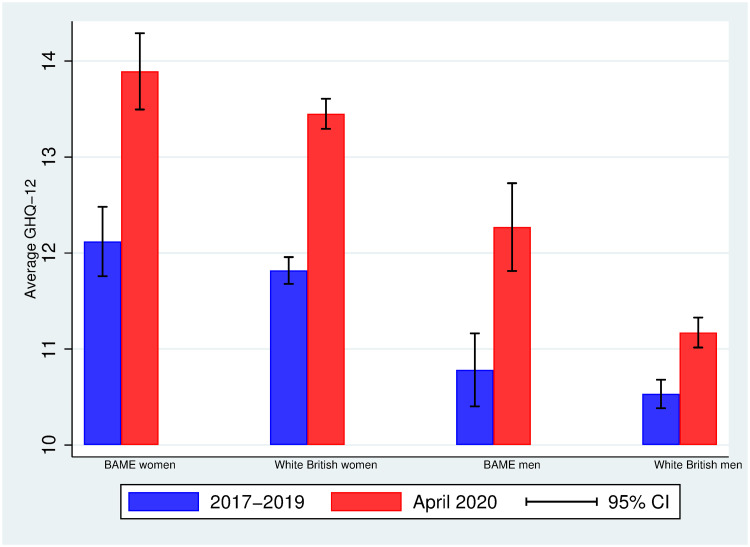
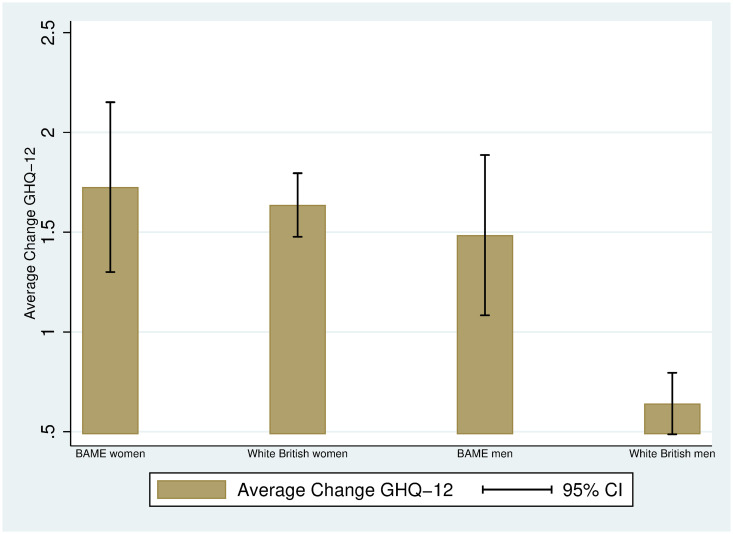
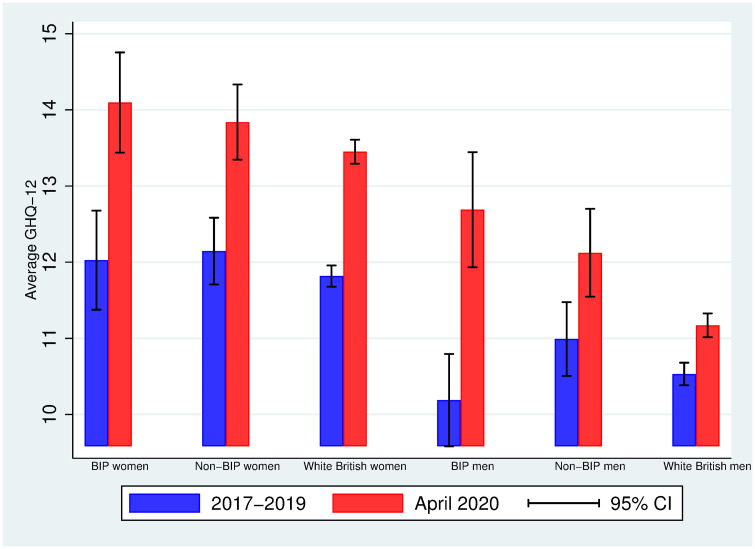
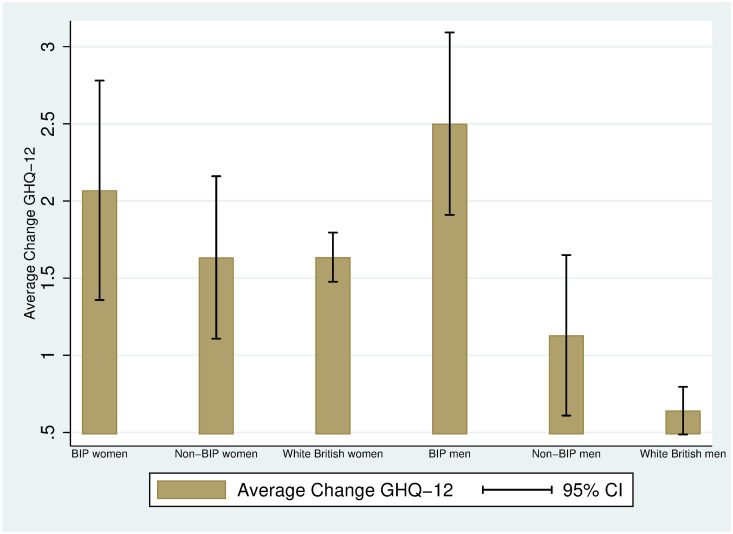
We use the UK Household Longitudinal Study and compare pre-COVID-19 pandemic (2017-2019) and during-COVID-19 pandemic data (April 2020) for the same group of individuals to assess and quantify changes in mental health as measured by changes in the GHQ-12 (General Health Questionnaire), among ethnic groups in the UK. We confirm the previously documented average deterioration in mental health for the whole sample of individuals interviewed before and during the COVID-19 pandemic. In addition, we find that the average increase in mental distress varies by ethnicity and gender. Both women –regardless of their ethnicity– and Black, Asian, and minority ethnic (BAME) men experienced a higher average increase in mental distress than White British men, so that the gender gap in mental health increases only among White British individuals. These ethnic-gender specific changes in mental health persist after controlling for demographic and socioeconomic characteristics. Finally, we find some evidence that, among men, Bangladeshi, Indian and Pakistani individuals have experienced the highest average increase in mental distress with respect to White British men.
Overview
The claims and statistics of this paper haven’t been checked yet.
Run the check — free, no account needed. It reads the open-access text and checks the sources it cites.
Integrity signals
Registry
Cites
Statistics
Figures
Verification
Claims the paper makes
The claims and statistics of this paper haven’t been checked yet.
Run the check — free, no account needed. It reads the open-access text and checks the sources it cites.
Claims other papers make about this one
Each is checked against this paper’s own text: does it say what the citing paper says it does?
The cited source says what the claim attributes to it.
In the citing paper
“possibly due to worsening mental health outcomes during the COVID-19 pandemic [16].”
Self-check
Percentages, sums and reported differences re-computed from the paper’s own numbers.
The self-check needs the paper’s full text.
Citations
Cites
Factors associated with COVID-19-related death using OpenSAFELY
Williamson, E. J., Walker, A. J., Bhaskaran, K., Bacon, S., Bates, C., Morton, C. E., Curtis, H. J., Mehrkar, A., Evans, D., Inglesby, P., et al. (2020) · Nature · doi:10.1038/s41586-020-2521-4 · Cited by 6,674
(1988) · NFER-Nelson eBooks · Cited by 5,560
The Validity of Two Versions of the GHQ in the WHO Study of Mental Illness in General Health Care
GOLDBERG, D. P., GATER, R., SARTORIUS, N., USTUN, T. B., PICCINELLI, M., GUREJE, O., & RUTTER, C. (1997) · Psychological Medicine · doi:10.1017/s0033291796004242 · Cited by 3,657 · cited 1×
“Finally, we use a third measure based on the change of a binary indicator of being at risk of presenting with mental health problems (GHQ “caseness” score) [16], which has been validated against psychiatric interviews [29, 30].”
MethodCzeisler, M. É., Lane, R. I., Petrosky, E., Wiley, J. F., Christensen, A., Njai, R., Weaver, M. D., Robbins, R., Facer-Childs, E. R., Barger, L. K., et al. (2020) · MMWR. Morbidity and Mortality Weekly Report · doi:10.15585/mmwr.mm6932a1 · Cited by 2,686
Prevalence of depression symptoms in US adults before and during the COVID-19 pandemic
Ettman, C. K., Abdalla, S. M., Cohen, G. H., Sampson, L., Vivier, P. M., & Galea, S. (2020) · JAMA Network Open · doi:10.1001/jamanetworkopen.2020.19686 · Cited by 2,138
Daly, M., Sutin, A. R., & Robinson, E. (2020) · Psychological Medicine · doi:10.1017/s0033291720004432 · Cited by 780
Niedzwiedz, C. L., Green, M. J., Benzeval, M., Campbell, D., Craig, P., Demou, E., Leyland, A., Pearce, A., Thomson, R., Whitley, E., et al. (2021) · Journal of Epidemiology and Community Health · doi:10.1136/jech-2020-215060 · Cited by 525
Evidence mounts on the disproportionate effect of COVID-19 on ethnic minorities
Kirby, T. (2020) · The Lancet Respiratory Medicine · doi:10.1016/s2213-2600(20)30228-9 · Cited by 521
Psychological distress and adaptation to the COVID-19 crisis in the United States
Daly, M., & Robinson, E. (2021) · Journal of Psychiatric Research · doi:10.1016/j.jpsychires.2020.10.035 · Cited by 470
Does Employee Happiness Have an Impact on Productivity?
Bellet, C. S., Jan-emmanuel De Neve, A., & Ward, G. (2019) · Management Science · doi:10.1287/mnsc.2023.4766 · Cited by 339
Research works printed but not linked: 4
- Kenway P, Butt J. Evidence Into Action: A review of the report by Public Health England into disparities in risks and outcomes of COVID-19 between ethnic groups and by level of deprivation. Briefing paper. New Policy Insitute and the Race Equality Foundation. 2020.
- Oreffice S, Quintana-Domeque C. Gender inequality in COVID-19 times: Evidence from UK Prolific participants. IZA. 2020, IZA Discussion Paper 13463. · DOI
- University of Essex, Institute for Social and Economic Research. Understanding Society: COVID-19 Study, 2020. [data collection]. 4th Edition, 2020. UK Data Service. SN: 8644, http://doi.org/10.5255/UKDA-SN-8644-4. · DOI
- S Mc Fall, 2017, Understanding Society: UK Household Longitudinal Study: User Guide to ethnicity and immigration research, Institute for Social and Economic Research
Cited by
Sorted by citations
Aknin, L. B., De Neve, J.-E., Dunn, E. W., Fancourt, D. E., Goldberg, E., Helliwell, J. F., Jones, S. P., Karam, E., Layard, R., Lyubomirsky, S., et al. (2022) · Perspectives on Psychological Science · doi:10.1177/17456916211029964 · Cited by 418
“These findings are consistent with those of Banks and Xu (2020), who analyzed responses from 11,988 individuals in the same data set (U.K. Household Longitudinal Survey) and reported the greatest declines in mental health among young women (see also Proto & Quintana-Domeque, 2021).”
ResultJob loss and mental health during the COVID-19 lockdown: Evidence from South Africa
Posel, D. R., Oyenubi, A., & Kollamparambil, U. (2021) · PLoS ONE · doi:10.1371/journal.pone.0249352 · Cited by 338
“In contrast to research on the mental health implications of COVID-19 in the UK, there is no evidence that the effects of job loss on mental health were gendered (an interactive term for African and female did not yield significant results in any of the estimations) [10].”
ResultSalanti, G., Peter, N. L., Tonia, T., Holloway, A., White, I. R., Darwish, L., Low, N. N., Egger, M., Haas, A. D., Fazel, S., et al. (2022) · Annals of Internal Medicine · doi:10.7326/m22-1507 · Cited by 183
“…al, 2020 (46) Kikuchi et al, 2020 (36) Meseguer de Pedro et al, 2021 (33) Xue and McMunn, 2021 (43) Ahrens et al, 2021 (39) Pierce et al, 2021 (7) Proto and Quintana-Domeque, 2021 (37) Xue and McMunn, 2021 (43) Ahrens et al, 2021 (39) Wang et al, 2021 (35) Somatoform disorder Schützwohl and…”
BackgroundThe impact of the coronavirus lockdown on mental health: evidence from the United States
Adams‐Prassl, A., Boneva, T., Golin, M., & Rauh, C. (2022) · Economic Policy · doi:10.1093/epolic/eiac002 · Cited by 276
Aknin, L. B., Neve, J. E. D., Dunn, E. W., Fancourt, D. E., Goldberg, E., Helliwell, J. F., Jones, S., Karam, E. G., Layard, R., Lyubomirsky, S., et al. (2021) · doi:10.31234/osf.io/zw93g · Cited by 131
Metadata
- Authors
- Proto, E., & Quintana-Domeque, C.
- Affiliations
- IZA - Institute of Labor Economics (DE)
- Venue
- PLOS ONE
- Publisher
- Public Library of Science (PLoS)
- Published
- 2021-01-06
- Volume
- 16
- Issue
- 1
- Pages
- e0244419
- ISSN
- 1932-6203 (ISSN-L)
- PMC
- PMC7787387
- OpenAlex
- W3120271639
- Cited by
- 297
- References
- 27
- Citations by year
- 2026: 19 · 2025: 32 · 2024: 46 · 2023: 61 · 2022: 81 · 2021: 55
- FWCI
- 41.44
- Type
- journal article
- Language
- en
- Open access
- gold
- doi.org
- Licence
- Locations
- PLoS ONE (publishedVersion, cc-by)
- Europe PMC (PubMed Central) (publishedVersion, cc-by)
- PubMed Central (publishedVersion, cc-by)
- PubMed (publishedVersion)
- ENLIGHTEN (Jurnal Bimbingan dan Konseling Islam) (submittedVersion, cc-by-sa)
- RePEc: Research Papers in Economics (submittedVersion)
- DOAJ (DOAJ: Directory of Open Access Journals) (submittedVersion, cc-by-sa)
- Figshare (submittedVersion, cc-by)
- Open Research Exeter (University of Exeter) (submittedVersion, cc-by)
- Knowledge@UChicago (University of Chicago) (submittedVersion)
- University of Chicago (cc-by)
- Funders
- University of Essex
- University of Exeter
- University of Liverpool
- University of Queensland
- Economic and Social Research Council
- Topics
- Social Sciences › Psychology › Clinical Psychology › COVID-19 and Mental Health
- Health Sciences › Medicine › Psychiatry and Mental health › Mental Health Treatment and Access
- Health Sciences › Medicine › Public Health, Environmental and Occupational Health › Employment and Welfare Studies
- Keywords
- COVID-19 pandemic, mental health deterioration, psychological distress, ethnic differences, gender differences, Black, Asian and minority ethnic groups, UK Household Longitudinal Study, GHQ-12
- MeSH terms
- COVID-19, SARS-CoV-2, Adult, Mental Disorders, Ethnicity, Female, United Kingdom, Humans, Longitudinal Studies, Male, Mental Health, Middle Aged, Minority Groups, Racial Groups, Pandemics
About these checks
Registry, retraction, Cites and statistics results are computed, not judged, with one exception: a printed reference that no index lists is read once by a model before it counts as a citation error. Claims are extracted by a model and kept only when their quote appears verbatim in the text; each cited source is then checked, with a model’s help, for whether it says what the claim relies on. Those verdicts can be wrong — read the claim’s quote and the cited source before relying on one.
Statistics and arithmetic are recomputed, not judged.
Confidence bands are shown only for fields calibrated on our annotated test set. None is calibrated yet, so no band is shown.
What counts as a claim ›How we measure confidence ›How we check this ›
Are you an author, or do you see a problem with this page? Request a review
