

Estimation of the fraction of COVID-19 infected people in U.S. states and countries worldwide
Open accessPublished version of a preprint
The DOI matches its Crossref record; 16 of the 16 references it cites were found in a registry or an index.
Abstract
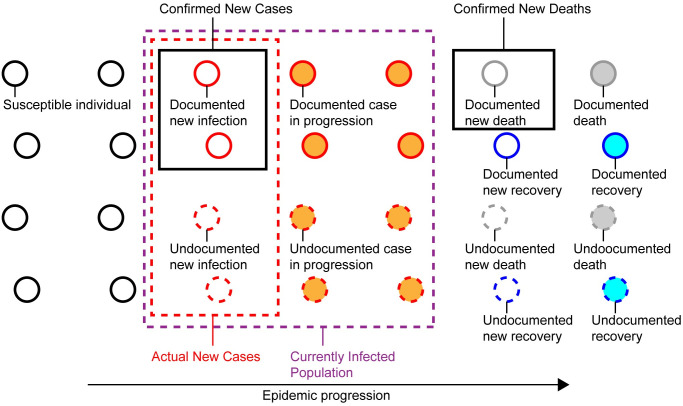
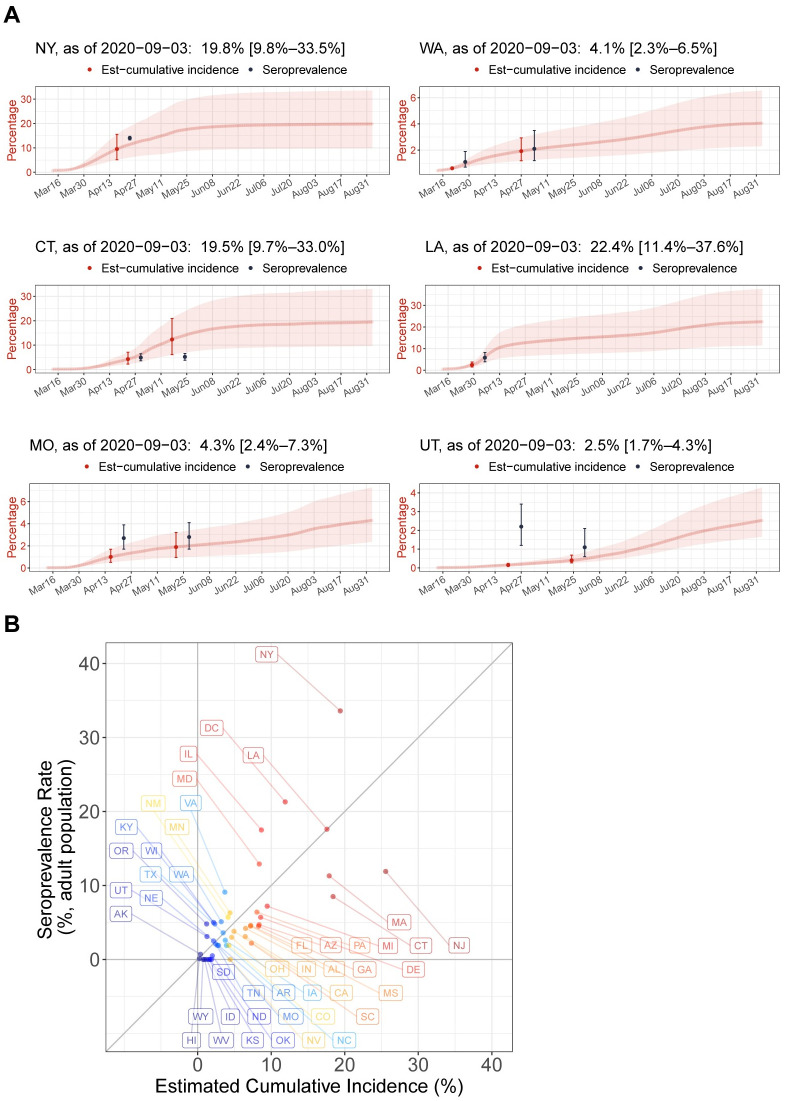
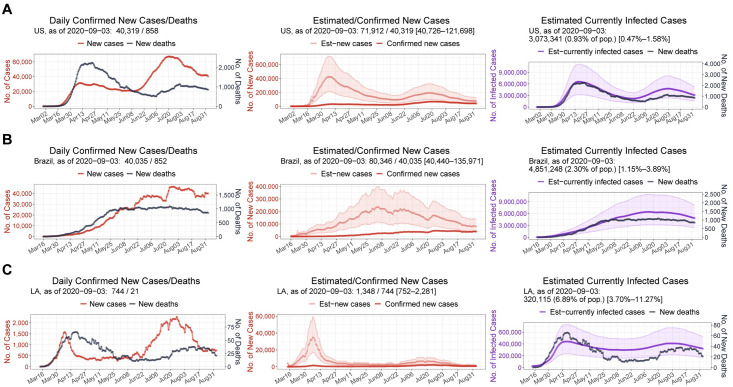
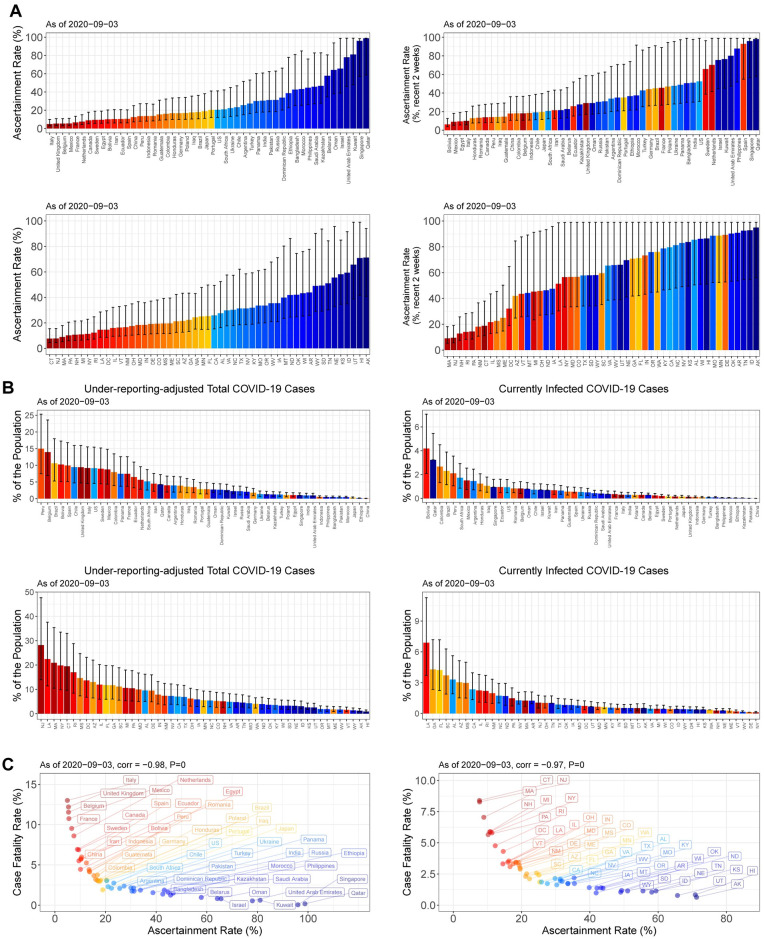
Since the beginning of the coronavirus disease 2019 (COVID-19) pandemic, daily counts of confirmed cases and deaths have been publicly reported in real-time to control the virus spread. However, substantial undocumented infections have obscured the true size of the currently infected population, which is arguably the most critical number for public health policy decisions. We developed a machine learning framework to estimate time courses of actual new COVID-19 cases and current infections in all 50 U.S. states and the 50 most infected countries from reported test results and deaths. Using published epidemiological parameters, our algorithm optimized slowly varying daily ascertainment rates and a time course of currently infected cases each day. Severe under-ascertainment of COVID-19 cases was found to be universal across U.S. states and countries worldwide. In 25 out of the 50 countries, actual cumulative cases were estimated to be 5–20 times greater than the confirmed cases. Our estimates of cumulative incidence were in line with the existing seroprevalence rates in 46 U.S. states. Our framework projected for countries like Belgium, Brazil, and the U.S. that ~10% of the population has been infected once. In the U.S. states like Louisiana, Georgia, and Florida, more than 4% of the population was estimated to be currently infected, as of September 3, 2020, while in New York this fraction is 0.12%. The estimation of the actual fraction of currently infected people is crucial for any definition of public health policies, which up to this point may have been misguided by the reliance on confirmed cases.
Overview
The claims and statistics of this paper haven’t been checked yet.
Free: it reads the open-access text and checks the first 5 claims that cite a source we can check. Create a free account to check every claim.
Integrity signals
Registry
Cites
Statistics
Figures
Verification
Claims the paper makes
The claims and statistics of this paper haven’t been checked yet.
Free: it reads the open-access text and checks the first 5 claims that cite a source we can check. Create a free account to check every claim.
Self-check
Percentages, sums and reported differences re-computed from the paper’s own numbers.
The self-check needs the paper’s full text.
Citations
Cites
An interactive web-based dashboard to track COVID-19 in real time
Dong, E., Du, H., & Gardner, L. (2020) · The Lancet Infectious Diseases · doi:10.1016/s1473-3099(20)30120-1 · Cited by 10,048
Estimates of the severity of coronavirus disease 2019: a model-based analysis
Verity, R., Okell, L. C., Dorigatti, I., Winskill, P., Whittaker, C., Imai, N., Cuomo-Dannenburg, G., Thompson, H., Walker, P. G. T., Fu, H., et al. (2020) · The Lancet Infectious Diseases · doi:10.1016/s1473-3099(20)30243-7 · Cited by 3,660
Li, R., Pei, S., Chen, B., Song, Y., Zhang, T., Yang, W., & Shaman, J. (2020) · Science · doi:10.1126/science.abb3221 · Cited by 3,633
To, K. K.-W., Tsang, O. T.-Y., Leung, W.-S., Tam, A. R., Wu, T.-C., Lung, D. C., Yip, C. C.-Y., Cai, J.-P., Chan, J. M.-C., Chik, T. S.-H., et al. (2020) · The Lancet Infectious Diseases · doi:10.1016/s1473-3099(20)30196-1 · Cited by 3,066
Wu, F., Wang, A., Liu, M., Wang, Q., Chen, J., Xia, S., Ling, Y., Zhang, Y., Xun, J., Lu, L., et al. (2020) · doi:10.1101/2020.03.30.20047365 · Cited by 754
Seroprevalence of antibodies to SARS-CoV-2 in 10 sites in the United States, March 23–May 12, 2020
Havers, F. P., Reed, C., Lim, T., Montgomery, J. M., Klena, J. D., Hall, A. J., Fry, A. M., Cannon, D. L., Chiang, C.-F., Gibbons, A., et al. (2020) · JAMA Internal Medicine · doi:10.1001/jamainternmed.2020.4130 · Cited by 647
Weinberger, D. M., Chen, J., Cohen, T., Crawford, F. W., Mostashari, F., Olson, D., Pitzer, V. E., Reich, N. G., Russi, M., Simonsen, L., et al. (2020) · JAMA Internal Medicine · doi:10.1001/jamainternmed.2020.3391 · Cited by 485
Anand, S., Montez-Rath, M., Han, J., Bozeman, J., Kerschmann, R., Beyer, P., Parsonnet, J., & Chertow, G. M. (2020) · The Lancet · doi:10.1016/s0140-6736(20)32009-2 · Cited by 265
Cumulative incidence and diagnosis of SARS-CoV-2 infection in New York
Rosenberg, E. S., Tesoriero, J. M., Rosenthal, E. M., Chung, R., Barranco, M. A., Styer, L. M., Parker, M. M., John Leung, S.-Y., Morne, J. E., Greene, D., et al. (2020) · Annals of Epidemiology · doi:10.1016/j.annepidem.2020.06.004 · Cited by 262
Lipton, Z. C., Ellington, J., smike, Ouyang, J., Riley, K., Ellinger, J., Hammerbacher, J., Lacan, O., Crane, J., & space-buzzer (2020) · Zenodo (CERN European Organization for Nuclear Research) · doi:10.5281/zenodo.3981599 · Cited by 217
Cited by
Items 101–105 of 105
Calibration in a Data Sparse Environment: How \nMany Cases Did We Miss?
Smith, R. M., Wise, S., & Ayling, S. C. E. (2023) · UCL Discovery (University College London)
Peixoto, V. R., McCallum, A. K., Reintjes, R., Lopes, H., Franco, D., Beccia, F., Prikazsky, V., Chatarajupalli, P., & Reid, J. (2021) · Portuguese National Funding Agency for Science, Research and Technology (RCAAP Project by FCT)
Retrospective estimate of COVID-19 infections in nine Colombian cities in 2020
Márquez, J., David, G.-G., Vigo, I., & Bordehore, C. (2026) · Epidemiology and Infection · doi:10.1017/s095026882610106x
Li, S., Aprahamian, H., & Chatterjee, S. (2026) · INFORMS journal on computing · doi:10.1287/ijoc.2023.0465
How Many Veteran COVID‐19 Cases Were There during the Pandemic?
Widanagamaachchi, W., Callahan, A. R., Willson, T. M., Barbeau, B., Lewis, J. E., Dalton, C. D., Stevens, V. W., Samore, M., Chaiyakunapruk, N., & Jones, M. M. (2026) · Journal of Medical Virology · doi:10.1002/jmv.71040
Metadata
- Authors
- Noh, J., & Danuser, G.
- Affiliations
- The University of Texas Southwestern Medical Center (US)
- Corresponding author
- Noh, Jungsik
- Venue
- PLOS ONE
- Publisher
- Public Library of Science (PLoS)
- Published
- 2021-02-08
- Volume
- 16
- Issue
- 2
- Pages
- e0246772
- ISSN
- 1932-6203 (ISSN-L)
- PMC
- PMC7869996
- OpenAlex
- W3126875101
- Cited by
- 104
- References
- 15
- Citations by year
- 2026: 2 · 2025: 5 · 2024: 12 · 2023: 19 · 2022: 31 · 2021: 34
- FWCI
- 9.28
- Type
- journal article
- Language
- en
- Open access
- gold
- doi.org
- Licence
- Locations
- PLoS ONE (publishedVersion, cc-by)
- medRxiv (acceptedVersion, cc-by-nc)
- PubMed Central (publishedVersion, cc-by)
- PubMed (publishedVersion)
- DOAJ (DOAJ: Directory of Open Access Journals) (submittedVersion, cc-by-sa)
- Funders
- Lyda Hill Foundation
- Topics
- Physical Sciences › Mathematics › Modeling and Simulation › COVID-19 epidemiological studies
- Health Sciences › Medicine › Epidemiology › Data-Driven Disease Surveillance
- Health Sciences › Medicine › Infectious Diseases › SARS-CoV-2 detection and testing
- Keywords
- COVID-19 pandemic, SARS-CoV-2, seroprevalence, cumulative incidence, confirmed cases, machine learning estimation, public health policy, United States states
- MeSH terms
- COVID-19, SARS-CoV-2, Humans, Time Factors, United States, Reproducibility of Results, Seroepidemiologic Studies
About these checks
Registry, retraction, Cites and statistics results are computed, not judged, with one exception: a printed reference that no index lists is read once by a model before it counts as a citation error. Claims are extracted by a model and kept only when their quote appears verbatim in the text; each cited source is then checked, with a model’s help, for whether it says what the claim relies on. Those verdicts can be wrong — read the claim’s quote and the cited source before relying on one.
Statistics and arithmetic are recomputed, not judged.
Confidence bands are shown only for fields calibrated on our annotated test set. None is calibrated yet, so no band is shown.
What counts as a claim ›How we measure confidence ›How we check this ›
Are you an author, or do you see a problem with this page? Request a review
Data sources
Bibliographic data: Semantic Scholar, OpenAlex, Crossref.
Contains information from the Semantic Scholar Academic Graph Datasets, made available under the ODC Attribution License (ODC-BY 1.0).
Semantic Scholar’s data is described in: Kinney, R., et al. (2023). The Semantic Scholar Open Data Platform. arXiv:2301.10140.
