

A systematic review and meta-analysis of asymptomatic malaria infection in pregnant women in Sub-Saharan Africa: A challenge for malaria elimination efforts
Open accessThe DOI matches its Crossref record; 50 of the 50 references it cites were found in a registry or an index.
Abstract
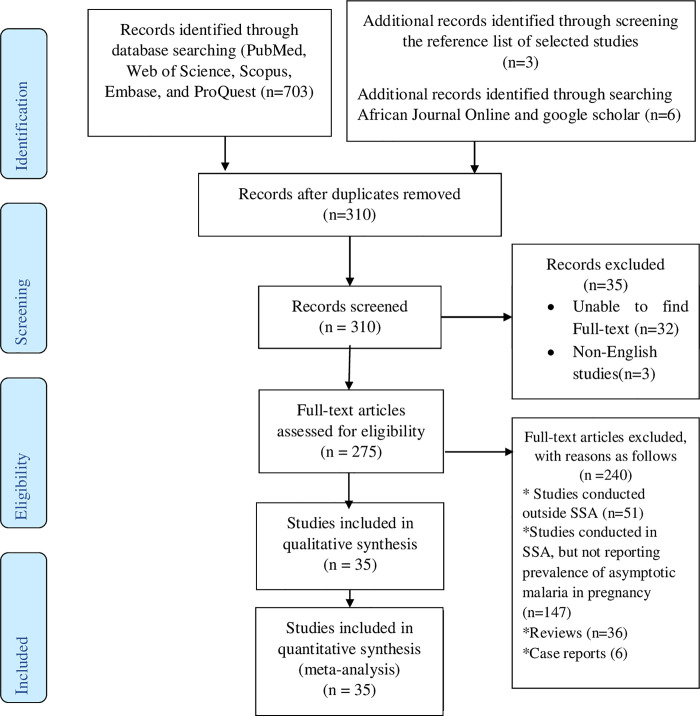
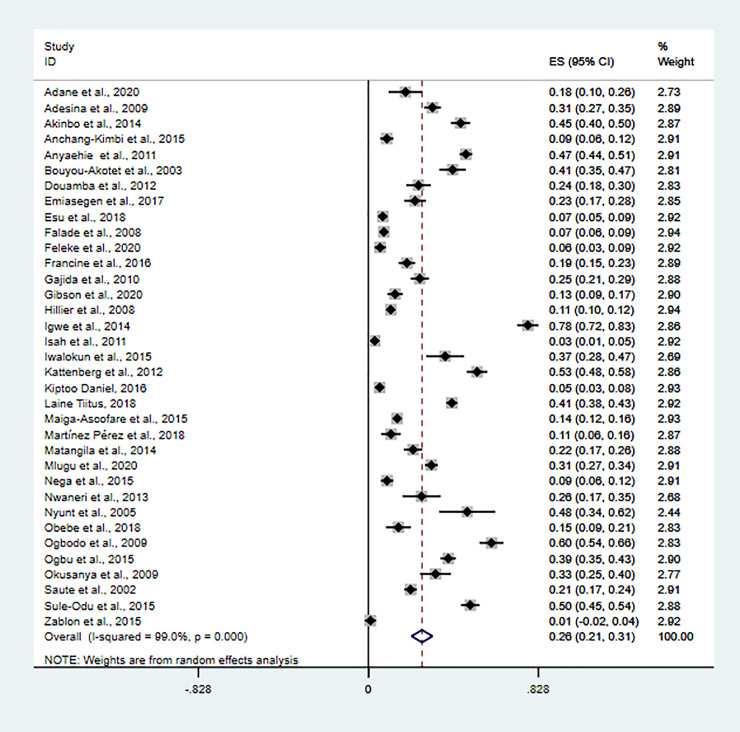
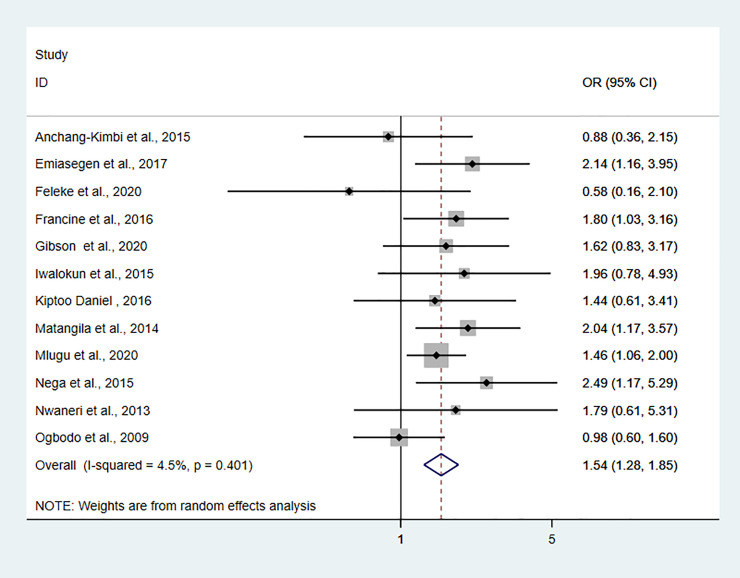
Background: In Sub-Saharan Africa (SSA), where malaria transmission is stable, malaria infection in pregnancy adversely affects pregnant women, fetuses, and newborns and is often asymptomatic. So far, a plethora of primary studies have been carried out on asymptomatic malaria infection in pregnant women in SSA. Nevertheless, no meta-analysis estimated the burden of asymptomatic malaria infection in pregnant women in SSA, so this meta-analysis was carried out to bridge this gap. Methods: PubMed, Web of Science, Scopus, Embase, and ProQuest were systematically searched for relevant studies published until 4 August 2020, and also the expansion of the search was performed by October 24, 2020. We assessed heterogeneity among included studies using I-squared statistics (I 2). Publication bias was assessed by visual inspection of the funnel plot and further quantitatively validated by Egger’s and Begg’s tests. The pooled prevalence and pooled odds ratio (OR) and their corresponding 95% Confidence Interval (CI) were estimated using the random-effects model in Stata 15 software. Results: For this meta-analysis, we included 35 eligible studies. The overall prevalence estimate of asymptomatic Plasmodium infection prevalence was 26.1%% (95%CI: 21–31.2%, I 2 = 99.0%). According to species-specific pooled prevalence estimate, Plasmodium falciparum was dominant species (22.1%, 95%CI: 17.1–27.2%, I 2 = 98.6%), followed by Plasmodium vivax, Plasmodium malariae and Plasmodium ovale, respectively, found to be 3% (95%CI: 0–5%, I 2 = 88.3%), 0.8% (95%CI: 0.3–0.13%, I 2 = 60.5%), and 0.2% (95%CI: -0.01–0.5%, I 2 = 31.5%). Asymptomatic malaria-infected pregnant women were 2.28 times more likely anemic (OR = 2.28, 95%CI: 1.66–3.13, I 2 = 56.3%) than in non-infected pregnant women. Asymptomatic malaria infection was 1.54 times higher (OR = 1.54, 95%CI: 1.28–1.85, I 2 = 11.5%) in primigravida women compared to multigravida women. Conclusion: In SSA, asymptomatic malaria infection in pregnant women is prevalent, and it is associated with an increased likelihood of anemia compared to non-infected pregnant women. Thus, screening of asymptomatic pregnant women for malaria and anemia should be included as part of antenatal care.
Overview
The claims and statistics of this paper haven’t been checked yet.
Free: it reads the open-access text and checks the first 5 claims that cite a source we can check. Create a free account to check every claim.
Integrity signals
Registry
Cites
Statistics
Figures
Verification
Claims the paper makes
The claims and statistics of this paper haven’t been checked yet.
Free: it reads the open-access text and checks the first 5 claims that cite a source we can check. Create a free account to check every claim.
Claims other papers make about this one
Each is checked against this paper’s own text: does it say what the citing paper says it does?
The source backs part of the claim, not all of it — or backs it for a different population, condition or comparison.
In the citing paper
“Likewise, other studies reported that pregnant women, especially those in their first pregnancy (primigravidae), are at a higher risk of severe malaria and its complications [8–11].”
From Current update on malaria in pregnancy: a systematic review (2025) · cites this paper as [11]
Experimental — accuracy not yet measuredThe source backs part of the claim, not all of it — or backs it for a different population, condition or comparison.
In the citing paper
“Similarly, studies have indicated that primigravidae have an increased risk of severe malaria and associated complications [8–11].”
From Current update on malaria in pregnancy: a systematic review (2025) · cites this paper as [11]
Experimental — accuracy not yet measuredThe source backs part of the claim, not all of it — or backs it for a different population, condition or comparison.
In the citing paper
“The African region accounts for approximately 90% of global malaria cases, and pregnant women, especially those in their first pregnancy (primigravidae), are at a higher risk of severe malaria and its complications [8–11].”
From Current update on malaria in pregnancy: a systematic review (2025) · cites this paper as [11]
Experimental — accuracy not yet measuredThe source backs part of the claim, not all of it — or backs it for a different population, condition or comparison.
In the citing paper
“Even though the studies of Africa have shown a significant reduction in the prevalence of malaria, it is worth noting that these measures have not accounted for all the countries in the region, hence limiting its generalizability [11].”
From Malaria in pregnancy: Meta-analyses of prevalence and associated complications (2024) · cites this paper as [11]
Experimental — accuracy not yet measured
Self-check
Percentages, sums and reported differences re-computed from the paper’s own numbers.
The self-check needs the paper’s full text.
Citations
Cites
Bias in meta-analysis detected by a simple, graphical test
Egger, M., Smith, G. D., Schneider, M., & Minder, C. (1997) · BMJ · doi:10.1136/bmj.315.7109.629 · Cited by 56,722
The Cochrane Collaboration's tool for assessing risk of bias in randomised trials
Higgins, J. P. T., Altman, D. G., Gotzsche, P. C., Juni, P., Moher, D., Oxman, A. D., Savovic, J., Schulz, K. F., Weeks, L., Sterne, J. A. C., et al. (2011) · BMJ · doi:10.1136/bmj.d5928 · Cited by 33,817
Operating characteristics of a rank correlation test for publication bias
Begg, C. B., & Mazumdar, M. (1994) · Biometrics · doi:10.2307/2533446 · Cited by 16,955 · cited 1×
“We assessed publication bias by visual inspection of the funnel plot and further validated using Egger’s regression test [26] and Begg’s correlation test [27].”
MethodHoy, D., Brooks, P., Woolf, A., Blyth, F., March, L., Bain, C., Baker, P., Smith, E., & Buchbinder, R. (2012) · Journal of Clinical Epidemiology · doi:10.1016/j.jclinepi.2011.11.014 · Cited by 2,555 · cited 1×
“[24], risk of a bias assessment tool for cross-sectional studies.”
BackgroundDisease Tolerance as a Defense Strategy
Medzhitov, R., Schneider, D. S., & Soares, M. P. (2012) · Science · doi:10.1126/science.1214935 · Cited by 1,718
Epidemiology and burden of malaria in pregnancy
Desai, M., ter Kuile, F. O., Nosten, F., McGready, R., Asamoa, K., Brabin, B., & Newman, R. D. (2007) · The Lancet Infectious Diseases · doi:10.1016/s1473-3099(07)70021-x · Cited by 1,432
The burden of malaria in pregnancy in malaria-endemic areas
Steketee, R., Nahlen, B., Parise, M., & Menendez, C. (2001) · The American Journal of Tropical Medicine and Hygiene · doi:10.4269/ajtmh.2001.64.28 · Cited by 1,063
The silent threat: asymptomatic parasitemia and malaria transmission
Lindblade, K. A., Steinhardt, L., Samuels, A., Kachur, S. P., & Slutsker, L. (2013) · Expert Review of Anti-infective Therapy · doi:10.1586/eri.13.45 · Cited by 600 · cited 2×
“Moreover, asymptomatic malaria-infected individuals are a silent reservoir host of natural infection that usually goes undetectable and less likely to get treated, thus can transmit the disease to the population [17, 18].”
BackgroundEffect of inflammatory cytokines on hypoxia-induced erythropoietin production
Faquin, W., Schneider, T., & Goldberg, M. (1992) · Blood · doi:10.1182/blood.v79.8.1987.1987 · Cited by 532 · cited 1×
“The complete mechanisms of anemia related to malaria are not fully understood: it is suggested that malaria infection causes destruction of red blood cells (erythrophagocytosis) as well as disturbance of red blood cell formation (dyserythropoiesis) that eventually contribute to maternal anemia [41, 42].”
BackgroundThe complexities of malaria disease manifestations with a focus on asymptomatic malaria
Laishram, D. D., Sutton, P. L., Nanda, N., Sharma, V. L., Sobti, R. C., Carlton, J. M., & Joshi, H. (2012) · Malaria Journal · doi:10.1186/1475-2875-11-29 · Cited by 340 · cited 3×
“Clinical presentation of malaria during pregnancy vary depending on the intricate interplay of malaria transmission intensity in particular geographical settings, parasites, and the level of acquired immunity [3, 4].”
Background
Cited by
Current update on malaria in pregnancy: a systematic review
Minwuyelet, A., Yewhalaw, D., Siferih, M., & Atenafu, G. (2025) · Tropical Diseases, Travel Medicine and Vaccines · doi:10.1186/s40794-025-00248-1 · Cited by 49
“Likewise, other studies reported that pregnant women, especially those in their first pregnancy (primigravidae), are at a higher risk of severe malaria and its complications [8–11].”
Performance and utility of more highly sensitive malaria rapid diagnostic tests
Slater, H., Ding, X. C., Knudson, S., Bridges, D. J., Moonga, H. B., Saad, N. J., Smet, M. D., Bennett, A. F., Dittrich, S., Slutsker, L., et al. (2022) · BMC Infectious Diseases · doi:10.1186/s12879-021-07023-5 · Cited by 43
“falciparum infections are typically harder to detect in pregnant women as the parasites commonly sequester in the placenta [7] and treating asymptomatic infections has been shown to have positive impacts on both the mother and the infant [8].”
BackgroundMalaria in pregnancy: Meta-analyses of prevalence and associated complications
Das, J. K., Lakhani, S., Rahman, A. R., Siddiqui, F., Ali Padhani, Z., Rashid, Z., Mahmud, O., Naqvi, S. K., Amir Naseem, H., Jehanzeb, H., et al. (2024) · Epidemiology and Infection · doi:10.1017/s0950268824000177 · Cited by 31
“Even though the studies of Africa have shown a significant reduction in the prevalence of malaria, it is worth noting that these measures have not accounted for all the countries in the region, hence limiting its generalizability [11].”
BackgroundInfluentialNana, R. R. D., Hawadak, J., Foko, L. P. K., Kumar, A., Chaudhry, S., Arya, A., & Singh, V. (2022) · Pathogens and Global Health · doi:10.1080/20477724.2022.2128563 · Cited by 40
“diagnosed either as asymptomatic or uncomplicated malaria, thereby limiting their management with intravenous/intramuscular AS and ACTs injections [75,77].”
BackgroundAdegbola, A. J., Ijarotimi, O. A., Ubom, A. E., Adesoji, B. A., Babalola, O. E., Hocke, E. F., Hansson, H. S., Mousa, A., Bolaji, O. O., Alifrangis, M., et al. (2023) · Malaria Journal · doi:10.1186/s12936-023-04487-5 · Cited by 29
“It has been well established that asymptomatic malaria infection is associated with poor maternal or fetal health [48].”
BackgroundMalaria parasite classification framework using a novel channel squeezed and boosted CNN
Khan, S. H., Shah, N. S., Nuzhat, R., Majid, A., Alquhayz, H., & Khan, A. (2022) · Microscopy · doi:10.1093/jmicro/dfac027 · Cited by 37
Re-orienting anti-malarial drug development to better serve pregnant women
Gaaloul, M. E., Tornesi, B. M., Lebus, F., Reddy, D., & Kaszubska, W. (2022) · Malaria Journal · doi:10.1186/s12936-022-04137-2 · Cited by 24
“Moreover, as asymptomatic malaria infection in pregnant women is associated with an increased likelihood of anaemia [31], there will be an added benefit to individuals participating in the elimination campaigns in averting this adverse consequence of untreated asymptomatic infection.”
Chacha, G. A., Francis, F. T., Mandai, S. S., Seth, M. D., Madebe, R. A., Challe, D. P., Petro, D. A., Pereus, D., Moshi, R., Budodo, R. M., et al. (2025) · Parasites & Vectors · doi:10.1186/s13071-024-06639-1 · Cited by 26
Detecting temporal and spatial malaria patterns from first antenatal care visits
Pujol, A., Brokhattingen, N., Matambisso, G., Mbeve, H., Cisteró, P., Escoda, A., Maculuve, S. A., Cuna, B., Melembe, C., Ndimande, N., et al. (2023) · Nature Communications · doi:10.1038/s41467-023-39662-4 · Cited by 20
Malaria parasitic detection using a new Deep Boosted and Ensemble Learning framework
Asif, H. M., Khan, S. H., Alahmadi, T. J., Alsahfi, T., & Mahmoud, A. (2024) · Complex & Intelligent Systems · doi:10.1007/s40747-024-01406-2 · Cited by 20
“P. Falciparum malaria is particularly dangerous to pregnant women as it increases stillbirth, maternal death, miscarriage, and newborn [3].”
Haileselassie, W., Habtemichael, M., Adam, R., Haidar, J., David, R. E., Belachew, A., Mengesha, A. T., Koepfli, C., Deressa, W. A., Parker, D. M., et al. (2022) · International Health · doi:10.1093/inthealth/ihac024 · Cited by 20
Duguma, T. A., Tekalign, E., Kebede, S. S., & Bambo, G. M. (2023) · Frontiers in Reproductive Health · doi:10.3389/frph.2023.1258952 · Cited by 18
“The current fi nding is much lower compared to the one found in Sub-Saharan Africa and Nigeria, with a reported pooled prevalence of asymptomatic malaria of 26.1% (30) and 34.3% (31) respectively.”
ResultInfluentialSingh, L., Fontinha, D., Francisco, D., Prudêncio, M., & Singh, K. (2022) · Scientific Reports · doi:10.1038/s41598-021-04532-w · Cited by 14
Asmelash, D., Agegnehu, W., Zewdia, W. F., Asmelash, Y., Debebe, S., & Asres, A. (2025) · Journal of Epidemiology and Global Health · doi:10.1007/s44197-025-00365-2 · Cited by 19
Debash, H., Alemayehu, E., Belete, M. A., Ebrahim, H., Mohammed, O., Gebretsadik, D., Tilahun, M., & Gedefie, A. (2025) · Malaria Journal · doi:10.1186/s12936-025-05246-4 · Cited by 15
“[36] and Nigeria (34.3”
InfluentialKassie, G. A., Azeze, G. A., Gebrekidan, A. Y., Lombebo, A. A., Adella, G. A., Haile, K. E., Dendir, G., Efa, A. G., & Asgedom, Y. S. (2024) · Parasite Epidemiology and Control · doi:10.1016/j.parepi.2024.e00339 · Cited by 17
Prevalence of Pregnancy Associated Malaria in India
Jain, K., Gupta, P., Balodhi, A., Deeba, F., & Salam, N. (2022) · Frontiers in Global Women s Health · doi:10.3389/fgwh.2022.832880 · Cited by 15
Guimsop, D. K., Kenmogne, A. F. T., Kodji, H., & Ateudjieu, J. (2024) · PLOS Global Public Health · doi:10.1371/journal.pgph.0001245 · Cited by 13
Lingani, M., Zango, S. H., Valéa, I., Samadoulougou, S., Somé, G., Sanou, M., Kaboré, B., Rouamba, T., Sorgho, H., Tahita, M. C., et al. (2023) · Malaria Journal · doi:10.1186/s12936-023-04530-5 · Cited by 12
“These infections are endemic in SSA [7, 8] and are usually asymptomatic in pregnancy with high risk of misdiagnosis and missed treatment [9, 10].”
BackgroundAlemayehu, A., Abossie, A., Zeynudin, A., Beyene, J., & Yewhalaw, D. (2024) · Malaria Journal · doi:10.1186/s12936-024-05041-7 · Cited by 12
“On the other hand, the prevalence of AMiP in the current study was lower than the pooled 26.1% prevalence in sub-Saharan Africa [19], 36.4% in Tanzania [27], and 29.5% in The Democratic Republic of The Congo [26].”
BackgroundInfluentialAmpofo, G. D., Osarfo, J., Okyere, D. D., Kouevidjin, E., Aberese-Ako, M., & Tagbor, H. K. (2025) · BMC Pregnancy and Childbirth · doi:10.1186/s12884-025-07735-5 · Cited by 13
“[13].”
InfluentialRahman, M. S., & Shiddik, M. A. B. (2025) · Scientific Reports · doi:10.1038/s41598-025-12872-0 · Cited by 16
Ebong, C. E., Ali, I. M., Fouedjio, J. H., Essangui, E., Achu, D. F., Lawrence, A., & Sama, D. J. (2022) · Malaria Journal · doi:10.1186/s12936-022-04109-6 · Cited by 12
Prospective study of malaria in pregnancy, placental and congenital malaria in Northwest Colombia
Cardona-Arias, J. A., & Carmona-Fonseca, J. (2024) · Malaria Journal · doi:10.1186/s12936-024-04948-5 · Cited by 8
“…contexts, the highest proportion of PAM infections are submicroscopic (positive with qPCR and negative with thick blood smear TBS), and they are associated with clinical outcomes [11] and constitute a great challenge for the elimination of malaria because the majority are asymptomatic [13, 14].”
BackgroundEmmanuel, B. N., Chessed, G., Erukainure, F. E., Ekeuhie, J. C., & Philips, V. (2023) · Journal of Umm Al-Qura University for Applied Sciences · doi:10.1007/s43994-023-00092-z · Cited by 11
Silwamba, W., Chisompola, D., Nzobokela, J., Chakulya, M., Kabwe, L. S., & Tembo, K. M. (2025) · Malaria Journal · doi:10.1186/s12936-025-05472-w · Cited by 8
“These findings align with previous studies that have demonstrated the heterogeneous nature of malaria transmission dynamics across and within regions of SSA, highlighting varying rates of asymptomatic malaria among deferent vulnerable and demographic groups [7, 8, 25, 37].”
Nlinwe, N. O., Nchefor, F. G., & Takwi, N. B. (2022) · Parasite Epidemiology and Control · doi:10.1016/j.parepi.2022.e00265 · Cited by 7
Paper functionalization for detection of Plasmodium falciparum DNA using square waves voltammetry
Clément, R., Bienvenu, A., Lavoignat, A., Bonnot, G., Doumèche, B., & Picot, S. (2022) · Talanta · doi:10.1016/j.talanta.2022.123839 · Cited by 8
Synthesis of Qualitative Evidence on Malaria in Pregnancy, 2005–2022: A Systematic Review
Cardona‐Arias, J. A. (2023) · Tropical Medicine and Infectious Disease · doi:10.3390/tropicalmed8040235 · Cited by 10
Nzoputam, C. I., Ogidan, O. C., Barrow, A., & Ekholuenetale, M. (2024) · Malaria Journal · doi:10.1186/s12936-024-05195-4 · Cited by 11
Malaria in pregnancy at the frontline: a delicate balance
Kokuhennadige, V., Aitken, E. H., & Rogerson, S. J. (2026) · Current Opinion in Immunology · doi:10.1016/j.coi.2026.102726 · Cited by 8
Chacha, G. A., Francis, F. T., Mandai, S. S., Seth, M. D., Madebe, R. A., Challe, D. P., Petro, D. A., Pereus, D., Moshi, R., Budodo, R. M., et al. (2024) · medRxiv · doi:10.1101/2024.06.05.24308481 · Cited by 7
Mukhtar, A., Ismail, M. M., Usman, A., Odetokun, I. A., Ibrahim, M. A., Salman, A. A., Bawa-Sani, H. G., Nass, S. S., Goni, B. W., Shehu, M. N., et al. (2025) · Malaria Journal · doi:10.1186/s12936-025-05671-5 · Cited by 8
“[46] and a Nigeria-specific analysis (34.3”
InfluentialAnabire, N. G., Aculley, B., Pobee, A. N. A., Baafour, E. K., Awandare, G. A., Quintana, M. D. P., Hviid, L., & Ofori, M. F. (2023) · Infection · doi:10.1007/s15010-023-02058-z · Cited by 7
“That notwithstanding, within Sub-Saharan Africa, the contributions of infectious diseases including HIV, schistosomiasis and malaria to maternal anaemia is significant [4, 10, 11].”
BackgroundResultInfluentialUba, C. C., Ikegbunam, M., Anagor, I. S., Eleanya, L. C., Ezeumeh, E. N., Ezekwueche, S. N., Okechukwu, E. C., & Esimone, C. O. (2021) · Advances in Infectious Diseases · doi:10.4236/aid.2021.114035 · Cited by 5
“falciparum is the leading cause of malaria in pregnant women [2].”
BackgroundBarrow, A., Ogidan, O. C., Nzoputam, C. I., & Ekholuenetale, M. (2025) · PLOS Global Public Health · doi:10.1371/journal.pgph.0004207 · Cited by 4
Hamad, M. N. M., Albadrani, G. M., Ghazwani, A. A. M., Abdelmola, A. A., Suliman, R. S., Mahjaf, G. M., Fahmy, S. A., Badi, S., Yassin, H. M., Othman, G. A. M., et al. (2025) · BMC Immunology · doi:10.1186/s12865-025-00753-0 · Cited by 5
“The invasive malaria vector An. ste-phensi was initially detected in Sudan in 2019 [15–18], raising concerns about malaria in urban settings.”
Lupaka, M., Degefa, T., Eba, K., Zeynudin, A., & Yewhalaw, D. (2023) · Malaria Journal · doi:10.1186/s12936-023-04790-1 · Cited by 4
Uyaiabasi, G. N., Olaleye, A. O., Elikwu, C. J., Funwei, R. I., Okangba, C., Adepoju, A., Akinyede, A. A., Adeyemi, O., & Walker, O. (2023) · European Journal of Obstetrics & Gynecology and Reproductive Biology X · doi:10.1016/j.eurox.2023.100233 · Cited by 5
“Our data has demonstrated that asymptomatic malaria in pregnancy is prevalent in our environment [4, 32, 33].”
Elmugabil, A., Ahmed, I. A. M., Ali, L. E., Alorini, M., Mohmmed, A. A., & Adam, I. (2024) · The Journal of Infection in Developing Countries · doi:10.3855/jidc.18466 · Cited by 2
Lingani, M., Zango, S. H., Valéa, I., Bonko, M. D. A., Samadoulougou, S., Rouamba, T., Tahita, M. C., Sanou, M., Robert, A. R., Tinto, H., et al. (2021) · Tropical Medicine and Health · doi:10.1186/s41182-021-00381-5 · Cited by 5
“The high susceptibility of primigravid women to malaria [10], combined with the high prevalence of STI/RTI Table 3 Prevalence of malaria and curable STI/RTI coinfection among first antenatal care attendees in the Yako health district, Burkina Faso (n = 402)”
BackgroundMalaria Parasitic Detection using a New Deep Boosted and Ensemble Learning FrameworkPreprint
Khan, S. H., Sadiq, M., Liang, J., & Hassnain, S. A. (2022) · Research Square · doi:10.21203/rs.3.rs-2368739/v1 · Cited by 3
Detecting temporal and spatial malaria patterns from first antenatal care visitsPreprint
Pujol, A., Brokhattingen, N., Matambisso, G., Mbeve, H., Cisteró, P., Escoda, A., Maculuve, S. A., Cuna, B., Melembe, C., Ndimande, N., et al. (2023) · Research Square · doi:10.21203/rs.3.rs-2592126/v1 · Cited by 3
Alemayehu, A., Kiya, G. T., Mogas, S. B., Zeynudin, A., Beyene, J., & Yewhalaw, D. (2025) · Archives of Public Health · doi:10.1186/s13690-025-01772-4 · Cited by 7
“A consistent finding was reported from an SRMA on asymptomatic malaria in pregnancy (AMiP) in SSA in which primigravidae were found to have a higher odds of AMiP [227].”
Kamau, E. T., Maisiba, R., Dear, N. F., Esber, A. L., Parikh, A. P., Iroezindu, M. O., Bahemana, E., Kibuuka, H. N., Owuoth, J., Maswai, J. K., et al. (2023) · International Journal of Infectious Diseases · doi:10.1016/j.ijid.2023.09.018 · Cited by 2
Quach, A., Madaj, B., Fahy, K., Konate, A. T., Souley, I., Marcel, L. O., Traore, A., Islam, M., Egere, U., & Ameh, C. (2024) · PLOS Global Public Health · doi:10.1371/journal.pgph.0003268 · Cited by 1
Ali, I. M., Manga, I. A., Nji, A. M., Tchuenkam, V. P. K., Niba, P. T. N., Achu, D. F., Bigoga, J. D., Faye, B., Roper, C., Sutherland, C. J., et al. (2024) · Malaria Journal · doi:10.1186/s12936-024-05150-3 · Cited by 3
“Among the people living in endemic areas, a significant proportion of people asymptomatic infections due to non-immunity that develops following exposure to infected mosquito bites [3].”
Malaria Parasitic Detection using a New Deep Boosted and Ensemble Learning FrameworkPreprint
Khan, S. H. (2023) · Research Square · doi:10.21203/rs.3.rs-2368739/v2 · Cited by 2
Alemu, T., Nkosi, Z. Z., & Yakob, T. (2024) · Nutrition and Metabolic Insights · doi:10.1177/11786388241263676 · Cited by 1
Abdi, M. Y., Mohamud, F. A., & Abdullahi, S. A. (2025) · Malaria Journal · doi:10.1186/s12936-025-05665-3 · Cited by 3
“Among these complexities, gestational malaria is a particular public health concern [6].”
Mazigo, E., Jun, H., Lee, W.-J., Louis, J. M., Fitriana, F., Syahada, J. H., Muh, F., Chun, W., Park, W., Lee, S. J., et al. (2026) · Infectious Diseases of Poverty · doi:10.1186/s40249-025-01397-3 · Cited by 2
Ssekitooleko, J. (2021) · Texila international journal of public health · doi:10.21522/tijph.2013.09.04.art017 · Cited by 1
Lestari, M., Purba, E. R. V., Suci, E. S., Putri, B. A. K. D., & Wenda, A. (2024) · Jurnal Masyarakat Madani Indonesia · doi:10.59025/js.v3i1.197 · Cited by 1
Docquier, L., Taelman, C., Cantinieaux, B., Belhomme, J., de Wind, R., Dauby, N., & Martin, C. (2025) · CMI Communications · doi:10.1016/j.cmicom.2025.105131 · Cited by 1
Kambou, S. A. E., Sondo, P., Kaboré, B., Bayala, I. M. C., Kouevi, A. F. C., Compaore, E. W., Millogo, K. S., Bouda, I., Rouamba, T., Kazienga, A., et al. (2025) · Malaria Journal · doi:10.1186/s12936-025-05453-z · Cited by 2
“The presence of asymptomatic infections (patent and sub-patent) in household members living around the children under SMC coverage but who are not targeted by any specific intervention seems to be one of these factors [8–10].”
Submicroscopic malaria parasitemia and migration: the hidden weight carried by pregnant womenPreprint
Docquier, L., Taelman, C., Delforge, M., & Martin, C. (2024) · medRxiv · doi:10.1101/2024.01.21.24301565 · Cited by 1
Abdoli, A. (2022) · Transactions of the Royal Society of Tropical Medicine and Hygiene · doi:10.1093/trstmh/trac077
Guimsop, D. K., Kenmogne, A. F. T., Kodji, H., & Ateudjieu, J. (2022) · medRxiv · doi:10.1101/2022.10.12.22281001
Ararso, D., Animut, A., Golassa, L., & Dugassa, S. (2023) · Public Health in Practice · doi:10.1016/j.puhip.2023.100454
“The prevalence of ASM was increased among those who never used insecticide-treated nets and were living near stagnant water by six and three times, respectively [30] and ASM infection was 1.54 times higher in primigravida women compared to multigravida women.”
InfluentialAsymptomatic Malaria among Pregnant Women Attending Ante-Natal Clinic in Osogbo, Nigeria
A., A. R., Adeagbo, I. A., Igbe, E. U., Uthman-Izobo, O. S., & Akindele, A. A. (2023) · Pan African Journal of Life Sciences · doi:10.36108/pajols/3202/70.0370
Adegbola, A. J., Ogboye, R. M., Ijarotimi, O. A., Ubom, A. E., Adesoji, B. A., & Bolaji, O. O. (2024) · Transactions of the Royal Society of Tropical Medicine and Hygiene · doi:10.1093/trstmh/trae076 · Cited by 6
Leveraging Deep Learning Techniques for Definitude Malaria Detection Using Microscopic Images
Kumar, R. (2025) · International Journal for Research in Applied Science and Engineering Technology · doi:10.22214/ijraset.2025.71015
Oguta, O., Mohammed, J., Umer, U., & Solomon, E. T. (2025) · Health Science Reports · doi:10.1002/hsr2.71310 · Cited by 1
“…cases were caused by P. falciparum species this was lower than study conducted in Fendeka town health facilities, Jawi District, North west Ethiopia which re-ported 53% of the cases were caused by P. falciparum [25], and lower than the finding of a systematic review and meta ‐ analysis 22.1% [32].”
InfluentialAdditional file 2 of Performance and utility of more highly sensitive malaria rapid diagnostic tests
Slater, H., Ding, X. C., Knudson, S., Bridges, D. J., Moonga, H. B., Saad, N. J., Smet, M. D., Bennett, A., Dittrich, S., Slutsker, L., et al. (2022) · Figshare · doi:10.6084/m9.figshare.19127670
Additional file 3 of Performance and utility of more highly sensitive malaria rapid diagnostic tests
Slater, H., Ding, X. C., Knudson, S., Bridges, D. J., Moonga, H. B., Saad, N. J., Smet, M. D., Bennett, A., Dittrich, S., Slutsker, L., et al. (2022) · Figshare · doi:10.6084/m9.figshare.19127676
Additional file 1 of Performance and utility of more highly sensitive malaria rapid diagnostic tests
Slater, H., Ding, X. C., Knudson, S., Bridges, D. J., Moonga, H. B., Saad, N. J., Smet, M. D., Bennett, A., Dittrich, S., Slutsker, L., et al. (2022) · Figshare · doi:10.6084/m9.figshare.19127667
Additional file 4 of Performance and utility of more highly sensitive malaria rapid diagnostic tests
Slater, H., Ding, X. C., Knudson, S., Bridges, D. J., Moonga, H. B., Saad, N. J., Smet, M. D., Bennett, A., Dittrich, S., Slutsker, L., et al. (2022) · Figshare · doi:10.6084/m9.figshare.19127682
Ebong, C. E., Ali, I. M., Fouedjio, J. H., Essangui, E., Achu, D. F., Lawrence, A., & Sama, D. (2022) · Figshare · doi:10.6084/m9.figshare.19336032
Adegbola, A. J., Ijarotimi, O. A., Ubom, A. E., Adesoji, B. A., Babalola, O. E., Hocke, E. F., Hansson, H. S., Mousa, A., Bolaji, O. O., Alifrangis, M., et al. (2024) · London School of Hygiene & Tropical Medicine · doi:10.6084/m9.figshare.26572123
AI-Based Early Diagnosis of Malaria in Blood Smear for Resource-Limited Settings in Africa
Basilwango, E., & Sylla, S. N. (2026) · Lecture notes of the Institute for Computer Sciences, Social Informatics and Telecommunications Engineering · doi:10.1007/978-3-032-15154-4_5
Akilimali, A., Mehmood, L., Njazi, I. P., Ali, B., Maqbool, S., Younas, M., Sagide, M., Rizvi, S. V. Z., Munsab, R., Rizvi, S., et al. (2026) · Health Science Reports · doi:10.1002/hsr2.72262 · Cited by 1
“At district (or sub‐ county) level, a malaria officer from the NMCP should be in charge of the support and supervision of malaria control activities at all levels of health facilities, and at the community level as well [7].”
InfluentialFaltamo, T. T., Assele, D. D., Meskele, M., & Tadesse, T. (2026) · Malaria Journal · doi:10.1186/s12936-026-05938-5 · Cited by 1
“[45], and refugee camps in Africa (35.93”
InfluentialDuguma, T. A., Fikadu, S., Kochito, S., Mohammed, H., & Demango, F. (2026) · Journal of Parasitology Research · doi:10.1155/japr/2720965
Yaswanth, C. A., & Kingsley, D. J. (2026) · Journal of Parasitic Diseases · doi:10.1007/s12639-026-01949-w
Quaye, D., Konadu, E. A., Letsa, T. E., Asante, P., Amponsah-Effah, S., Oduro, D., & Obiri, D. (2026) · Malaria Journal · doi:10.1186/s12936-026-06071-z
“A substantial proportion of malaria infections in pregnancy are sub-clinical, particularly among multigravidae, and remain undetected without sensitive molecular diagnostics such as PCR [86–89].”
Metadata
- Authors
- Yimam, Y., Nateghpour, M., Mohebali, M., & Abbaszadeh Afshar, M. J.
- Affiliations
- Woldia University (ET)
- Tehran University of Medical Sciences (IR)
- Corresponding author
- Mohebali, Mehdi
- Venue
- PLOS ONE
- Publisher
- Public Library of Science (PLoS)
- Published
- 2021-04-01
- Volume
- 16
- Issue
- 4
- Pages
- e0248245
- ISSN
- 1932-6203 (ISSN-L)
- PMC
- PMC8016273
- OpenAlex
- W3150989998
- Cited by
- 75
- References
- 50
- Citations by year
- 2026: 8 · 2025: 16 · 2024: 15 · 2023: 14 · 2022: 18 · 2021: 4
- FWCI
- 2.32
- Type
- journal article
- Language
- en
- Open access
- gold
- doi.org
- Licence
- Locations
- PLoS ONE (publishedVersion, cc-by)
- PubMed Central (publishedVersion, cc-by)
- PubMed (publishedVersion)
- RePEc: Research Papers in Economics (submittedVersion)
- DOAJ (DOAJ: Directory of Open Access Journals) (submittedVersion, cc-by-sa)
- Greater South Information System
- Topics
- Health Sciences › Medicine › Public Health, Environmental and Occupational Health › Malaria Research and Control
- Health Sciences › Medicine › Genetics (clinical) › Hemoglobinopathies and Related Disorders
- Life Sciences › Immunology and Microbiology › Parasitology › Bird parasitology and diseases
- Keywords
- asymptomatic malaria, malaria in pregnancy, Plasmodium falciparum, Plasmodium vivax, Plasmodium malariae, Plasmodium ovale, anemia, malaria elimination, sub-Saharan Africa, prevalence, maternal health, pregnancy outcomes, neonatal outcomes, placental malaria, malaria species distribution, malaria risk factors
- MeSH terms
- Female, Humans, Malaria, Plasmodium falciparum, Pregnancy, Prenatal Care, Pregnancy Complications, Parasitic, Prevalence, Africa South of the Sahara, Asymptomatic Infections, Coinfection
About these checks
Registry, retraction, Cites and statistics results are computed, not judged, with one exception: a printed reference that no index lists is read once by a model before it counts as a citation error. Claims are extracted by a model and kept only when their quote appears verbatim in the text; each cited source is then checked, with a model’s help, for whether it says what the claim relies on. Those verdicts can be wrong — read the claim’s quote and the cited source before relying on one.
Statistics and arithmetic are recomputed, not judged.
Confidence bands are shown only for fields calibrated on our annotated test set. None is calibrated yet, so no band is shown.
What counts as a claim ›How we measure confidence ›How we check this ›
Are you an author, or do you see a problem with this page? Request a review
Data sources
Bibliographic data: Semantic Scholar, OpenAlex, Crossref.
Contains information from the Semantic Scholar Academic Graph Datasets, made available under the ODC Attribution License (ODC-BY 1.0).
Semantic Scholar’s data is described in: Kinney, R., et al. (2023). The Semantic Scholar Open Data Platform. arXiv:2301.10140.
