

The DOI matches its Crossref record; 33 of the 35 references it cites were found in a registry or an index; none of the 7 sources its claims cite is checked for support yet.
An improved NFC device authentication protocol
Open accessAbstract
Aimed at the security authentication problem between Near Field Communication (NFC) devices, this paper uses the technology of asymmetric encryption algorithm, symmetric encryption algorithm, hash function, timestamp and survival period to improve the confidentiality, performance and security of the protocol. The symmetric encryption algorithm encrypts the transmission content, while the asymmetric encryption algorithm encrypts the shared key. The whole authentication process is secure, and the key distribution is secure. The improved NFC device authentication protocol can effectively resist the brute force attack, man-in-the-middle attack and replay attack in the authentication process, it can reduce the number of message transmission in the authentication process, improve the transmission efficiency, enhance the confidentiality, integrity, non-repudiation and improve the security of NFC device authentication.
Overview
CoChat Summary
TL;DR
This paper proposes an improved NFC device authentication protocol that combines symmetric encryption, asymmetric encryption, hash functions, timestamps, and device survival periods to strengthen security while keeping transmission efficient. The authors claim it resists brute force, man-in-the-middle, and replay attacks and reduces the number of message transmissions.
Key findings
- The protocol is designed in two stages: a registration phase and an authentication phase, using symmetric encryption for transmitted content, asymmetric encryption for shared-key distribution and authentication, and hash functions for integrity checking.
- The paper states the protocol can resist brute force attacks, man-in-the-middle attacks, and replay attacks, and can achieve mutual authentication between NFC devices.
- It claims the protocol reduces the number of message transmissions in the authentication process, improving transmission efficiency while preserving confidentiality, integrity, and non-repudiation.
- The paper says it uses random numbers from both the NFC device and the authentication server, plus a survival period and timestamp, to strengthen two-factor authentication and replay protection.
Methods
- Protocol design only: a proposed NFC device authentication scheme with a registration phase and an authentication phase; no experimental user study or dataset is described in the provided text.
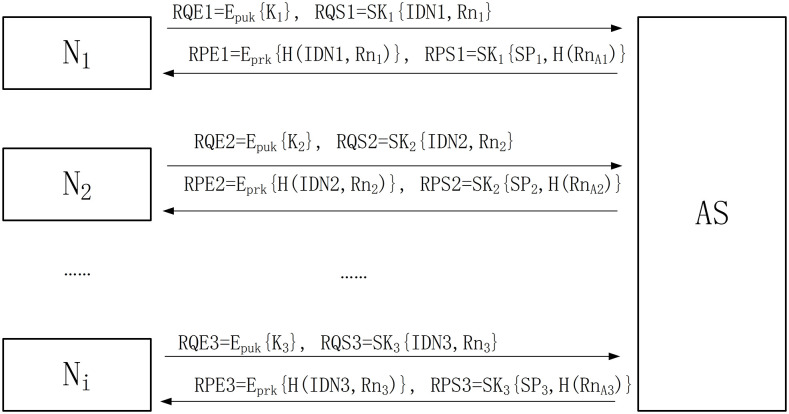
- In registration, device N1 sends encrypted identifiers and a random number to the authentication server (AS); AS decrypts, stores the values, generates its own random number and a survival period, and returns hashed verification material.
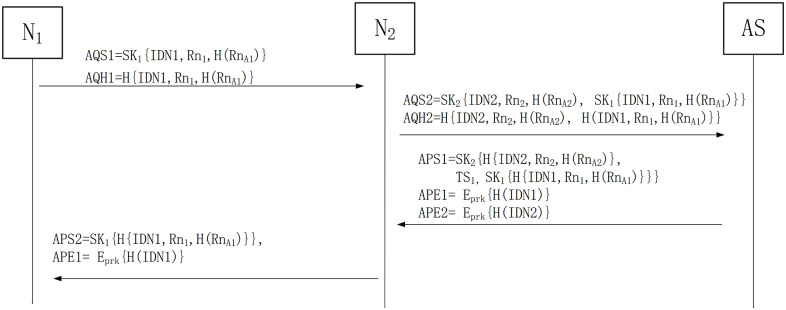
- In authentication, N1 and N2 exchange encrypted/hash-protected messages through AS, with AS verifying consistency against its database and the devices verifying AS-originated messages via public-key decryption, timestamps, and local hash checks.
Limitations
- Not stated in the paper.
- Evident from the text: the provided sections report a protocol proposal and qualitative security claims, but no quantitative evaluation, implementation results, attack experiments, or performance measurements are shown here.
Model-written summary. Check it against the paper before relying on it.
Integrity signals
Registry
Cites
Statistics
Figures
Verification
Claims the paper makes
0 Valid · 0 Not valid · 3 Not checked · 23 Own results and interpretations
A conclusion the paper draws from its own results — it cites no other source for it, so there is none to check. The quote shows it is in the paper.
In the paper
“The improved NFC device authentication protocol can effectively resist the brute force attack, man-in-the-middle attack and replay attack in the authentication process”
- Also stated in: § Prevent brute force attacks · boosted
“At the same time, symmetric encryption, asymmetric encryption and hash encryption technologies are adopted, making brute force cracking extremely difficult.”
§ An improved NFC device authentication protocol > Abstract
boostedstates a cause- Asserted: passes — The authors put it forward as true.
- Checkable: passes — It can be checked against evidence.
- Load-bearing: passes — The paper’s conclusions depend on it.
- Based: passes — The paper gives a reason why it holds.
- Rests on 2 assumptions not shown here.
- Also stated in: § Prevent brute force attacks · boosted
A conclusion the paper draws from its own results — it cites no other source for it, so there is none to check. The quote shows it is in the paper.
In the paper
“In this paper, ciphertext transmission is adopted. In the whole process of the protocol, including two phases of registration and authentication, the middleman cannot obtain the effective plaintext information.”
- Also stated in: § Ensure data confidentiality · plain
“The whole process is encrypted, so that all the data obtained by the attacker are ciphertext.”
§ An improved NFC device authentication protocol > Results > Prevent man-in-the-middle attacks
plainstates a cause- Asserted: passes — The authors put it forward as true.
- Checkable: passes — It can be checked against evidence.
- Load-bearing: passes — The paper’s conclusions depend on it.
- Based: passes — The paper gives a reason why it holds.
- Rests on an assumption not shown here.
- Also stated in: § Ensure data confidentiality · plain
A conclusion the paper draws from its own results — it cites no other source for it, so there is none to check. The quote shows it is in the paper.
In the paper
“enhance the confidentiality, integrity, non-repudiation and improve the security of NFC device authentication”
- Also stated in: § Safety analysis · plain
“It can be seen that the protocol in this paper can complete the mutual authentication of NFC devices and ensure the security at the same time.”
- Also stated in: § Conclusion · plain
“which makes the whole system more secure.”
§ An improved NFC device authentication protocol > Abstract
plainstates a cause- Asserted: passes — The authors put it forward as true.
- Checkable: passes — It can be checked against evidence.
- Load-bearing: passes — The paper’s conclusions depend on it.
- Based: passes — The paper gives a reason why it holds.
- Also stated in: § Safety analysis · plain
What the paper did — it cites no source for this, so there is none to check. The quote shows it is in the paper.
In the paper
“In this paper, the protocol uses symmetric algorithm to guarantee the security of NFC device Identity (ID) and random number in the transmission process”
§ An improved NFC device authentication protocol > Methodology
plainstates a cause- Asserted: passes — The authors put it forward as true.
- Checkable: passes — It can be checked against evidence.
- Load-bearing: passes — The paper’s conclusions depend on it.
- Based: passes — The paper gives a reason why it holds.
What the paper did — it cites no source for this, so there is none to check. The quote shows it is in the paper.
In the paper
“The symmetric encryption is used to make the protocol more efficient.”
§ An improved NFC device authentication protocol > Conclusion
plainstates a cause- Asserted: passes — The authors put it forward as true.
- Checkable: passes — It can be checked against evidence.
- Load-bearing: passes — The paper’s conclusions depend on it.
- Based: passes — The paper gives a reason why it holds.
10 more claims
Create a free account to see all 26 claims and every source verdict.
- Probably not a substantial claim. 3
- It may state two separate claims as one. 8
Citations
Cites
Introduction to Modern Cryptography
Katz, J., & Lindell, Y. (2014) · Chapman & Hall/CRC eBooks · doi:10.1201/b17668 · Cited by 1,880
A Survey of Man in the Middle Attacks
Conti, M., Dragoni, N., & Lesyk, V. (2016) · IEEE Communications Surveys & Tutorials · doi:10.1109/comst.2016.2548426 · Cited by 724 · cited 1×
“In the whole protocol design process, man-in-the-middle attack [17], replay attack [18], brute force attack [19], data integrity and confidentiality [20,21] and other factors are comprehensively considered.”
BackgroundA critical review of mobile payment research
Dahlberg, T., Guo, J., & Ondrus, J. (2015) · Electronic Commerce Research and Applications · doi:10.1016/j.elerap.2015.07.006 · Cited by 592
Identity-Based Remote Data Integrity Checking With Perfect Data Privacy Preserving for Cloud Storage
Yu, Y., Au, M. H., Ateniese, G., Huang, X., Susilo, W., Dai, Y., & Min, G. (2017) · IEEE Transactions on Information Forensics and Security · doi:10.1109/tifs.2016.2615853 · Cited by 479 · cited 1×
“In the whole protocol design process, man-in-the-middle attack [17], replay attack [18], brute force attack [19], data integrity and confidentiality [20,21] and other factors are comprehensively considered.”
BackgroundIntroduction to Modern Cryptography
Katz, J., & Lindell, Y. (2020) · Chapman & Hall/CRC eBooks · doi:10.1201/9781351133036 · Cited by 444 · cited 1×
“Symmetric encryption algorithm [11,12], asymmetric encryption algorithm [13,14], hash function [15,16] and other related technologies are used in the protocol.”
MethodA Survey on Near Field Communication (NFC) Technology
Coskun, V., Ozdenizci, B., & Ok, K. (2013) · Wireless Personal Communications · doi:10.1007/s11277-012-0935-5 · Cited by 390
Cryptography Engineering: Design Principles and Practical Applications
Ferguson, N., Schneier, B., & Kohno, T. (2015) · doi:10.1002/9781118722367 · Cited by 360
NFC mobile credit card: The next frontier of mobile payment?
Tan, G. W.-H., Ooi, K.-B., Chong, S.-C., & Hew, T.-S. (2014) · Telematics and Informatics · doi:10.1016/j.tele.2013.06.002 · Cited by 350
Epidermal Electronics with Advanced Capabilities in Near-Field Communication
Kim, J., Banks, A., Cheng, H., Xie, Z., Xu, S., Jang, K.-I., Lee, J. W., Liu, Z., Gutruf, P., Huang, X., et al. (2015) · Small · doi:10.1002/smll.201402495 · Cited by 274
Evaluating the Performance of Symmetric Encryption Algorithms
Elminaam, D. S. A., Kader, H. M. A., & Hadhoud, M. M. (2010) · International journal of network security · doi:10.6633/ijns.201005.10(3).06 · Cited by 242
TrustedDB: A Trusted Hardware-Based Database with Privacy and Data Confidentiality
Bajaj, S., & Sion, R. (2014) · IEEE Transactions on Knowledge and Data Engineering · doi:10.1109/tkde.2013.38 · Cited by 228
Stochastic coding detection scheme in cyber-physical systems against replay attack
Ye, D., Zhang, T.-Y., & Guo, G. (2019) · Information Sciences · doi:10.1016/j.ins.2018.12.091 · Cited by 201 · cited 1×
“In the whole protocol design process, man-in-the-middle attack [17], replay attack [18], brute force attack [19], data integrity and confidentiality [20,21] and other factors are comprehensively considered.”
BackgroundA Review and Comparative Analysis of Various Encryption Algorithms
Bhanot, R., & Hans, R. (2015) · International Journal of Security and Its Applications · doi:10.14257/ijsia.2015.9.4.27 · Cited by 175 · cited 1×
“Symmetric encryption algorithm [11,12], asymmetric encryption algorithm [13,14], hash function [15,16] and other related technologies are used in the protocol.”
MethodThe Survey on Near Field Communication
Coskun, V., Ozdenizci, B., & Ok, K. (2015) · Sensors · doi:10.3390/s150613348 · Cited by 122
Cho, J., Jeong, Y., & Park, S. O. (2012) · Computers & Mathematics with Applications · doi:10.1016/j.camwa.2012.02.025 · Cited by 78 · cited 1×
“In the whole protocol design process, man-in-the-middle attack [17], replay attack [18], brute force attack [19], data integrity and confidentiality [20,21] and other factors are comprehensively considered.”
BackgroundA Simple Secure Hash Function Scheme Using Multiple Chaotic Maps
Ahmad, M., Khurana, S., Singh, S., & Al-Sharari, H. D. (2017) · 3D Research · doi:10.1007/s13319-017-0123-1 · Cited by 60 · cited 1×
“Symmetric encryption algorithm [11,12], asymmetric encryption algorithm [13,14], hash function [15,16] and other related technologies are used in the protocol.”
MethodCeipidor, U. B., Medaglia, C. M., Marino, A., Sposato, S., & Moroni, A. (2012) · International ISC Conference on Information Security and Cryptology (ISCISC) · doi:10.1109/iscisc.2012.6408203 · Cited by 55
Weaknesses of the ISO/IEC 14443 protocol regarding relay attacks
Issovits, W., & Hutter, M. (2011) · 2011 IEEE International Conference on RFID-Technologies and Applications · doi:10.1109/rfid-ta.2011.6068658 · Cited by 39 · cited 1×
“Because NFC contains ISO/IEC 14443 standard, relay attack is feasible [9].”
BackgroundFinancial Technologies: A Note on Mobile Payment
Leng, S. Y., Talib, A. A., & Gunardi, A. (2018) · Jurnal Keuangan dan Perbankan · doi:10.26905/jkdp.v22i1.1993 · Cited by 39
A secure end-to-end proximity NFC-based mobile payment protocol
Bojjagani, S., & Sastry, V. (2019) · Comput. Stand. Interfaces · doi:10.1016/j.csi.2019.04.007 · Cited by 38
Asymmetric encryption algorithm for colour images based on fractional Hartley transform
Yadav, A. K., Singh, P., Saini, I., & Singh, K. (2018) · Journal of Modern Optics · doi:10.1080/09500340.2018.1559951 · Cited by 38 · cited 1×
“Symmetric encryption algorithm [11,12], asymmetric encryption algorithm [13,14], hash function [15,16] and other related technologies are used in the protocol.”
MethodNear Field Communication (NFC) Technology Security Vulnerabilities and Countermeasures
Singh, M. M., Adzman, K. A. A. K., & Hassan, R. (2018) · International Journal of Engineering & Technology · doi:10.14419/ijet.v7i4.31.23384 · Cited by 33
PSAP: Pseudonym-Based Secure Authentication Protocol for NFC Applications
Xu, J., Xue, K., Yang, Q., & Hong, P. (2018) · IEEE Transactions on Consumer Electronics · doi:10.1109/tce.2018.2811260 · Cited by 28
Research on WiFi Penetration Testing with Kali Linux
Lu, H.-J., & Yu, Y. (2021) · Complexity · doi:10.1155/2021/5570001 · Cited by 25
Self-citationThammarat, C., Chokngamwong, R., Techapanupreeda, C., & Kungpisdan, S. (2015) · International Conference on Information Networking · doi:10.1109/icoin.2015.7057870 · Cited by 19 · cited 1×
“’s research on NFC security lightweight protocol [24], Tung et al.”
BackgroundEfficient and Secure NFC Authentication for Mobile Payment Ensuring Fair Exchange Protocol
Thammarat, C. (2020) · Symmetry · doi:10.3390/sym12101649 · Cited by 18
A Tokenization-Based Communication Architecture for HCE-Enabled NFC Services
Özdenizci, B., Ok, K., & Coşkun, V. (2016) · Mobile Information Systems · doi:10.1155/2016/5046284 · Cited by 13
An anonymous and secure key agreement protocol for NFC applications using pseudonym
Ghafoorian, M., & Nikooghadam, M. (2020) · Wireless Networks · doi:10.1007/s11276-020-02319-x · Cited by 9
Anusha, R., & Shastrimath, V. V. D. (2018) · International Journal of Electrical and Computer Engineering (IJECE) · doi:10.11591/ijece.v8i2.pp1214-1221 · Cited by 6
Near Field Communication (NFC) Technology Security Vulnerabilities and Countermeasures
Singh, M. M., Adzman, K. A. A. K., & Hassan, R. (2018) · International Journal of Engineering & Technology · doi:10.14419/ijet.v7i4.31.23385 · Cited by 5
Secure and Efficient Mutual Authentication Scheme for NFC Mobile Devices
Tung, Y.-H., & Juang, W.-S. (2017) · doi:10.11989/jest.1674-862x.60804031 · Cited by 5 · cited 1×
“’ s research on efficient NFC authentication scheme [25] and other relevant studies [26–31], an improved efficient and secure NFC device authentication scheme is proposed.”
BackgroundResearch of Explode Exposure at the Relief Vent System Structures with Soft Transparent Material
Pozdieiev, S., Pidgoretskiy, Y., Nekora, O., et al. (2018) · International Journal of Engineering & Technology · doi:10.14419/ijet.v7i4.3.19808 · Cited by 5
A Near Field Communication(NFC) Security Model Based on OSI Reference Model
Fan, W., Huang, W., Zhang, Z., Wang, Y., & Sun, D. (2015) · IEEE International Conference on Trust, Security and Privacy in Computing and Communications (TrustCom) · doi:10.1109/trustcom.2015.525 · Cited by 5
Research works printed but not linked: 1
- Lee YS, Kim E, Jung MS. A NFC based authentication method for defense of the man in the middle attack. Proceedings of the 3rd International Conference on Computer Science and Information Technology. 2013: 10–14.
Cited by
State-of-the-art survey of artificial intelligent techniques for IoT security
Ahanger, T. A., Aljumah, A. A., & Atiquzzaman, M. (2022) · Computer Networks · doi:10.1016/j.comnet.2022.108771 · Cited by 125
Blockchain Multi-signature Wallet System Based on QR Code Communication
Zhang, H., Zou, X. G., Xie, G., et al. (2022) · Communications in computer and information science · doi:10.1007/978-981-19-8877-6_3 · Cited by 5
Hotel room access control: an NFC approach ecotourism framework
JosephNg, P. S. (2023) · Journal of Science and Technology Policy Management · doi:10.1108/jstpm-10-2021-0153 · Cited by 10
Security and Privacy Based NFC Wallet Design
ÖZKAN, F., & Aydın, Ö. (2021) · European Journal of Science and Technology · doi:10.31590/ejosat.995411 · Cited by 2
“For mobile phones, IoT and lightweight devices so many security mechanisms or challenges are created and investigated in the literature [10-20].”
BackgroundBattery-free NFC-powered nanocomposite films for on-demand active food preservation
Fadeyibi, A., Belay, Z. A., Adebayo, A. A., et al. (2026) · Next Chemical Engineering · doi:10.1016/j.nxcen.2026.100109
Metadata
- Authors
- Lu, H.-J., & Liu, D.
- Affiliations
- Anhui Xinhua University (CN)
- Corresponding author
- Lu, He-Jun
- ORCID
- Lu, He-Jun
- Venue
- PLOS ONE
- Publisher
- Public Library of Science (PLoS)
- Published
- 2021-08-16
- Volume
- 16
- Issue
- 8
- Pages
- e0256367
- ISSN
- 1932-6203 (ISSN-L)
- PMC
- PMC8366982
- OpenAlex
- W3195741634
- Cited by
- 10
- References
- 35
- Citations by year
- 2026: 1 · 2025: 3 · 2024: 2 · 2023: 1 · 2022: 2 · 2021: 1
- FWCI
- 0.67
- Type
- journal article
- Language
- en
- Open access
- gold
- doi.org
- Licence
- Locations
- PLoS ONE (publishedVersion, cc-by)
- PubMed Central (publishedVersion, cc-by)
- PubMed (publishedVersion)
- RePEc: Research Papers in Economics (submittedVersion)
- DOAJ (DOAJ: Directory of Open Access Journals) (submittedVersion, cc-by-sa)
- Funders
- Ministry of Education of the People's Republic of China (201702139041)
- Anhui Xinhua University (2019sysxx03)
- Topics
- Physical Sciences › Computer Science › Computer Networks and Communications › Advanced Authentication Protocols Security
- Physical Sciences › Computer Science › Computer Networks and Communications › RFID technology advancements
- Physical Sciences › Computer Science › Information Systems › User Authentication and Security Systems
- Keywords
- near field communication, device authentication, authentication protocols, public-key cryptography, symmetric encryption, hash functions, timestamps, brute force attacks, man-in-the-middle attacks, replay attacks, non-repudiation, integrity
- MeSH terms
- Algorithms, Confidentiality, Computer Security
About these checks
Registry, retraction, Cites and statistics results are computed, not judged, with one exception: a printed reference that no index lists is read once by a model before it counts as a citation error. Claims are extracted by a model and kept only when their quote appears verbatim in the text; each cited source is then checked, with a model’s help, for whether it says what the claim relies on. Those verdicts can be wrong — read the claim’s quote and the cited source before relying on one.
A language model drew the claims from the paper on 2026-10-06, under version 3 of the claim definition (model deepseek-v4.1-flash, prompt extract-v3).
A second model labelled each claim on 2026-10-06 (model jev-1.13-20260917, definition revision gold-guideline-v0.2).
Statistics and arithmetic are recomputed, not judged.
Confidence bands are shown only for fields calibrated on our annotated test set. None is calibrated yet, so no band is shown.
What counts as a claim ›How we measure confidence ›How we check this ›
Are you an author, or do you see a problem with this page? Request a review
Data sources
Bibliographic data: Semantic Scholar, OpenAlex, Crossref.
Contains information from the Semantic Scholar Academic Graph Datasets, made available under the ODC Attribution License (ODC-BY 1.0).
Semantic Scholar’s data is described in: Kinney, R., et al. (2023). The Semantic Scholar Open Data Platform. arXiv:2301.10140.
