

The DOI matches its Crossref record; 6 of the 6 references it cites were found in a registry or an index.
Racial disparities in the SOFA score among patients hospitalized with COVID-19
Published version of a preprint
Abstract
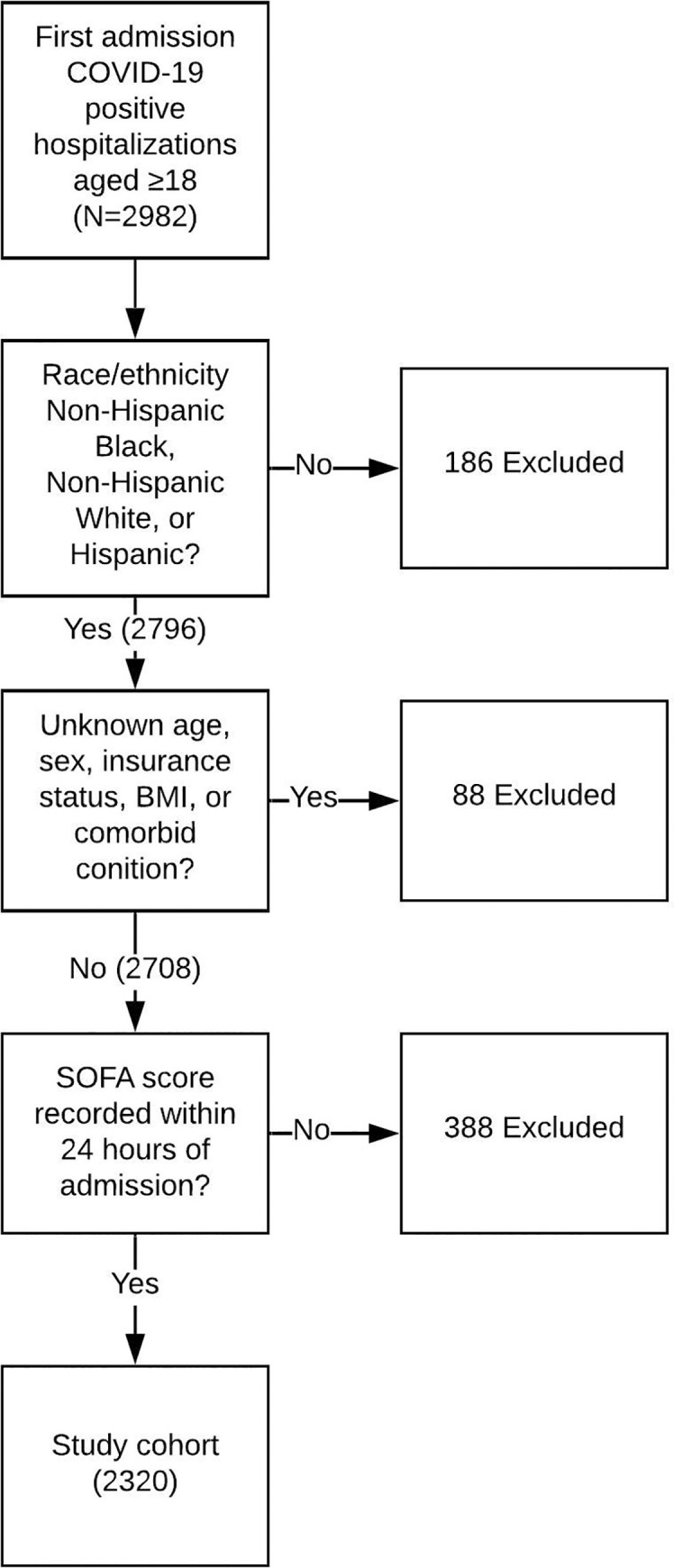
Background: Sequential Organ Failure Assessment (SOFA) score predicts probability of in-hospital mortality. Many crisis standards of care suggest the use of SOFA scores to allocate medical resources during the COVID-19 pandemic. Research question: Are SOFA scores elevated among Non-Hispanic Black and Hispanic patients hospitalized with COVID-19, compared to Non-Hispanic White patients? Study design and methods: Retrospective cohort study conducted in Yale New Haven Health System, including 5 hospitals with total of 2681 beds. Study population drawn from consecutive patients aged ≥18 admitted with COVID-19 from March 29 th to August 1 st , 2020. Patients excluded from the analysis if not their first admission with COVID-19, if they did not have SOFA score recorded within 24 hours of admission, if race and ethnicity data were not Non-Hispanic Black, Non-Hispanic White, or Hispanic, or if they had other missing data. The primary outcome was SOFA score, with peak score within 24 hours of admission dichotomized as <6 or ≥6. Results: Of 2982 patients admitted with COVID-19, 2320 met inclusion criteria and were analyzed, of whom 1058 (45.6%) were Non-Hispanic White, 645 (27.8%) were Hispanic, and 617 (26.6%) were Non-Hispanic Black. Median age was 65.0 and 1226 (52.8%) were female. In univariate logistic screen and in full multivariate model, Non-Hispanic Black patients but not Hispanic patients had greater odds of an elevated SOFA score ≥6 when compared to Non-Hispanic White patients (OR 1.49, 95%CI 1.11–1.99). Interpretation: Given current unequal patterns in social determinants of health, US crisis standards of care utilizing the SOFA score to allocate medical resources would be more likely to deny these resources to Non-Hispanic Black patients.
Overview
The claims and statistics of this paper haven’t been checked yet.
Run the check — free, no account needed. It reads the open-access text and checks the sources it cites.
Integrity signals
Registry
Cites
Statistics
Figures
Verification
Claims the paper makes
The claims and statistics of this paper haven’t been checked yet.
Run the check — free, no account needed. It reads the open-access text and checks the sources it cites.
Claims other papers make about this one
Each is checked against this paper’s own text: does it say what the citing paper says it does?
The source backs part of the claim, not all of it — or backs it for a different population, condition or comparison.
In the citing paper
“Like eGFR, SOFA scores can act as quantifiable justification for denial of care, because the score is not reflexive – it is not sensitive to variation between biomarkers and organ function known to occur across the human population, and most importantly, is does not account for the multitude of problems known to delay treatment and lower the standard of care that BIPOC patients experience and that”
From On race, human variation, and who gets and dies of sepsis (2022) · cites this paper as Tolchin et al., 2021
Experimental — accuracy not yet measuredThe source backs part of the claim, not all of it — or backs it for a different population, condition or comparison.
In the citing paper
“suggesting that in Black sepsis patients are more likely to be assessed as being more pathologically advanced than they are (Miller et al., 2021; Roy et al., 2021; Tolchin et al., 2021).”
From On race, human variation, and who gets and dies of sepsis (2022) · cites this paper as Tolchin et al., 2021
Experimental — accuracy not yet measuredThe source backs part of the claim, not all of it — or backs it for a different population, condition or comparison.
In the citing paper
“High creatinine levels when incorporated into SOFA scores, however, often result in US Black patients having a higher SOFA score than White patients, but not higher in‐hospital mortality”
From On race, human variation, and who gets and dies of sepsis (2022) · cites this paper as Tolchin et al., 2021
Experimental — accuracy not yet measuredIn the citing paper
“The systemic error generated by SOFA scoring can alter the end of care treatment based on a score‐based assessment of likelihood of intervention benefit, or prioritization for care at all when hospitals are overwhelmed and must implement Crisis of Care Standards that prioritize patients with the highest likelihood of survival (Tolchin et al., 2021).”
From On race, human variation, and who gets and dies of sepsis (2022) · cites this paper as Tolchin et al., 2021
In the citing paper
“However, controlling for higher creatinine levels on the basis of race has a similar deprioritizing effect.”
From On race, human variation, and who gets and dies of sepsis (2022) · cites this paper as Tolchin et al., 2021
Self-check
Percentages, sums and reported differences re-computed from the paper’s own numbers.
The self-check needs the paper’s full text.
Citations
Cites
Implicit bias in healthcare professionals: a systematic review
FitzGerald, C., & Hurst, S. (2017) · BMC Medical Ethics · doi:10.1186/s12910-017-0179-8 · Cited by 2,556
Hospitalization and mortality among Black patients and White patients with Covid-19.
Price-Haywood, E. G., Burton, J., Fort, D., & Seoane, L. (2020) · New England Journal of Medicine · doi:10.1056/nejmsa2011686 · Cited by 1,660
A meta-analytical integration of over 40 years of research on diversity training evaluation
Bezrukova, K., Spell, C. S., Perry, J. L., & Jehn, K. A. (2016) · Psychological Bulletin · doi:10.1037/bul0000067 · Cited by 601
Gibson, M., Petticrew, M., Bambra, C., Sowden, A. J., Wright, K. E., & Whitehead, M. (2011) · Health & Place · doi:10.1016/j.healthplace.2010.09.011 · Cited by 539
Socio-economic inequalities in health care in England
Cookson, R., Propper, C., Asaria, M., & Raine, R. (2016) · Fiscal Studies · doi:10.1111/j.1475-5890.2016.12109 · Cited by 223 · cited 2×
“They are less likely to have access to preventive healthcare and more likely to experience bias when they do access the healthcare system, resulting in higher rates of chronic comorbidities including diabetes, hypertension, and chronic pulmonary diseases [23, 24].”
BackgroundEquitably Allocating Resources during Crises: Racial Differences in Mortality Prediction Models
Ashana, D. C., Anesi, G. L., Liu, V. X., Escobar, G. J., Chesley, C., Eneanya, N. D., Weissman, G. E., Miller, W. D., Harhay, M. O., & Halpern, S. D. (2021) · American Journal of Respiratory and Critical Care Medicine · doi:10.1164/rccm.202012-4383oc · Cited by 98
Research works printed but not linked: 47
- 2015, New York State Task Force on Life and the Law, Ventilator Allocation Guidelines
- G Grasselli, 2020, Critical care utilization for the COVID-19 outbreak in Lombardy, Italy: early experience and forecast during an emergency response, JAMA, 323, 1545, 10.1001/jama.2020.4031 · DOI
- M Vergano, 2020, Clinical ethics recommendations for the allocation of intensive care treatments in exceptional, resource-limited circumstances: the Italian perspective during the COVID-19 epidemic
- Società Italiana Anestesia Analgesia Rianimazione e Terapia Intensiva, DECISIONI PER LE CURE INTENSIVE IN CASO DI SPROPORZIONE TRA NECESSITÀ ASSISTENZIALI E RISORSE DISPONIBILI IN CORSO DI PANDEMIA DA COVID-19 January 13th, 2021
- DB White, 2020, A Framework for Rationing Ventilators and Critical Care Beds During the COVID-19 Pandemic, JAMA., 323, 1773, 10.1001/jama.2020.5046 · DOI
- ELD Biddison, 2019, Too many patients… a framework to guide statewide allocation of scarce mechanical ventilation during disasters, Chest, 155, 848, 10.1016/j.chest.2018.09.025 · DOI
- B Tolchin, 2020, Developing a Triage Protocol for the COVID-19 Pandemic: Allocating Scarce Medical Resources in a Public Health Emergency, The Journal of clinical ethics, 31, 303, 10.1086/JCE2020314303 · DOI
- ECC Manchanda, Crisis standards of care in the USA: a systematic review and implications for equity amidst COVID-19, Journal of Racial and Ethnic Health Disparities, 2020, 1
- ECC Manchanda, 2021, Racial Equity in Crisis Standards of Care—Reassuring Data or Reason for Concern?, JAMA network open, 4, e214527, 10.1001/jamanetworkopen.2021.4527 · DOI
- A Supady, 2021, Allocating scarce intensive care resources during the COVID-19 pandemic: practical challenges to theoretical frameworks, The Lancet Respiratory Medicine
- AHM Antommaria, 2020, Ventilator triage policies during the COVID-19 pandemic at US hospitals associated with members of the association of bioethics program directors, Ann Intern Med
- FL Ferreira, 2001, Serial evaluation of the SOFA score to predict outcome in critically ill patients, JAMA, 286, 1754, 10.1001/jama.286.14.1754 · DOI · Paper page
- EP Raith, 2017, Prognostic accuracy of the SOFA score, SIRS criteria, and qSOFA score for in-hospital mortality among adults with suspected infection admitted to the intensive care unit, JAMA, 317, 290, 10.1001/jama.2016.20328 · DOI · Paper page
- X Zou, 2020, Acute Physiology and Chronic Health Evaluation II Score as a Predictor of Hospital Mortality in Patients of Coronavirus Disease 2019, Crit Care Med.
- RA Raschke, 2021, Discriminant accuracy of the SOFA score for determining the probable mortality of patients with COVID-19 pneumonia requiring mechanical ventilation, JAMA, 325, 1469, 10.1001/jama.2021.1545 · DOI
- TL Cowger, 2020, Comparison of Weighted and Unweighted Population Data to Assess Inequities in Coronavirus Disease 2019 Deaths by Race/Ethnicity Reported by the US Centers for Disease Control and Prevention, JAMA Network Open, 3, e2016933, 10.1001/jamanetworkopen.2020.16933 · DOI
- EJ Williamson, OpenSAFELY: factors associated with COVID-19 death in 17 million patients, Nature, 2020, 1
- World Health Organization, 2018, WHO Housing and Health Guidelines
- G McCormack, 2020, Economic Vulnerability of Households With Essential Workers, JAMA
- UN Emeruwa, 2020, Associations between built environment, neighborhood socioeconomic status, and SARS-CoV-2 infection among pregnant women in New York City, JAMA, 324, 390, 10.1001/jama.2020.11370 · DOI
- E Reinhart, 2020, Incarceration And Its Disseminations: COVID-19 Pandemic Lessons From Chicago’s Cook County Jail: Study examines how arrest and pre-trial detention practices may be contributing to the spread of COVID-19, Health Aff (Millwood)
- National Center for Health Statistics, 2019, Health, United States, 2018
- LE Egede, 2020, Structural Racism, Social Risk Factors, and Covid-19—A Dangerous Convergence for Black Americans, N Engl J Med
- MA Garcia, 2020, The Color of COVID-19: Structural Racism and the Pandemic’s Disproportionate Impact on Older Racial and Ethnic Minorities, The Journals of Gerontology: Series B
- E Cleveland Manchanda, 2020, Inequity in Crisis Standards of Care, N Engl J Med
- DB White, 2021, Mitigating inequities and saving lives with ICU triage during the COVID-19 pandemic, Am J Respir Crit Care Med, 203, 287, 10.1164/rccm.202010-3809CP · DOI
- 2021, Connecticut Medicaid
- 2021, Rhode Island Medical Assistance (Medicaid)
- The Office of Governor Ned Lamont, 2020, Governor Lamont Provides Update on Connecticut’s Coronavirus Response Efforts
- Rhode Island Department of Health, 2020, COVID-19 Information: Resources for Undocumented Immigrants
- T Brooks, 2020, Medicaid and CHIP eligibility, enrollment, and cost sharing policies as of January 2020: Findings from a 50-state survey
- A Persoskie, 2013, Just blowing smoke? Social desirability and reporting of intentions to quit smoking, nicotine & tobacco research, 15, 2088, 10.1093/ntr/ntt101 · DOI
- DA Asch, 2021, Patient and Hospital Factors Associated With Differences in Mortality Rates Among Black and White US Medicare Beneficiaries Hospitalized With COVID-19, Infection. JAMA Network Open, 4, e2112842, 10.1001/jamanetworkopen.2021.12842 · DOI
- CA Peralta, 2010, The association of African ancestry and elevated creatinine in the Coronary Artery Risk Development in Young Adults (CARDIA) Study, Am J Nephrol., 31, 202, 10.1159/000268955 · DOI
- AG Cuevas, 2020, Discrimination and systemic inflammation: A critical review and synthesis, Brain Behav Immun
- R De la Garza Ramos, 2020, Racial disparities in clinical presentation, type of intervention, and in-hospital outcomes of patients with metastatic spine disease: An analysis of 145,809 admissions in the United States, Cancer Epidemiol., 68, 101792, 10.1016/j.canep.2020.101792 · DOI
- AD Hanchate, 2019, Association of Race/Ethnicity With Emergency Department Destination of Emergency Medical Services Transport, JAMA Network Open, 2, e1910816, 10.1001/jamanetworkopen.2019.10816 · DOI
- AM Morris, 2010, Understanding racial disparities in cancer treatment and outcomes, J Am Coll Surg, 211, 105, 10.1016/j.jamcollsurg.2010.02.051 · DOI
- AP Galvani, 2020, The imperative for universal healthcare to curtail the COVID-19 outbreak in the USA, EClinicalMedicine., 23, 100380, 10.1016/j.eclinm.2020.100380 · DOI
- M Tuomala, 2016, Optimal redistributive taxation, 10.1093/acprof:oso/9780198753414.001.0001 · DOI
- JP Block, 2015, Moving beyond “food deserts”: reorienting United States policies to reduce disparities in diet quality, PLoS Med, 12, e1001914, 10.1371/journal.pmed.1001914 · DOI
- WC Lee, 2016, Improving the Collection of Race, Ethnicity, and Language Data to Reduce Healthcare Disparities: A Case Study from an Academic Medical Center, Perspect Health Inf Manag., 13, 1g
- The Sullivan Commission, 2016, Missing Persons: Minorities in the Health Professions
- AJ Knighton, 2016, Introduction of an area deprivation index measuring patient socioeconomic status in an integrated health system: implications for population health, eGEMs, 4, 10.13063/2327-9214.1238 · DOI
- B Tolchin, 2020, Triage and justice in an unjust pandemic: ethical allocation of scarce medical resources in the setting of racial and socioeconomic disparities, J Med Ethics
- CP Jones, 2012, Using “socially assigned race” to probe White advantages in health status, Race, Ethnicity, and Health: A Public Health Reader, 26, 57
- AM Nuru-Jeter, 2018, Relative roles of race versus socioeconomic position in studies of health inequalities: a matter of interpretation, Annu Rev Public Health, 39, 169, 10.1146/annurev-publhealth-040617-014230 · DOI
Cited by
Sorted by citations
On race, human variation, and who gets and dies of sepsis
Brinkworth, J. F., & Shaw, J. G. (2022) · American Journal of Biological Anthropology · doi:10.1002/ajpa.24527 · Cited by 9
Metadata
- Authors
- Tolchin, B., Oladele, C., Galusha, D., Kashyap, N., Showstark, M., Bonito, J., Salazar, M. C., Herbst, J. L., Martino, S., Kim, N., Nash, K. A., Nguemeni Tiako, M. J., Roy, S., Vergara Greeno, R., & Jubanyik, K.
- Venue
- PLOS ONE
- Publisher
- Public Library of Science (PLoS)
- Published
- 2021-09-17
- Volume
- 16
- Issue
- 9
- Pages
- e0257608
- ISSN
- 1932-6203
- PMC
- PMC8448580
- Cited by
- 23
- References
- 6
- Language
- en
- Funders
- C.G. Swebilius Foundation (Swebilius Grant)
- National Center for Advancing Translational Sciences (TL1 TR001864)
- U.S. Department of Veterans Affairs (VISN 1 Career Development Award)
About these checks
Registry, retraction, Cites and statistics results are computed, not judged, with one exception: a printed reference that no index lists is read once by a model before it counts as a citation error. Claims are extracted by a model and kept only when their quote appears verbatim in the text; each cited source is then checked, with a model’s help, for whether it says what the claim relies on. Those verdicts can be wrong — read the claim’s quote and the cited source before relying on one.
Statistics and arithmetic are recomputed, not judged.
Confidence bands are shown only for fields calibrated on our annotated test set. None is calibrated yet, so no band is shown.
What counts as a claim ›How we measure confidence ›How we check this ›
Are you an author, or do you see a problem with this page? Request a review
