

The DOI matches its Crossref record; 33 of the 35 references it cites were found in a registry or an index, and 2 are not checked yet.
Investigating the incidence and risk factors of hypertension: A multicentre retrospective cohort study in Tabuk, Saudi Arabia
Open accessAbstract
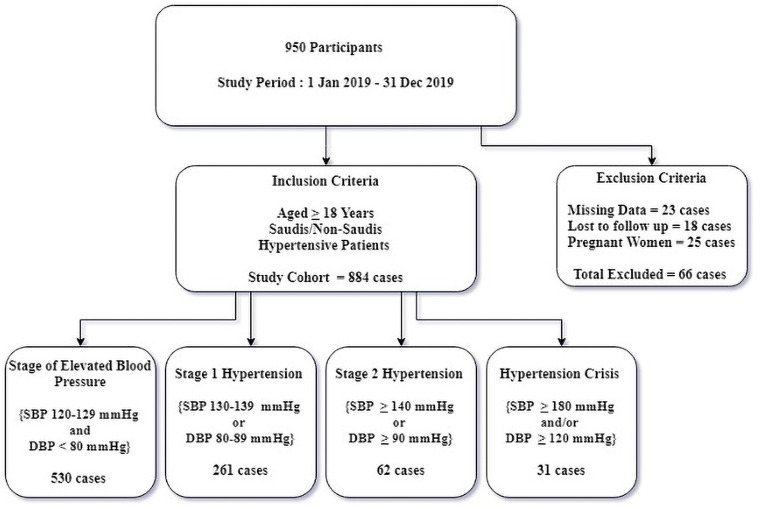
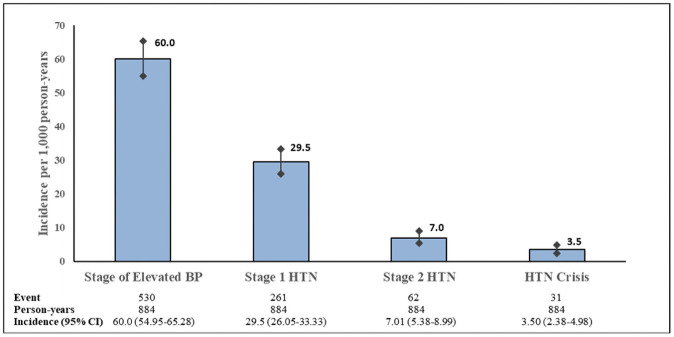
Background: Hypertension is a major global health concern affecting approximately 1.13 billion people worldwide, with most of them residing in developing countries. The aim of this study was to determine the incidence of different stages of hypertension and its associated modifiable and non-modifiable risk factors among patients in military-setting hospitals in Tabuk, Saudi Arabia. Methods: This retrospective cohort study was conducted at two hospitals in Tabuk, Saudi Arabia. The data were collected from hospital electronic records from 1 January 2019 to 31 December 2019. The blood pressure levels of patients from the last three separate medical visits were recorded. Descriptive statistics and multinomial logistic regression were used for the data analysis. Results: The study included 884 hypertensive patients. The incidences of stage of elevated BP, stage 1, stage 2, and hypertension crisis were 60.0, 29.5, 7.0, and 3.5 cases per 1000 persons. Multivariate analysis indicated that progression from the stage of elevated blood pressure to hypertension crisis was significantly associated with advanced age (odds ratio [OR] = 3.62, 95% confidence interval [CI] = 1.99–8.42), male sex (OR = 2.84, 95% CI: 0.57–5.92), and a positive family history of hypertension (OR = 1.95, 95% CI: 1.23–3.09). Other key determinants of the development of stage of elevated blood pressure to hypertension crisis were current smoking status (OR = 1.74, 95% CI: 1.23–4.76), and physical inactivity (OR = 6.48, 95% CI: 2.46–9.14). Conclusion: The incidence stage of elevated blood pressure was high among the patients investigated at armed forces hospitals in Tabuk, Saudi Arabia. The logistic regression model proposed in the present study can be used to predict the development of different stages of hypertension. Age, sex, marital status, family history, smoking status, and physical activity play an important role in the development of hypertension. Better strategies to improve awareness, screening, treatment, and management of hypertension are required in Saudi Arabia.
Overview
The claims and statistics of this paper haven’t been checked yet.
Run the check — free, no account needed. It reads the open-access text and checks the sources it cites.
Integrity signals
Registry
Cites
Statistics
Figures
Verification
Claims the paper makes
The claims and statistics of this paper haven’t been checked yet.
Run the check — free, no account needed. It reads the open-access text and checks the sources it cites.
Claims other papers make about this one
Each is checked against this paper’s own text: does it say what the citing paper says it does?
The cited source says what the claim attributes to it.
In the citing paper
“This sevenfold increase in odds exceeds many national [37] and international studies [38,39], suggesting particularly strong familial aggregation in Saudi populations.”
From The Dynamic Interplay of Lifestyle, Dietary Factors, and Cardiometabolic Risk in Hypertension: A Cross-Sectional Investigation Among Saudi Adults (2025) · cites this paper as [37]
Self-check
Percentages, sums and reported differences re-computed from the paper’s own numbers.
The self-check needs the paper’s full text.
Citations
Cites
Whelton, P. K., Carey, R. M., Aronow, W. S., Casey, D. E., Collins, K. J., Dennison Himmelfarb, C., DePalma, S. M., Gidding, S., Jamerson, K. A., Jones, D. W., et al. (2018) · Journal of the American College of Cardiology · doi:10.1016/j.jacc.2017.11.006 · Cited by 6,616
Geldsetzer, P., Manne-Goehler, J., Marcus, M.-E., Ebert, C., Zhumadilov, Z., Wesseh, C. S., Tsabedze, L., Supiyev, A., Sturua, L., Bahendeka, S. K., et al. (2019) · The Lancet · doi:10.1016/s0140-6736(19)30955-9 · Cited by 860
Hypertension and cardiovascular risk: General aspects
Kjeldsen, S. E. (2018) · Pharmacological Research · doi:10.1016/j.phrs.2017.11.003 · Cited by 694
Lim, R. B. T., Wee, W. K., For, W. C., Ananthanarayanan, J. A., Soh, Y. H., Goh, L. M. L., Tham, D. K. T., & Wong, M. L. (2020) · BMC Public Health · doi:10.1186/s12889-019-7969-5 · Cited by 618
Harrison, B., Ogara, C., Gladstone, M., Carrol, E. D., Dusabe-Richards, J., Medina‐Lara, A., Ditai, J., & Weeks, A. D. (2019) · BMC Public Health · doi:10.1186/s12889-018-6343-3 · Cited by 376
Gender Differences in Hypertension and Hypertension Awareness Among Young Adults
Everett, B. G., & Zajacova, A. (2015) · Biodemography and Social Biology · doi:10.1080/19485565.2014.929488 · Cited by 370
Marital status and risk of cardiovascular diseases: a systematic review and meta-analysis
Wong, C. W., Kwok, C. S., Narain, A., Gulati, M., Mihailidou, A. S., Wu, P., Alasnag, M. A., Myint, P. K., & Mamas, M. A. (2018) · Heart · doi:10.1136/heartjnl-2018-313005 · Cited by 271
Ethnic Differences in Hypertension Incidence Among Middle-Aged and Older Adults
Carson, A. P., Howard, G., Burke, G. L., Shea, S., Levitan, E. B., & Muntner, P. (2011) · Hypertension · doi:10.1161/hypertensionaha.110.168005 · Cited by 242
Liu, H., & Waite, L. J. (2014) · Journal of Health and Social Behavior · doi:10.1177/0022146514556893 · Cited by 218
Gender Differences in Hypertension: Myths and Reality
Doumas, M. N., Papademetriou, V., Faselis, C. J., & Kokkinos, P. F. (2013) · Current Hypertension Reports · doi:10.1007/s11906-013-0359-y · Cited by 190
Research works printed but not linked: 3
- FAL Alnasir, 2008, Hypertension the silent killer: Part two, J Bahrain Med Soc, 20, 128
- MF Aldhawi, 2016, Relationship between risk factors and hypertension Riyadh-Saudi Arabia, International Journal of Healthcare Sciences, 4, 441
- V Mohan, 2020, Incidence of hypertension among Asian Indians: 10 year follow up of the Chennai Urban Rural Epidemiology Study (CURES-153), Journal of Diabetes and its Complications, 107652, 10.1016/j.jdiacomp.2020.107652 · DOI
Cited by
A national perspective on cardiovascular diseases in Saudi Arabia
Alqahtani, B. A., & Alenazi, A. M. (2024) · BMC Cardiovascular Disorders · doi:10.1186/s12872-024-03845-8 · Cited by 44
Self-citationBody composition predicts hypertension using machine learning methods: a cohort study
Nematollahi, M. A., Jahangiri, S., Asadollahi, A., Salimi, M., Dehghan, A., Mashayekh, M., Roshanzamir, M., Gholamabbas, G., Alizadehsani, R., Bazrafshan, M., et al. (2023) · Scientific Reports · doi:10.1038/s41598-023-34127-6 · Cited by 35
National Heart Center/Saudi Heart Association 2023 Guidelines on the Management of Hypertension
AlHabeeb, W., Tash, A. A., Alshamiri, M. Q., Arafat, M., Balghith, M. A., Almasood, A. S., Eltayeb, A., Elghetany, H., Hassan, T., & Alshemmari, O. (2023) · Journal of the Saudi Heart Association · doi:10.37616/2212-5043.1328 · Cited by 27
Thirunavukkarasu, A., Alshahrani, A. N. A., Abdel-Salam, D. M., Alhazmi, A., ALruwaili, B. F., Alsaidan, A. A., Narapureddy, B. R., AL-Ruwaili, A. M., aljabri, F. G., Albalawi, R. K., et al. (2022) · Patient Preference and Adherence · doi:10.2147/ppa.s388365 · Cited by 23
Prevalence of hypertension and associated factors: a cross-sectional study in Riyadh, Saudi Arabia
Nasser, S. M., Shubair, M. M., Fatani, F., Alhawiti, N. M., Aleissa, B., Aldubikhi, A. I. S., Angawi, K., Alshahrani, A. S., Ali, S. A., Javed, S., et al. (2025) · BMC Health Services Research · doi:10.1186/s12913-025-12481-7 · Cited by 12
Metadata
- Authors
- Yagoub, U., Saiyed, N. S., Al Qahtani, B., Al Zahrani, A. M., Birema, Y., & Al Hariri, I.
- Affiliations
- Armed Forces Hospital (SA)
- Corresponding author
- Yagoub, Umar
- Venue
- PLOS ONE
- Publisher
- Public Library of Science (PLoS)
- Published
- 2022-01-06
- Volume
- 17
- Issue
- 1
- Pages
- e0262259
- ISSN
- 1932-6203 (ISSN-L)
- PMC
- PMC8735626
- OpenAlex
- W4206236465
- Cited by
- 21
- References
- 33
- Citations by year
- 2026: 4 · 2025: 4 · 2024: 3 · 2023: 5 · 2022: 5
- FWCI
- 2.96
- Type
- journal article
- Language
- en
- Open access
- gold
- doi.org
- Licence
- Locations
- PLoS ONE (publishedVersion, cc-by)
- PubMed Central (publishedVersion, cc-by)
- PubMed (publishedVersion)
- DOAJ (DOAJ: Directory of Open Access Journals) (submittedVersion, cc-by-sa)
- Funders
- Research Unit, Academic Affairs Department, King Salman Armed Forces Hospital Tabuk, Saudi Arabia (KSAFH/AFD/006)
- Topics
- Health Sciences › Medicine › Cardiology and Cardiovascular Medicine › Blood Pressure and Hypertension Studies
- Health Sciences › Nursing › Nutrition and Dietetics › Sodium Intake and Health
- Health Sciences › Medicine › Cardiology and Cardiovascular Medicine › Cardiovascular Health and Disease Prevention
- Keywords
- hypertension, hypertension incidence, hypertension risk factors, elevated blood pressure, hypertensive crisis, military personnel, smoking, physical inactivity, family history of hypertension, age and sex differences
- MeSH terms
- Adolescent, Adult, Female, Humans, Hypertension, Male, Middle Aged, Retrospective Studies, Risk Factors, Saudi Arabia, Smoking, Exercise, Incidence, Multivariate Analysis, Young Adult, Sedentary Behavior
About these checks
Registry, retraction, Cites and statistics results are computed, not judged, with one exception: a printed reference that no index lists is read once by a model before it counts as a citation error. Claims are extracted by a model and kept only when their quote appears verbatim in the text; each cited source is then checked, with a model’s help, for whether it says what the claim relies on. Those verdicts can be wrong — read the claim’s quote and the cited source before relying on one.
Statistics and arithmetic are recomputed, not judged.
Confidence bands are shown only for fields calibrated on our annotated test set. None is calibrated yet, so no band is shown.
What counts as a claim ›How we measure confidence ›How we check this ›
Are you an author, or do you see a problem with this page? Request a review
Data sources
Bibliographic data: Semantic Scholar, OpenAlex, Crossref.
Contains information from the Semantic Scholar Academic Graph Datasets, made available under the ODC Attribution License (ODC-BY 1.0).
Semantic Scholar’s data is described in: Kinney, R., et al. (2023). The Semantic Scholar Open Data Platform. arXiv:2301.10140.
