

The Dynamic Interplay of Lifestyle, Dietary Factors, and Cardiometabolic Risk in Hypertension: A Cross-Sectional Investigation Among Saudi Adults
Open accessThe DOI matches its Crossref record; 39 of the 41 references it cites were found in a registry or an index; 6 of the 12 sources its claims cite were checked for support.
Abstract
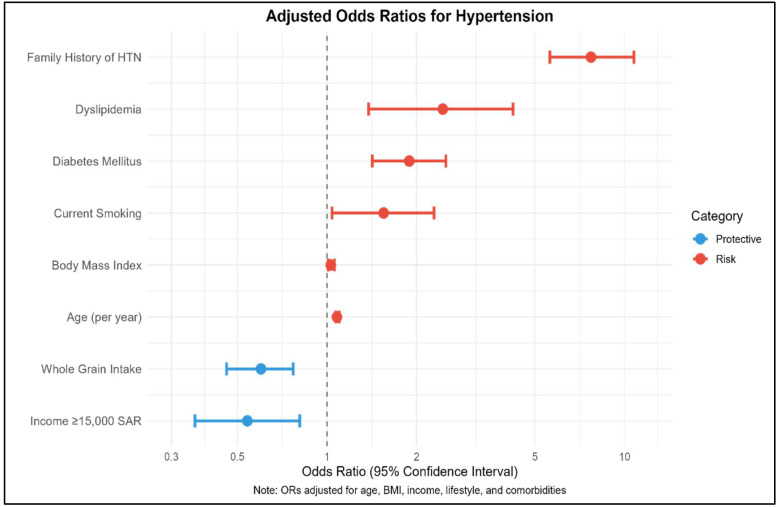
Background/Objectives: Hypertension is a growing public health concern in Saudi Arabia, driven by rapid socioeconomic changes. This study investigated the interplay between habitual, behavioral, and dietary risk factors associated with hypertension among Saudi adults. Methods: A cross-sectional survey was conducted among 3312 Saudi adults using multistage stratified random sampling. The data were collected via validated questionnaires assessing sociodemographic, anthropometric indicators, lifestyle behaviors, dietary patterns, and medical history. Hypertension status was determined through self-reported diagnosis. Bivariate analyses and multiple logistic regression identified independent predictors (p < 0.05). Results: Hypertension prevalence was 13% (mean age: 34 ± 15 years; 50% male). The strongest predictors were age (OR = 1.08/year; 95% CI: 1.07–1.10; p < 0.001), increased body mass index (OR = 1.03; 95% CI: 1.01–1.06; p = 0.011), smoking (OR = 1.55; 95% CI: 1.04–2.29; p = 0.030), and family history of hypertension (OR = 7.71; 95% CI: 5.61–10.75; p < 0.001). Participants with diabetes mellitus had 89% higher odds of hypertension (OR = 1.89; 95% CI: 1.42–2.51; p < 0.001), and those with dyslipidemia had more than double the odds (OR = 2.45; 95% CI: 1.38–4.22; p = 0.002). Protective factors included higher income (≥15,000 SAR; OR = 0.54; 95% CI: 0.36–0.81; p = 0.003) and regular whole grain consumption (OR = 0.60; 95% CI: 0.46–0.77; p < 0.001). Conclusions: Hypertension risk in Saudi adults is shaped by age, obesity, smoking, comorbid metabolic conditions (diabetes and dyslipidemia), and genetic pre-disposition. In contrast, higher income and whole grain intake may offer protection. These findings underscore the need for comprehensive prevention strategies that address both lifestyle and cardiometabolic comorbidities, in alignment with Saudi Vision 2030 health priorities.
Overview
CoChat Summary
## TL;DR
This cross-sectional survey of 3,312 Saudi adults found hypertension prevalence was 13% and was most strongly associated with older age, higher BMI, current smoking, family history of hypertension, and cardiometabolic comorbidities. Higher income and regular whole grain consumption were protective, while some self-reported healthy dietary patterns showed counterintuitive positive associations that the authors interpret as possible reverse causality.
## Key findings
- Among 3,312 adults, hypertension prevalence was 13% (n = 431); participants had a mean age of 34 ± 15 years and 50% were male.
- In multivariable analysis, the strongest predictors were age (OR = 1.08 per year; 95% CI: 1.07–1.10), family history of hypertension (OR = 7.71; 95% CI: 5.61–10.75), BMI (OR = 1.03 per unit; 95% CI: 1.01–1.06), and current smoking (OR = 1.55; 95% CI: 1.04–2.29).
- Diabetes mellitus (OR = 1.89; 95% CI: 1.42–2.51) and dyslipidemia (OR = 2.45; 95% CI: 1.38–4.22) were independently associated with higher odds of hypertension.
- Higher income (≥SAR 15,000/month) was protective (OR = 0.54; 95% CI: 0.36–0.81), and regular whole grain consumption was also protective (OR = 0.60; 95% CI: 0.46–0.77). The model explained 31% of the variance (Tjur’s R² = 0.309).
## Methods
- Design: Cross-sectional survey conducted May–June 2024 across multiple regions in Saudi Arabia using multistage stratified random sampling targeting urban and rural populations.
- Sample/data: 3,312 Saudi adults aged 18+; data were collected with structured interviewer-administered questionnaires in Arabic and English, covering sociodemographics, anthropometrics, lifestyle, diet, and medical history. Hypertension was self-reported physician diagnosis.
- Analysis: Descriptive statistics, t-tests/chi-square tests for bivariate associations, and multiple logistic regression to identify independent predictors; analyses were done in R 4.2.3.
## Limitations
- The paper states that the cross-sectional design precludes causal inference, especially for dietary associations that may reflect reverse causality.
- The authors state that self-reported dietary and lifestyle data and self-reported hypertension diagnosis may introduce recall, reporting, and social desirability bias; they recommend standardized blood pressure measurements in future studies.
- The paper notes that sampling may not fully capture remote or institutionalized populations, and the model’s moderate explanatory power (R² = 0.309) suggests unmeasured factors remain; this limitation is stated in the paper.
Model-written summary. Check it against the paper before relying on it.
Integrity signals
Registry
Cites
Statistics
Figures
Verification
Claims the paper makes
3 Valid · 1 Not valid · 3 Not checked · 45 Own results and interpretations
A result the paper reports from its own data — it cites no other source for it, so there is none to check. The quote shows it is in the paper.
In the paper
“those with dyslipidemia had more than double the odds (OR = 2.45; 95% CI: 1.38–4.22; p = 0.002)”
- Also stated in: § 3.6. Independent Predictors of Hypertension · plain
“those with diagnosed dyslipidemia showed more than doubled odds (OR = 2.45; 95% CI: 1.38–4.22; p = 0.002).”
§ The Dynamic Interplay of Lifestyle, Dietary Factors, and Cardiometabolic Risk in Hypertension: A Cross-Sectional Investigation Among Saudi Adults > Abstract
plainstates an associationn = 3,312 ·- Asserted: passes — The authors put it forward as true.
- Checkable: passes — It can be checked against evidence.
- Load-bearing: passes — The paper’s conclusions depend on it.
- Based: passes — The paper gives a reason why it holds.
- Rests on 2 assumptions not shown here.
- Also stated in: § 3.6. Independent Predictors of Hypertension · plain
A result the paper reports from its own data — it cites no other source for it, so there is none to check. The quote shows it is in the paper.
In the paper
“The strongest predictors were age (OR = 1.08/year; 95% CI: 1.07–1.10; p < 0.001)”
- Also stated in: § 3.6. Independent Predictors of Hypertension · plain
“Age emerged as the strongest continuous predictor, with each additional year increasing hypertension odds by 8% (OR = 1.08; 95% CI: 1.07–1.10; p < 0.001).”
§ The Dynamic Interplay of Lifestyle, Dietary Factors, and Cardiometabolic Risk in Hypertension: A Cross-Sectional Investigation Among Saudi Adults > Abstract
plainstates an associationn = 3,312 ·- Asserted: passes — The authors put it forward as true.
- Checkable: passes — It can be checked against evidence.
- Load-bearing: passes — The paper’s conclusions depend on it.
- Based: passes — The paper gives a reason why it holds.
- Rests on 2 assumptions not shown here.
- Also stated in: § 3.6. Independent Predictors of Hypertension · plain
A result the paper reports from its own data — it cites no other source for it, so there is none to check. The quote shows it is in the paper.
In the paper
“smoking (OR = 1.55; 95% CI: 1.04–2.29; p = 0.030)”
- Also stated in: § 3.6. Independent Predictors of Hypertension · plain
“Current smoking increased hypertension odds by 55% compared to non-smokers (OR = 1.55; 95% CI: 1.04–2.29; p = 0.030).”
§ The Dynamic Interplay of Lifestyle, Dietary Factors, and Cardiometabolic Risk in Hypertension: A Cross-Sectional Investigation Among Saudi Adults > Abstract
plainstates an associationn = 3,312 ·- Asserted: passes — The authors put it forward as true.
- Checkable: passes — It can be checked against evidence.
- Load-bearing: passes — The paper’s conclusions depend on it.
- Based: passes — The paper gives a reason why it holds.
- Rests on 2 assumptions not shown here.
- Also stated in: § 3.6. Independent Predictors of Hypertension · plain
A result the paper reports from its own data — it cites no other source for it, so there is none to check. The quote shows it is in the paper.
In the paper
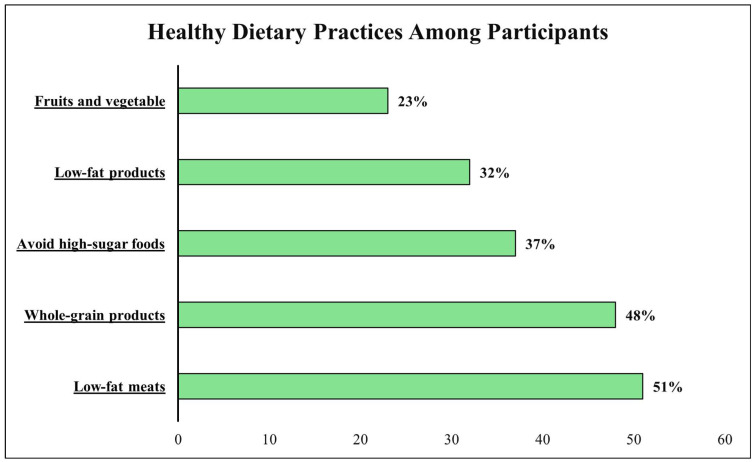
“consuming ≥ 5 servings of fruits and vegetables daily was associated with 38% higher odds (OR = 1.38; 95% CI: 1.04–1.83; p = 0.025)”
- Also stated in: § 4.5. Dietary Patterns and Nutritional Paradoxes · plain
“unexpected positive associations emerged for fruits/vegetables (OR = 1.38; p = 0.025)”
§ The Dynamic Interplay of Lifestyle, Dietary Factors, and Cardiometabolic Risk in Hypertension: A Cross-Sectional Investigation Among Saudi Adults > 3. Results > 3.6. Independent Predictors of Hypertension
plainstates an association- Asserted: passes — The authors put it forward as true.
- Checkable: passes — It can be checked against evidence.
- Load-bearing: passes — The paper’s conclusions depend on it.
- Based: passes — The paper gives a reason why it holds.
- Rests on 3 assumptions not shown here.
- Also stated in: § 4.5. Dietary Patterns and Nutritional Paradoxes · plain
A result the paper reports from its own data — it cites no other source for it, so there is none to check. The quote shows it is in the paper.
In the paper
“choosing low-fat meats increased odds by 37% (OR = 1.37; 95% CI: 1.06–1.78; p = 0.016)”
- Also stated in: § 4.5. Dietary Patterns and Nutritional Paradoxes · plain
“low-fat meat consumption (OR = 1.37; p = 0.016)”
§ The Dynamic Interplay of Lifestyle, Dietary Factors, and Cardiometabolic Risk in Hypertension: A Cross-Sectional Investigation Among Saudi Adults > 3. Results > 3.6. Independent Predictors of Hypertension
plainstates an association- Asserted: passes — The authors put it forward as true.
- Checkable: passes — It can be checked against evidence.
- Load-bearing: passes — The paper’s conclusions depend on it.
- Based: passes — The paper gives a reason why it holds.
- Rests on 3 assumptions not shown here.
- Also stated in: § 4.5. Dietary Patterns and Nutritional Paradoxes · plain
25 more claims
Create a free account to see all 52 claims and every source verdict.
- Probably not a substantial claim. 13
- It may state two separate claims as one. 11
- The quote only partly states this claim. 1
Citations
Cites
Home visits: a strategy to improve newborn survival - Authors' reply
(2008) · Americanae (AECID Library) · doi:10.1016/s0140 · Cited by 22,524
(2000) · PubMed · Cited by 13,173
World Health Organization 2020 guidelines on physical activity and sedentary behaviour
Bull, F. C., Al-Ansari, S. S., Biddle, S., Borodulin, K., Buman, M. P., Cardon, G., Carty, C., Chaput, J.-P., Chastin, S., Chou, R., et al. (2020) · British Journal of Sports Medicine · doi:10.1136/bjsports-2020-102955 · Cited by 11,657 · cited 1×
“Physical activity patterns were assessed using validated questions adapted from international surveys [22], categorized as no physical activity per week, moderate or vigorous activity for less than 30 min five times per week, or moderate or vigorous activity for minimum 30 min five times per week.”
Whelton, P. K., Carey, R. M., Aronow, W. S., Casey, D. E., Collins, K. J., Dennison Himmelfarb, C., DePalma, S. M., Gidding, S., Jamerson, K. A., Jones, D. W., et al. (2018) · Journal of the American College of Cardiology · doi:10.1016/j.jacc.2017.11.006 · Cited by 6,616
A Clinical Trial of the Effects of Dietary Patterns on Blood Pressure
Appel, L. J., Moore, T. J., Obarzanek, E., Vollmer, W. M., Svetkey, L. P., Sacks, F. M., Bray, G. A., Vogt, T. M., Cutler, J. A., Windhauser, M. M., et al. (1997) · New England Journal of Medicine · doi:10.1056/nejm199704173361601 · Cited by 5,981
The global epidemiology of hypertension
Mills, K. T., Stefanescu, A., & He, J. (2020) · Nature Reviews Nephrology · doi:10.1038/s41581-019-0244-2 · Cited by 4,133
Zhou, B., Bentham, J., Di Cesare, M., Bixby, H., Danaei, G., Cowan, M. J., Paciorek, C. J., Singh, G., Hajifathalian, K., Bennett, J. E., et al. (2017) · The Lancet · doi:10.1016/s0140-6736(16)31919-5 · Cited by 2,579
Gangwisch, J. E., Heymsfield, S. B., Boden-Albala, B., Buijs, R. M., Kreier, F., Pickering, T. G., Rundle, A. G., Zammit, G. K., & Malaspina, D. (2006) · Hypertension · doi:10.1161/01.hyp.0000217362.34748.e0 · Cited by 1,284
Management and Prevention Strategies for Non-communicable Diseases (NCDs) and Their Risk Factors
Budreviciute, A., Damiati, S., Sabir, D. K., Onder, K., Schuller-Goetzburg, P., Plakys, G., Katileviciute, A., Khoja, S., & Kodzius, R. (2020) · Frontiers in Public Health · doi:10.3389/fpubh.2020.574111 · Cited by 946
Stress and Food Choice: A Laboratory Study
Oliver, G., Wardle, J., & Gibson, E. L. (2000) · Psychosomatic Medicine · doi:10.1097/00006842-200011000-00016 · Cited by 879
Research works printed but not linked: 2
- Al-Hazzaa H.M. Physical inactivity in Saudi Arabia: An urgent public health concern Saudi Med. J. 2004 25 559 564
- World Health Organization Obesity: Preventing and Managing the Global Epidemic WHO Technical Report Series 894 WHO Geneva, Switzerland 2000 11234459
Cited by
Murickan, A., & Toma, M. (2026) · Technologies · doi:10.3390/technologies14050264
Oral and cardiometabolic health through the lens of biobanks and large-scale epidemiologic research
Hashim, N. T., Babiker, R. A., Padmanabhan, V., Islam, M. S., Priya, S. P., Chaitanya, N. C. S. K., Mohammed, R., Dasnadi, S. P., Ahmed, A., Gismalla, B. G., et al. (2026) · Frontiers in Oral Health · doi:10.3389/froh.2026.1774868
Mersal, F. A., Mersal, N. A., Alenezi, A. A. H., Aldughmi, O. N., Alshwail, F. A., Gushgari, O. Y., Bawaked, R. A., & Eltaib, F. A. (2026) · Frontiers in Public Health · doi:10.3389/fpubh.2026.1794111
Metadata
- Authors
- Jareebi, M. A.
- Affiliations
- Jazan University (SA)
- Corresponding author
- Jareebi, Mohammad A.
- ORCID
- Jareebi, Mohammad A.
- Venue
- Diagnostics
- Publisher
- MDPI AG
- Published
- 2025-08-20
- Volume
- 15
- Issue
- 16
- Pages
- 2097
- ISSN
- 2075-4418 (ISSN-L)
- PMC
- PMC12386032
- OpenAlex
- W4413351060
- Semantic Scholar
- c80c6bfc3929debf75ec36fe7271c3803b345dcc
- Cited by
- 5
- References
- 41
- Citations by year
- 2026: 5
- FWCI
- 3.47
- Type
- journal article
- Language
- en
- Open access
- gold
- doi.org
- Licence
- Locations
- Diagnostics (publishedVersion, cc-by)
- Europe PMC (PubMed Central) (publishedVersion, cc-by)
- PubMed Central (publishedVersion, cc-by)
- PubMed (publishedVersion)
- DOAJ (DOAJ: Directory of Open Access Journals) (submittedVersion, cc-by-sa)
- Funders
- Jazan University
- Topics
- Health Sciences › Medicine › Cardiology and Cardiovascular Medicine › Blood Pressure and Hypertension Studies
- Health Sciences › Nursing › Nutrition and Dietetics › Sodium Intake and Health
- Health Sciences › Medicine › Cardiology and Cardiovascular Medicine › Cardiovascular Health and Risk Factors
- Keywords
- hypertension, cardiometabolic risk, lifestyle factors, dietary habits, body mass index, obesity, smoking, family history of hypertension, diabetes mellitus, dyslipidemia, whole grain intake, income, Saudi adults, hypertension prevalence, risk factors, protective factors, socioeconomic status, Saudi Arabia, Gulf region, Middle East, North Africa, Mediterranean, Asia
About these checks
Registry, retraction, Cites and statistics results are computed, not judged, with one exception: a printed reference that no index lists is read once by a model before it counts as a citation error. Claims are extracted by a model and kept only when their quote appears verbatim in the text; each cited source is then checked, with a model’s help, for whether it says what the claim relies on. Those verdicts can be wrong — read the claim’s quote and the cited source before relying on one.
The claim verdicts this report counts are experimental: their accuracy is not yet measured.
A language model drew the claims from the paper on 2026-10-10, under version 3 of the claim definition (model deepseek-v4.1-flash, prompt extract-v3).
A second model labelled each claim on 2026-10-10 (model jev-1.13-20260917, definition revision gold-guideline-v0.2).
Statistics and arithmetic are recomputed, not judged.
Confidence bands are shown only for fields calibrated on our annotated test set. None is calibrated yet, so no band is shown.
What counts as a claim ›How we measure confidence ›How we check this ›
Are you an author, or do you see a problem with this page? Request a review
How to cite
Cite CoChat for the checks on this page, and the paper for its own findings.
- This page
- CoChat. (2026). Citation check: The Dynamic Interplay of Lifestyle, Dietary Factors, and Cardiometabolic Risk in Hypertension: A Cross-Sectional Investigation Among Saudi Adults. https://app.cochat.ai/papers/10.3390/diagnostics15162097
- The paper
- Jareebi, M. A. (2025). The Dynamic Interplay of Lifestyle, Dietary Factors, and Cardiometabolic Risk in Hypertension: A Cross-Sectional Investigation Among Saudi Adults. Diagnostics. https://doi.org/10.3390/diagnostics15162097
Data sources
Bibliographic data: Semantic Scholar, OpenAlex, Crossref.
Contains information from the Semantic Scholar Academic Graph Datasets, made available under the ODC Attribution License (ODC-BY 1.0).
Semantic Scholar’s data is described in: Kinney, R., et al. (2023). The Semantic Scholar Open Data Platform. arXiv:2301.10140.
