

The DOI matches its Crossref record; 87 of the 87 references it cites were found in a registry or an index; 24 of the 55 sources its claims cite were checked for support.
A group resilience training program for people with multiple sclerosis: Study protocol of a multi-centre cluster-randomized controlled trial (multi-READY for MS)
Open accessAbstract
Introduction REsilience and Activities for every DaY (READY) is an Acceptance and Commitment Therapy-based group resilience-training program that has preliminary empirical support in promoting quality of life and other psychosocial outcomes in people with multiple sclerosis (PwMS). Consistent with the Medical Research Council framework for developing and evaluating complex interventions, we conducted a pilot randomized controlled trial (RCT), followed by a phase III RCT. The present paper describes the phase III RCT protocol. Methods and analysis This is a multi-centre cluster RCT comparing READY with a group relaxation program (1:1 ratio) in 240 PwMS from eight centres in Italy (trial registration: isrctn.org Identifier: ISRCTN67194859). Both interventions are composed of 7 weekly sessions plus a booster session five weeks later. Resilience (primary outcome), mood, health-related quality of life, well-being and psychological flexibility will be assessed at baseline, after the booster session, and at three and six month follow-ups. If face-to-face group meetings are interrupted because of COVID-19 related-issues, participants will be invited to complete their intervention via teleconferencing. Relevant COVID-19 information will be collected and the COVID-19 Peritraumatic Distress scale will be administered (ancillary study) at baseline and 3-month follow-up. Analysis will be by intention-to-treat to show superiority of READY over relaxation. Longitudinal changes will be compared between the two arms using repeated-measures, hierarchical generalized linear mixed models. Conclusion It is expected that his study will contribute to the body of evidence on the efficacy and effectiveness of READY by comparing it with an active group intervention in frontline MS rehabilitation and clinical settings. Results will be disseminated in peer-reviewed journals and at other relevant conferences. © 2022 Giovannetti et al. This is an open access article distributed under the terms of the Creative Commons Attribution License, which permits unrestricted use, distribution, and reproduction in any medium, provided the original author and source are credited.
Overview
CoChat Summary
## TL;DR
This paper is a study protocol for a multi-centre cluster-randomized controlled trial testing whether the ACT-based READY resilience program outperforms an active relaxation control in people with multiple sclerosis (PwMS). It plans to enroll 240 PwMS from eight centres in Italy and assess resilience, mood, health-related quality of life, well-being, and psychological flexibility through 6 months after baseline.
## Key findings
- Not stated in the paper.
- The planned trial will randomize 240 PwMS from eight centres in Italy in a 1:1 ratio to READY or relaxation.
- The study’s primary endpoint is the between-arm difference from baseline to 3-month follow-up in CD-RISC 25 resilience scores.
- Sample size planning is based on pilot data showing mean CD-RISC 25 change at 3 months of 15.61 (SD 13.63; n = 18) in READY vs 5.95 (SD 14.11; n = 19) in relaxation; the proposed design is said to achieve 94.6% power to detect a mean difference of 9.66.
## Methods
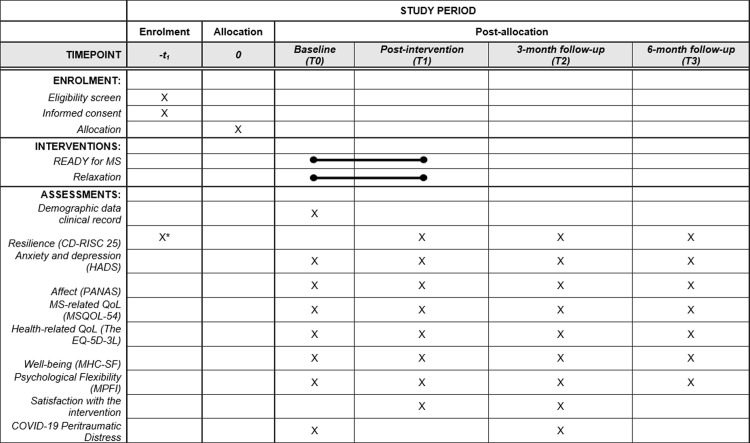
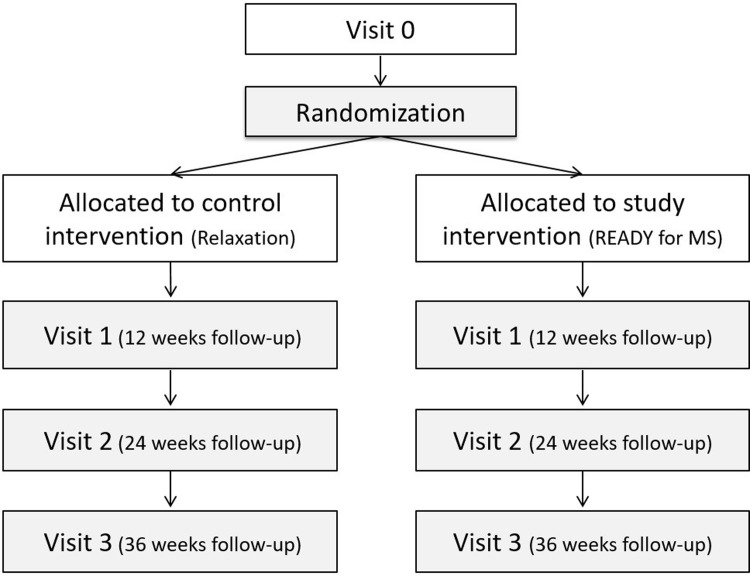
- Design: Multi-centre cluster randomized controlled trial comparing READY with an active group relaxation program, with assessments at baseline, after the booster session (12 weeks after baseline), and at 3- and 6-month follow-ups.
- Sample/data: 240 PwMS with MS diagnosis, age ≥18, Italian fluency, and CD-RISC 25 < 83; excluded were people with severe cognitive compromise, recent psychotherapy, prior mindfulness training/current meditation practice, severe suicidality, recent relapse/corticosteroid treatment, serious comorbidity, pregnancy, or MS diagnosed less than 3 months earlier.
- Analysis: Intention-to-treat analyses using repeated-measures hierarchical generalized linear mixed models with random intercepts for clusters; missing data handled with multiple imputation where appropriate, plus a per-protocol sensitivity analysis.
## Limitations
- The paper states that blinding of patients is not possible because of the intervention type.
- The paper states that the READY and relaxation programs are similar in frequency and number of sessions, but not in duration.
- Evident from the text: this is a protocol, so it reports planned methods and hypothesized effects rather than trial outcomes.
Model-written summary. Check it against the paper before relying on it.
Integrity signals
Registry
Cites
Statistics
Figures
Verification
Claims the paper makes
19 Valid · 2 Not valid · 17 Not checked · 24 Own results and interpretations
Every source the paper cites for this claim was checked and supports it.
In the paper
“there were no between-arm differences in any patient-reported outcomes.”
§ A group resilience training program for people with multiple sclerosis: Study protocol of a multi-centre cluster-randomized controlled trial (multi-READY for MS) > Introduction
What the sources say
- Supportedcites [50] AM Giovannetti, 2020, A resilience group training program for people with multiple sclerosis: Results of a pilot single-blind randomized controlled trial and nested qualitative study, PLoS One source
The Discussion (page unavailable) says READY was not more efficacious than relaxation in producing statistically significant improvements on the outcome measures. The Results > RCT table (page unavailable) likewise shows no significant time-by-arm interaction for the reported outcomes. The claim is supported when ‘no between-arm differences’ means no statistically significant differences in improvement, rather than identical scores. (LLM, conf=0.88)
plain- Asserted: passes — The authors put it forward as true.
- Checkable: passes — It can be checked against evidence.
- Load-bearing: passes — The paper’s conclusions depend on it.
- Based: passes — The paper gives a reason why it holds.
- Supported
Every source the paper cites for this claim was checked and supports it.
In the paper
“Resilience-training interventions have been shown to promote a range of positive psychosocial outcomes in people with chronic illnesses [21], including QoL, anxiety, depression, perceived stress and well-being in adults with cancer [22–24], congenital heart disease [25], diabetes [26], neurofibromatosis [27], and MS [28].”
§ A group resilience training program for people with multiple sclerosis: Study protocol of a multi-centre cluster-randomized controlled trial (multi-READY for MS) > Introduction
What the sources say
- Supportedcites [21] GM Kim, 2019, Resilience of patients with chronic diseases: A systematic review, Health Soc Care Community source
The Additional analysis section reports that a meta-analysis of five trials involving 540 participants found overall benefits from resilience-enhancement programmes for depression, anxiety and quality of life. This supports the broad claim attached to this citation; the condition-specific examples and other outcomes in the sentence have separate citations. (LLM, conf=0.91)
boostedstates a cause- Asserted: passes — The authors put it forward as true.
- Checkable: passes — It can be checked against evidence.
- Load-bearing: passes — The paper’s conclusions depend on it.
- Based: passes — The paper gives a reason why it holds.
- Supported
Every source the paper cites for this claim was checked and supports it.
In the paper
“A recent review of meta-analyses demonstrated that ACT is superior to inactive controls (e.g. waitlist, placebo), treatment as usual, and most active intervention conditions (with the exception of other cognitive behavioral therapy-based intervention) [48].”
§ A group resilience training program for people with multiple sclerosis: Study protocol of a multi-centre cluster-randomized controlled trial (multi-READY for MS) > Introduction
What the sources say
- Supportedcites [48] AT Gloster, 2020, The empirical status of acceptance and commitment therapy: A review of meta-analyses, J Contextual Behav Sci source
Split into 2 atoms — 2 confirmed, 0 partially supported, 0 disputed, 0 misattributed, 0 unverifiable. Expand the claim to see per-atom verdicts.
boostedstates a cause- Asserted: passes — The authors put it forward as true.
- Checkable: passes — It can be checked against evidence.
- Load-bearing: passes — The paper’s conclusions depend on it.
- Based: passes — The paper gives a reason why it holds.
- Supported
Every source the paper cites for this claim was checked and supports it.
In the paper
“Qualitative data showed that participants viewed READY as superior to relaxation”
§ A group resilience training program for people with multiple sclerosis: Study protocol of a multi-centre cluster-randomized controlled trial (multi-READY for MS) > Introduction
What the sources say
- Supportedcites [50] AM Giovannetti, 2020, A resilience group training program for people with multiple sclerosis: Results of a pilot single-blind randomized controlled trial and nested qualitative study, PLoS One source
The Results (Nested qualitative study results, Theme 6) state that a majority of the interviewed sub-sample highlighted READY’s superiority over relaxation. The reported advantages included greater satisfaction, impact on more areas, and acquisition of more skills. This supports the claim about participants’ views, not a claim of objectively greater effectiveness. (LLM, conf=0.94)
plain- Asserted: passes — The authors put it forward as true.
- Checkable: passes — It can be checked against evidence.
- Load-bearing: passes — The paper’s conclusions depend on it.
- Based: passes — The paper gives a reason why it holds.
- Supported
The cited sources support only part of this claim — read each source’s verdict below.
In the paper
“The sample size calculation was based on the pilot study results [50], which showed a mean change in the CD-RISC 25 at 3-month follow-up in the READY arm equal to 15.61 (SD 13.63, n = 18) vs. a mean change in the relaxation arm equal to 5.95 (SD 14.11, n = 19).”
§ A group resilience training program for people with multiple sclerosis: Study protocol of a multi-centre cluster-randomized controlled trial (multi-READY for MS) > Materials and methods > Data analysis
What the sources say
- Partly supportedcites [50] AM Giovannetti, 2020, A resilience group training program for people with multiple sclerosis: Results of a pilot single-blind randomized controlled trial and nested qualitative study, PLoS One sourceExperimental — accuracy not yet measured
Table 2 (Results > RCT; page unavailable) reports CD-RISC 25 scores for 18 READY and 19 relaxation participants. Subtracting baseline from three-month follow-up gives approximate mean changes of 15.6 and 5.9, consistent with the claimed means after rounding. The table reports standard errors for scores at each time point, not the claimed standard deviations of change (13.63 and 14.11), so those figures are not supported by our copy. (LLM, conf=0.88)
plainn = 18- Asserted: passes — The authors put it forward as true.
- Checkable: passes — It can be checked against evidence.
- Load-bearing: passes — The paper’s conclusions depend on it.
- Based: passes — The paper gives a reason why it holds.
- Partly supported
12 more claims · 4 with their cited sources checked
Create a free account to see all 62 claims and to verify the 1 reference still open.
- Probably not a substantial claim. 35
- It may state two separate claims as one. 23
Citations
Cites
The Hospital Anxiety and Depression Scale
Zigmond, A. S., & Snaith, R. P. (1983) · Acta Psychiatrica Scandinavica · doi:10.1111/j.1600-0447.1983.tb09716.x · Cited by 47,139 · cited 2×
“Unlike many similar measures, the HADS excludes somatic symptoms of anxiety and depression, which may overlap with physical illness symptoms [66].”
BackgroundRating neurologic impairment in multiple sclerosis: An expanded disability status scale (EDSS)
Kurtzke, J. F. (1983) · Neurology · doi:10.1212/wnl.33.11.1444 · Cited by 15,011
Depression and quality of life in older persons: A review
Sivertsen, H., Bjørkløf, G. H., Engedal, K., Selbæk, G., & Helvik, A.-S. (2015) · Dementia and Geriatric Cognitive Disorders · doi:10.1159/000437299 · Cited by 14,152
Development of a new resilience scale: The Connor-Davidson Resilience Scale (CD-RISC)
Connor, K. M., & Davidson, J. R. T. (2003) · Depression and Anxiety · doi:10.1002/da.10113 · Cited by 11,793 · cited 1×
“its internal consistency, test–retest reliability, and convergent and divergent validity) [64].”
BackgroundDeveloping and evaluating complex interventions: the new Medical Research Council guidance
Craig, P., Dieppe, P., Macintyre, S., Michie, S., Nazareth, I., & Petticrew, M. (2008) · BMJ · doi:10.1136/bmj.a1655 · Cited by 10,995 · cited 2×
“The design of the present study not only overcomes all the limitations reported in these reviews, it adheres to the MRC framework for developing and evaluating complex interventions [49], and it also aligns with all the recommendations for future research identified by Öst in his systematic review and meta-analysis on…”
MethodInfluentialDiagnostic criteria for multiple sclerosis: 2010 revisions to the McDonald criteria
Polman, C. H., Reingold, S. C., Banwell, B., Clanet, M., Cohen, J. A., Filippi, M., Fujihara, K., Havrdova, E., Hutchinson, M., Kappos, L., et al. (2011) · Annals of Neurology · doi:10.1002/ana.22366 · Cited by 9,802 · cited 1×
“Participant inclusion criteria are: MS diagnosis [57]; age�18 years; written informed consent; CD-RISC 25 score< 83, which indicates that the person could still improve his/her level of Box 1.”
BackgroundAcceptance and commitment therapy: model, processes and outcomes
Hayes, S. C., Luoma, J. B., Bond, F. W., Masuda, A., & Lillis, J. (2006) · Behaviour Research and Therapy · doi:10.1016/j.brat.2005.06.006 · Cited by 6,587 · cited 2×
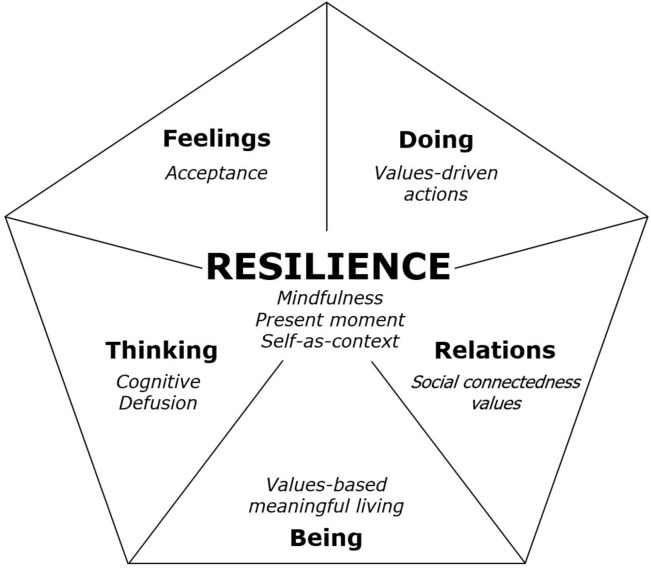
“Psychological flexibility is established through the following six processes: (1) acceptance– openness to experience, (2) cognitive defusion–observing thoughts rather than taking them literally, (3) present moment awareness–mindfulness, (4) self-as-context–contact with a sense of self that is continuous and provides f…”
BackgroundInfluentialSPIRIT 2013 explanation and elaboration: guidance for protocols of clinical trials
Chan, A.-W., Tetzlaff, J. M., Gotzsche, P. C., Altman, D. G., Mann, H., Berlin, J. A., Dickersin, K., Hrobjartsson, A., Schulz, K. F., Parulekar, W. R., et al. (2013) · BMJ · doi:10.1136/bmj.e7586 · Cited by 6,251
Qiu, J., Shen, B., Zhao, M., Wang, Z., Xie, B., & Xu, Y. (2020) · General Psychiatry · doi:10.1136/gpsych-2020-100213 · Cited by 4,307
New Multiple Sclerosis Phenotypic Classification
Lublin, F. D. (2014) · European Neurology · doi:10.1159/000367614 · Cited by 4,259
Research works printed but not linked: 1
- UM Sansom-Daly, 2014, Adapting evidence based psychological therapy to the computer screen for adolescent and young adult cancer survivors: Preliminary results from the ‘recapture life’ randomized controlled trial, Asia Pac J Clin Oncol, 10, 36
Cited by
Vivas-Fernández, M., López, L. J. G., Piqueras, J. A., Fernández, L. E., Muela-Martínez, J. A., Jiménez-Vázquez, D., Díaz-Castela, M. D. M., & Ehrenreich, J. T. (2023) · Child Psychiatry & Human Development · doi:10.1007/s10578-023-01638-2 · Cited by 18
Pakenham, K. I., & Landi, G. (2023) · Sclerosis · doi:10.3390/sclerosis1010005 · Cited by 17
“The MPFI has good psychometric properties in clinical and community samples [42–44] and has been recently used in MS research [27].”
MethodSelf-citationFoote, H., Bowen, A., Cotterill, S., Hill, G., Pieri, M., & Patchwood, E. (2023) · Clinical Rehabilitation · doi:10.1177/02692155221144554 · Cited by 7
Broche‐Pérez, Y., & Jiménez-Morales, R. M. (2025) · Multiple Sclerosis and Related Disorders · doi:10.1016/j.msard.2025.106919 · Cited by 3
Καλτσάτου, Α., Theodorou, S., & Orologas, A. (2024) · Healthcare · doi:10.3390/healthcare12090870 · Cited by 2
“This kind of psychological support can have profound effects on well-being, as it addresses both the psychological and emotional challenges that come with MS [17].”
Background
Metadata
- Authors
- Giovannetti, A. M., Pakenham, K. I., Presti, G., Quartuccio, M. E., Confalonieri, P., Bergamaschi, R., Grobberio, M., Di Filippo, M., Micheli, M., Brichetto, G., Patti, F., Copetti, M., Kruger, P., & Solari, A.
- Affiliations
- The University of Queensland (AU)
- Università degli Studi di Enna Kore (IT)
- Azienda Ospedaliera San Camillo-Forlanini (IT)
- Fondazione IRCCS Istituto Neurologico Carlo Besta (IT)
- Azienda Socio Sanitaria Territoriale Lariana (IT)
- Associazione Italiana Sclerosi Multipla (IT)
- Azienda Ospedaliero Universitaria Policlinico "G.Rodolico - San Marco" (IT)
- Casa Sollievo della Sofferenza (IT)
- Corresponding author
- Giovannetti, Ambra Mara
- ORCID
- Venue
- PLoS ONE
- Publisher
- Public Library of Science (PLoS)
- Published
- 2022-05-02
- Volume
- 17
- Issue
- 5
- Pages
- e0267245
- ISSN
- 1932-6203 (ISSN-L)
- PMC
- PMC9060330
- OpenAlex
- W4225289889
- Cited by
- 11
- References
- 87
- Citations by year
- 2026: 1 · 2025: 4 · 2024: 3 · 2023: 2 · 2022: 1
- FWCI
- 2.28
- Type
- journal article
- Language
- en
- Open access
- gold
- doi.org
- Licence
- Locations
- PLoS ONE (publishedVersion, cc-by)
- PubMed Central (publishedVersion, cc-by)
- PubMed (publishedVersion)
- DOAJ (DOAJ: Directory of Open Access Journals) (acceptedVersion)
- DOAJ (DOAJ: Directory of Open Access Journals) (submittedVersion, cc-by-sa)
- Funders
- Fondazione Italiana Sclerosi Multipla (2016/B/3)
- Topics
- Social Sciences › Psychology › Clinical Psychology › Mindfulness and Compassion Interventions
- Health Sciences › Medicine › Clinical Neurology › Multiple Sclerosis Research Studies
- Social Sciences › Psychology › Clinical Psychology › Resilience and Mental Health
- Keywords
- multiple sclerosis, resilience training, acceptance and commitment therapy, group intervention, relaxation program, psychological flexibility, health-related quality of life, mood, well-being, telemedicine
- MeSH terms
- Equivalence Trials as Topic, COVID-19, Humans, Italy, Multiple Sclerosis, Quality of Life, Multicenter Studies as Topic, Randomized Controlled Trials as Topic, Clinical Trials, Phase III as Topic, Acceptance and Commitment Therapy
About these checks
Registry, retraction, Cites and statistics results are computed, not judged, with one exception: a printed reference that no index lists is read once by a model before it counts as a citation error. Claims are extracted by a model and kept only when their quote appears verbatim in the text; each cited source is then checked, with a model’s help, for whether it says what the claim relies on. Those verdicts can be wrong — read the claim’s quote and the cited source before relying on one.
The claim verdicts this report counts are experimental: their accuracy is not yet measured.
A language model drew the claims from the paper on 2026-10-11, under version 3 of the claim definition (model deepseek-v4.1-flash, prompt extract-v3).
A second model labelled each claim on 2026-10-11 (model jev-1.13-20260917, definition revision gold-guideline-v0.2).
Cited sources are checked with a language model’s help (gpt-6-sol).
Statistics and arithmetic are recomputed, not judged.
Confidence bands are shown only for fields calibrated on our annotated test set. None is calibrated yet, so no band is shown.
What counts as a claim ›How we measure confidence ›How we check this ›
Are you an author, or do you see a problem with this page? Request a review
How to cite
Cite CoChat for the checks on this page, and the paper for its own findings.
- This page
- CoChat. (2026). Citation check: A group resilience training program for people with multiple sclerosis: Study protocol of a multi-centre cluster-randomized controlled trial (multi-READY for MS). https://app.cochat.ai/papers/10.1371/journal.pone.0267245
- The paper
- Giovannetti, A. M., Pakenham, K. I., Presti, G., Quartuccio, M. E., Confalonieri, P., Bergamaschi, R., Grobberio, M., Di Filippo, M., Micheli, M., Brichetto, G., Patti, F., Copetti, M., Kruger, P., & Solari, A. (2022). A group resilience training program for people with multiple sclerosis: Study protocol of a multi-centre cluster-randomized controlled trial (multi-READY for MS). PLoS ONE. https://doi.org/10.1371/journal.pone.0267245
Data sources
Bibliographic data: Semantic Scholar, OpenAlex, Crossref.
Contains information from the Semantic Scholar Academic Graph Datasets, made available under the ODC Attribution License (ODC-BY 1.0).
Semantic Scholar’s data is described in: Kinney, R., et al. (2023). The Semantic Scholar Open Data Platform. arXiv:2301.10140.
