

The DOI matches its Crossref record; 29 of the 29 references it cites were found in a registry or an index.
Artificial intelligence in medical education curriculum: An e-Delphi study for competencies
Open accessAbstract
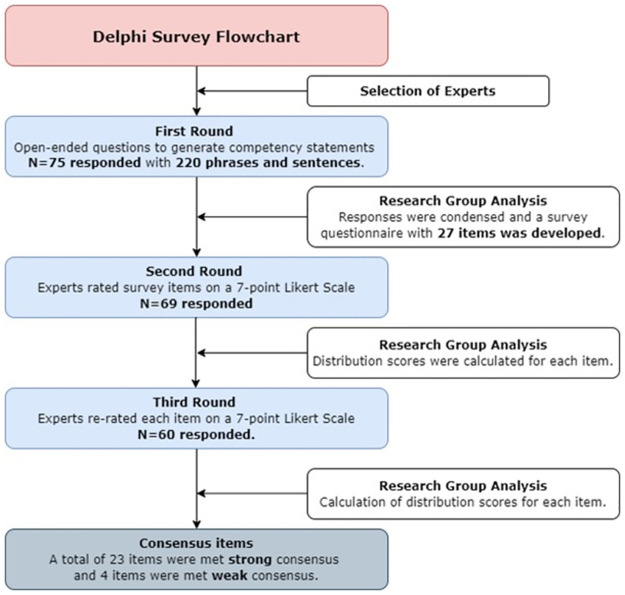
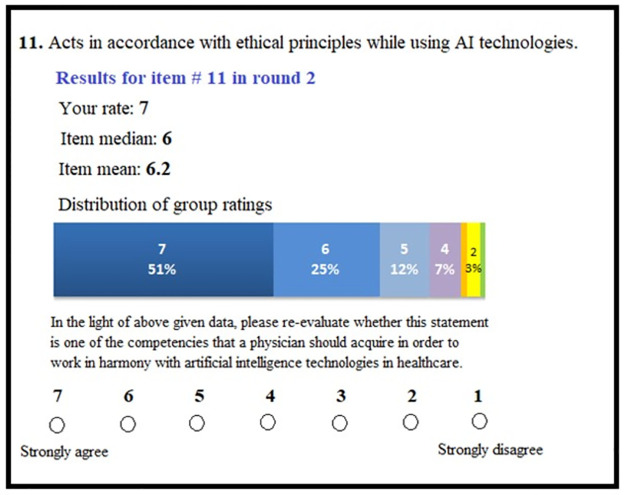
BACKGROUND: Artificial intelligence (AI) has affected our day-to-day in a great extent. Healthcare industry is one of the mainstream fields among those and produced a noticeable change in treatment and education. Medical students must comprehend well why AI technologies mediate and frame their decisions on medical issues. Formalizing of instruction on AI concepts can facilitate learners to grasp AI outcomes in association with their sensory perceptions and thinking in the dynamic and ambiguous reality of daily medical practice. The purpose of this study is to provide consensus on the competencies required by medical graduates to be ready for artificial intelligence technologies and possible applications in medicine and reporting the results. MATERIALS AND METHODS: A three-round e-Delphi survey was conducted between February 2020 and November 2020. The Delphi panel accorporated experts from different backgrounds; (i) healthcare professionals/ academicians; (ii) computer and data science professionals/ academics; (iii) law and ethics professionals/ academics; and (iv) medical students. Round 1 in the Delphi survey began with exploratory open-ended questions. Responses received in the first round evaluated and refined to a 27-item questionnaire which then sent to the experts to be rated using a 7-point Likert type scale (1: Strongly Disagree-7: Strongly Agree). Similar to the second round, the participants repeated their assessments in the third round by using the second-round analysis. The agreement level and strength of the consensus was decided based on third phase results. Median scores was used to calculate the agreement level and the interquartile range (IQR) was used for determining the strength of the consensus. RESULTS: Among 128 invitees, a total of 94 agreed to become members of the expert panel. Of them 75 (79.8%) completed the Round 1 questionnaire, 69/75 (92.0%) completed the Round 2 and 60/69 (87.0%) responded to the Round 3. There was a strong agreement on the 23 items and weak agreement on the 4 items. CONCLUSIONS: This study has provided a consensus list of the competencies required by the medical graduates to be ready for AI implications that would bring new perspectives to medical education curricula. The unique feature of the current research is providing a guiding role in integrating AI into curriculum processes, syllabus content and training of medical students.
Overview
The claims and statistics of this paper haven’t been checked yet.
Run the check — free, no account needed. It reads the open-access text and checks the sources it cites.
Integrity signals
Registry
Cites
Statistics
Figures
Verification
Claims the paper makes
The claims and statistics of this paper haven’t been checked yet.
Run the check — free, no account needed. It reads the open-access text and checks the sources it cites.
Claims other papers make about this one
Each is checked against this paper’s own text: does it say what the citing paper says it does?
The cited source says what the claim attributes to it.
In the citing paper
“Caliskan et al. identified 23 competencies with strong consensus among experts and four with weak consensus [161].”
From Artificial intelligence in undergraduate medical education: an updated scoping review (2025) · cites this paper as [161]
In the citing paper
“The advantages of using AI in healthcare include early disease detection and diagnosis, personalized medicine, improved workflow, decreased workload, reduced costs, and improved overall efficiency in healthcare systems globally [7–9].”
From Shaping the future: perspectives on the Integration of Artificial Intelligence in health profession education: a multi-country survey (2024) · cites this paper as [9]
In the citing paper
“While current publications on AI-related medical education emphasize key competencies or explore educational AI programs and concepts, they fail to specifically account for the four main pillars of biomedical ethics: autonomy, justice, non-maleficence, and beneficence [21–24].”
From Biomedical Ethical Aspects Towards the Implementation of Artificial Intelligence in Medical Education (2023) · cites this paper as [23]
Self-check
Percentages, sums and reported differences re-computed from the paper’s own numbers.
The self-check needs the paper’s full text.
Citations
Cites
High-performance medicine: the convergence of human and artificial intelligence
Topol, E. J. (2019) · Nature Medicine · doi:10.1038/s41591-018-0300-7 · Cited by 10,450
Research guidelines for the Delphi survey technique
Hasson, F. (2000) · Journal of Advanced Nursing · doi:10.1046/j.1365-2648.2000.01567.x · Cited by 5,951
The Delphi Technique: Making Sense of Consensus
Hsu, C.-C., & Sandford, B. A. (2007) · University of Massachusetts Amherst · doi:10.7275/pdz9-th90 · Cited by 4,500
Artificial intelligence in healthcare
Yu, K.-H., Beam, A. L., & Kohane, I. S. (2018) · Nature Biomedical Engineering · doi:10.1038/s41551-018-0305-z · Cited by 2,817
Boulkedid, R., Abdoul, H., Loustau, M., Sibony, O., & Alberti, C. (2011) · PLoS ONE · doi:10.1371/journal.pone.0020476 · Cited by 2,045
The Delphi Technique in Nursing and Health Research
Keeney, S., Hasson, F., & McKenna, H. (2011) · Wiley eBooks · doi:10.1002/9781444392029 · Cited by 1,568
A critical review of the Delphi technique as a research methodology for nursing
Keeney, S., Hasson, F., & McKenna, H. (2001) · International Journal of Nursing Studies · doi:10.1016/s0020-7489(00)00044-4 · Cited by 1,333
Managing Delphi Surveys Using Nonparametric Statistical Techniques*
Schmidt, R. C. (1997) · Decision Sciences · doi:10.1111/j.1540-5915.1997.tb01330.x · Cited by 1,240
The Delphi technique in health sciences education research
de Villiers, M., Villiers, P. J. T. D., & Kent, A. (2005) · Medical Teacher · doi:10.1080/13611260500069947 · Cited by 1,007
The Delphi technique: a critique
Goodman, C. (1987) · Journal of Advanced Nursing · doi:10.1111/j.1365-2648.1987.tb01376.x · Cited by 928
Research works printed but not linked: 1
- O Karaca, 2020, From Artificial Intelligence Theory to Application in Education, 346
Cited by
Sorted by citations
Items 101–115 of 115
Buckmaster, F., van Staden, D. B., & Coetzee, L. (2026) · Optometry and Vision Science · doi:10.1002/ovs2.70077 · Cited by 1
Tetteh, A., Foli, J. Y., Ackon, S. K., & Awaah, F. (2026) · Research Square · doi:10.21203/rs.3.rs-10058356/v1
Mehta, N., Benjamin, J. C., Mehta, S., Valanci, S., MacNeill, H., & Masters, K. (2026) · Medical Teacher · doi:10.1080/0142159x.2026.2681971
Elnemr, N., Aref, S. R., Abdelmohsen, A. M., Elzeiny, N. A., & Eltayar, A. (2026) · Discover Education · doi:10.1007/s44217-026-02000-z
Artificial Intelligence in Anesthesiology Education
Rosenkrans, D. J., Blacker, S. N., Lele, A. V., & Buhl, L. K. (2026) · Anesthesiology Clinics · doi:10.1016/j.anclin.2026.06.005
Srinivasan, R., Caube, F. D. M., Punt, C., Bolander, S., Bowker, B., Brownlee, L., Forest, C. P., Juarez, L., Kenney, A., King, M. R., et al. (2026) · The Journal of Physician Assistant Education · doi:10.1097/jpa.0000000000000784
Frutuoso, J., Maria, A. R. J., Donato, H., & Carneiro, A. V. (2026) · Acta Médica Portuguesa · doi:10.20344/amp.25177
Artificial intelligence in emergency medicine education: A narrative review
Pelletier, J., Arango-Ibañez, J. P., Taylor, R. A., Smith, M. E., Gottlieb, M. A., Jones, D. D., Colletti, J. E., Rego, A., & Long, B. (2026) · The American Journal of Emergency Medicine · doi:10.1016/j.ajem.2026.09.006
Hilty, D. M., ELNahas, G., Mphil, S. J., Mucić, D., Vukojević, J., Halbreich, U. M., Riese, H., Gentry, M. T., Gkouvas, N., Gaur, V., et al. (2026) · Journal of Technology in Behavioral Science · doi:10.1007/s41347-026-00708-1
Perle, J. G. (2026) · Mental Health and Digital Technologies · doi:10.1108/mhdt-04-2026-0024
Synthesising Generative Artificial Intelligence Competency Domains for Medical Education Faculty
Meyers, P., & Miller, C. (2026) · The Clinical Teacher · doi:10.1111/tct.70532 · Cited by 1
Obiajunwa, O., Adewale, B., & Fasiku, O. B. (2026) · Research Square · doi:10.21203/rs.3.rs-10715973/v1
Simoni, J., Pereira, J. L., Sánchez, S. C., Egaña-Yin, D., García-Gargallo, C., Hertog, O. L. A., Idoate, A., López-Ortiz, L., Morales-Gutiérrez, I., Romero, A., et al. (2026) · Frontiers in Digital Health · doi:10.3389/fdgth.2026.1918847
Dargél, A., Tanya, T., Backstein, L., Lin, Z., Zayadi, A. A., Li, K. Y., & Rothwell, D. (2026) · doi:10.2196/preprints.110915
Explainable AI in Medicine: Trends and Educational Implications
Rigas, E. S., Billis, A., & Bamidis, P. D. (2026) · Proceedings - IEEE Symposium on Computer-Based Medical Systems · doi:10.1109/cbms69103.2026.00097
Metadata
- Authors
- Çalışkan, S. A., Demir, K., & Karaca, O.
- Affiliations
- Ege University (TR)
- İzmir Demokrasi Üniversitesi (TR)
- Corresponding author
- Çalışkan, S. Ayhan
- Venue
- PLOS ONE
- Publisher
- Public Library of Science (PLoS)
- Published
- 2022-07-21
- Volume
- 17
- Issue
- 7
- Pages
- e0271872
- ISSN
- 1932-6203 (ISSN-L)
- PMC
- PMC9302857
- OpenAlex
- W4286493308
- Cited by
- 115
- References
- 29
- Citations by year
- 2026: 37 · 2025: 33 · 2024: 28 · 2023: 14 · 2022: 2
- FWCI
- 5.80
- Type
- journal article
- Language
- en
- Open access
- gold
- doi.org
- Licence
- Locations
- PLoS ONE (publishedVersion, cc-by)
- PubMed Central (publishedVersion, cc-by)
- PubMed (publishedVersion)
- DOAJ (DOAJ: Directory of Open Access Journals) (submittedVersion, cc-by-sa)
- Topics
- Health Sciences › Medicine › Health Informatics › Artificial Intelligence in Healthcare and Education
- Social Sciences › Education › Innovations in Medical Education
- Health Sciences › Health Professions › General Health Professions › Health and Medical Education
- Keywords
- artificial intelligence in healthcare, medical curriculum, AI competencies, medical graduates, competency framework, AI literacy, expert consensus, curriculum integration
- MeSH terms
- Artificial Intelligence, Curriculum, Delphi Technique, Education, Medical, Humans, Consensus
About these checks
Registry, retraction, Cites and statistics results are computed, not judged, with one exception: a printed reference that no index lists is read once by a model before it counts as a citation error. Claims are extracted by a model and kept only when their quote appears verbatim in the text; each cited source is then checked, with a model’s help, for whether it says what the claim relies on. Those verdicts can be wrong — read the claim’s quote and the cited source before relying on one.
Statistics and arithmetic are recomputed, not judged.
Confidence bands are shown only for fields calibrated on our annotated test set. None is calibrated yet, so no band is shown.
What counts as a claim ›How we measure confidence ›How we check this ›
Are you an author, or do you see a problem with this page? Request a review
