

Intimate partner violence and unmet need for family planning in the Democratic Republic of the Congo: A secondary analysis of the moderating role of reproductive coercion using performance monitoring for action data
Open accessThe DOI matches its Crossref record; 57 of the 57 references it cites were found in a registry or an index; none of the 67 sources its claims cite is checked for support yet.
Abstract
Introduction: Intimate partner violence (IPV) has harmful effects on women’s physical, mental, and reproductive health. This study investigates the relationship between experiencing IPV and unmet need for family planning in two provinces of the Democratic Republic of the Congo (DRC), emphasizing the potential mediating effect of reproductive coercion. To our knowledge, this is the first examination of the connection between IPV and unmet need for family planning in the DRC, particularly regarding the underlying mechanisms of this association. Materials and methods: This research utilized secondary data from the third wave of the Performance Monitoring for Action (PMA) surveys carried out in two provinces of the DRC during the period from 2021 to 2022. The analysis focused on a sample comprising 1,387 women in unions aged between 15 and 49 years. To investigate the relationship between IPV and unmet need for family planning, linear probability models were employed and various factors were controlled. Additionally, we explored the moderating influence of reproductive coercion in this context. Results: The linear probability model indicated that experiencing sexual IPV within the past 12 months was linked to an unmet need for family planning [aCoef = 0.12, CI95% = 0.04–0.21]. When sexual IPV occurred alongside reproductive coercion, a stronger correlation with unmet need was detected [aCoef = 0.24, CI95% = 0.03–0.44]. Conclusion: We showed that sexual IPV is associated with an unmet need for family planning in the DRC. While IPV should be considered a policy target, these results emphasize the importance of responding appropriately to IPV when sexual and reproductive health services are provided to women. This was the first study on the DRC and, more generally, on sub-Saharan Africa (SSA) to illuminate the underlying mechanisms of the association, revealing the moderating role of reproductive coercion.
Overview
CoChat Summary
TL;DR
In two DRC provinces, women who experienced sexual IPV in the past 12 months were more likely to have an unmet need for family planning, and this association was substantially stronger when sexual IPV co-occurred with reproductive coercion. Physical and emotional IPV showed no significant association with unmet need.
Key findings
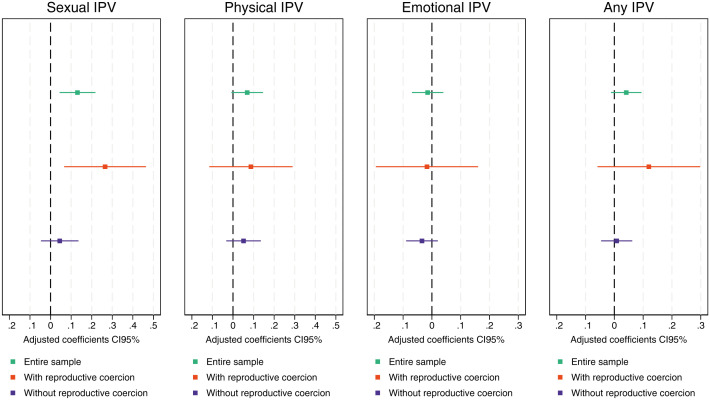
- Sexual IPV was associated with unmet need for family planning after adjustment [aCoef = 0.12, 95% CI = 0.04–0.21]; physical IPV [aCoef = 0.07, 95% CI = −0.01–0.15], emotional IPV [aCoef = −0.02, 95% CI = −0.07–0.03], and any IPV [aCoef = 0.04, 95% CI = −0.01–0.09] were not significant.
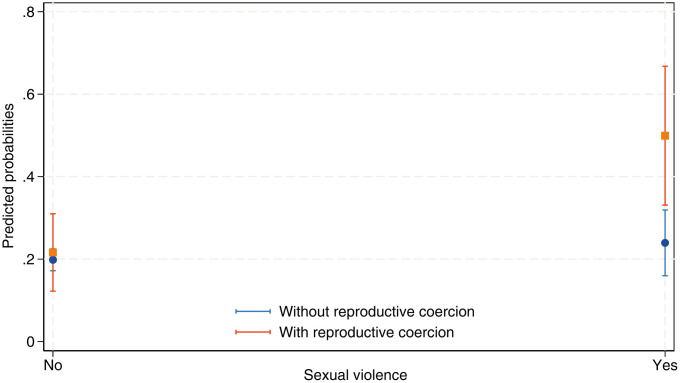
- The interaction between sexual IPV and reproductive coercion was significant [aCoef = 0.24, 95% CI = 0.03–0.44]; predicted probability of unmet need rose to roughly 50% when sexual IPV occurred with reproductive coercion versus about 20% without it. Interactions for physical, emotional, and any IPV were not significant.
- Prevalence: 32.5% (95% CI 29.6–35.4) reported any IPV in the past 12 months (emotional 25.8%, sexual 12.2%, physical 12.2%); 11.4% (95% CI 9.6–13.4) reported reproductive coercion; 21.5% (95% CI 19.1–24.1) had unmet need for family planning (17.1% spacing, 4.4% limiting).
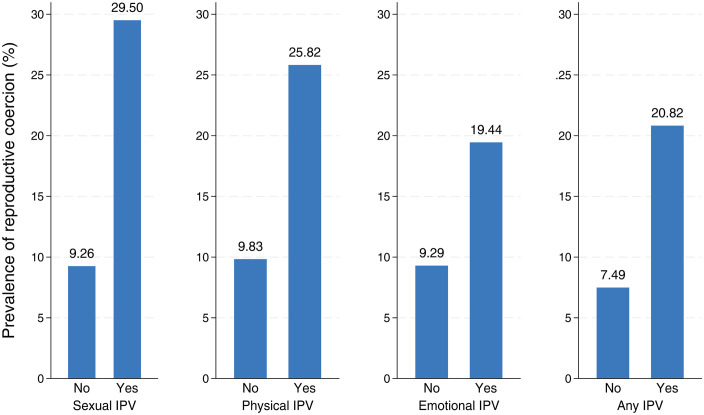
- Reproductive coercion was more common among women reporting IPV (20.8%) than among those not reporting IPV (7.5%), and highest among those reporting sexual IPV (29.5%).
Methods
- Secondary cross-sectional analysis of Phase 3 (2022) Performance Monitoring for Action (PMA) data from Kinshasa and Kongo Central provinces, DRC; of 2,621 women in unions, 1,387 met inclusion criteria and 1,382 had complete data.
- Sample: women aged 15–49 in a union who answered the violence module. IPV (sexual, physical, emotional, and any) measured with the Conflict Tactics Scale; reproductive coercion measured with five PMA items; unmet need constructed from fertility preferences, contraceptive use, and pregnancy risk.
- Linear probability models with survey weights (FQWEIGHT), adjusted for age, employment, couple's educational attainment, parity, wealth tercile, religion, and province; interaction terms between each IPV type and reproductive coercion; robust (Eicker-White) standard errors after a Breusch–Pagan/Cook–Weisberg heteroskedasticity test.
Limitations
- Stated: cross-sectional data preclude causal inference; underreporting of IPV due to topic sensitivity; parity may be an intermediate rather than purely confounding factor; findings are limited to two provinces and not nationally generalizable.
- Evident from the text: the abstract describes reproductive coercion as a "mediating" effect while the analysis and discussion test moderation (interaction), an inconsistency in framing; the reported confidence interval for sexual IPV in the interaction model (−0.5; 0.13) appears inconsistent with the stated coefficient of 0.04 and the paper's own significance claims.
Model-written summary. Check it against the paper before relying on it.
Integrity signals
Registry
Cites
Statistics
Figures
Verification
Claims the paper makes
0 Valid · 1 Not valid · 33 Not checked · 39 Own results and interpretations
A result the paper reports from its own data — it cites no other source for it, so there is none to check. The quote shows it is in the paper.
In the paper
“In addition, a lower prevalence of unmet need was observed among women who had experienced emotional IPV (19.6%) than among those who had not (22.1%).”
§ Intimate partner violence and unmet need for family planning in the Democratic Republic of the Congo: A secondary analysis of the moderating role of reproductive coercion using performance monitoring for action data > Results > Descriptive statistics
plainstates an associationn = 1,382- Asserted: passes — The authors put it forward as true.
- Checkable: passes — It can be checked against evidence.
- Load-bearing: unclear — It is unclear whether the paper’s conclusions depend on it.
- Based: passes — The paper gives a reason why it holds.
A result the paper reports from its own data — it cites no other source for it, so there is none to check. The quote shows it is in the paper.
In the paper
“Emotional IPV | −0.02 | (−0.08; 0.03) | −0.02 | (−0.07; 0.03)”
§ Intimate partner violence and unmet need for family planning in the Democratic Republic of the Congo: A secondary analysis of the moderating role of reproductive coercion using performance monitoring for action data > Results > Multivariate models
plainn = 1,382- Asserted: passes — The authors put it forward as true.
- Checkable: passes — It can be checked against evidence.
- Load-bearing: passes — The paper’s conclusions depend on it.
- Based: passes — The paper gives a reason why it holds.
A result the paper reports from its own data — it cites no other source for it, so there is none to check. The quote shows it is in the paper.
In the paper
“Any IPV | 0.04 | (−0.01; 0.09) | 0.04 | (−0.01; 0.09)”
§ Intimate partner violence and unmet need for family planning in the Democratic Republic of the Congo: A secondary analysis of the moderating role of reproductive coercion using performance monitoring for action data > Results > Multivariate models
plainn = 1,382- Asserted: passes — The authors put it forward as true.
- Checkable: passes — It can be checked against evidence.
- Load-bearing: passes — The paper’s conclusions depend on it.
- Based: passes — The paper gives a reason why it holds.
A result the paper reports from its own data — it cites no other source for it, so there is none to check. The quote shows it is in the paper.
In the paper
“Physical IPV | 0.06 | (−0.01; 0.14) | 0.07 | (−0.01; 0.15)”
§ Intimate partner violence and unmet need for family planning in the Democratic Republic of the Congo: A secondary analysis of the moderating role of reproductive coercion using performance monitoring for action data > Results > Multivariate models
plainn = 1,382- Asserted: passes — The authors put it forward as true.
- Checkable: passes — It can be checked against evidence.
- Load-bearing: passes — The paper’s conclusions depend on it.
- Based: passes — The paper gives a reason why it holds.
A result the paper reports from its own data — it cites no other source for it, so there is none to check. The quote shows it is in the paper.
In the paper
“When sexual IPV occurred alongside reproductive coercion, a stronger correlation with unmet need was detected [aCoef = 0.24, CI95% = 0.03–0.44].”
§ Intimate partner violence and unmet need for family planning in the Democratic Republic of the Congo: A secondary analysis of the moderating role of reproductive coercion using performance monitoring for action data > Abstract > Results
plainstates an association- Asserted: passes — The authors put it forward as true.
- Checkable: passes — It can be checked against evidence.
- Load-bearing: passes — The paper’s conclusions depend on it.
- Based: passes — The paper gives a reason why it holds.
30 more claims
Create a free account to see all 73 claims and to verify the 67 references still open.
- It may state two separate claims as one. 22
- The quote only partly states this claim. 1
- Probably not a substantial claim. 23
Self-check
Percentages, sums and reported differences re-computed from the paper’s own numbers.
Each contradiction between two passages listed here was confirmed by an independent check.
Rated major: it would touch a result — a value a result rests on, reported and recomputed p-values on opposite sides of the significance level, two passages that conflict with no sign which is right, or a cited work retracted before this paper was published.
In the paper
§ Intimate partner violence and unmet need for family planning in the Democratic Republic of the Congo: A secondary analysis of the moderating role of reproductive coercion using performance monitoring for action data > Results > Descriptive statistics
“| No | 1199 | 87.8 | 239 (19.7) | | Yes | 183 | 12.2 | 55 (34.2) |”
§ Intimate partner violence and unmet need for family planning in the Democratic Republic of the Congo: A secondary analysis of the moderating role of reproductive coercion using performance monitoring for action data > Results > Descriptive statistics
“| Women with an unmet need for family planning (total) | 298 | 21.5 | (19.10–24.11) |”
Rated minor: it would not touch a result — a value no result rests on, a p-value that stays on the same side of the significance level, or a conflict that is clerical, resolved elsewhere in the paper, or outside its own findings.
In the paper
“| Model 2a | Sexual IPV | 0.04 | (−0.5; 0.13) |”
§ Intimate partner violence and unmet need for family planning in the Democratic Republic of the Congo: A secondary analysis of the moderating role of reproductive coercion using performance monitoring for action data > Results > Multivariate models
Reported 0.04 · recomputed -0.185
Rated minor: it would not touch a result — a value no result rests on, a p-value that stays on the same side of the significance level, or a conflict that is clerical, resolved elsewhere in the paper, or outside its own findings.
In the paper
§ Intimate partner violence and unmet need for family planning in the Democratic Republic of the Congo: A secondary analysis of the moderating role of reproductive coercion using performance monitoring for action data > Abstract > Introduction
“emphasizing the potential mediating effect of reproductive coercion”
§ Intimate partner violence and unmet need for family planning in the Democratic Republic of the Congo: A secondary analysis of the moderating role of reproductive coercion using performance monitoring for action data > Abstract > Materials and methods
“Additionally, we explored the moderating influence of reproductive coercion in this context.”
Rated minor: it would not touch a result — a value no result rests on, a p-value that stays on the same side of the significance level, or a conflict that is clerical, resolved elsewhere in the paper, or outside its own findings.
In the paper
§ Intimate partner violence and unmet need for family planning in the Democratic Republic of the Congo: A secondary analysis of the moderating role of reproductive coercion using performance monitoring for action data > Results > Descriptive statistics
“those with the most children (23.6%)”
§ Intimate partner violence and unmet need for family planning in the Democratic Republic of the Congo: A secondary analysis of the moderating role of reproductive coercion using performance monitoring for action data > Results > Descriptive statistics
“| 3–4 children | 458 | 33.1 | 96 (23.6) | | 5 children or more | 369 | 28.2 | 90 (23.2) |”
Citations
Cites
Toward an experimental ecology of human development.
Bronfenbrenner, U. (1977) · American Psychologist · doi:10.1037/0003-066x.32.7.513 · Cited by 10,853
The world report on violence and health
Krug, E. G., Mercy, J. A., Dahlberg, L. L., & Zwi, A. B. (2002) · The Lancet · doi:10.1016/s0140-6736(02)11133-0 · Cited by 9,110
The Revised Conflict Tactics Scales (CTS2): Development and Preliminary Psychometric Data
STRAUS, M. A., HAMBY, S. L., BONEY-McCOY, S., & SUGARMAN, D. B. (1996) · Journal of Family Issues · doi:10.1177/019251396017003001 · Cited by 6,923
Weltgesundheitsorganisation (2013) · Cited by 3,520
Logistic Regression: Why We Cannot Do What We Think We Can Do, and What We Can Do About It
Mood, C. (2010) · European Sociological Review · doi:10.1093/esr/jcp006 · Cited by 3,158
Pregnancy coercion, intimate partner violence and unintended pregnancy
Miller, E., Decker, M. R., McCauley, H. L., Tancredi, D. J., Levenson, R. R., Waldman, J., Schoenwald, P., & Silverman, J. G. (2010) · Contraception · doi:10.1016/j.contraception.2009.12.004 · Cited by 638
Adding It Up: Investing in Sexual and Reproductive Health 2019
Guttmacher Institute, Sully, E. A., Biddlecom, A., Darroch, J. E., Riley, T., Ashford, L. S., Lince-Deroche, N., Firestein, L., & Murro, R. (2020) · doi:10.1363/2020.31593 · Cited by 412
The Causes of Unmet Need for Contraception and the Social Content of Services
Bongaarts, J., & Bruce, J. (1995) · Studies in Family Planning · doi:10.2307/2137932 · Cited by 380
Wulifan, J. K., Brenner, S., Jahn, A., & De Allegri, M. (2016) · BMC Women's Health · doi:10.1186/s12905-015-0281-3 · Cited by 311
Pallitto, C. C., & O'Campo, P. (2004) · International Family Planning Perspectives · doi:10.1363/3016504 · Cited by 176
Research works printed but not linked: 7
- Vereinte N. Seeing the unseen: the case for action in the neglected crisis of unintended pregnancy. New York, NY: United Nations Population Fund; 2022.
- Obeagu IE, Bunu UO. Factors that influence unmet need for family planning. International Journal of Current Research in Biology and Medicine. 2023: 23– 7.
- Ouedraogo R, Stenzel MD. The heavy economic toll of gender-based violence: evidence from Sub-Saharan Africa. International Monetary Fund. 2021.
- INS. Enquête par grappes à indicateurs multiples, 2017-2018, rapport de résultats de l’enquête. Kinshasa, République Démocratique du Congo; 2018.
- Ministère du Plan et Suivi de la Mise en œuvre de la Révolution de la Modernité (MPSMRM), Ministère de la Santé Publique (MSP) et ICF International. Enquête Démographique et de Santé en République Démocratique du Congo 2013-2014. Rockville, Maryland, USA: MPSMRM, MSP et ICF International; 2014.
- Ministère du Plan et Suivi de la Mise en œuvre de la Révolution de la Modernité (MPSMRM), Ministère de la Santé Publique (MSP) et ICF International. Enquête Démographique et de Santé en République Démocratique du Congo 2023-2024. Rockville, Maryland, USA: MPSMRM, MSP et ICF International; 2024.
- Tulane University School of Public Health, University of Kinshasa School of Public Health, The Bill & Melinda Gates Institute for Population and Reproductive Health at The Johns Hopkins Bloomberg School of Public Health. Performance Monitoring for Action (PMA) Democratic Republic of Congo (Kinshasa & Kongo Central) Phase 3 Household and Female Survey. The Bill & Melinda Gates Institute for Population and Reproductive Health at The Johns Hopkins Bloomberg School of Public Health; 2022. doi: 10.34976/DGPR-SZ30 · DOI
Cited by
Ndombe, D. M., Mangalu, J., & Manun’Ebo, M. F. (2026) · Frontiers in Public Health · doi:10.3389/fpubh.2026.1898629
Self-citation
Metadata
- Authors
- Ndombe, D. M., & Rizzi, E. L.
- Affiliations
- University of Kinshasa (CD)
- UCLouvain (BE)
- Corresponding author
- Ndombe, Didier Mbombo
- Venue
- PLOS One
- Publisher
- Public Library of Science (PLoS)
- Published
- 2026-05-05
- Volume
- 21
- Issue
- 5
- Pages
- e0331236
- ISSN
- 1932-6203 (ISSN-L)
- PMC
- PMC13143080
- OpenAlex
- W7160271333
- Cited by
- 1
- References
- 56
- Citations by year
- 2026: 1
- FWCI
- 3.04
- Type
- journal article
- Language
- en
- Open access
- gold
- doi.org
- Licence
- Locations
- PLoS ONE (publishedVersion, cc-by)
- PubMed Central (publishedVersion, cc-by)
- PubMed (publishedVersion)
- DOAJ (DOAJ: Directory of Open Access Journals) (submittedVersion)
- Funders
- Université Catholique de Louvain (http://dx.doi.org/10.13039/100007370)
- Topics
- Social Sciences › Health › Intimate Partner and Family Violence
- Health Sciences › Medicine › Public Health, Environmental and Occupational Health › Reproductive Health and Contraception
- Health Sciences › Medicine › Reproductive Medicine › Reproductive Health and Technologies
- Keywords
- intimate partner violence, intimate partner sexual violence, unmet need for family planning, reproductive coercion, women's reproductive health, sexual and reproductive health services, Democratic Republic of the Congo, sub-Saharan Africa
- MeSH terms
- Intimate Partner Violence, Secondary Data Analysis, Adolescent, Adult, Coercion, Family Planning Services, Female, Humans, Middle Aged, Democratic Republic of the Congo, Young Adult
About these checks
Registry, retraction, Cites and statistics results are computed, not judged, with one exception: a printed reference that no index lists is read once by a model before it counts as a citation error. Claims are extracted by a model and kept only when their quote appears verbatim in the text; each cited source is then checked, with a model’s help, for whether it says what the claim relies on. Those verdicts can be wrong — read the claim’s quote and the cited source before relying on one.
A language model drew the claims from the paper on 2026-11-29, under version 3 of the claim definition (model deepseek-v4.1-flash, prompt extract-v3).
A second model labelled each claim on 2026-11-29 (model jev-1.13-20260917, definition revision gold-guideline-v0.2).
Statistics and arithmetic are recomputed, not judged.
Confidence bands are shown only for fields calibrated on our annotated test set. None is calibrated yet, so no band is shown.
What counts as a claim ›How we measure confidence ›How we check this ›
Are you an author, or do you see a problem with this page? Request a review
Data sources
Bibliographic data: Semantic Scholar, OpenAlex, Crossref.
Contains information from the Semantic Scholar Academic Graph Datasets, made available under the ODC Attribution License (ODC-BY 1.0).
Semantic Scholar’s data is described in: Kinney, R., et al. (2023). The Semantic Scholar Open Data Platform. arXiv:2301.10140.
