

The DOI matches its Crossref record; 75 of the 75 references it cites were found in a registry or an index.
Mosquitoes Put the Brake on Arbovirus Evolution: Experimental Evolution Reveals Slower Mutation Accumulation in Mosquito Than Vertebrate Cells
Open accessAbstract
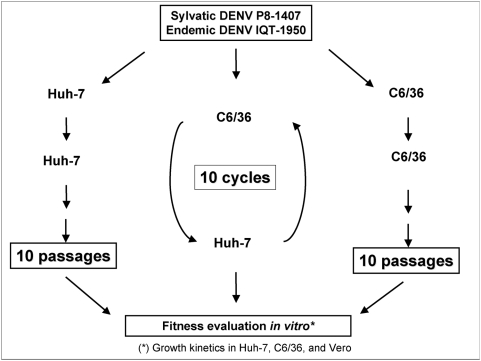
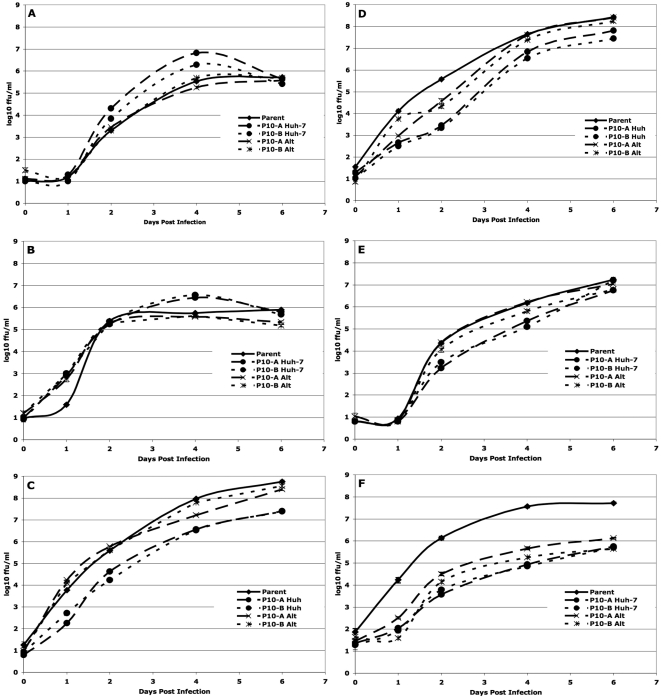
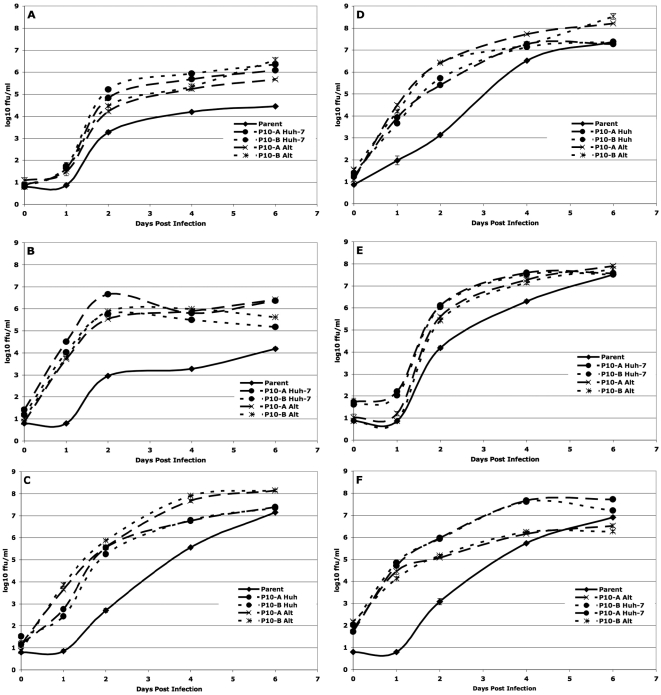
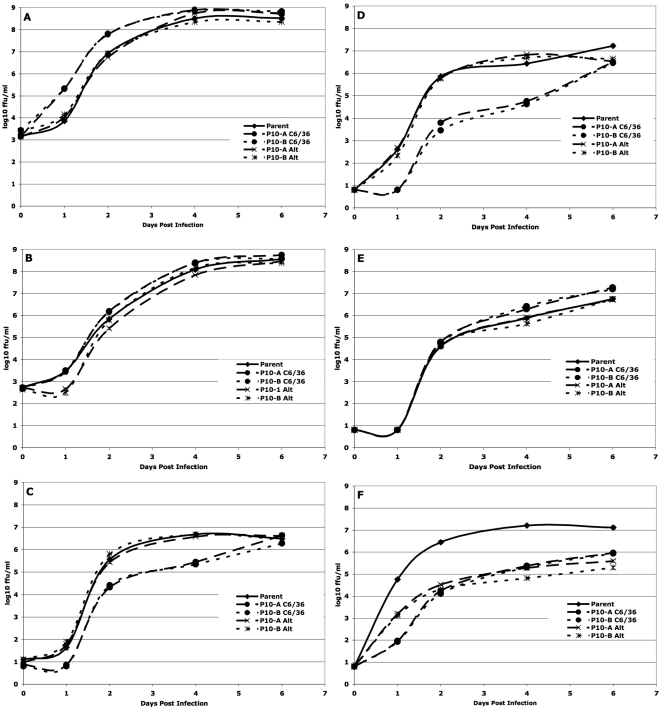
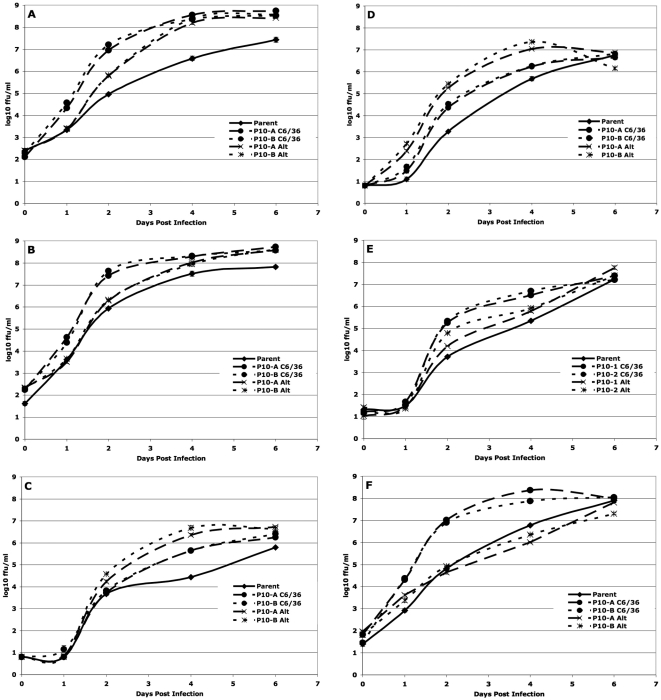
Like other arthropod-borne viruses (arboviruses), mosquito-borne dengue virus (DENV) is maintained in an alternating cycle of replication in arthropod and vertebrate hosts. The trade-off hypothesis suggests that this alternation constrains DENV evolution because a fitness increase in one host usually diminishes fitness in the other. Moreover, the hypothesis predicts that releasing DENV from host alternation should facilitate adaptation. To test this prediction, DENV was serially passaged in either a single human cell line (Huh-7), a single mosquito cell line (C6/36), or in alternating passages between Huh-7 and C6/36 cells. After 10 passages, consensus mutations were identified and fitness was assayed by evaluating replication kinetics in both cell types as well as in a novel cell type (Vero) that was not utilized in any of the passage series. Viruses allowed to specialize in single host cell types exhibited fitness gains in the cell type in which they were passaged, but fitness losses in the bypassed cell type, and most alternating passages, exhibited fitness gains in both cell types. Interestingly, fitness gains were observed in the alternately passaged, cloned viruses, an observation that may be attributed to the acquisition of both host cell-specific and amphi-cell-specific adaptations or to recovery from the fitness losses due to the genetic bottleneck of biological cloning. Amino acid changes common to both passage series suggested convergent evolution to replication in cell culture via positive selection. However, intriguingly, mutations accumulated more rapidly in viruses passed in Huh-7 cells than in those passed in C6/36 cells or in alternation. These results support the hypothesis that releasing DENV from host alternation facilitates adaptation, but there is limited support for the hypothesis that such alternation necessitates a fitness trade-off. Moreover, these findings suggest that patterns of genetic evolution may differ between viruses replicating in mammalian and mosquito cells.
Overview
The claims and statistics of this paper haven’t been checked yet.
Run the check — free, no account needed. It reads the open-access text and checks the sources it cites.
Integrity signals
Registry
Cites
Statistics
Figures
Verification
Claims the paper makes
The claims and statistics of this paper haven’t been checked yet.
Run the check — free, no account needed. It reads the open-access text and checks the sources it cites.
Claims other papers make about this one
Each is checked against this paper’s own text: does it say what the citing paper says it does?
The source backs part of the claim, not all of it — or backs it for a different population, condition or comparison.
In the citing paper
“The trade-off hypothesis predicts that constraining evolution in one host species diminishes fitness in the other (Vasilakis et al., 2009).”
From Codon Pair Bias Is a Direct Consequence of Dinucleotide Bias (2016) · cites this paper as Vasilakis et al., 2009
Experimental — accuracy not yet measured
Self-check
Percentages, sums and reported differences re-computed from the paper’s own numbers.
The self-check needs the paper’s full text.
Citations
Cites
Dengue and Dengue Hemorrhagic Fever
Gubler, D. J. (1998) · Clinical Microbiology Reviews · doi:10.1128/cmr.11.3.480 · Cited by 4,394
Risk factors for human disease emergence
Taylor, L. H., Latham, S. M., & woolhouse, M. E. J. (2001) · Philosophical Transactions of the Royal Society of London. Series B: Biological Sciences · doi:10.1098/rstb.2001.0888 · Cited by 2,835
Rates of Molecular Evolution in RNA Viruses: A Quantitative Phylogenetic Analysis
Jenkins, G. M., Rambaut, A., Pybus, O. G., & Holmes, E. C. (2002) · Journal of Molecular Evolution · doi:10.1007/s00239-001-0064-3 · Cited by 693
Origins of Dengue Type 2 Viruses Associated with Increased Pathogenicity in the Americas
Rico-Hesse, R., Harrison, L. M., Salas, R. A., Tovar, D., Nisalak, A., Ramos, C., Bóshell, J., de Mesa, M. T. R., Nogueira, R. M. R., & da Rosa, A. T. (1997) · Virology · doi:10.1006/viro.1997.8504 · Cited by 676
Dengue Virus Structural Differences That Correlate with Pathogenesis
Leitmeyer, K. C., Vaughn, D. W., Watts, D. M., Salas, R., Villalobos, I., de Chacon, Ramos, C., & Rico-Hesse, R. (1999) · Journal of Virology · doi:10.1128/jvi.73.6.4738-4747.1999 · Cited by 622
Origin and Evolution of Viruses
Holland, J. J., & Domingo, E. (1998) · Virus Genes · doi:10.1023/a:1007989407305 · Cited by 524
Kliks, S. C., Nisalak, A., Brandt, W. E., Wahl, L. M., & Burke, D. S. (1989) · American Journal of Tropical Medicine and Hygiene · doi:10.4269/ajtmh.1989.40.444 · Cited by 519
Fitness of RNA virus decreased by Muller’s ratchet
Chao, L. (1990) · Nature · doi:10.1038/348454a0 · Cited by 488
Dengue and dengue hemorrhagic fever : Its history and resurgence as a global public health problem
GUBLER, D. J. (1997) · Medical Entomology and Zoology · Cited by 453
Evolutionary Relationships of Endemic/Epidemic and Sylvatic Dengue Viruses
Wang, E., Ni, H., Xu, R., Barrett, A. D. T., Watowich, S. J., Gubler, D. J., & Weaver, S. C. (2000) · Journal of Virology · doi:10.1128/jvi.74.7.3227-3234.2000 · Cited by 445
Self-citationIn Vivo Enhancement of Dengue Virus Infection in Rhesus Monkeys by Passively Transferred Antibody
Halstead, S. B. (1979) · The Journal of Infectious Diseases · doi:10.1093/infdis/140.4.527 · Cited by 441
Dengue Prevention and 35 Years of Vector Control in Singapore
Ooi, E. E., Goh, K.-T., & Gubler, D. J. (2006) · Emerging infectious diseases · doi:10.3201/10.3201/eid1206.051210 · Cited by 438
Microevolution and virulence of dengue viruses
Rico-Hesse, R. (2003) · Advances in virus research · doi:10.1016/s0065-3527(03)59009-1 · Cited by 422
Viruses Associated with Epidemic Hemorrhagic Fevers of the Philippines and Thailand
Hammon, W. M., Rundnick, A., & Sather, G. E. (1960) · Science · doi:10.1126/science.131.3407.1102 · Cited by 410
Ecological Origins of Novel Human Pathogens
Woolhouse, M. E. J., & Gaunt, E. R. (2007) · Critical Reviews in Microbiology · doi:10.1080/10408410701647560 · Cited by 394
Klimstra, W. B., Ryman, K. D., & Johnston, R. E. (1998) · Journal of Virology · doi:10.1128/jvi.72.9.7357-7366.1998 · Cited by 381
Molecular evolution and epidemiology of dengue-3 viruses
Lanciotti, R. S., Lewis, J. G., GUBLER, D. J., & Trent, D. W. (1994) · Journal of General Virology · doi:10.1099/0022-1317-75-1-65 · Cited by 355
Rapid fitness losses in mammalian RNA virus clones due to Muller’s ratchet
Duarte, E., Clarke, D., Moya, A., Domingo, E., & Holland, J. (1992) · Proceedings of the National Academy of Sciences · doi:10.1073/pnas.89.13.6015 · Cited by 331
Measurement of the mutation rates of animal viruses: influenza A virus and poliovirus type 1
Parvin, J. D., Moscona, A., Pan, W. T., Leider, J. M., & Palese, P. (1986) · Journal of Virology · doi:10.1128/jvi.59.2.377-383.1986 · Cited by 310
Dengue and Dengue Hemorrhagic Fever, Brazil, 1981–2002
Siqueira, J. B., Martelli, C. M. T., Coelho, G. E., Simplicio, A. C. R., & Hatch, D. L. (2005) · Emerging infectious diseases · doi:10.3201/eid1101.031091 · Cited by 308
Failure of secondary infection with American genotype dengue 2 to cause dengue haemorrhagic fever
Watts, D. M., Porter, K. R., Putvatana, P., Vasquez, B., Calampa, C., Hayes, C. G., & Halstead, S. B. (1999) · The Lancet · doi:10.1016/s0140-6736(99)04015-5 · Cited by 305
Clinical, epidemiologic, and virologic features of dengue in the 1998 epidemic in Nicaragua.
Harris, E., Videa, E., Pérez, L., Sandoval, E., Téllez, Y., Pérez, M. L., Cuadra, R., Rocha, J., Idiaquez, W., Alonso, R. E., et al. (2000) · American Journal of Tropical Medicine and Hygiene · doi:10.4269/ajtmh.2000.63.5 · Cited by 302
Binding of Sindbis Virus to Cell Surface Heparan Sulfate
Byrnes, A. P., & Griffin, D. E. (1998) · Journal of Virology · doi:10.1128/jvi.72.9.7349-7356.1998 · Cited by 296
Pathogenesis of liver involvement during dengue viral infections
Seneviratne, S. L., Malavige, G. N., & de Silva, H. J. (2006) · Transactions of the Royal Society of Tropical Medicine and Hygiene · doi:10.1016/j.trstmh.2005.10.007 · Cited by 291
Phylogenetic Relationships and Differential Selection Pressures among Genotypes of Dengue-2 Virus
Twiddy, S. S., Farrar, J., Chau, N. V., Wills, B. A., Gould, E. A., Грицун, Т. С., Lloyd, G., & Holmes, E. C. (2002) · Virology · doi:10.1006/viro.2002.1447 · Cited by 276
Quasispecies theory in the context of population genetics
Wilke, C. O. (2005) · BMC Evolutionary Biology · doi:10.1186/1471-2148-5-44 · Cited by 276
Quantitation of relative fitness and great adaptability of clonal populations of RNA viruses
Holland, J. J., de la Torre, J. C., Clarke, D. K., & Duarte, E. A. (1991) · Journal of Virology · doi:10.1128/jvi.65.6.2960-2967.1991 · Cited by 272
Weaver, S. C., Brault, A. C., Kang, W., & Holland, J. J. (1999) · Journal of Virology · doi:10.1128/jvi.73.5.4316-4326.1999 · Cited by 266
Self-citationCost of Host Radiation in an RNA Virus
Turner, P. E., & Elena, S. F. (2000) · Genetics · doi:10.1093/genetics/156.4.1465 · Cited by 263
The Emperor's New Clothes Revisited, or Reflections on the Pathogenesis of Dengue Hemorrhagic Fever
Rosen, L. (1977) · American Journal of Tropical Medicine and Hygiene · doi:10.4269/ajtmh.1977.26.337 · Cited by 259
Molecular evolution and phylogeny of dengue-4 viruses.
Lanciotti, R. S., Trent, D. W., & Gubler, D. J. (1997) · Journal of General Virology · doi:10.1099/0022-1317-78-9-2279 · Cited by 258
Selection for Virulent Dengue Viruses Occurs in Humans and Mosquitoes
Cologna, R., Armstrong, P. M., & Rico-Hesse, R. (2004) · Journal of Virology · doi:10.1128/jvi.79.2.853-859.2005 · Cited by 228
Genetic Lesions Associated with Muller's Ratchet in an RNA Virus
Escarmı́s, C., Dávila, M., Charpentier, N., Bracho, M. A., Moyá, A., & Domingo, E. (1996) · Journal of Molecular Biology · doi:10.1006/jmbi.1996.0639 · Cited by 221
Arbovirus evolution in vivo is constrained by host alternation
Coffey, L. L., Vasilakis, N., Brault, A. C., Powers, A. M., Tripet, F., & Weaver, S. C. (2008) · Proceedings of the National Academy of Sciences · doi:10.1073/pnas.0712130105 · Cited by 215
Self-citationRNA virus quasispecies populations can suppress vastly superior mutant progeny
de la Torre, J. C., & Holland, J. J. (1990) · Journal of Virology · doi:10.1128/jvi.64.12.6278-6281.1990 · Cited by 187
The evolution of RNA viruses: A population genetics view
Moyá, A., Elena, S. F., Bracho, M. A., Miralles, R., & Barrio, E. (2000) · Proceedings of the National Academy of Sciences · doi:10.1073/pnas.97.13.6967 · Cited by 178
Genetic bottlenecks and population passages cause profound fitness differences in RNA viruses
Clarke, D. K., Duarte, E. A., Moyá, A., Elena, S. F., Domingo, E., & Holland, J. J. (1993) · Journal of Virology · doi:10.1128/jvi.67.1.222-228.1993 · Cited by 177
Dynamic effects of antibody-dependent enhancement on the fitness of viruses
Cummings, D. A. T., Schwartz, I. B., Billings, L., Shaw, L. B., & Burke, D. S. (2005) · Proceedings of the National Academy of Sciences · doi:10.1073/pnas.0507320102 · Cited by 166
Wahid, S. F., Sanusi, S., Zawawi, M., & Ali, R. A. (2000) · PubMed · Cited by 162
Immunological enhancement of dengue virus replication.
Halstead, S. B., Chow, J. S., & Marchette, N. J. (1973) · PubMed · Cited by 162
Messer, W. B., Vitarana, U. T., Sivananthan, K., Elvtigala, J., Preethimala, L. D., Ramesh, R., Withana, N., Gubler, D. J., & de Silva, A. M. (2002) · American Journal of Tropical Medicine and Hygiene · doi:10.4269/ajtmh.2002.66.765 · Cited by 154
Effect of Alternating Passage on Adaptation of Sindbis Virus to Vertebrate and Invertebrate Cells
Greene, I. P., Wang, E., Deardorff, E. R., Milleron, R. S., Domingo, E., & Weaver, S. C. (2005) · Journal of Virology · doi:10.1128/jvi.79.22.14253-14260.2005 · Cited by 147
Self-citationNovella, I. S., Elena, S. F., Moyá, A., Domingo, E., & Holland, J. J. (1995) · Journal of Virology · doi:10.1128/jvi.69.5.2869-2872.1995 · Cited by 142
Novella, I. S., Hershey, C. L., Escarmı́s, C., Domingo, E., & Holland, J. J. (1999) · Journal of Molecular Biology · doi:10.1006/jmbi.1999.2635 · Cited by 141
Wolfs, T. F. W., de Jong, J. J., van den Berg, H., Tijnagel, J. M. G. H., Krone, W., & Goudsmit, J. (1990) · Proceedings of the National Academy of Sciences · doi:10.1073/pnas.87.24.9938 · Cited by 141
Hanley, K. A., Nelson, J. T., Schirtzinger, E. E., Whitehead, S. S., & Hanson, C. T. (2008) · BMC Ecology · doi:10.1186/1472-6785-8-1 · Cited by 139
Self-citationSubclonal components of consensus fitness in an RNA virus clone
Duarte, E. A., Novella, I. S., Ledesma, S., Clarke, D. K., Moyá, A., Elena, S. F., Domingo, E., & Holland, J. J. (1994) · Journal of Virology · doi:10.1128/jvi.68.7.4295-4301.1994 · Cited by 137
Profile of liver involvement in dengue virus infection.
Itha, S., Kashyap, R., Krishnani, N., Saraswat, V. A., Choudhuri, G., & Aggarwal, R. (2005) · PubMed · Cited by 131
Is the Quasispecies Concept Relevant to RNA Viruses?
Holmes, E. C., & Moyá, A. (2002) · Journal of Virology · doi:10.1128/jvi.76.1.460-462.2002 · Cited by 128
The West Nile virus mutant spectrum is host-dependant and a determinant of mortality in mice
Slyke, G. V., Bernard, K. A., Kramer, L. D., Shi, P., & Ebel, G. D. (2006) · Virology · doi:10.1016/j.virol.2006.10.029 · Cited by 122
Lee, E., Weir, R. C., & Dalgarno, L. (1997) · Virology · doi:10.1006/viro.1997.8570 · Cited by 111
Pryor, M. J., Carr, J. M., Hocking, H., Davidson, A. D., Li, P., & Wright, P. J. (2001) · American Journal of Tropical Medicine and Hygiene · doi:10.4269/ajtmh.2001.65.427 · Cited by 111
Cell-specific adaptation of two flaviviruses following serial passage in mosquito cell culture
Ciota, A. T., Lovelace, A. O., Ngo, K. A., Le, A. N., Maffei, J. G., Franke, M. A., Payne, A. F., Jones, S. A., Kauffman, E. B., & Kramer, L. D. (2006) · Virology · doi:10.1016/j.virol.2006.08.005 · Cited by 110
Cooper, L. A., & Scott, T. W. (2001) · Genetics · doi:10.1093/genetics/157.4.1403 · Cited by 102
Role of the mutant spectrum in adaptation and replication of West Nile virus
Ciota, A. T., Ngo, K. A., Lovelace, A. O., Payne, A. F., Zhou, Y., Shi, P., & Kramer, L. D. (2007) · Journal of General Virology · doi:10.1099/vir.0.82606-0 · Cited by 101
Potential of ancestral sylvatic dengue-2 viruses to re-emerge
Vasilakis, N., Shell, E. J., Fokam, E. B., Mason, P. W., Hanley, K. A., Estes, D. M., & Weaver, S. C. (2006) · Virology · doi:10.1016/j.virol.2006.08.049 · Cited by 100
Self-citationExponential Fitness Gains of RNA Virus Populations Are Limited by Bottleneck Effects
Novella, I. S., Quer, J., Domingo, E., & Holland, J. J. (1999) · Journal of Virology · doi:10.1128/jvi.73.2.1668-1671.1999 · Cited by 97
Sequencing the termini of capped viral RNA by 5'-3' ligation and PCR.
Mandl, C. W., Heinz, F. X., Puchhammer‐Stöckl, E., & Kunz, C. (1991) · PubMed · Cited by 97
Dengue Virus Circulation and Evolution in Mexico: A Phylogenetic Perspective
Díaz, F. J., Black, W. C., Farfán-Ale, J. A., Loroño-Pino, M. A., Olson, K. E., & Beaty, B. J. (2006) · Archives of Medical Research · doi:10.1016/j.arcmed.2006.02.004 · Cited by 85
Venuti, A., Manni, V., Morello, R., Marco, F. D., Marzetti, F., & Marcante, M. L. (2000) · Journal of Medical Virology · doi:10.1002/(sici)1096-9071(200004)60:4 · Cited by 69
Adaptation Studies with Ross River Virus: Laboratory Mice and Cell Cultures
Taylor, W. P., & Marshall, I. D. (1975) · Journal of General Virology · doi:10.1099/0022-1317-28-1-59 · Cited by 66
Duarte, E. A., Clarke, D. K., Moyá, A., Elena, S. F., Domingo, E., & Holland, J. J. (1993) · Journal of Virology · doi:10.1128/jvi.67.6.3620-3623.1993 · Cited by 65
E/NS1 Modifications of Dengue 2 Virus after Serial Passages in Mammalian and/or Mosquito Cells
Chen, W., Wu, H.-R., & Chiou, S.-S. (2003) · Intervirology · doi:10.1159/000073208 · Cited by 63
Dengue Virus Replication Enhancement in Peripheral Blood Leukocytes from Immune Human Beings
Halstead, S. B., Marchette, N. J., Chow, J. S., & Lolekha, S. (1976) · Experimental Biology and Medicine · doi:10.3181/00379727-151-39160 · Cited by 63
Evidence for the Non-quasispecies Evolution of RNA Viruses
Jenkins, G. M., Worobey, M., Woelk, C. H., & Holmes, E. C. (2001) · Molecular Biology and Evolution · doi:10.1093/oxfordjournals.molbev.a003900 · Cited by 58
Basic Statistical Considerations in Virological Experiments
Richardson, B. A., & Overbaugh, J. (2004) · Journal of Virology · doi:10.1128/jvi.79.2.669-676.2005 · Cited by 54
Evolution of Fitness in Experimental Populations of Vesicular Stomatitis Virus
Elena, S. F., Gónzález‐Candelas, F., Novella, I. S., Duarte, E. A., Clarke, D. K., Domingo, E., Holland, J. J., & Moyá, A. (1996) · Genetics · doi:10.1093/genetics/142.3.673 · Cited by 53
Ciota, A. T., Lovelace, A. O., Jones, S. A., Payne, A. F., & Kramer, L. D. (2007) · Journal of General Virology · doi:10.1099/vir.0.83061-0 · Cited by 51
Ruiz-Jarabo, C. M., Pariente, N., Baranowski, É., Dávila, M., Gómez‐Mariano, G., & Domingo, E. (2004) · Journal of General Virology · doi:10.1099/vir.0.80126-0 · Cited by 36
Evolution of Dengue Prevention and Control Programme in Indonesia
Kusriastuti, R., & Sutomo, S. (2005) · Cited by 36
Adaptation Studies with Ross River Virus: Retention of Field Level Virulence
Taylor, W. P., & Marshall, I. D. (1975) · Journal of General Virology · doi:10.1099/0022-1317-28-1-73 · Cited by 35
Glycosaminoglycan Binding Properties of Natural Venezuelan Equine Encephalitis Virus Isolates
Wang, E., Brault, A. C., Powers, A. M., Kang, W., & Weaver, S. C. (2002) · Journal of Virology · doi:10.1128/jvi.77.2.1204-1210.2003 · Cited by 30
Self-citationHanley, K. A., & Weaver, S. C. (2008) · Origin and Evolution of Viruses · doi:10.1016/b978-0-12-374153-0.00016-3 · Cited by 28
Self-citationKalayanarooj, S., Rimal, H. S., Andjaparidze, A., Vatcharasaevee, V., Nisalak, A., Jarman, R. G., Chinnawirotpisan, P., Mammen, M. P., Holmes, E. C., & Gibbons, R. V. (2007) · American Journal of Tropical Medicine and Hygiene · doi:10.4269/ajtmh.2007.77.534 · Cited by 19
Current Status of Dengue/Dengue Haemorrhagic Fever in WHO South-East Asia Region
Prasittisuk, C., & Kumar, V. (1998) · Cited by 16
Cited by
Sorted by citations
Grubaugh, N. D., Gangavarapu, K., Quick, J., Matteson, N. L., de Jesus, J. G., Main, B. J., Tan, A. L., Paul, L. M., Brackney, D. E., Grewal, S., et al. (2019) · Genome biology · doi:10.1186/s13059-018-1618-7 · Cited by 979
Vasilakis, N., Cardosa, J., Hanley, K. A., Holmes, E. C., & Weaver, S. C. (2011) · Nature Reviews Microbiology · doi:10.1038/nrmicro2595 · Cited by 401
Self-citationC6/36 Aedes albopictus Cells Have a Dysfunctional Antiviral RNA Interference Response
Brackney, D. E., Scott, J. C., Sagawa, F., Woodward, J. E., Miller, N., Schilkey, F., Mudge, J., Wilusz, J., Olson, K. E., Blair, C. D., et al. (2010) · PLoS neglected tropical diseases · doi:10.1371/journal.pntd.0000856 · Cited by 327
Chen, R., & Vasilakis, N. (2011) · Viruses · doi:10.3390/v3091562 · Cited by 297
Self-citationArbovirus high fidelity variant loses fitness in mosquitoes and mice
Coffey, L. L., Beeharry, Y., Bordería, A. V., Blanc, H., & Vignuzzi, M. (2011) · Proceedings of the National Academy of Sciences · doi:10.1073/pnas.1111650108 · Cited by 249
Metadata
- Authors
- Vasilakis, N., Deardorff, E. R., Kenney, J. L., Rossi, S. L., Hanley, K. A., & Weaver, S. C.
- Affiliations
- The University of Texas Medical Branch at Galveston (US)
- New Mexico State University (US)
- Corresponding author
- Weaver, Scott C.
- Venue
- PLoS Pathogens
- Publisher
- Public Library of Science (PLoS)
- Published
- 2009-06-05
- Volume
- 5
- Issue
- 6
- Pages
- e1000467
- ISSN
- 1553-7366 (ISSN-L)
- 1553-7374
- PMC
- PMC2685980
- OpenAlex
- W2098987669
- Cited by
- 191
- References
- 75
- Citations by year
- 2026: 8 · 2025: 5 · 2024: 24 · 2023: 6 · 2022: 3 · 2021: 15 · 2020: 13 · 2019: 13 · 2018: 11 · 2017: 8 · 2016: 12 · 2015: 11 · 2014: 21 · 2013: 8 · 2012: 5
- FWCI
- 6.43
- Type
- journal article
- Language
- en
- Open access
- gold
- doi.org
- Locations
- PLoS Pathogens (publishedVersion, cc-by)
- PubMed Central (publishedVersion, cc-by)
- PubMed (publishedVersion)
- DOAJ (DOAJ: Directory of Open Access Journals) (submittedVersion, cc-by-sa)
- Funders
- National Institutes of Health (NIH T32)
- Centers for Disease Control and Prevention (T01 CCT622892)
- U.S. Public Health Service (T01/CCT 622892)
- National Institute of Allergy and Infectious Diseases (R01AI069145, AI069145)
- National Center for Research Resources (P20RR016480)
- Topics
- Life Sciences › Biochemistry, Genetics and Molecular Biology › Genetics › Evolution and Genetic Dynamics
- Health Sciences › Medicine › Public Health, Environmental and Occupational Health › Mosquito-borne diseases and control
- Physical Sciences › Mathematics › Applied Mathematics › Mathematical and Theoretical Epidemiology and Ecology Models
- Keywords
- dengue virus, mosquito-borne arboviruses, host alternation, trade-off hypothesis, host adaptation, viral fitness, mutation accumulation, serial passage, C6/36 cells, Huh7 cells, Vero cells, convergent evolution, positive selection, host cell specificity
- MeSH terms
- Adaptation, Biological, Aedes, Analysis of Variance, Animals, Arboviruses, Cell Line, Chlorocebus aethiops, Dengue Virus, Humans, Kinetics, Mutation, Research Design, Selection, Genetic, Serial Passage, Vero Cells, Virulence, Virus Replication, Consensus Sequence, Sequence Analysis, RNA, Evolution, Molecular, Cell Line, Tumor
About these checks
Registry, retraction, Cites and statistics results are computed, not judged, with one exception: a printed reference that no index lists is read once by a model before it counts as a citation error. Claims are extracted by a model and kept only when their quote appears verbatim in the text; each cited source is then checked, with a model’s help, for whether it says what the claim relies on. Those verdicts can be wrong — read the claim’s quote and the cited source before relying on one.
Statistics and arithmetic are recomputed, not judged.
Confidence bands are shown only for fields calibrated on our annotated test set. None is calibrated yet, so no band is shown.
What counts as a claim ›How we measure confidence ›How we check this ›
Are you an author, or do you see a problem with this page? Request a review
