

The DOI matches its Crossref record; 95 of the 95 references it cites were found in a registry or an index.
Helicobacter pylori Perturbs Iron Trafficking in the Epithelium to Grow on the Cell Surface
Open accessAbstract
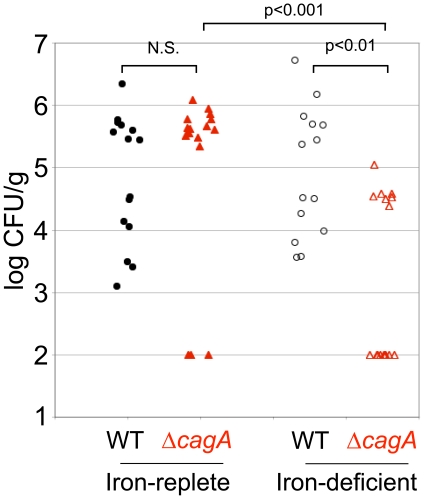
Helicobacter pylori (Hp) injects the CagA effector protein into host epithelial cells and induces growth factor-like signaling, perturbs cell-cell junctions, and alters host cell polarity. This enables Hp to grow as microcolonies adhered to the host cell surface even in conditions that do not support growth of free-swimming bacteria. We hypothesized that CagA alters host cell physiology to allow Hp to obtain specific nutrients from or across the epithelial barrier. Using a polarized epithelium model system, we find that isogenic ΔcagA mutants are defective in cell surface microcolony formation, but exogenous addition of iron to the apical medium partially rescues this defect, suggesting that one of CagA's effects on host cells is to facilitate iron acquisition from the host. Hp adhered to the apical epithelial surface increase basolateral uptake of transferrin and induce its transcytosis in a CagA-dependent manner. Both CagA and VacA contribute to the perturbation of transferrin recycling, since VacA is involved in apical mislocalization of the transferrin receptor to sites of bacterial attachment. To determine if the transferrin recycling pathway is involved in Hp colonization of the cell surface, we silenced transferrin receptor expression during infection. This resulted in a reduced ability of Hp to colonize the polarized epithelium. To test whether CagA is important in promoting iron acquisition in vivo, we compared colonization of Hp in iron-replete vs. iron-deficient Mongolian gerbils. While wild type Hp and ΔcagA mutants colonized iron-replete gerbils at similar levels, ΔcagA mutants are markedly impaired in colonizing iron-deficient gerbils. Our study indicates that CagA and VacA act in concert to usurp the polarized process of host cell iron uptake, allowing Hp to use the cell surface as a replicative niche.
Overview
The claims and statistics of this paper haven’t been checked yet.
Run the check — free, no account needed. It reads the open-access text and checks the sources it cites.
Integrity signals
Registry
Cites
Statistics
Figures
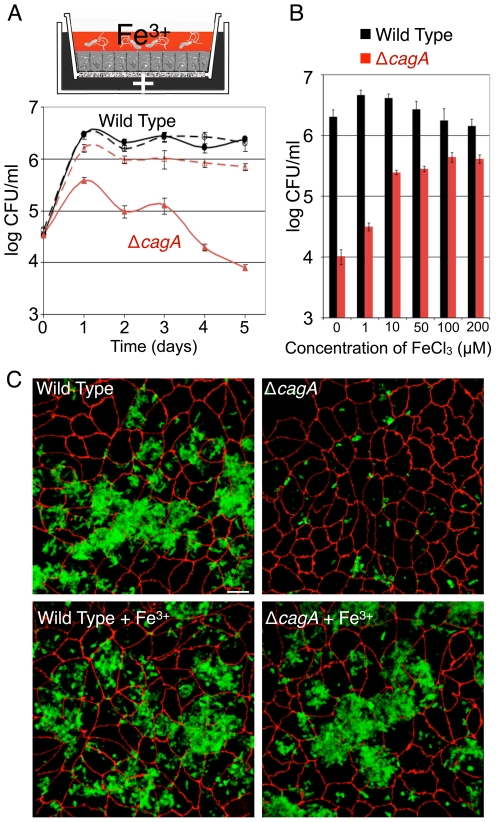
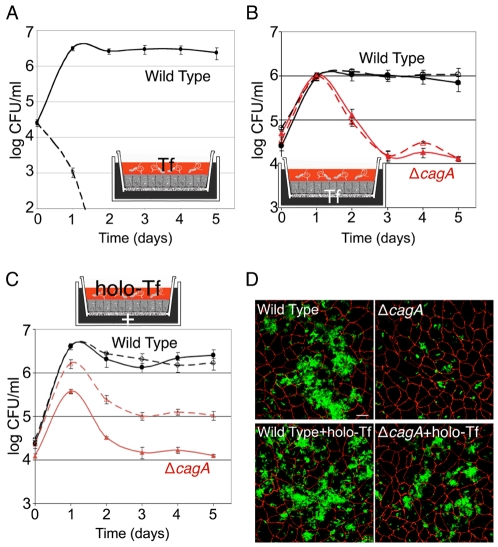
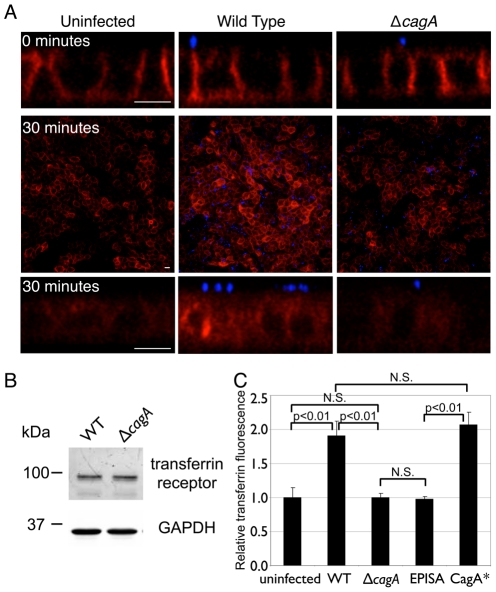
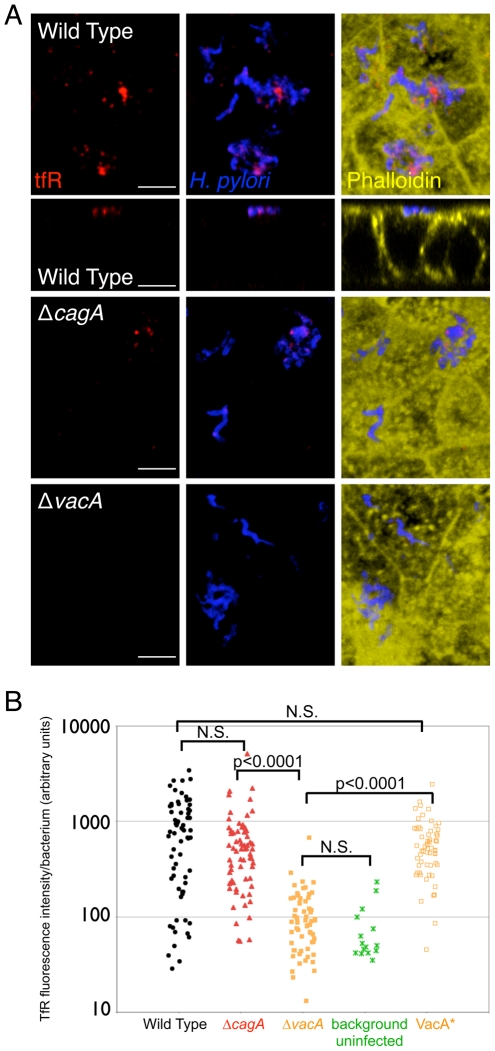
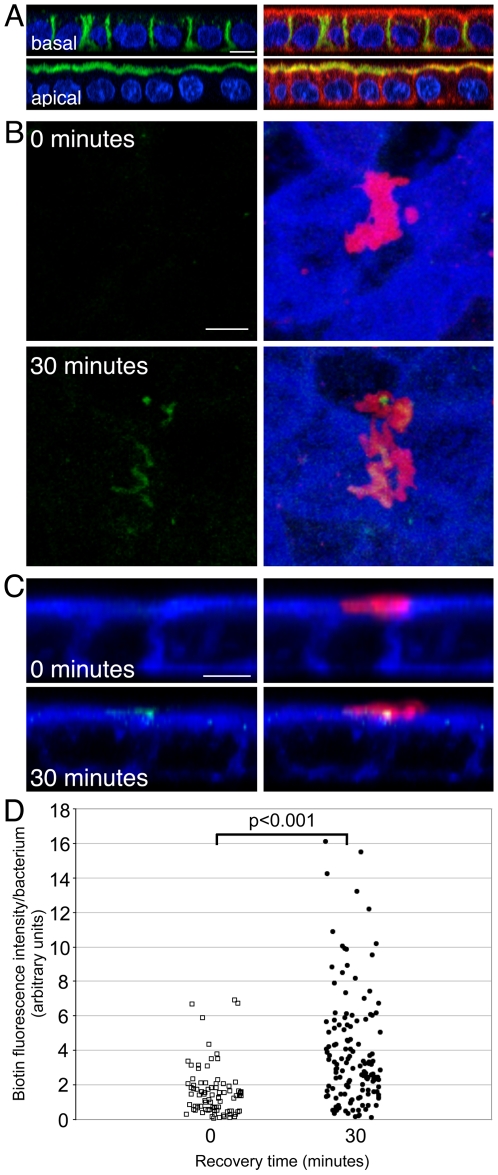
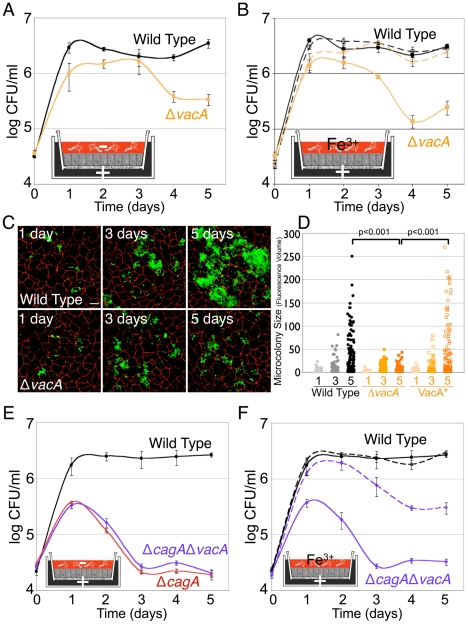
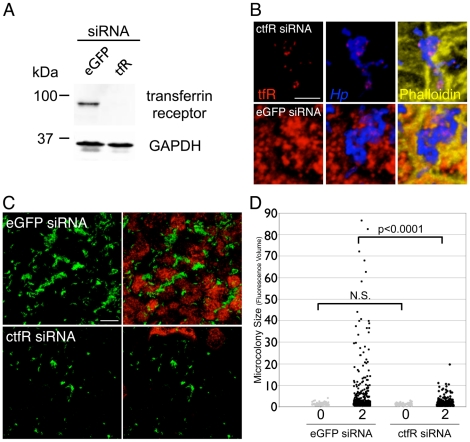
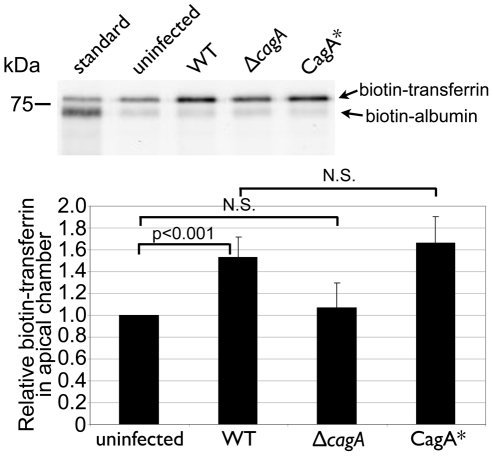
Verification
Claims the paper makes
The claims and statistics of this paper haven’t been checked yet.
Run the check — free, no account needed. It reads the open-access text and checks the sources it cites.
Claims other papers make about this one
Each is checked against this paper’s own text: does it say what the citing paper says it does?
In the citing paper
“H. pylori subsequently acquires iron from transferrin and reveals how H. pylori manipulates host iron metabolism under iron-deplete conditions to promote survival in the stomach.”
From The Impact of Dietary Transition Metals on Host-Bacterial Interactions (2018) · cites this paper as Tan et al., 2011
In the citing paper
“CagA causes the mislocalization of transferrin receptors from the basolateral membrane to the apical surface where the pathogen is located (Tan et al., 2011).”
From The Impact of Dietary Transition Metals on Host-Bacterial Interactions (2018) · cites this paper as Tan et al., 2011
In the citing paper
“H. pylori subsequently acquires iron from transferrin”
From The Impact of Dietary Transition Metals on Host-Bacterial Interactions (2018) · cites this paper as Tan et al., 2011
Self-check
Percentages, sums and reported differences re-computed from the paper’s own numbers.
The self-check needs the paper’s full text.
Citations
Cites
Malfertheiner, P., Mégraud, F., O'Morain, C. A., Bazzoli, F., El-Omar, E. M., Graham, D., Hunt, R. H., Rokkas, T., Vakil, N. B., Kuipers, E. J., et al. (2006) · Gut · doi:10.1136/gut.2006.101634 · Cited by 2,242
Mosaicism in Vacuolating Cytotoxin Alleles of Helicobacter pylori
Atherton, J. C., Cao, P., Peek, R. M., Tummuru, M. K. R., Blaser, M. J., & Cover, T. L. (1995) · Journal of Biological Chemistry · doi:10.1074/jbc.270.30.17771 · Cited by 1,564
Self-citationHelicobacter pylori Adhesin Binding Fucosylated Histo-Blood Group Antigens Revealed by Retagging
Ilver, D., Arnqvist, A., Ögren, J., Frick, I.-M., Kersulyte, D., Incecik, E. T., Berg, D. E., Covacci, A., Engstrand, L. G., & Borén, T. (1998) · Science · doi:10.1126/science.279.5349.373 · Cited by 1,225
SHP-2 Tyrosine Phosphatase as an Intracellular Target of Helicobacter pylori CagA Protein
Higashi, H., Tsutsumi, R., Muto, S., Sugiyama, T., Azuma, T., Asaka, M., & Hatakeyama, M. (2002) · Science · doi:10.1126/science.1067147 · Cited by 1,028
Helicobacter pylori SabA Adhesin in Persistent Infection and Chronic Inflammation
Mahdavi, J., Sondén, B., Hurtig, M., Olfat, F. O., Forsberg, L., Roche, N., Ångström, J., Larsson, T. P., Teneberg, S., Karlsson, K., et al. (2002) · Science · doi:10.1126/science.1069076 · Cited by 935
Lactoferrin: structure, function and applications
González‐Chávez, S. A., Arévalo‐Gallegos, S., & Rascón-Cruz, Q. (2008) · International Journal of Antimicrobial Agents · doi:10.1016/j.ijantimicag.2008.07.020 · Cited by 759
Disruption of the Epithelial Apical-Junctional Complex by Helicobacter pylori CagA
Amieva, M. R., Vogelmann, R., Covacci, A., Tompkins, L. S., Nelson, W. J., & Falkow, S. (2003) · Science · doi:10.1126/science.1081919 · Cited by 739
Self-citationThe serine protease TMPRSS6 is required to sense iron deficiency
Du, X., She, E., Gelbart, T., Truksa, J., Lee, P., Xia, Y., Khovananth, K., Mudd, S., Mann, N., Moresco, E. M. Y., et al. (2008) · Science · doi:10.1126/science.1157121 · Cited by 578
Organization of vesicular trafficking in epithelia
Rodriguez-Boulan, E., Kreitzer, G., & Müsch, A. (2005) · Nature Reviews Molecular Cell Biology · doi:10.1038/nrm1593 · Cited by 574
Helicobacter pylori VacA, a paradigm for toxin multifunctionality
Cover, T. L., & Blanke, S. R. (2005) · Nature Reviews Microbiology · doi:10.1038/nrmicro1095 · Cited by 569
Cited by
Sorted by citations
Pathobiology of Helicobacter pylori–Induced Gastric Cancer
Amieva, M. R., & Peek, R. M. (2015) · Gastroenterology · doi:10.1053/j.gastro.2015.09.004 · Cited by 907
Self-citationLife in the human stomach: persistence strategies of the bacterial pathogen Helicobacter pylori
Salama, N. R., Hartung, M. L., & Mueller, A. (2013) · Nature Reviews Microbiology · doi:10.1038/nrmicro3016 · Cited by 668
Helicobacter pylori CagA and Gastric Cancer: A Paradigm for Hit-and-Run Carcinogenesis
Hatakeyama, M. (2014) · Cell Host & Microbe · doi:10.1016/j.chom.2014.02.008 · Cited by 557
Helicobacter pylori and gastric cancer: mechanisms and new perspectives
Duan, Y., Xu, Y., Dou, Y., & Xu, D. (2025) · Journal of Hematology & Oncology · doi:10.1186/s13045-024-01654-2 · Cited by 311
Gastrointestinal biofilms in health and disease
Motta, J., Wallace, J. L., Buret, A. G., Deraison, C., & Vergnolle, N. (2021) · Nature Reviews Gastroenterology & Hepatology · doi:10.1038/s41575-020-00397-y · Cited by 291
Metadata
- Authors
- Tan, S., Noto, J. M., Romero-Gallo, J., Peek, R. M., & Amieva, M. R.
- Affiliations
- Stanford University (US)
- Vanderbilt University (US)
- Corresponding author
- Amieva, Manuel R.
- Venue
- PLoS Pathogens
- Publisher
- Public Library of Science (PLoS)
- Published
- 2011-05-12
- Volume
- 7
- Issue
- 5
- Pages
- e1002050
- ISSN
- 1553-7366 (ISSN-L)
- 1553-7374
- PMC
- PMC3093365
- OpenAlex
- W2079054594
- Cited by
- 175
- References
- 95
- Citations by year
- 2026: 8 · 2025: 8 · 2024: 4 · 2023: 6 · 2022: 9 · 2021: 14 · 2020: 15 · 2019: 8 · 2018: 8 · 2017: 15 · 2016: 17 · 2015: 17 · 2014: 12 · 2013: 18 · 2012: 13
- FWCI
- 15.07
- Type
- journal article
- Language
- en
- Open access
- gold
- doi.org
- Locations
- PLoS Pathogens (publishedVersion, cc-by)
- PubMed Central (publishedVersion, cc-by)
- PubMed (publishedVersion)
- DOAJ (DOAJ: Directory of Open Access Journals) (submittedVersion, cc-by-sa)
- Figshare (submittedVersion, cc-by)
- Funders
- National Institutes of Health (CA-77955)
- National Cancer Institute (R29CA077955, CA 92229, CA-77955, CA116837, R01CA092229, R01CA077955)
- National Institute of Allergy and Infectious Diseases (R01AI038459, AI038459)
- National Institute of Diabetes and Digestive and Kidney Diseases (R01DK058587, DK-58587)
- Topics
- Health Sciences › Medicine › Gastroenterology › Helicobacter pylori-related gastroenterology studies
- Health Sciences › Medicine › Gastroenterology › Gastrointestinal motility and disorders
- Health Sciences › Medicine › Hematology › Iron Metabolism and Disorders
- Keywords
- Helicobacter pylori, CagA, VacA, iron acquisition, transferrin, transferrin receptor, transcytosis, iron trafficking, host-pathogen interaction, iron deficiency, Mongolian gerbil, bacterial effector proteins
- MeSH terms
- Adaptation, Physiological, Animals, Antigens, Bacterial, Bacterial Adhesion, Bacterial Proteins, Cell Line, Cell Membrane, Dogs, Epithelium, Gastric Mucosa, Gerbillinae, Humans, Intercellular Junctions, Iron, Receptors, Transferrin, Transferrin, Signal Transduction, Down-Regulation, Helicobacter pylori, Helicobacter Infections, Cell Polarity, Sequence Deletion, Caco-2 Cells, Transcytosis
About these checks
Registry, retraction, Cites and statistics results are computed, not judged, with one exception: a printed reference that no index lists is read once by a model before it counts as a citation error. Claims are extracted by a model and kept only when their quote appears verbatim in the text; each cited source is then checked, with a model’s help, for whether it says what the claim relies on. Those verdicts can be wrong — read the claim’s quote and the cited source before relying on one.
Statistics and arithmetic are recomputed, not judged.
Confidence bands are shown only for fields calibrated on our annotated test set. None is calibrated yet, so no band is shown.
What counts as a claim ›How we measure confidence ›How we check this ›
Are you an author, or do you see a problem with this page? Request a review
