

The DOI matches its Crossref record; 31 of the 32 references it cites were found in a registry or an index.
Seasonal Pulses of Marburg Virus Circulation in Juvenile Rousettus aegyptiacus Bats Coincide with Periods of Increased Risk of Human Infection
Open accessAbstract
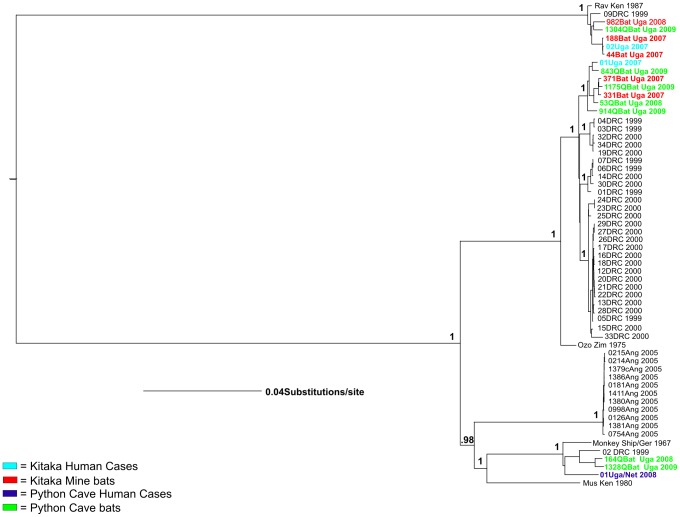
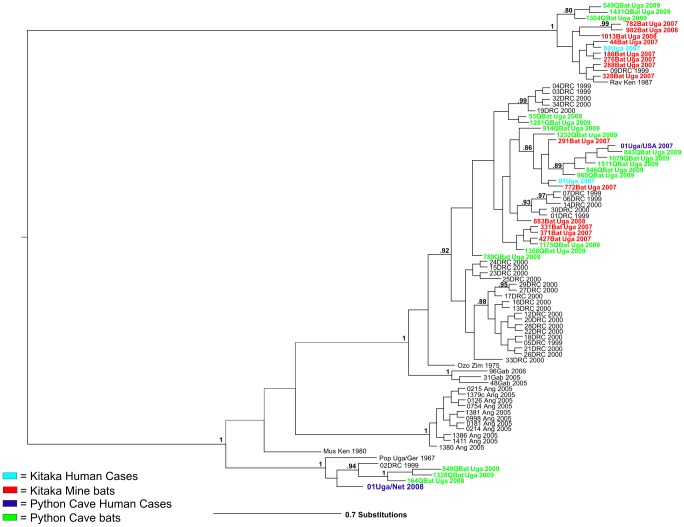
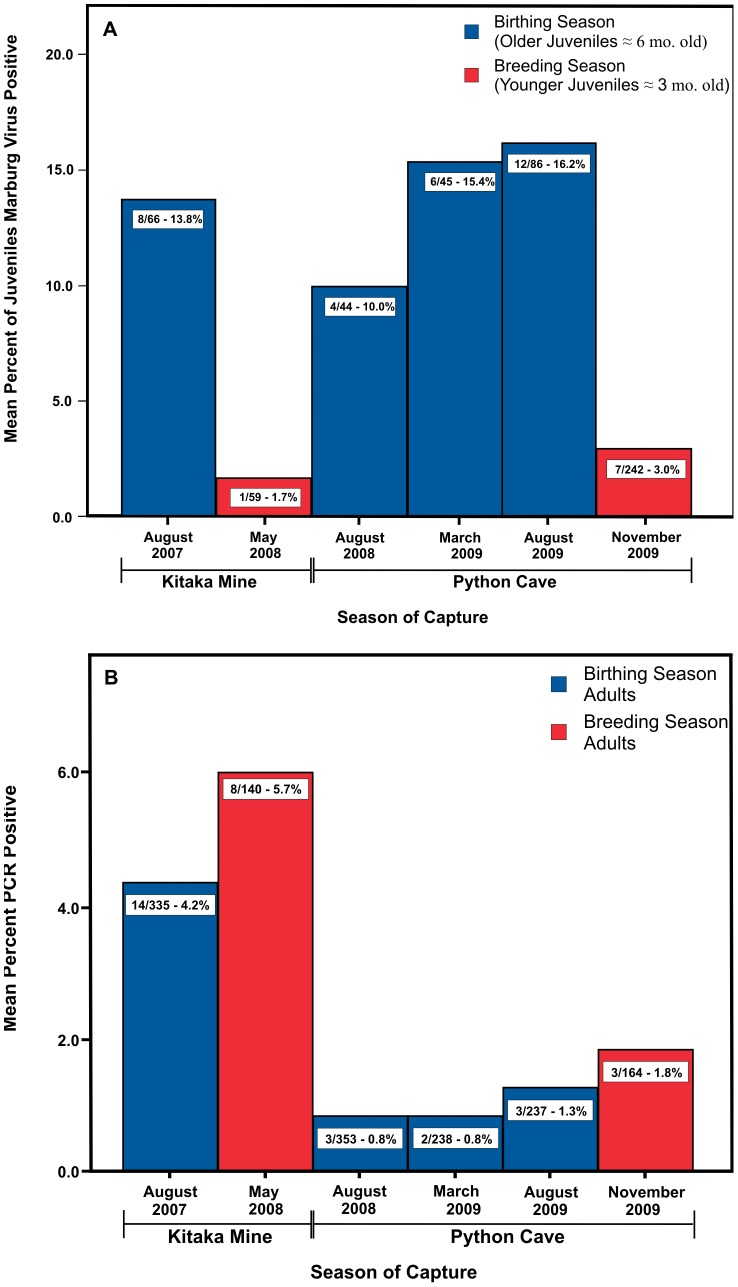
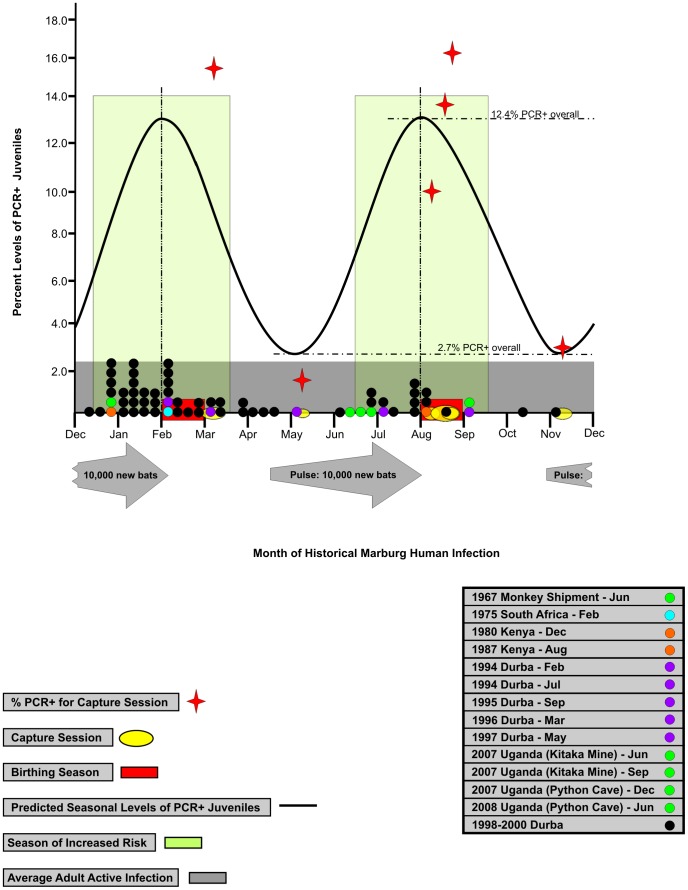
Marburg virus (family Filoviridae) causes sporadic outbreaks of severe hemorrhagic disease in sub-Saharan Africa. Bats have been implicated as likely natural reservoir hosts based most recently on an investigation of cases among miners infected in 2007 at the Kitaka mine, Uganda, which contained a large population of Marburg virus-infected Rousettus aegyptiacus fruit bats. Described here is an ecologic investigation of Python Cave, Uganda, where an American and a Dutch tourist acquired Marburg virus infection in December 2007 and July 2008. More than 40,000 R. aegyptiacus were found in the cave and were the sole bat species present. Between August 2008 and November 2009, 1,622 bats were captured and tested for Marburg virus. Q-RT-PCR analysis of bat liver/spleen tissues indicated ~2.5% of the bats were actively infected, seven of which yielded Marburg virus isolates. Moreover, Q-RT-PCR-positive lung, kidney, colon and reproductive tissues were found, consistent with potential for oral, urine, fecal or sexual transmission. The combined data for R. aegyptiacus tested from Python Cave and Kitaka mine indicate low level horizontal transmission throughout the year. However, Q-RT-PCR data show distinct pulses of virus infection in older juvenile bats (~six months of age) that temporarily coincide with the peak twice-yearly birthing seasons. Retrospective analysis of historical human infections suspected to have been the result of discrete spillover events directly from nature found 83% (54/65) events occurred during these seasonal pulses in virus circulation, perhaps demonstrating periods of increased risk of human infection. The discovery of two tags at Python Cave from bats marked at Kitaka mine, together with the close genetic linkages evident between viruses detected in geographically distant locations, are consistent with R. aegyptiacus bats existing as a large meta-population with associated virus circulation over broad geographic ranges. These findings provide a basis for developing Marburg hemorrhagic fever risk reduction strategies.
Overview
The claims and statistics of this paper haven’t been checked yet.
Run the check — free, no account needed. It reads the open-access text and checks the sources it cites.
Integrity signals
Registry
Cites
Statistics
Figures
Verification
Claims the paper makes
The claims and statistics of this paper haven’t been checked yet.
Run the check — free, no account needed. It reads the open-access text and checks the sources it cites.
Claims other papers make about this one
Each is checked against this paper’s own text: does it say what the citing paper says it does?
The source backs part of the claim, not all of it — or backs it for a different population, condition or comparison.
In the citing paper
“The host of MV is the fruit bat (Rousettus aegyptiacus), with transmission to humans occurring via direct contact with an infected animal host (13,14).”
From Marburg virus disease outbreaks, mathematical models, and disease parameters: a systematic review (2024) · cites this paper as [13]
Experimental — accuracy not yet measured
Self-check
Percentages, sums and reported differences re-computed from the paper’s own numbers.
The self-check needs the paper’s full text.
Citations
Cites
MrBayes 3: Bayesian phylogenetic inference under mixed models
Ronquist, F., & Huelsenbeck, J. P. (2003) · Bioinformatics · doi:10.1093/bioinformatics/btg180 · Cited by 29,194
Guide for the Care and Use of Laboratory Animals: Eighth Edition
(2011) · doi:10.17226/12910 · Cited by 16,199
MAFFT version 5: improvement in accuracy of multiple sequence alignment
Katoh, K., Kuma, K., Toh, H., & Miyata, T. (2005) · Nucleic Acids Research · doi:10.1093/nar/gki198 · Cited by 5,063
Guide for the care and use of laboratory animals
(1997) · Choice Reviews Online · doi:10.5860/choice.34-3310 · Cited by 2,930
SEAVIEW and PHYLO_WIN: two graphic tools for sequence alignment and molecular phylogeny
Galtier, N., Gouy, M., & Gautier, C. (1996) · Computer applications in the biosciences · doi:10.1093/bioinformatics/12.6.543 · Cited by 2,264
Isolation of Genetically Diverse Marburg Viruses from Egyptian Fruit Bats
Towner, J. S., Amman, B. R., Sealy, T. K., Carroll, S. A., Comer, J. A., Kemp, A. C., Swanepoel, R., Paddock, C. D., Balinandi, S. K., Khristova, M. L., et al. (2009) · PLoS Pathogens · doi:10.1371/journal.ppat.1000536 · Cited by 732
Self-citationMarburg Virus Infection Detected in a Common African Bat
Towner, J. S., Pourrut, X., Albariño, C. G., Nze-Nkogue, C., Bird, B. H., Grard, G., Ksiazek, T. G., Gonzalez, J., Nichol, S. T., & Leroy, E. M. (2007) · PLoS ONE · doi:10.1371/journal.pone.0000764 · Cited by 411
Self-citationRowe, A. K., Bertolli, J., Khan, A. S., Mukunu, R., Muyembe‐Tamfum, J. J., Bressler, D. S., Williams, A. J., Peters, C. J., Rodrı́guez, L. L., Feldmann, H., et al. (1999) · The Journal of Infectious Diseases · doi:10.1086/514318 · Cited by 385
Self-citationMarburgvirus Genomics and Association with a Large Hemorrhagic Fever Outbreak in Angola
Towner, J. S., Khristova, M. L., Sealy, T. K., Vincent, M. J., Erickson, B. R., Bawiec, D. A., Hartman, A. L., Comer, J. A., Zaki, S. R., Ströher, U., et al. (2006) · Journal of Virology · doi:10.1128/jvi.00069-06 · Cited by 378
Self-citationOutbreake of Marburg virus disease in Johannesburg
Gear, J. S., Cassel, G. A., Gear, A. J., Trappler, B., Clausen, L., Meyers, A. M., Kew, M. C., Bothwell, T. H., Sher, R., Miller, G. B., et al. (1975) · BMJ · doi:10.1136/bmj.4.5995.489 · Cited by 352
Marburg-virus disease in Kenya
Smith, D. H., Isaacson, M., Johnson, K. M., Bagshawe, A., Johnson, B. K., Swanapoel, R., Killey, M., Siongok, T., & Koinange Keruga, W. (1982) · The Lancet · doi:10.1016/s0140-6736(82)91871-2 · Cited by 324
Studies of Reservoir Hosts for Marburg Virus
Swanepoel, R., Smit, S., Rollin, P. E., Formenty, P. B. H., Leman, P. A., Kemp, A. C., Burt, F. J., Grobbelaar, A. A., Croft, J. E., Bausch, D. G., et al. (2007) · Emerging infectious diseases · doi:10.3201/eid1312.071115 · Cited by 320
Self-citationRodrı́guez, L. L., Roo, A. D., Guimard, Y., Trappier, S. G., Sánchez, A. P., Bressler, D. S., Williams, A. J., Rowe, A. K., Bertolli, J., Khan, A. S., et al. (1999) · The Journal of Infectious Diseases · doi:10.1086/514291 · Cited by 310
Self-citationMarburg Hemorrhagic Fever Associated with Multiple Genetic Lineages of Virus
Bausch, D. G., Nichol, S. T., Muyembe-Tamfum, J. J., Borchert, M., Rollin, P. E., Sleurs, H., Campbell, P., Tshioko, F. K., Roth, C., Colebunders, R., et al. (2006) · New England Journal of Medicine · doi:10.1056/nejmoa051465 · Cited by 307
Self-citationELISA for the Detection of Antibodies to Ebola Viruses
Ksiazek, T. G., West, C. P., Rollin, P. E., Jahrling, P. B., & Peters, C. (1999) · The Journal of Infectious Diseases · doi:10.1086/514313 · Cited by 253
Self-citationZaki, S. R., Shieh, W., Greer, P. W., Goldsmith, C. S., Ferebee, T., Katshitshi, J., Tshioko, F. K., Bwaka, M. A., Swanepoel, R., Calain, P., et al. (1999) · The Journal of Infectious Diseases · doi:10.1086/514319 · Cited by 235
Self-citationCharacterization of a new Marburg virus isolated from a 1987 fatal case in Kenya
Johnson, E. D., Johnson, B. K., Silverstein, D. M., Tukei, P. M., Geisbert, T. W., Sanchez, A. N., & Jahrling, P. B. (1996) · Springer eBooks · doi:10.1007/978-3-7091-7482-1_10 · Cited by 175
Response to Imported Case of Marburg Hemorrhagic Fever, the Netherlands
Timen, A. (2009) · Emerging infectious diseases · doi:10.3201/eid1508.090051 · Cited by 154
Outbreak of Marburg hemorrhagic fever among miners in Kamwenge and Ibanda Districts, Uganda, 2007
Adjemian, J., Farnon, E. C., Tschioko, F., Wamala, J. F., Byaruhanga, E., Bwire, G. S., Kansiime, E., Kagirita, A., Ahimbisibwe, S., Katunguka, F., et al. (2011) · The Journal of Infectious Diseases · doi:10.1093/infdis/jir312 · Cited by 152
Self-citationImported case of Marburg hemorrhagic fever - Colorado, 2008.
Fujita, N., Miller, A., Miller, G. B., Gershman, K., Gallagher, N., Marano, N., Hale, C. R., & Jentes, E. S. (2009) · PubMed · Cited by 135
Slenczka, W., & Klenk, H. D. (2007) · The Journal of Infectious Diseases · doi:10.1086/520551 · Cited by 129
Spermatogene Übertragung des „Virus Marburg“
Martini, G. A., & Schmidt, H. (1968) · Journal of Molecular Medicine · doi:10.1007/bf01734141 · Cited by 114
Epidemiologic investigation of Marburg virus disease, Southern Africa, 1975
Conrad, J. L., Isaacson, M., Smith, E. B., Wulff, H., Crees, M., Geldenhuys, P., & Johnston, J. (1978) · The American Journal of Tropical Medicine and Hygiene · doi:10.4269/ajtmh.1978.27.1210 · Cited by 98
Towner, J. S., Sealy, T. K., Ksiazek, T. G., & Nichol, S. T. (2007) · The Journal of Infectious Diseases · doi:10.1086/520601 · Cited by 96
Self-citationImported case of Marburg hemorrhagic fever - Colorado, 2008.
(2009) · PubMed · Cited by 84
Imported Case of Marburg Hemorrhagic Fever—Colorado, 2008
Leggiadro, R. J. (2010) · The Pediatric Infectious Disease Journal · doi:10.1097/inf.0b013e3181d467bc · Cited by 82
A hitherto unknown infectious disease contracted from monkeys. "Marburg-virus" disease.
Martini, G. A., Knauff, H. G., Schmidt, H., Mayer, G., & Baltzer, G. (1968) · PubMed · Cited by 65
The aetiology of an unknown human infection transmitted by monkeys (preliminary communication).
Siegert, R., Shu, H. L., Slenczka, H. L., Peters, D., & Müller, G. (1968) · PubMed · Cited by 40
The breeding biology of the fruit bat Rousettus aegyptiacus E. Geoffroy living at o degrees 22'S.
Mutere, F. A. (1968) · PubMed · Cited by 40
Bergmans, W. (1989) · Data Archiving and Networked Services (DANS) · doi:10.5281/zenodo.13532890 · Cited by 34
Green Monkey Disease ("Marburg Virus" Disease): A New Zoonosis
Luby, J. P., & SANDERS, C. V. (1969) · Annals of Internal Medicine · doi:10.7326/0003-4819-71-3-657 · Cited by 29
Research works printed but not linked: 4
- [3]Wilson, D E. and Reeder, D M. (2005) Mammal species of the world. Baltimore: Johns Hopkins University Press. 2142 p.
- [16]Zaki SR, Shieh WJ, Greer PW, Goldsmith CS, Ferebee T, et al (1999) A novel immunohistochemical assay for the detection of Ebola virus in skin: implications for diagnosis, spread, and surveillance of Ebola hemorrhagic fever. Commission de Lutte contre les Epidemies a Kikwit. J Infect Dis 179 Suppl 1: S36– S47. 9988163
- [17]Martini GA, Schmidt HA (1968) [Spermatogenic transmission of the “Marburg virus”. (Causes of “Marburg simian disease”)]. Klin Wochenschr 46: 398– 400. 4971902
- [23]Towner JS, Amman BR, Nichol ST (2011) Significant zoonotic diseases identified in bats: Filoviruses. In: Investigating the Role of Bats in Emerging Zoonoses. Newman SH, Field HE, de Jong CE, Epstein JH, editors. Rome: Food and Agriculture Organisation of the United Nations. pp. 123–135.
Cited by
Sorted by citations
Pathways to zoonotic spillover
Plowright, R. K., Parrish, C. R., McCallum, H. I., Hudson, P. J., Ko, A. I., Graham, A. L., & Lloyd‐Smith, J. O. (2017) · Nature Reviews Microbiology · doi:10.1038/nrmicro.2017.45 · Cited by 1,281
One Health, emerging infectious diseases and wildlife: two decades of progress?
Cunningham, A. A., Daszak, P., & Wood, J. L. N. (2017) · Philosophical Transactions of the Royal Society B Biological Sciences · doi:10.1098/rstb.2016.0167 · Cited by 671
Bat-borne virus diversity, spillover and emergence
Letko, M. C., Seifert, S. N., Olival, K. J., Plowright, R. K., & Munster, V. J. (2020) · Nature Reviews Microbiology · doi:10.1038/s41579-020-0394-z · Cited by 583
Ecological dynamics of emerging bat virus spillover
Plowright, R. K., Eby, P., Hudson, P. J., Smith, I., Westcott, D. A., Bryden, W. L., Middleton, D., Reid, P. A., McFarlane, R. A., Martín, G., et al. (2014) · Proceedings of the Royal Society B Biological Sciences · doi:10.1098/rspb.2014.2124 · Cited by 535
Bats as ‘special’ reservoirs for emerging zoonotic pathogens
Brook, C. E., & Dobson, A. P. (2015) · Trends in Microbiology · doi:10.1016/j.tim.2014.12.004 · Cited by 537
Metadata
- Authors
- Amman, B. R., Carroll, S. A., Reed, Z. D., Sealy, T. K., Balinandi, S., Swanepoel, R., Kemp, A., Erickson, B. R., Comer, J. A., Campbell, S., Cannon, D. L., Khristova, M. L., Atimnedi, P., Paddock, C. D., Kent Crockett, R. J., Flietstra, T. D., Warfield, K. L., Unfer, R., Katongole-Mbidde, E., Downing, R., Tappero, J. W., Zaki, S. R., Rollin, P. E., Ksiazek, T. G., Nichol, S. T., & Towner, J. S.
- Affiliations
- Centers for Disease Control and Prevention (US)
- National Institute for Communicable Diseases (ZA)
- Uganda Wildlife Authority (UG)
- Integrated BioTherapeutics (United States) (US)
- Corresponding author
- Towner, Jonathan S.
- ORCID
- Venue
- PLoS Pathogens
- Publisher
- Public Library of Science (PLoS)
- Published
- 2012-10-04
- Volume
- 8
- Issue
- 10
- Pages
- e1002877
- ISSN
- 1553-7366 (ISSN-L)
- 1553-7374
- PMC
- PMC3464226
- OpenAlex
- W2131851182
- Cited by
- 453
- References
- 32
- Citations by year
- 2026: 36 · 2025: 41 · 2024: 34 · 2023: 46 · 2022: 40 · 2021: 25 · 2020: 36 · 2019: 36 · 2018: 34 · 2017: 32 · 2016: 31 · 2015: 31 · 2014: 17 · 2013: 11 · 2012: 3
- FWCI
- 13.75
- Type
- journal article
- Language
- en
- Open access
- gold
- doi.org
- Licence
- Locations
- PLoS Pathogens (publishedVersion, public-domain)
- Europe PMC (PubMed Central) (publishedVersion, public-domain)
- PubMed Central (publishedVersion, public-domain)
- PubMed (publishedVersion)
- DOAJ (DOAJ: Directory of Open Access Journals) (submittedVersion, cc-by-sa)
- Figshare (submittedVersion, cc-by)
- UpSpace Institutional Repository (University of Pretoria) (submittedVersion, cc-by)
- Funders
- U.S. Department of Health and Human Services
- Centers for Disease Control and Prevention
- Topics
- Health Sciences › Medicine › Infectious Diseases › Viral Infections and Outbreaks Research
- Health Sciences › Medicine › Infectious Diseases › Viral Infections and Vectors
- Health Sciences › Medicine › Epidemiology › Virology and Viral Diseases
- Keywords
- Marburg virus, Rousettus aegyptiacus, Pteropodidae, bat reservoir hosts, juvenile bats, Marburg hemorrhagic fever, horizontal transmission, metapopulation, risk mitigation strategies
- MeSH terms
- Animals, Base Sequence, Chiroptera, Disease Reservoirs, Female, Humans, Male, Marburg Virus Disease, Nuclear Proteins, Phylogeny, Retrospective Studies, RNA, Viral, Seasons, Uganda, Sequence Analysis, RNA, Marburgvirus, Viral Regulatory and Accessory Proteins, Caves
About these checks
Registry, retraction, Cites and statistics results are computed, not judged, with one exception: a printed reference that no index lists is read once by a model before it counts as a citation error. Claims are extracted by a model and kept only when their quote appears verbatim in the text; each cited source is then checked, with a model’s help, for whether it says what the claim relies on. Those verdicts can be wrong — read the claim’s quote and the cited source before relying on one.
Statistics and arithmetic are recomputed, not judged.
Confidence bands are shown only for fields calibrated on our annotated test set. None is calibrated yet, so no band is shown.
What counts as a claim ›How we measure confidence ›How we check this ›
Are you an author, or do you see a problem with this page? Request a review
