

Rebuttal of Holliday et al.’s Comprehensive Gish Gallop of the Younger Dryas Impact Hypothesis
Open accessThe DOI matches its Crossref record; 102 of the 104 references it cites were found in a registry or an index; none of the 360 sources its claims cite is checked for support yet.
Abstract
In an article comprising some 96,000 words, Holliday et al. (2023) (HEA) claim to have “comprehensively refuted” the Younger Dryas impact hypothesis (YDIH), even though it has been corroborated by scores of articles in dozens of peer-reviewed journals based on the discovery of some combination of synchronous nanodiamonds, exotic microspherules and platinum enrichment at more than 50 Younger Dryas boundary sites on five continents. No hypothesis or theory is immune from criticism, but to “comprehensively refute” one so well established should require dispositive falsifying evidence. However, HEA provide no new evidence of their own and many of their arguments are based on faulty reasoning. Their remaining differences of opinion do not lend themselves to the falsification of an active hypothesis supported by an abundance of reproducible evidence, which now includes shocked quartz which is generally accepted to be produced only by cosmic impacts. Their article can therefore be called a Gish gallop; a long series of weak or flawed arguments designed to overwhelm an opponent. Since HEA’s claims are too many to respond to individually, we instead have selected portions of their article for critical analysis. By providing strong line-by-line counterarguments to their text we crucially show that they demonstrate a poor understanding of the logic required to test the YDIH and a poor understanding of uncertainty in experimental data analysis, and these problems propagate through many parts of their review. We also show that they repeatedly distort the facts and make misleading claims or derisory remarks. In summary, their approach is a corruption of the scientific method. In fact, the YDIH remains in a very strong position and probably represents a second example to go along with the Alvarez Theory of an extraterrestrial event that affected life on Earth. A hypothesis with such potential should not be so casually dismissed and instead should continue to be the subject of research.
Overview
CoChat Summary
TL;DR
The paper argues that Holliday et al. (2023) fail to refute the Younger Dryas impact hypothesis (YDIH), calling their ~96,000-word review a “Gish gallop” built on flawed radiocarbon reasoning and misread evidence. It concludes that the YDIH remains strongly supported by impact proxies at more than 50 YDB sites across multiple continents and should continue to be researched.
Key findings
- HEA provide no new falsifying data; the authors say no YDB site is shown to be inconsistent with the YD impact age, and 17 sites on four continents fall within a 1,000-year window. Poisson calculations give probabilities of 1.1 × 10⁻¹⁵ (or 5.0 × 10⁻¹¹ at a higher rate) for independent Tunguska-like events, and 1.9 × 10⁻¹² (or 2.2 × 10⁻¹⁰) for independent super-Tunguska events.
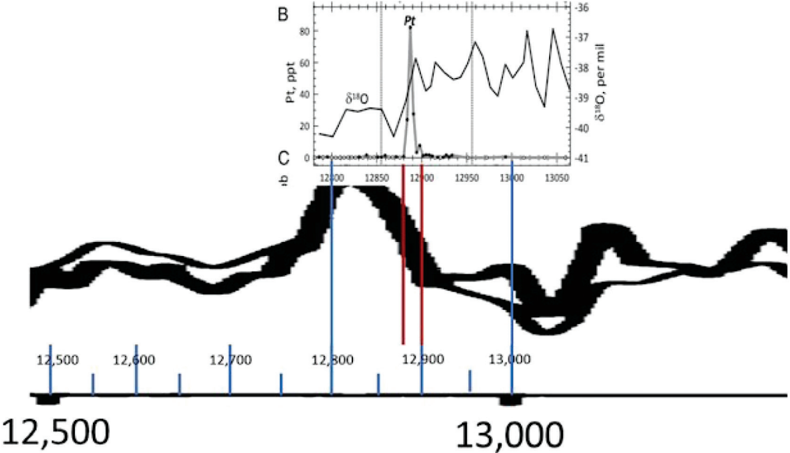
- Meltzer et al. (2014) age-depth models omit confidence intervals for regression coefficients and use calibrated radiocarbon data; the authors argue correct uncertainty treatment would nullify Meltzer et al.’s conclusions. For Abu Hureyra, the YDB depth of 284.7 masl is only marginally consistent at 2σ without regression uncertainty but easily consistent when that uncertainty is included.
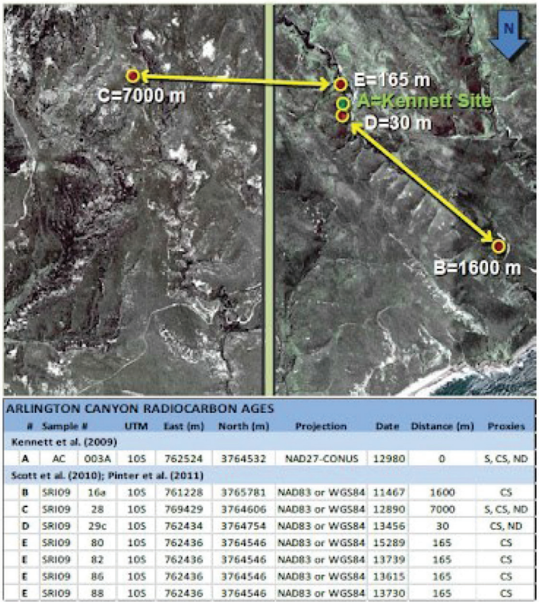
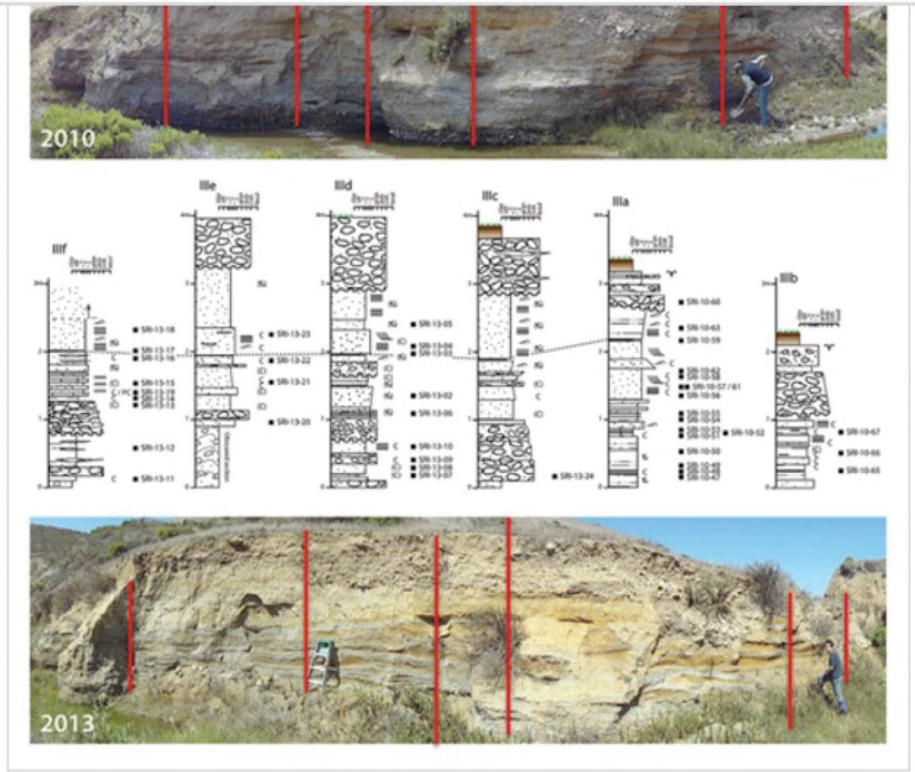
- HEA are said to misuse uncertainty: O’Keefe et al. (2023) claim “almost certainly before” the YD onset uses a 1σ interval, while at 2σ it overlaps the YDB; Usselo/Finow charcoal dates are not inconsistent with a synchronous event; HEA shifted Bull Creek nanodiamond data upward by one cell; and Daulton et al. (2010) sampled Arlington Canyon locations different from Kennett et al. (2009).
- The paper also criticizes HEA on coherent catastrophism, microspherules, platinum, nanodiamonds, and derisive/ad hominem language, concluding the YDIH “remains in a very strong position” and probably represents a second Alvarez-type extraterrestrial event.
Methods
- Design: a line-by-line rebuttal and critical analysis of selected sections of Holliday et al. (2023), including HEA Sections 1, 5.3–5.8, 7, 4.1, 10, and 11, plus a catalog of disparaging remarks.
- Data/sample: no new primary data; the paper re-examines published radiocarbon datasets and prior studies, including Gill et al. (2009), O’Keefe et al. (2023), Meltzer et al. (2014), Kennett et al. (2015a), Bement et al. (2014), and Kaiser et al. (2009), and compiles YDB site dates in tables.
- Main analysis: logical and statistical critique, including reanalysis of radiocarbon age-depth modeling, Poisson probability arguments for synchroneity, and comparison of HEA’s quotations and data handling against original sources.
Limitations
- Stated: HEA’s claims are “too many to respond to individually,” so the authors select only portions of HEA for critical analysis; the rebuttal is therefore not exhaustive.
- Stated: the paper presents no new primary evidence of its own; it is a critique and reanalysis of existing literature and data.
- Evident from the text: the authors are YDIH proponents with declared competing interests (books related to the YDIH, CRG funding, and journal-editor roles with recusal), and the rebuttal is openly partisan rather than an independent new test of the hypothesis.
Model-written summary. Check it against the paper before relying on it.
Integrity signals
Registry
Cites
Statistics
Figures

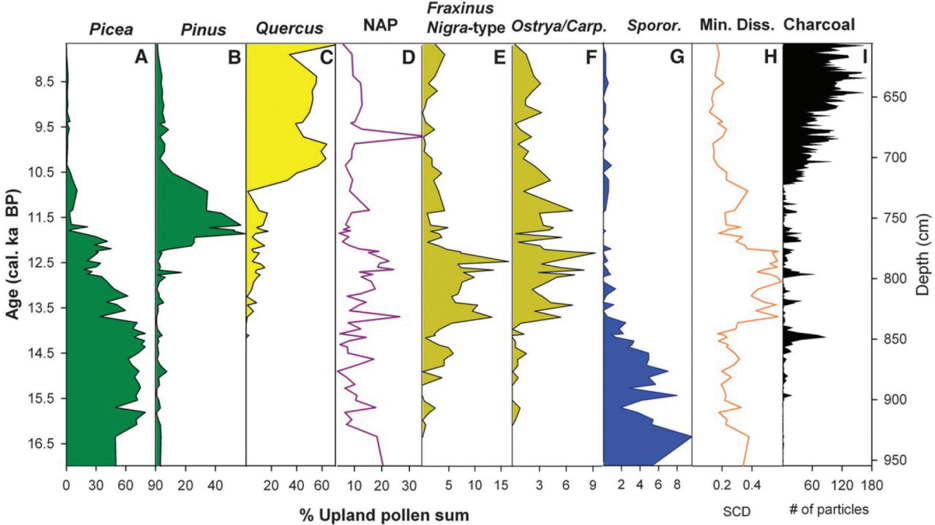
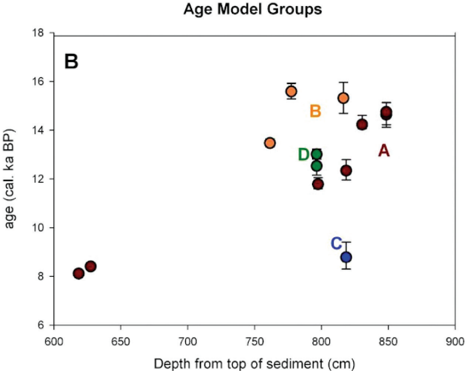
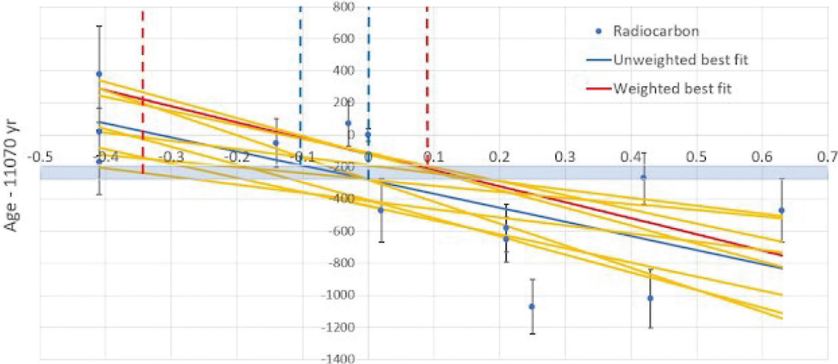
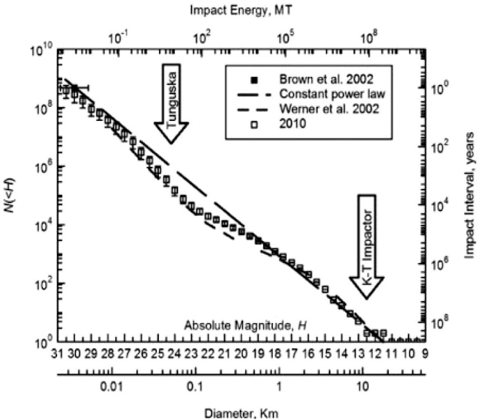
Verification
Claims the paper makes
0 Valid · 79 Not valid · 290 Not checked · 312 Own results and interpretations
A result the paper states — it cites no source for it, so there is none to check. The quote shows it is in the paper.
In the paper
“HEA consistently fail to test the HEA according to its own predictions, i.e. they frequently criticize ideas that are not the YDIH or correspond to early versions of the YDIH without taking any updates into account.”
§ Rebuttal of Holliday et al.'s Comprehensive Gish Gallop of the Younger Dryas Impact Hypothesis > 2.1. Failures of Holliday et al. (2023) in the sections reviewed
plain- Asserted: passes — The authors put it forward as true.
- Checkable: passes — It can be checked against evidence.
- Load-bearing: passes — The paper’s conclusions depend on it.
- Based: unclear — It is unclear why the paper says it holds.
The paper states this without a source or data behind it here, so there is nothing to check it against. The quote shows it is in the paper.
In the paper
“In fact, the radiocarbon data from the charcoal-rich Ussello/Finow horizon is consistent with a synchronous event.”
§ Rebuttal of Holliday et al.'s Comprehensive Gish Gallop of the Younger Dryas Impact Hypothesis > 2.1. Failures of Holliday et al. (2023) in the sections reviewed
plainstates an association- Asserted: passes — The authors put it forward as true.
- Checkable: passes — It can be checked against evidence.
- Load-bearing: passes — The paper’s conclusions depend on it.
- Based: unclear — It is unclear why the paper says it holds.
The paper states this without a source or data behind it here, so there is nothing to check it against. The quote shows it is in the paper.
In the paper
“As shown in our Section 4, their claims are false.”
§ Rebuttal of Holliday et al.'s Comprehensive Gish Gallop of the Younger Dryas Impact Hypothesis > 2.1. Failures of Holliday et al. (2023) in the sections reviewed
plain- Asserted: passes — The authors put it forward as true.
- Checkable: passes — It can be checked against evidence.
- Load-bearing: passes — The paper’s conclusions depend on it.
- Based: unclear — It is unclear why the paper says it holds.
In the paper
“However, this contradicts the review by French and Koeberl (2010) that suggests that this is possible (note that C. Koeberl is a co-author of HEA).”
§ Rebuttal of Holliday et al.'s Comprehensive Gish Gallop of the Younger Dryas Impact Hypothesis > 2.1. Failures of Holliday et al. (2023) in the sections reviewed
What the sources say
- Not checked yetcites French and Koeberl (2010) matched to “The convincing identification of terrestrial meteorite impact structures: What works, what doesn't, and why” (2010) source
hedged- Asserted: passes — The authors put it forward as true.
- Checkable: passes — It can be checked against evidence.
- Load-bearing: passes — The paper’s conclusions depend on it.
- Based: passes — The paper gives a reason why it holds.
The paper states this without a source or data behind it here, so there is nothing to check it against. The quote shows it is in the paper.
In the paper
“HEA frequently misuse confidence intervals, error bars and uncertainty estimates.”
§ Rebuttal of Holliday et al.'s Comprehensive Gish Gallop of the Younger Dryas Impact Hypothesis > 2.1. Failures of Holliday et al. (2023) in the sections reviewed
plainstates a cause- Asserted: passes — The authors put it forward as true.
- Checkable: passes — It can be checked against evidence.
- Load-bearing: unclear — It is unclear whether the paper’s conclusions depend on it.
- Based: unclear — It is unclear why the paper says it holds.
263 more claims
Create a free account to see all 681 claims and to verify the 328 references still open.
- Probably not a substantial claim. 280
- It may state two separate claims as one. 223
- The quote only partly states this claim. 1
Self-check
Percentages, sums and reported differences re-computed from the paper’s own numbers.
Each contradiction between two passages listed here was confirmed by an independent check.
Rated major: it would touch a result — a value a result rests on, reported and recomputed p-values on opposite sides of the significance level, two passages that conflict with no sign which is right, or a cited work retracted before this paper was published.
In the paper
§ Rebuttal of Holliday et al.'s Comprehensive Gish Gallop of the Younger Dryas Impact Hypothesis > 2.2. Conclusions
“All 58 sites show abundance peaks in up to six impact proxies, such as exotic microspherules, platinum and nanodiamonds, that are consistent with an impact date of 12885-12785 cal BP (using the latest radiocarbon calibration curve, see Cheng et al., 2020).”
§ Rebuttal of Holliday et al.'s Comprehensive Gish Gallop of the Younger Dryas Impact Hypothesis > Declaration of competing interests
“| Chile | El Salto | 13275 | 315 | Pigati et al. (2012) |”
Rated minor: it would not touch a result — a value no result rests on, a p-value that stays on the same side of the significance level, or a conflict that is clerical, resolved elsewhere in the paper, or outside its own findings.
In the paper
§ Rebuttal of Holliday et al.'s Comprehensive Gish Gallop of the Younger Dryas Impact Hypothesis > 7.4. Daulton et al.'s (2010) nanodiamond samples
“the only Arlington Canyon samples examined for nanodiamonds by Daulton et al. (2010) are those labeled SRI-09028 and SRI-09-29c.”
§ Rebuttal of Holliday et al.'s Comprehensive Gish Gallop of the Younger Dryas Impact Hypothesis > Later in the same section we read;
“sample SRI09-028 is charred wood (see the table in Figure 12 above) while sample SRI09-29A is dated to 13,341-13,619 BP (2-sigma), and therefore neither sample is expected to contain any nanodiamonds anyway”
Citations
Cites
National Cancer Institute (2020) · Definitions · doi:10.32388/bz83sn · Cited by 2,981
High-Resolution Greenland Ice Core Data Show Abrupt Climate Change Happens in Few Years
Steffensen, J. P., Andersen, K. K., Bigler, M., Clausen, H. B., Dahl-Jensen, D., Fischer, H., Goto-Azuma, K., Hansson, M., Johnsen, S. J., Jouzel, J., et al. (2008) · Science · doi:10.1126/science.1157707 · Cited by 983
Tephrochronology and its application: A review
Lowe, D. J. (2011) · Quaternary Geochronology · doi:10.1016/j.quageo.2010.08.003 · Cited by 764
Firestone, R. B., West, A., Kennett, J. P., Becker, L., Bunch, T. E., Revay, Z. S., Schultz, P. H., Belgya, T., Kennett, D. J., Erlandson, J. M., et al. (2007) · Proceedings of the National Academy of Sciences · doi:10.1073/pnas.0706977104 · Cited by 690
Self-citationPleistocene Megafaunal Collapse, Novel Plant Communities, and Enhanced Fire Regimes in North America
Gill, J. L., Williams, J. W., Jackson, S. T., Lininger, K. B., & Robinson, G. S. (2009) · Science · doi:10.1126/science.1179504 · Cited by 598
French, B. M., & Koeberl, C. (2010) · Earth-Science Reviews · doi:10.1016/j.earscirev.2009.10.009 · Cited by 578
Wildfire responses to abrupt climate change in North America
Marlon, J. R., Bartlein, P. J., Walsh, M. K., Harrison, S. P., Brown, K. J., Edwards, M. E., Higuera, P. E., Power, M. J., Anderson, R. S., Briles, C., et al. (2009) · Proceedings of the National Academy of Sciences · doi:10.1073/pnas.0808212106 · Cited by 429
The Atmosphere During the Younger Dryas
Mayewski, P. A., Meeker, L. D., Whitlow, S., Twickler, M. S., Morrison, M. C., Alley, R. B., Bloomfield, P., & Taylor, K. (1993) · Science · doi:10.1126/science.261.5118.195 · Cited by 266
Timing and structure of the Younger Dryas event and its underlying climate dynamics
Cheng, H., Zhang, H., Spötl, C., Baker, J., Sinha, A., Li, H., Bartolomé, M., Moreno, A., Kathayat, G., Zhao, J., et al. (2020) · Proceedings of the National Academy of Sciences · doi:10.1073/pnas.2007869117 · Cited by 265
Younger Dryas “black mats” and the Rancholabrean termination in North America
Haynes, C. V. (2008) · Proceedings of the National Academy of Sciences · doi:10.1073/pnas.0800560105 · Cited by 234
Research works printed but not linked: 2
- Firestone, R., West, A., Warwick-Smith, S. (2006). The Cycle of Cosmic Catastrophes: How a Stone-Age Comet Changed the Course of World Culture. Bear & Company.
- cal B.P. Sci. Adv., 6, eaax8587. https://doi.org/10.1126/sciadv. · doi:10.1126/sciadv
Cited by
Rejection of Holliday et al.'s alleged refutation of the Younger Dryas impact hypothesis
Sweatman, M. B., Powell, J. L., & West, A. (2024) · Earth-Science Reviews · doi:10.1016/j.earscirev.2024.104960 · Cited by 8
Self-citationFitzenreiter, R., Ernstson, K., Kletetschka, G., LeCompte, M. A., Moore, C. R., Kennett, J. P., Bizimis, M., Hofmann, F., Takáč, M., Adedeji, A. V., et al. (2025) · Airbursts and Cratering Impacts · doi:10.14293/aci.2025.0004 · Cited by 5
Self-citationMoore, C. R., Tselmovich, V. A., LeCompte, M. A., West, A., Culver, S. J., Mallinson, D. J., Baalousha, M., Kennett, J. P., Napier, W. M., Bizimis, M., et al. (2026) · Airbursts and Cratering Impacts · doi:10.14293/aci.2026.0004 · Cited by 2
Self-citationKennett, J. P., Mayewski, P. A., Kurbatov, A. V., Wolbach, W. S., Introne, D., Handley, M., LeCompte, M. A., Moore, C. R., Kletetschka, G., ADEDEJI, A. V., et al. (2026) · Airbursts and Cratering Impacts · doi:10.14293/aci.2026.0007 · Cited by 1
Self-citationMoore, C. R., Powell, J. L., Sweatman, M. B., West, A., LeCompte, M. A., Kennett, J. P., Wolbach, W. S., & Kletetschka, G. (2026) · Airbursts and Cratering Impacts · doi:10.14293/aci.2026.0001 · Cited by 1
Self-citationCryo-paleosols and paleoclimate/cosmic archives in the Dry Valleys, Antarctica
Mahaney, W. C., & Somelar, P. (2025) · Journal of Palaeogeography · doi:10.1016/j.jop.2025.100291
Thackeray, F. (2026) · Airbursts and Cratering Impacts · doi:10.14293/aci.2026.0008
Metadata
- Authors
- Sweatman, M. B., Powell, J. L., & West, A.
- Affiliations
- University of Edinburgh (GB)
- University of Southern California (US)
- Corresponding author
- Sweatman, Martin B.
- Venue
- Airbursts and Cratering Impacts
- Publisher
- ScienceOpen
- Published
- 2024
- Volume
- 2
- Issue
- 1
- ISSN
- 2941-9085 (ISSN-L)
- OpenAlex
- W4403342503
- Cited by
- 9
- References
- 99
- Citations by year
- 2026: 4 · 2025: 4 · 2024: 1
- FWCI
- 2.45
- Type
- journal article
- Language
- en
- Open access
- hybrid
- doi.org
- Locations
- Airbursts and Cratering Impacts (publishedVersion, cc-by)
- Edinburgh Research Explorer (University of Edinburgh) (publishedVersion, cc-by)
- Topics
- Physical Sciences › Earth and Planetary Sciences › Space and Planetary Science › Astro and Planetary Science
- Physical Sciences › Earth and Planetary Sciences › Atmospheric Science › Geology and Paleoclimatology Research
- Social Sciences › Anthropology › Pleistocene-Era Hominins and Archaeology
- Keywords
- Younger Dryas impact hypothesis, Younger Dryas boundary, nanodiamonds, microspherules, shocked quartz, extraterrestrial impact, falsification, scientific method
About these checks
Registry, retraction, Cites and statistics results are computed, not judged, with one exception: a printed reference that no index lists is read once by a model before it counts as a citation error. Claims are extracted by a model and kept only when their quote appears verbatim in the text; each cited source is then checked, with a model’s help, for whether it says what the claim relies on. Those verdicts can be wrong — read the claim’s quote and the cited source before relying on one.
A language model drew the claims from the paper on 2026-11-24, under version 3 of the claim definition (model deepseek-v4.1-flash, prompt extract-v3).
A second model labelled each claim on 2026-11-24 (model jev-1.13-20260917, definition revision gold-guideline-v0.2).
Statistics and arithmetic are recomputed, not judged.
Confidence bands are shown only for fields calibrated on our annotated test set. None is calibrated yet, so no band is shown.
What counts as a claim ›How we measure confidence ›How we check this ›
Are you an author, or do you see a problem with this page? Request a review
Data sources
Bibliographic data: Semantic Scholar, OpenAlex, Crossref.
Contains information from the Semantic Scholar Academic Graph Datasets, made available under the ODC Attribution License (ODC-BY 1.0).
Semantic Scholar’s data is described in: Kinney, R., et al. (2023). The Semantic Scholar Open Data Platform. arXiv:2301.10140.
