

The DOI matches its Crossref record; 42 of the 42 references it cites were found in a registry or an index.
Effects of Long-Term Combination LT4 and LT3 Therapy for Improving Hypothyroidism and Overall Quality of Life
Open accessAbstract
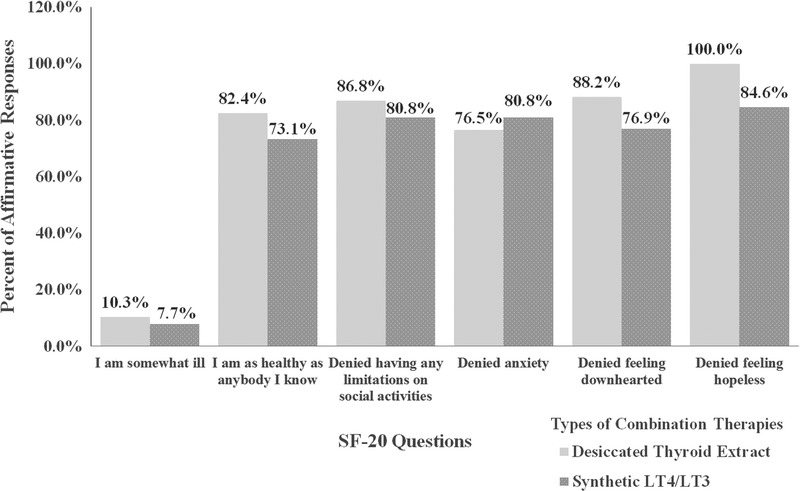
OBJECTIVES: Hypothyroidism results in decreased mood and neurocognition, weight gain, fatigue, and many other undesirable symptoms. The American Association of Clinical Endocrinologists, the American Thyroid Association (ATA), and The Endocrine Society recommend levothyroxine (LT4) monotherapy as the treatment for hypothyroidism; however, after years of monotherapy, some patients continue to experience impaired quality of life. Combination LT4 and synthetic liothyronine (LT3) therapy or the use of desiccated thyroid extract (DTE), has not been suggested for this indication based on short-duration studies with no significant benefits. Our first observational study examined the role of combination therapy for 6 years in improving quality of life in a subset of a hypothyroid population without adverse effects and cardiac mortality. METHODS: An observational retrospective study examining patients prescribed thyroid replacements with serum triiodothyronine (FT3), LT4 with LT3 (synthetic therapy) or DTE (natural therapy), compared with LT4 alone in the United States from 2010 to 2016. Thyroid-stimulating hormone (TSH), serum thyroxine (FT4), and FT3 levels were documented for each patient in addition to any admissions of myxedema coma, thyrotoxicosis, or cardiovascular complications, such as arrhythmias, atrial fibrillation, and mortality. At the conclusion of the study, a cross-sectional interview assessed quality of life for each combination therapy through the Medical Outcomes Study Short Form-20 questionnaire. RESULTS: < 0.05). Less than 5% of patients had supratherapeutic FT3. None of the patients who had abnormally low TSH or elevated FT3 or FT4 levels had hospitalizations for arrhythmias or thyrotoxicosis. On the Medical Outcomes Study Short Form-20 questionnaire, >92% answered feeling "excellent, very good, or good" when questioned about their health while undergoing thyroid replacement compared with levothyroxine alone. CONCLUSIONS: This is the only retrospective study reported to use long-term (mean 27 months) thyroid replacements with combination therapy and to compare between the two forms of therapy: synthetic and natural. For patients undergoing either therapy, we did not identify additional risks of atrial fibrillation, cardiovascular disease, or mortality in patients of all ages with hypothyroidism.
Overview
The claims and statistics of this paper haven’t been checked yet.
Run the check — free, no account needed. It reads the open-access text and checks the sources it cites.
Integrity signals
Registry
Cites
Statistics
Figures
Verification
Claims the paper makes
The claims and statistics of this paper haven’t been checked yet.
Run the check — free, no account needed. It reads the open-access text and checks the sources it cites.
Claims other papers make about this one
Each is checked against this paper’s own text: does it say what the citing paper says it does?
The source backs part of the claim, not all of it — or backs it for a different population, condition or comparison.
In the citing paper
“Fortunately, it is possible using T4+T3 combination therapy to keep serum TSH, FT4, and FT3 within their normal range in ≥90% of patients [86].”
From T4+T3 Combination Therapy: An Unsolved Problem of Increasing Magnitude and Complexity (2021) · cites this paper as [86]
Experimental — accuracy not yet measuredThe cited source says what the claim attributes to it.
In the citing paper
“published data about preference or improvement of symptoms with such therapy is entirely from uncontrolled (23), sparsely documented (25) or small studies (24).”
From Short-Term Time Trends in Prescribing Therapy for Hypothyroidism: Results of a Survey of American Thyroid Association Members (2019) · cites this paper as [25]
Self-check
Percentages, sums and reported differences re-computed from the paper’s own numbers.
The self-check needs the paper’s full text.
Citations
Cites
Hollowell, J. G., Staehling, N. W., Flanders, W. D., Hannon, W. H., Gunter, E. W., Spencer, C. A., & Braverman, L. E. (2002) · The Journal of Clinical Endocrinology & Metabolism · doi:10.1210/jc.87.2.489 · Cited by 4,279 · cited 1×
“6% of the US population has hypothyroidism.(1) Physiologically, the hypothalamus releases thyroid-releasing hormone, which produces thyroid-stimulating hormone (TSH) that subsequently enhances the thyroid gland’s production of largely inactivated serum thyroxine (FT4) and”
BackgroundGarber, J. R., Cobin, R. H., Gharib, H., Hennessey, J. V., Klein, I., Mechanick, J. I., Pessah-Pollack, R., Singer, P. A., & Woeber, K. A. (2012) · Endocrine Practice · doi:10.4158/ep12280.gl · Cited by 1,567 · cited 2×
“All of the patients were hypothyroid as defined by the ATA criteria, with elevated TSH and normal or subnormal FT4 at the beginning of LT4 therapy.(2)”
BackgroundSaravanan, P., Chau, W. ‐., Roberts, N., Vedhara, K., Greenwood, R., & Dayan, C. M. (2002) · Clinical Endocrinology · doi:10.1046/j.1365-2265.2002.01654.x · Cited by 514
Bunevičius, R., Kažanavičius, G., Žalinkevičius, R., & Prange, A. J. (1999) · New England Journal of Medicine · doi:10.1056/nejm199902113400603 · Cited by 482 · cited 1×
“5 μg) were used in 33 patients, improving mood, well-being, and psychometric functionality.(13) Another study in 2002 with a sample size of 10 thyroidectomized patients for the treatment of Graves disease showed similar positive effects of the synthetic therapy.”
Method2012 ETA Guidelines: The Use of L-T4 + L-T3 in the Treatment of Hypothyroidism
Wiersinga, W. M., Duntas, L., Fadeyev, V., Nygaard, B., & Vanderpump, M. P. J. (2012) · European Thyroid Journal · doi:10.1159/000339444 · Cited by 427 · cited 1×
“For years, the American Thyroid Association (ATA) and European guidelines suggested monitoring TSH and FT4 to make clinical decisions for starting and monitoring therapy of hypothyroidism.(2,3) This classic monotherapy of levothyroxine (LT4) provides adequate control of symptoms for a majority of the population; howev…”
BackgroundFish, L. H., Schwartz, H. L., Cavanaugh, J., Steffes, M. W., Bantle, J. P., & Oppenheimer, J. H. (1987) · New England Journal of Medicine · doi:10.1056/nejm198703263161302 · Cited by 353
Grozinsky-Glasberg, S., Fraser, A., Nahshoni, E., Weizman, A., & Leibovici, L. (2006) · The Journal of Clinical Endocrinology & Metabolism · doi:10.1210/jc.2006-0448 · Cited by 296 · cited 1×
“The first, a 2006 meta-analysis analyzed 1216 patients in 11 RCTs resulting in no advantage of synthetic therapy in bodily pain, depression, anxiety, fatigue, quality of life, body weight, and serum cholesterol.(30) A second metaanalysis in 2009 found some benefits in synthetic therapy for psychological and physical w…”
BackgroundEscobar-Morreale, H. F., Obregón, M. J., Escobar del Rey, F., & Morreale de Escobar, G. (1995) · Journal of Clinical Investigation · doi:10.1172/jci118353 · Cited by 287 · cited 1×
“LT4 was initially found to be suboptimal in normalizing FT4 and FT3 in hypothyroid rats.(5) Subsequently, researchers were able to restore euthyroidism with a combination of LT4 and synthetic LT3, resulting in lower doses of LT4 and a normalization of FT3.”
BackgroundEscobar-Morreale, H. F., del Rey, F. E., Obregón, M. J., & de Escobar, G. M. (1996) · Endocrinology · doi:10.1210/endo.137.6.8641203 · Cited by 261 · cited 5×
“The primary outcomes of the study were whether combination therapy was effective in improving clinical signs and symptoms of hypothyroidism as documented in the clinic note; improvement in hypothyroidism symptoms via the SF-20 questionnaire; and adverse effects of clinical or biochemical hyperthyroidism, as measured b…”
BackgroundInfluentialWalsh, J. P., Shiels, L., Lim, E. M., Bhagat, C. I., Ward, L. C., Stuckey, B. G. A., Dhaliwal, S. S., Chew, G. T., Bhagat, M. C., & Cussons, A. J. (2003) · The Journal of Clinical Endocrinology & Metabolism · doi:10.1210/jc.2003-030249 · Cited by 210
Research works printed but not linked: 1
- Hypothyroidism, 752
Cited by
Sorted by citations
Liothyronine and Desiccated Thyroid Extract in the Treatment of Hypothyroidism
Idrees, T., Palmer, S., Maciel, R. M. B., & Bianco, A. C. (2020) · Thyroid® · doi:10.1089/thy.2020.0153 · Cited by 58
“The mean follow-up duration was 27 months (median 22; range 1–111 months) (98).”
BackgroundResultInfluentialThe relevance of T3 in the management of hypothyroidism
Salvatore, D., Porcelli, T., Ettleson, M. D., & Bianco, A. C. (2022) · The Lancet Diabetes & Endocrinology · doi:10.1016/s2213-8587(22)00004-3 · Cited by 44
Individualised requirements for optimum treatment of hypothyroidism: complex needs, limited options
Hoermann, R., Midgley, J. E. M., Larisch, R., & Dietrich, J. W. (2019) · Drugs in Context · doi:10.7573/dic.212597 · Cited by 41
Gluvic, Z. M., Obradovic, M. M., Stewart, A. J., Essack, M., Pitt, S. J., Samardzic, V. S., Šoškić, S., Gojobori, T., & Isenović, E. R. (2021) · Frontiers in Endocrinology · doi:10.3389/fendo.2021.758043 · Cited by 42
“did not find any additional risk for atrial fibrillation and cardiovascular disease in patients on combined LT3+LT4 therapy (133).”
BackgroundMariani, G., Tonacchera, M., Grosso, M., Fiore, E., Falcetta, P., Montanelli, L., Bagattini, B., Vitti, P., & Strausś, H. W. (2021) · Journal of Nuclear Medicine · doi:10.2967/jnumed.120.251504 · Cited by 35
“Nevertheless, a subgroup of hypothyroid patients does not achieve good results with L-thyroxine therapy alone (72); in these patients, combination therapy with L-thyroxine and liothyronine (L-T3) might be considered (73,74).”
BackgroundThyroid hormone resistance: mechanisms and therapeutic development
Yao, B., Yang, C., Pan, C., & Li, Y. (2022) · Molecular and Cellular Endocrinology · doi:10.1016/j.mce.2022.111679 · Cited by 26
Borson‐Chazot, F., Terra, J., Goichot, B., & Caron, P. J. (2021) · Journal of Clinical Medicine · doi:10.3390/jcm10071386 · Cited by 27
“Tariq [83] South Med J 2018 Switch from LT4 to LT4 + LT3 or DTE Observational retrospective study USA (1) Hypothyroidism on “optimal” LT4 only (n = 100 (40 switched to LT4/LT3, 60 switched to DTE)) MOS Short Form-20 (primary outcome) ↑ for a switch to LT4 + LT3 from LT4”
BackgroundInfluentialJonklaas, J., Tefera, E., & Shara, N. (2019) · Frontiers in Endocrinology · doi:10.3389/fendo.2019.00031 · Cited by 23
“It is difficult to identify original published data that might account for the current willingness to prescribe combination therapy, and published data about preference or improvement of symptoms with such therapy is entirely from uncontrolled (23), sparsely documented (25)”
BackgroundHealth‐related quality of life in hypothyroidism—A population‐based study, the WHO MONICA Project
Ellegård, L., Krantz, E., Trimpou, P., & Landin‐Wilhelmsen, K. (2021) · Clinical Endocrinology · doi:10.1111/cen.14448 · Cited by 23
“Antidepressants and minor 17 (24) 63 (18) Ns”
BackgroundPatient Experiences and Perceptions Associated with the Use of Desiccated Thyroid Extract
Toloza, F. J. K., Espinoza Suarez, N. R., El Kawkgi, O., Golembiewski, E. H., Ponce, O. J., Yao, L., Maraka, S., Singh Ospina, N. M., & Brito, J. P. (2020) · Medicina · doi:10.3390/medicina56040161 · Cited by 22
“Improvements in quality of life were also previously in an observational study of 100 patients prescribed T3-containing thyroid hormone replacement (LT4 + LT3 or DTE) after receiving LT4 monotherapy, indicating reports of improved quality of life in 93% and 89% of the DTE and LT4/LT3 populations, respectively, as asse…”
MethodT4+T3 Combination Therapy: An Unsolved Problem of Increasing Magnitude and Complexity
Wiersinga, W. M. (2021) · Endocrinology and Metabolism · doi:10.3803/enm.2021.501 · Cited by 21
“Fortunately, it is possible using T4+T3 combination therapy to keep serum TSH, FT4, and FT3 within their normal range in ≥ 90% of patients [86].”
BackgroundMonzani, M. L., Piccinini, F., Boselli, G., Corleto, R., Margiotta, G., Peeters, R. P., Simoni, M., & Brigante, G. (2022) · Journal of Endocrinological Investigation · doi:10.1007/s40618-022-01903-6 · Cited by 19
Casula, S., Ettleson, M. D., & Bianco, A. C. (2023) · Endocrine Practice · doi:10.1016/j.eprac.2023.04.003 · Cited by 19
Thyroid Gland Organoids: Current Models and Insights for Application in Tissue Engineering
Ogundipe, V. M. L., Plukker, J. T. M., Links, T. P., & Coppes, R. P. (2022) · Tissue Engineering Part A · doi:10.1089/ten.tea.2021.0221 · Cited by 16
Managing symptoms in hypothyroid patients on adequate levothyroxine: a narrative review
Razvi, S., Mrabeti, S., & Luster, M. (2020) · Endocrine Connections · doi:10.1530/ec-20-0205 · Cited by 15
Heald, A. H., Premawardhana, L., Taylor, P., Okosieme, O., Bangi, T., Devine, H., Livingston, M., Javed, A., Moreno, G. Y. C., Watt, T., et al. (2021) · International Journal of Clinical Practice · doi:10.1111/ijcp.14967 · Cited by 14
“However, studies of NDT that employed dose titration and sensitive methods to measure serum TSH, showed no differences versus levothyroxine in heart rate, blood pressure, serum lipids, or additional risk of atrial fibrillation, cardiovascular disease, or mortality [7, 9-11].”
Quality of life, social support, and adherence in female patients with thyroid disorders
Kollerits, E., Zsila, Á., & Matuszka, B. (2023) · BMC Women s Health · doi:10.1186/s12905-023-02718-0 · Cited by 19
“Based on the literature [47, 48, 61, 69–73], it is hypothesized that social support will be associated with higher adherence, which in turn is associated with a better quality of life in thyroid patients.”
Ruíz-Pacheco, M. G., Hernández, I., Hernández-Estrella, G., Basurto, L., Vargas‐Ortega, G., González‐Virla, B., Molina-Ayala, M., Hernández-Martínez, A. F., Luengas-Mondragón, R., Hernández-Allende, A. A., et al. (2023) · Biomedicines · doi:10.3390/biomedicines11030811 · Cited by 11
“The prevalence of fatigue in people living with diabetes remains unclear due to the lack of a cut-off point for the instrument, and factors associated with fatigue such as BMI and glycosylated hemoglobin have been proposed, but the data are still inconclusive [17,18].”
BackgroundRiis, K. R., Larsen, C. B., & Bonnema, S. J. (2024) · Thyroid® · doi:10.1089/thy.2023.0649 · Cited by 10
“37 In the study by Baisier et al., 24-hour urine excretion of T3 was higher during DTE treatment compared with LT4 or no FIG.”
InfluentialPenna, G. C., Bianco, A. C., & Ettleson, M. D. (2024) · The Journal of Clinical Endocrinology & Metabolism · doi:10.1210/clinem/dgad629 · Cited by 8
Ruscio, M., Guard, G., Piedrahita, G., & D’Adamo, C. R. (2022) · Nutrients · doi:10.3390/nu14173572 · Cited by 11
Simon, C., Weidman-Evans, E., & Allen, S. E. (2020) · JAAPA · doi:10.1097/01.jaa.0000660120.03250.55 · Cited by 7
Cui, Z., Ding, X., Bian, N., Chang, X., Wang, J., An, Y., Liu, J., & Wang, G. (2022) · International Journal of Endocrinology · doi:10.1155/2022/1918674 · Cited by 9
Elghawy, O., Hafey, A. C., McCartney, C. R., & Steinman, J. R. (2021) · Journal of Clinical and Translational Endocrinology Case Reports · doi:10.1016/j.jecr.2021.100095 · Cited by 4
Doctor-patient communication in thyroid conditions
Lathia, T. B., Selvan, C., Namjoshi, S., & Badhe, S. (2021) · Thyroid Research and Practice · doi:10.4103/trp.trp_6_22 · Cited by 3
Hao, D., Tian, L., He, H., Zhu, C., Guo, L., Zhang, K., & Zhang, J. (2023) · European Journal of Translational Myology · doi:10.4081/ejtm.2023.11582 · Cited by 3
“9,10 Opposition to the latter argued that the administration of LT4 monotherapy significantly reduces serum FT3 concentrations, 11 implying reduced intercellular T3 hormones in the brain and other vital organs.”
BackgroundMatyjaszek‐Matuszek, B., Woźniak, M. M., Ochmańska, A., Sawicka‐Gutaj, N., Ruchała, M., & Czarnywojtek, A. (2021) · Endokrynologia Polska · doi:10.5603/ep.a2021.0013 · Cited by 3
“improvement in quality of life (QOL), is achieved in the subjective assessment of a patient [14, 31].”
BackgroundRolle der bioidenten Schilddrüsenhormone in der Behandlung der Hypothyreose: Ein Update
WEISSEL, M. (2019) · Journal für Klinische Endokrinologie und Stoffwechsel · doi:10.1007/s41969-019-0071-x · Cited by 3
Effect of Empagliflozin on Serum Levels of Thyroid Hormones Among Prediabetic and Diabetic Patients
Sanjari, M., Sadeghi, N., Amirkhosravi, L., Hadavizadeh, M., Naghibzadeh‐Tahami, A., & Safi, Z. (2025) · International Journal of Endocrinology · doi:10.1155/ije/9920286 · Cited by 2
“Some authors recommended adding T3 to therapy in such cases [48].”
Rethinking strategies for solving thyroid dysfunction at the heart of cardiovascular disease
Rajagopalan, V., Ojamaa, K., & Gerdes, A. M. (2025) · Molecular Medicine · doi:10.1186/s10020-025-01351-x · Cited by 2
Khoshaba, L., & Patarkatsi, L. (2023) · Case Reports in Endocrinology · doi:10.1155/2023/4252894 · Cited by 2
Recent Advances in the Diagnosis, Pathophysiology, and Management of Thyroid Disorders
Naseer, Q. A., & Pan, J. (2025) · IntechOpen eBooks · doi:10.5772/intechopen.1011440 · Cited by 1
Mathuriya, G., & Panday, S. (2021) · International Journal of Clinical Obstetrics and Gynaecology · doi:10.33545/gynae.2021.v5.i4c.982 · Cited by 1
“documented that none of the patients who had abnormally low TSH or elevated FT3 or FT4 levels had hospitalizations, TSH levels improved significantly in majority of the subjects at 3 month follow up ([15]).”
BackgroundClinical thyroidology: beyond the 1970s’ TSH-T4 Paradigm
Lindner, H. H. (2025) · Frontiers in Endocrinology · doi:10.3389/fendo.2025.1529791 · Cited by 2
“A more recent retrospective study found that DTE and T4/T3 treatment, adjusted to a normal TSH, produced no adverse effects or events (293).”
The application of the network approach to quality of life and blood markers in Brazil
Ribeiro, C. G., & Pérez-Nebra, A. R. (2024) · Estudos de Psicologia (Natal) · doi:10.22491/1678-4669.202000025
“The point is that sometimes blood markers predict psychological states (Pulopulos & Kozusznik, 2018; Tariq, Wert, Cheriyath, & Joshi, 2018), or vice-versa (Martin & Dobbin, 1988).”
Gautam, N., & Upadhyay, S. (2022) · International Journal of Research in Ayurveda and Pharmacy · doi:10.7897/2277-4343.1304100
Ware, R. A., Chavhan, S. G., Gatfane, R. Y., & Denge, K. S. (2023) · International Journal of Ayurvedic Medicine · doi:10.47552/ijam.v13i4.3094
Endo, M. (2023) · Clinical Thyroidology · doi:10.1089/ct.2023;35.316-318
Ghaznavi, S. A. (2024) · Clinical Thyroidology · doi:10.1089/ct.2024;36.365-368
“15”
Hoermann, R., & Dietrich, J. W. (2025) · Springer eBooks · doi:10.1007/978-981-96-3682-2_11
Thyroid Health: Your Energy Engine
Jessa Landmann, N. D. (2026) · doi:10.1002/9781394381401.ch05
Wang, Y., Zainuddin, Z. A., & Yin, H. (2026) · Psycho-Oncologie · doi:10.18282/po4174
Aggarwal, S., Gupta, L., Khandelwal, D., Chittawar, S., Sharma, S., Shenoy, M. T., Garg, U. K., Parveen, N., & Sood, M. (2026) · Indian Journal of Endocrinology and Metabolism · doi:10.4103/ijem.ijem_259_25
“[4,7] .”
Metadata
- Authors
- Tariq, A., Wert, Y., Cheriyath, P., & Joshi, R.
- Affiliations
- Harrisburg Hospital (US)
- Venue
- Southern Medical Journal
- Publisher
- Southern Medical Association
- Published
- 2018-06
- Volume
- 111
- Issue
- 6
- Pages
- 363-369
- ISSN
- 0038-4348 (ISSN-L)
- 1541-8243
- PMC
- PMC5965938
- OpenAlex
- W2806754702
- Cited by
- 43
- References
- 42
- Citations by year
- 2026: 3 · 2025: 5 · 2024: 3 · 2023: 8 · 2022: 7 · 2021: 10 · 2020: 4 · 2019: 3
- FWCI
- 3.38
- Type
- journal article
- Language
- en
- Open access
- bronze
- doi.org
- Locations
- Southern Medical Journal (publishedVersion)
- PubMed Central (publishedVersion, cc-by-nc-nd)
- PubMed (publishedVersion)
- Topics
- Health Sciences › Medicine › Endocrinology, Diabetes and Metabolism › Thyroid Disorders and Treatments
- Health Sciences › Medicine › Surgery › Thyroid and Parathyroid Surgery
- Health Sciences › Medicine › Endocrinology, Diabetes and Metabolism › Hormonal and reproductive studies
- Keywords
- hypothyroidism, levothyroxine, liothyronine, combination thyroid hormone therapy, desiccated thyroid extract, quality of life, triiodothyronine, thyroid-stimulating hormone, atrial fibrillation, cardiovascular complications, myxedema coma, thyrotoxicosis
- MeSH terms
- Adult, Aged, Aged, 80 and over, Cross-Sectional Studies, Drug Therapy, Combination, Female, Humans, Hypothyroidism, Male, Middle Aged, Quality of Life, Surveys and Questionnaires, Retrospective Studies, Thyrotropin, Thyroxine, Triiodothyronine
About these checks
Registry, retraction, Cites and statistics results are computed, not judged, with one exception: a printed reference that no index lists is read once by a model before it counts as a citation error. Claims are extracted by a model and kept only when their quote appears verbatim in the text; each cited source is then checked, with a model’s help, for whether it says what the claim relies on. Those verdicts can be wrong — read the claim’s quote and the cited source before relying on one.
Statistics and arithmetic are recomputed, not judged.
Confidence bands are shown only for fields calibrated on our annotated test set. None is calibrated yet, so no band is shown.
What counts as a claim ›How we measure confidence ›How we check this ›
Are you an author, or do you see a problem with this page? Request a review
