

Collaborative Governance In Public Service In Indonesia: A Systematic Mapping Study
Open accessThe DOI matches its Crossref record; 42 of the 77 references it cites were found in a registry or an index.
Abstract
This research raises a problem in Indonesia’s public services, with its relation to the scope of Public Administration Science. The study aims to analyze research articles in international journals with a time span from 2015 to 2019. The databases that the researchers used in the preparation of these scientific articles are Scopus and Taylor and Francis Group, which already have recognition from academics internationally. This study uses a qualitative research method with a literature review approach model in the form of a systematic mapping study. The research concludes that collaborative governance is most widely applied in public services, especially in the health sector. In addition, the method most commonly used is qualitative research methods with a case study approach
Overview
CoChat Summary
TL;DR
This systematic mapping study reviews 30 relevant international journal articles from 2015–2019 on collaborative governance in public services. It concludes that collaborative governance is most widely applied in the health sector and that qualitative case study methods dominate the literature.
Key findings
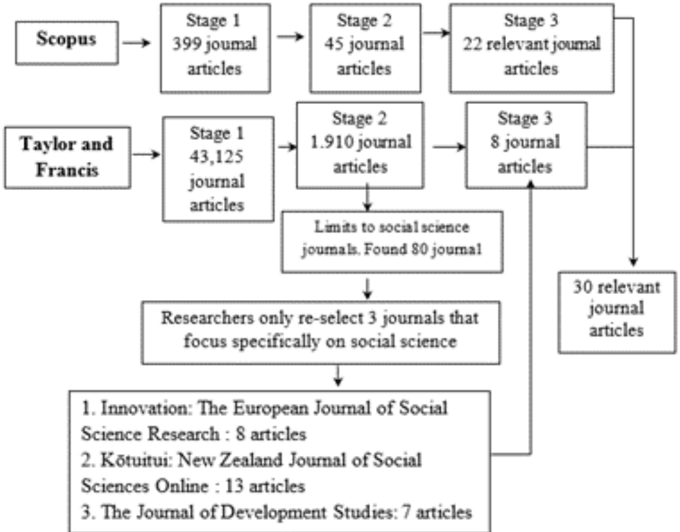
- The paper reports 30 relevant journal articles overall: Scopus yielded 22 relevant articles after stages (399 → 45 → 22), and Taylor & Francis yielded 8 relevant articles after limiting to social sciences (from 43,125 initial results).
- Collaborative governance in public services is most widely applied in the health sector; Table 1 reports 15 for health, 8 for administrative services, 3 for transportation, 2 for education, and 1 for goods, with a telecommunication sector row also listed.
- The most commonly used method is qualitative research with a case study approach; Table 2 reports 7 qualitative literature review articles, 3 mixed-method articles, 1 qualitative ethnographic article, and 1 quantitative experimental article, while a quantitative survey model is described without a clear result count in the provided text.
- The paper recommends further research on public-service goods provision and greater use of quantitative survey and experimental methods.
Methods
- Qualitative research method using a Systematic Mapping Study approach, drawing on international journal articles from Scopus and Taylor and Francis Group, with the keywords “collaborative governance” and “public services” and a 2015–2019 time limit.
- Screening/elimination criteria included removing articles not in English or a UN-approved language, without a clear research method, whose abstracts did not discuss collaborative governance or public services, that only reviewed books, that were not in the social sciences, or that were not open access.
- Analysis was organized around two research questions: which public-service sectors have implemented collaborative governance, and what research methods were used in the 2015–2019 articles.
Limitations
- Not stated in the paper: the article has no explicit limitations section.
- Evident from the text: the search is restricted to Scopus and Taylor and Francis Group, 2015–2019, English/UN-approved languages, open access, and social sciences, which may exclude other relevant literature.
- Evident from the text: the reported search counts are inconsistent in places (e.g., Taylor & Francis 43,125 → 3 social science journals → 8 articles; a mention of 28 articles; a total of 30; Scopus 399 → 45 → 22), and some table counts are unclear for the qualitative case study, telecommunication, and quantitative survey rows.
Model-written summary. Check it against the paper before relying on it.
Integrity signals
Registry
Cites
Statistics
Figures
Verification
Claims the paper makes
0 Valid · 0 Not valid · 0 Not checked · 12 Own results and interpretations
A result the paper reports from its own data — it cites no other source for it, so there is none to check. The quote shows it is in the paper.
In the paper
“Based on a search through the database that the researchers had conducted in three stages, the researchers found that there were at least 30 relevant journal articles in this study.”
- Also stated in: § RESULTS AND DISCUSSION · plain
“Thus, the total journal articles that match the keywords according to the two databases, namely collaborative governance and public services, are 30 journal articles.”
- Also stated in: § 2019©JIS-ISSN: 2548-4893. All rights reserved · plain
“Based on the analysis of RQ 1 in Table 1, it can be concluded that at least 30 research results regarding collaborative governance and public services are relevant in this study.”
§ Collaborative Governance In Public Service In Indonesia: A Systematic Mapping Study > RESULTS AND DISCUSSION
plain- Asserted: passes — The authors put it forward as true.
- Checkable: passes — It can be checked against evidence.
- Load-bearing: passes — The paper’s conclusions depend on it.
- Based: passes — The paper gives a reason why it holds.
- Also stated in: § RESULTS AND DISCUSSION · plain
A result the paper reports from its own data — it cites no other source for it, so there is none to check. The quote shows it is in the paper.
In the paper
“In addition, the method most commonly used is qualitative research methods with a case study approach.”
- Also stated in: § Source : data processed by researchers · plain
“Based on the analysis results for RQ 2 in Table 2, previous research used more qualitative research methods with a case study approach model.”
- Also stated in: § Source : data processed by researchers · hedged
“Therefore, in RQ 2 it can be concluded temporarily that in the 2015-2019 period, previous research on collaborative governance and public services used more qualitative research methods with a case study approach model.”
§ Collaborative Governance In Public Service In Indonesia: A Systematic Mapping Study > Abstract
plain- Asserted: passes — The authors put it forward as true.
- Checkable: passes — It can be checked against evidence.
- Load-bearing: passes — The paper’s conclusions depend on it.
- Based: passes — The paper gives a reason why it holds.
- Also stated in: § Source : data processed by researchers · plain
A result the paper reports from its own data — it cites no other source for it, so there is none to check. The quote shows it is in the paper.
In the paper
“The research concludes that collaborative governance is most widely applied in public services, especially in the health sector.”
- Also stated in: § 2019©JIS-ISSN: 2548-4893. All rights reserved · plain
“Then, in the 2015-2019 timeframe, collaborative governance in public services is widely applied in the health sector, which is the focus of public services.”
- Also stated in: § 2019©JIS-ISSN: 2548-4893. All rights reserved · plain
“The health sector has become a topic that has been widely reviewed and presented in several previous studies.”
§ Collaborative Governance In Public Service In Indonesia: A Systematic Mapping Study > Abstract
plainstates an association- Asserted: passes — The authors put it forward as true.
- Checkable: passes — It can be checked against evidence.
- Load-bearing: passes — The paper’s conclusions depend on it.
- Based: passes — The paper gives a reason why it holds.
- Also stated in: § 2019©JIS-ISSN: 2548-4893. All rights reserved · plain
A result the paper reports from its own data — it cites no other source for it, so there is none to check. The quote shows it is in the paper.
In the paper
“Meanwhile, the results found from the Scopus database were only 399 articles.”
- Also stated in: § CONCLUSION · plain
“In this first phase, the researchers found 399 journal articles.”
§ Collaborative Governance In Public Service In Indonesia: A Systematic Mapping Study > RESULTS AND DISCUSSION
plain- Asserted: passes — The authors put it forward as true.
- Checkable: passes — It can be checked against evidence.
- Load-bearing: unclear — It is unclear whether the paper’s conclusions depend on it.
- Based: passes — The paper gives a reason why it holds.
- Also stated in: § CONCLUSION · plain
A conclusion the paper draws from its own results — it cites no other source for it, so there is none to check. The quote shows it is in the paper.
In the paper
“Furthermore, fewer results were found in the Scopus database and were more relevant in compiling this study.Therefore, the researchers found indications that the Scopus database has a higher relevance compared to the Taylor and Francis Group.”
§ Collaborative Governance In Public Service In Indonesia: A Systematic Mapping Study > RESULTS AND DISCUSSION
hedged- Asserted: passes — The authors put it forward as true.
- Checkable: passes — It can be checked against evidence.
- Load-bearing: unclear — It is unclear whether the paper’s conclusions depend on it.
- Based: passes — The paper gives a reason why it holds.
- Probably not a substantial claim. 5
- It may state two separate claims as one. 2
Self-check
Percentages, sums and reported differences re-computed from the paper’s own numbers.
Each contradiction between two passages listed here was confirmed by an independent check.
Rated minor: it would not touch a result — a value no result rests on, a p-value that stays on the same side of the significance level, or a conflict that is clerical, resolved elsewhere in the paper, or outside its own findings.
In the paper
§ Collaborative Governance In Public Service In Indonesia: A Systematic Mapping Study > Source : data processed by researchers
“Several studies using qualitative research methods with case studies are Supromin & Choonhakhlai (2019); Tefera, Bijman, & Slingerland (2019); Thiarai, Chotvijit, & Jarvis (2019); Ward et al. (2018); Webster & Cheyne (2017).”
§ Collaborative Governance In Public Service In Indonesia: A Systematic Mapping Study > References
“Supromin, C., & Choonhakhlai, S. (2017). The provision of public services in municipalities in Thailand to improve the quality of life of elderly people.”
Citations
Cites
A conceptual model of service quality and its implications for future research
Parasuraman, A., Zeithaml, V. A., & Berry, L. L. (1985) · Journal of Marketing · doi:10.1177/002224298504900403 · Cited by 21,645
An Integrative Framework for Collaborative Governance
Emerson, K., Nabatchi, T., & Balogh, S. (2012) · Journal of Public Administration Research and Theory · doi:10.1093/jopart/mur011 · Cited by 3,637
Collaborative Platforms as a Governance Strategy
Ansell, C., & Gash, A. (2018) · Journal of Public Administration Research and Theory · doi:10.1093/jopart/mux030 · Cited by 604
Public Participation and Collaborative Governance
NEWMAN, J., BARNES, M., SULLIVAN, H., & KNOPS, A. (2004) · Journal of Social Policy · doi:10.1017/s0047279403007499 · Cited by 512
Galli, A., Iha, K., Moreno Pires, S., Mancini, M. S., Alves, A., Zokai, G., Lin, D., Murthy, A., & Wackernagel, M. (2020) · Cities · doi:10.1016/j.cities.2019.102442 · Cited by 249
Emerson, K. (2018) · BMJ Global Health · doi:10.1136/bmjgh-2017-000381 · Cited by 138
Ward, C. L., Shaw, D., Sprumont, D., Sankoh, O. A., Tanner, M., & Elger, B. S. (2018) · Globalization and Health · doi:10.1186/s12992-017-0319-4 · Cited by 134
Urban sharing in smart cities: the cases of Berlin and London
Zvolska, L., Lehner, M., Palgan, Y. V., Mont, O., & Plepys, A. (2018) · Local Environment · doi:10.1080/13549839.2018.1463978 · Cited by 117
Antibiotic resistance in Vietnam: moving towards a One Health surveillance system
Bordier, M., Binot, A., Pauchard, Q., Nguyen, T. D., Trung, T. N., Fortané, N., & Goutard, F. L. (2018) · BMC Public Health · doi:10.1186/s12889-018-6022-4 · Cited by 81
Access to What? Legal Agency and Access to Justice for Indigenous Peoples in Latin America
Brinks, D. M. (2018) · The Journal of Development Studies · doi:10.1080/00220388.2018.1451632 · Cited by 68
Research works printed but not linked: 4
- Ombudsman. (2016). Laporan Tahunan 2016 Ombudsman Republik Indonesia (pp. 18-19). Jakarta: Ombudsman Republik Indonesia.
- Ombudsman. (2017). Laporan Tahunan 2017 Ombudsman Republik Indonesia (pp. 14-15). Jakarta: Ombudsman Republik Indonesia. 2019©JIS-ISSN: 2548-4893. All rights reserved Jurnal Ilmu Sosial Volume 18 | Issue 2 | December 2019 | Page 144-163
- Ombudsman. (2018). Laporan Tahunan 2018 Ombudsman Republik Indonesia (pp. 1-39). Jakarta: Ombudsman Republik Indonesia.
- Sranko, G. R. (2011). Collaborative governance and a strategic approach to facilitating change: lessons learned from forest agreements in South East Queensland and the Great Bear Rainforest. Interface: a journal for and about social movements, 3(1): 210-239, [Online
Cited by
Malkab, H., & Syurkati, K. K. (2025) · Jurnal Hukum Administrasi Publik dan Negara · doi:10.62383/hukum.v2i4.653 · Cited by 9
Tiwari, R., Babb, C., Tye, M., & Hussein, F. (2024) · Sustainability · doi:10.3390/su16020503 · Cited by 8
Santoso, B., Widodo, S. P., Bramuda, M. Y., & Wardiyanto, B. (2026) · Jurnal Sosiologi Dialektika Sosial · doi:10.29103/jsds.v12i1.25792 · Cited by 3
Collaborative Governance Based on Local Wisdom for Social Conflict Prevention
Lolonlun, E., Putra, R., & Mustain, A. (2026) · SainETIn Jurnal Sains Energi Teknologi dan Industri · doi:10.31849/joels.34888 · Cited by 2
Collaborative Governance to Boost the Business of Village-Owned Enterprises in Sleman, IndonesiaPreprint
Wibawa, S., Sulistiyani, A. T., & Husna, H. H. (2024) · SSRN Electronic Journal · doi:10.2139/ssrn.5062520 · Cited by 1
Metadata
- Authors
- Tando, C. E., Sudarmo, S., & Haryanti, R. H.
- Affiliations
- Universitas Sebelas Maret (ID)
- Venue
- JURNAL ILMU SOSIAL
- Published
- 2020-01-25
- Volume
- 18
- Issue
- 2
- Pages
- 144-163
- ISSN
- 1411-8254 (ISSN-L)
- 2548-4893
- OpenAlex
- W3121951836
- Cited by
- 15
- References
- 38
- Citations by year
- 2026: 9 · 2025: 4 · 2024: 2
- FWCI
- 0.00
- Type
- journal article
- Language
- en
- Open access
- gold
- doi.org
- Licence
- Locations
- JURNAL ILMU SOSIAL (publishedVersion, cc-by-nc-sa)
- DOAJ (DOAJ: Directory of Open Access Journals) (submittedVersion)
- Funders
- Universitas Sebelas Maret
- Topics
- Social Sciences › Public Administration › Public Policy and Administration Research
- Social Sciences › Political Science and International Relations › Public Administration in Developing Nations
- Social Sciences › Political Science and International Relations › Public Policy and Governance
- Keywords
- collaborative governance, public services, public administration, health sector, Indonesia, research trends, case study method
About these checks
Registry, retraction, Cites and statistics results are computed, not judged, with one exception: a printed reference that no index lists is read once by a model before it counts as a citation error. Claims are extracted by a model and kept only when their quote appears verbatim in the text; each cited source is then checked, with a model’s help, for whether it says what the claim relies on. Those verdicts can be wrong — read the claim’s quote and the cited source before relying on one.
A language model drew the claims from the paper on 2026-11-24, under version 3 of the claim definition (model deepseek-v4.1-flash, prompt extract-v3).
A second model labelled each claim on 2026-11-24 (model jev-1.13-20260917, definition revision gold-guideline-v0.2).
Statistics and arithmetic are recomputed, not judged.
Confidence bands are shown only for fields calibrated on our annotated test set. None is calibrated yet, so no band is shown.
What counts as a claim ›How we measure confidence ›How we check this ›
Are you an author, or do you see a problem with this page? Request a review
Data sources
Bibliographic data: Semantic Scholar, OpenAlex, Crossref.
Contains information from the Semantic Scholar Academic Graph Datasets, made available under the ODC Attribution License (ODC-BY 1.0).
Semantic Scholar’s data is described in: Kinney, R., et al. (2023). The Semantic Scholar Open Data Platform. arXiv:2301.10140.
