

In-Hospital and Long-Term Outcomes of Beta-Blocker Treatment in Cocaine Users: A Systematic Review and Meta-analysis
Open accessThe DOI matches its Crossref record; 42 of the 42 references it cites were found in a registry or an index.
Abstract
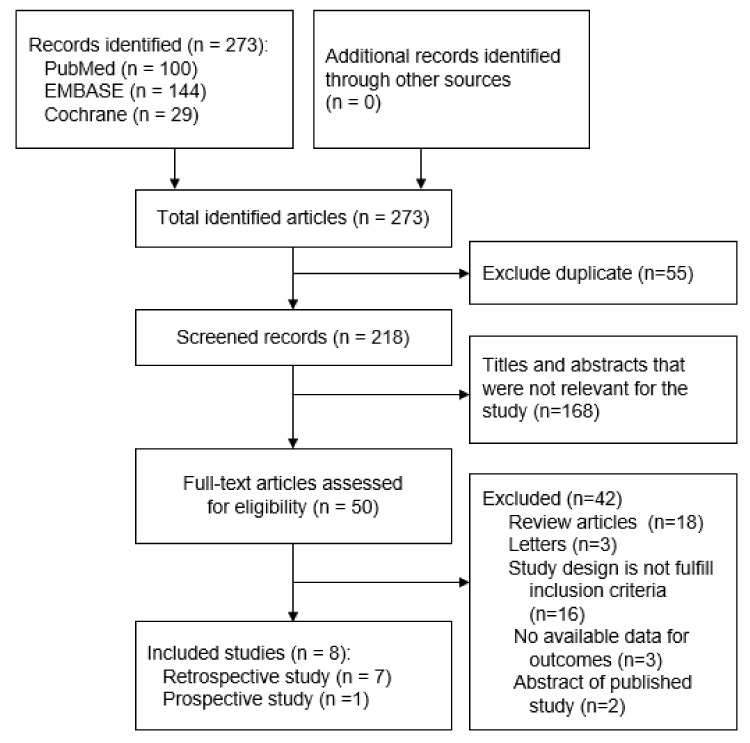
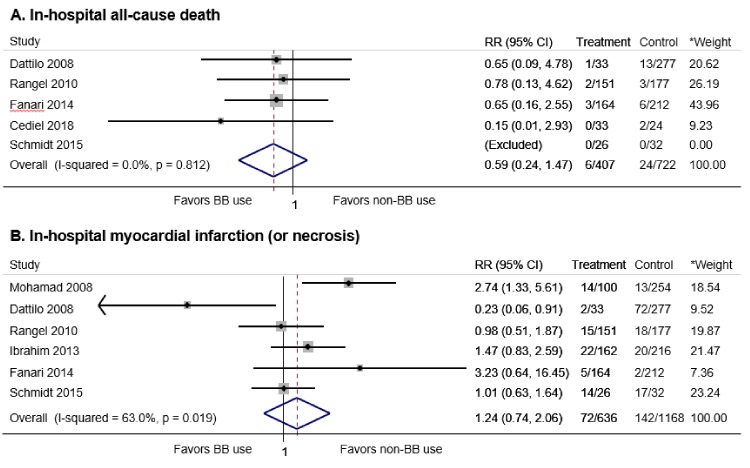
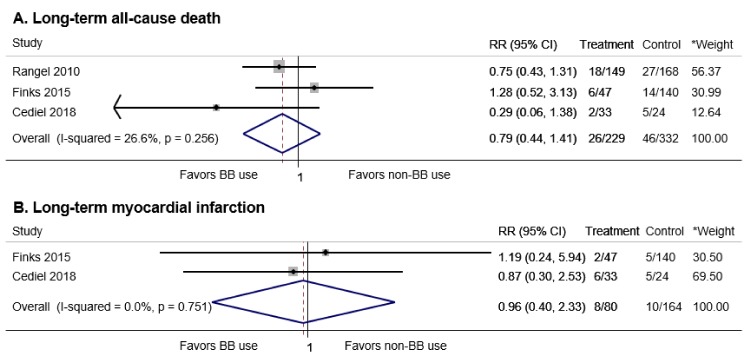
BACKGROUND: Although β-blocker treatment is generally contraindicated in patients presenting with acute cocaine intoxication due to concern for unopposed α-receptor stimulation, some studies have reported that β-blocker treatment did not increase adverse events in these patients. As this treatment is still controversial, we performed a meta-analysis of observational studies on this topic. METHODS: By searching three electronic databases (MEDLINE, EMBASE, and the Cochrane Library) from their inception to June 11, 2018, we identified eight observational studies with 2,048 patients who presented to hospital with cocaine-associated chest pain or after recent cocaine use. Outcomes of interest were myocardial necrosis or infarction (MI) and death during hospital stay or follow-up. Pooled relative risks (RRs) with 95% confidence intervals (CIs) were calculated by using a random-effects meta-analysis based on the DerSimonian-Laird method. RESULTS: Among patients presenting with cocaine-associated chest pain or recent cocaine use, there was no significant difference in in-hospital all-cause mortality (RR, 0.59; 95% CI, 0.24 - 1.47) and MI (RR, 1.24; 95% CI, 0.74 - 2.06) between patients who did and did not receive β-blocker treatment during their hospital stay. During long-term follow-up (mean 2.6 years), there was no significant difference in all-cause mortality (RR, 0.79; 95% CI, 0.44 - 1.41) and MI (RR, 0.96; 95% CI, 0.40 - 2.33) between the two groups. CONCLUSIONS: These results suggest that β-blocker treatment in patients presenting with cocaine intoxication may not be as harmful as originally believed. Further clinical studies are needed to investigate this topic.
Overview
The claims and statistics of this paper haven’t been checked yet.
Free: it reads the open-access text and checks the first 5 claims that cite a source we can check. Create a free account to check every claim.
Integrity signals
Registry
Cites
Statistics
Figures
Verification
Claims the paper makes
The claims and statistics of this paper haven’t been checked yet.
Free: it reads the open-access text and checks the first 5 claims that cite a source we can check. Create a free account to check every claim.
Claims other papers make about this one
Each is checked against this paper’s own text: does it say what the citing paper says it does?
The check wasn’t confident either way, so it gives no verdict — never disputed.
In the citing paper
“current recommendations from the American Academy of Pediatrics (AAP) that urine drug testing only be used in conjunction with a careful, confidential history and physical examination 188”
From The ASAM/AAAP Clinical Practice Guideline on the Management of Stimulant Use Disorder (2024) · cites this paper as [188]
Experimental — accuracy not yet measured
Self-check
Percentages, sums and reported differences re-computed from the paper’s own numbers.
The self-check needs the paper’s full text.
Citations
Cites
Measuring inconsistency in meta-analyses
Higgins, J. P. T., Thompson, S. G., Deeks, J. J., & Altman, D. G. (2003) · BMJ · doi:10.1136/bmj.327.7414.557 · Cited by 63,139
Bias in meta-analysis detected by a simple, graphical test
Egger, M., Smith, G. D., Schneider, M., & Minder, C. (1997) · BMJ · doi:10.1136/bmj.315.7109.629 · Cited by 56,722
Meta-analysis in clinical trials
DerSimonian, R., & Laird, N. (1986) · Controlled Clinical Trials · doi:10.1016/0197-2456(86)90046-2 · Cited by 39,552 · cited 1×
“A random-effects meta-analysis based on the DerSimonian-Laird method [20] was used due to functional inequality and difference in true effect sizes among the studies.”
Method(2014) · Medical Entomology and Zoology · Cited by 17,633
2014 AHA/ACC Guideline for the Management of Patients With Non–ST-Elevation Acute Coronary Syndromes
Amsterdam, E. A., Wenger, N. K., Brindis, R. G., Casey, D. E., Ganiats, T. G., Holmes, D. R., Jaffe, A. S., Jneid, H., Kelly, R. F., Kontos, M. C., et al. (2014) · Journal of the American College of Cardiology · doi:10.1016/j.jacc.2014.09.017 · Cited by 3,595
2017 ACC/AHA/HFSA Focused Update of the 2013 ACCF/AHA Guideline for the Management of Heart Failure
Yancy, C. W., Jessup, M., Bozkurt, B., Butler, J., Casey, D. E., Colvin, M. M., Drazner, M. H., Filippatos, G. S., Fonarow, G. C., Givertz, M. M., et al. (2017) · Journal of the American College of Cardiology · doi:10.1016/j.jacc.2017.04.025 · Cited by 3,418
Yancy, C. W., Jessup, M., Bozkurt, B., Butler, J., Casey, D. E., Colvin, M. M., Drazner, M. H., Filippatos, G. S., Fonarow, G. C., Givertz, M. M., et al. (2017) · Circulation · doi:10.1161/cir.0000000000000509 · Cited by 3,109
Anderson, J. L., Adams, C. D., Antman, E. M., Bridges, C. R., Califf, R. M., Casey, D. E., Chavey, W. E., Fesmire, F. M., Hochman, J. S., Levin, T. N., et al. (2013) · Journal of the American College of Cardiology · doi:10.1016/j.jacc.2013.01.014 · Cited by 960
Cocaine-Induced Coronary-Artery Vasoconstriction
Lange, R. A., Cigarroa, R. G., Yancy, C. W., Willard, J. E., Popma, J. J., Sills, M. N., McBride, W., Kim, A. S., & Hillis, L. D. (1989) · New England Journal of Medicine · doi:10.1056/nejm198912073212301 · Cited by 619
McCord, J., Jneid, H., Hollander, J. E., de Lemos, J. A., Cercek, B., Hsue, P., Gibler, W. B., Ohman, E. M., Drew, B., Philippides, G., et al. (2008) · Circulation · doi:10.1161/circulationaha.107.188950 · Cited by 429
Potentiation of Cocaine-Induced Coronary Vasoconstriction by Beta-Adrenergic Blockade
Lange, R. A., Cigarroa, R. G., Flores, E. D., McBride, W., Kim, A. S., Wells, P. J., Bedotto, J. B., Danziger, R. S., & Hillis, L. D. (1990) · Annals of Internal Medicine · doi:10.7326/0003-4819-112-12-897 · Cited by 414
Cardiovascular Effects of Cocaine
Schwartz, B. G., Rezkalla, S., & Kloner, R. A. (2010) · Circulation · doi:10.1161/circulationaha.110.940569 · Cited by 411
Cocaine-related medical problems: Consecutive series of 233 patients
Brody, S. L., Slovis, C. M., & Wrenn, K. D. (1990) · The American Journal of Medicine · doi:10.1016/0002-9343(90)90484-u · Cited by 347 · cited 1×
“More than half of these patients had cardiovascular toxicity, and 40% reported chest pain [3, 4].”
BackgroundProspective Multicenter Evaluation of Cocaine‐associated Chest Pain
Hollander, J. E., Hoffman, R. S., Gennis, P., Fairweather, P., DiSano, M. J., Schumb, D. A., Feldman, J. A., Fish, S. S., Dyer, S., Wax, P., et al. (1994) · Academic Emergency Medicine · doi:10.1111/j.1553-2712.1994.tb02639.x · Cited by 316
2007 WRITING COMMITTEE MEMBERS, Anderson, J. L., Adams, C. D., Antman, E. M., Bridges, C. R., Califf, R. M., Casey, D. E., Chavey, W. E., Fesmire, F. M., Hochman, J. S., et al. (2013) · Circulation · doi:10.1161/cir.0b013e31828478ac · Cited by 272
Effect of Cocaine on the Disposition of Noradrenaline labelled with Tritium
WHITBY, L. G., HERTTING, G., & AXELROD, J. (1960) · Nature · doi:10.1038/187604a0 · Cited by 238 · cited 2×
“First, it stimulates the sympathetic nervous system by increasing central sympathetic outflow [28] and blocking reuptake of catecholamines at the presynaptic adrenergic terminal [7, 10].”
BackgroundInfluence of labetalol on cocaine-induced coronary vasoconstriction in humans
Boehrer, J. D., Moliterno, D. J., Willard, J. E., Hillis, L. D., & Lange, R. A. (1993) · The American Journal of Medicine · doi:10.1016/0002-9343(93)90212-8 · Cited by 196 · cited 1×
“There have been two small prospective studies, but only 19 patients received intracoronary/intravenous BB in total [30, 31].”
ResultCocaine and Marijuana Use Among Young Adults With Myocardial Infarction
DeFilippis, E. M., Singh, A., Divakaran, S., Gupta, A., Collins, B. L., Biery, D., Qamar, A., Fatima, A., Ramsis, M., Pipilas, D., et al. (2018) · Journal of the American College of Cardiology · doi:10.1016/j.jacc.2018.02.047 · Cited by 176 · cited 6×
“Although β-blockers (BB) are a core component of treatment for patients with traditional ACS, they have been contraindicated in patients with signs of acute cocaine intoxication [3, 9, 10].”
BackgroundInfluentialCocaine Stimulates the Human Cardiovascular System via a Central Mechanism of Action
Vongpatanasin, W., Mansour, Y., Chavoshan, B., Arbique, D., & Victor, R. G. (1999) · Circulation · doi:10.1161/01.cir.100.5.497 · Cited by 163
Treatment of cocaine cardiovascular toxicity: a systematic review
Richards, J. R., Garber, D., Laurin, E. G., Albertson, T. E., Derlet, R. W., Amsterdam, E. A., Olson, K. R., Ramoska, E. A., & Lange, R. A. (2016) · Clinical Toxicology · doi:10.3109/15563650.2016.1142090 · Cited by 116 · cited 2×
“However, there is much debate on this theory because it is largely based on animal studies, case reports, and small retrospective studies [1, 2, 11-13].”
BackgroundDirect actions of cocaine on cardiac cellular electrical activity.
Przywara, D. A., & Dambach, G. E. (1989) · Circulation Research · doi:10.1161/01.res.65.1.185 · Cited by 108 · cited 1×
“Second, like a class I antiarrhythmic agent, cocaine can cause electrocardiographic changes and induce arrhythmia by blocking sodium and potassium channels [10, 29].”
Backgroundβ-Blockers Are Associated With Reduced Risk of Myocardial Infarction After Cocaine Use
Dattilo, P., Hailpern, S. M., Fearon, K., Sohal, D. P. S., & Nordin, C. (2007) · Annals of Emergency Medicine · doi:10.1016/j.annemergmed.2007.04.015 · Cited by 102
Feldman, J. A., Fish, S. S., Beshansky, J. R., Griffith, J. L., Woolard, R. H., & Selker, H. P. (2000) · Annals of Emergency Medicine · doi:10.1067/mem.2000.110994 · Cited by 88
Rethinking Cocaine-Associated Chest Pain and Acute Coronary Syndromes
Finkel, J. B., & Marhefka, G. D. (2011) · Mayo Clinic Proceedings · doi:10.4065/mcp.2011.0338 · Cited by 83 · cited 3×
“However, there is much debate on this theory because it is largely based on animal studies, case reports, and small retrospective studies [1, 2, 11-13].”
Backgroundβ-Blockers for Chest Pain Associated With Recent Cocaine Use
Rangel, C. (2010) · Archives of Internal Medicine · doi:10.1001/archinternmed.2010.115 · Cited by 71 · cited 12×
“Five studies [14, 16, 17, 23, 24] reported in-hospital outcomes and three studies [15, 18, 25] reported in-hospital and/or long-term outcomes.”
BackgroundMethodResultInfluentialβ-Blockers, Cocaine, and the Unopposed α-Stimulation Phenomenon
Richards, J. R., Hollander, J. E., Ramoska, E. A., Fareed, F. N., Sand, I. C., Izquierdo Gómez, M. M., & Lange, R. A. (2017) · Journal of Cardiovascular Pharmacology and Therapeutics · doi:10.1177/1074248416681644 · Cited by 61
Gupta, N., Washam, J. B., Mountantonakis, S., Li, S., Roe, M. T., de Lemos, J. A., & Arora, R. R. (2013) · The American Journal of Cardiology · doi:10.1016/j.amjcard.2013.11.023 · Cited by 46 · cited 6×
“Although β-blockers (BB) are a core component of treatment for patients with traditional ACS, they have been contraindicated in patients with signs of acute cocaine intoxication [3, 9, 10].”
BackgroundInfluentialCocaine-Induced Coronary-Artery Vasoconstriction
Gresch, E. E. (1990) · Journal of Occupational and Environmental Medicine · doi:10.1097/00043764-199004000-00006 · Cited by 37
Outcomes of beta blocker use in cocaine-associated chest pain: a meta-analysis
Pham, D., Addison, D., Kayani, W. T., Misra, A., Jneid, H. M., Resar, J. R., Lakkis, N., & Alam, M. (2018) · Emergency Medicine Journal · doi:10.1136/emermed-2017-207065 · Cited by 36 · cited 1×
“These results are generally consistent with those reported in the recent meta-analyses [26, 27], but our study is unique in that we included more studies than the prior meta-analyses and differentiated between in-hospital and long-term outcomes for the first time.”
ResultCocaine, Myocardial Infarction, and β-Blockers: Time to Rethink the Equation?
Freeman, K., & Feldman, J. A. (2007) · Annals of Emergency Medicine · doi:10.1016/j.annemergmed.2007.08.020 · Cited by 34
Fanari, Z., Kennedy, K., Lim, M. J., Laddu, A. A., & Stolker, J. M. (2014) · The American Journal of Cardiology · doi:10.1016/j.amjcard.2014.03.010 · Cited by 31 · cited 9×
“Five studies [14, 16, 17, 23, 24] reported in-hospital outcomes and three studies [15, 18, 25] reported in-hospital and/or long-term outcomes.”
BackgroundMethodResultInfluentialSafety of β-blockers in the acute management of cocaine-associated chest pain
Ibrahim, M., Maselli, D. J., Hasan, R., & Hamilton, A. (2012) · The American Journal of Emergency Medicine · doi:10.1016/j.ajem.2012.09.027 · Cited by 31
Lo, K. B., Virk, H. U. H., Lakhter, V., Ram, P., Gongora, C. A., Pressman, G. S., & Figueredo, V. M. (2018) · The American Journal of Medicine · doi:10.1016/j.amjmed.2018.11.041 · Cited by 22 · cited 1×
“These results are generally consistent with those reported in the recent meta-analyses [26, 27], but our study is unique in that we included more studies than the prior meta-analyses and differentiated between in-hospital and long-term outcomes for the first time.”
ResultCocaine-Induced Chest Pain and β-Blockade: An Inner City Experience
Mohamad, T. N., Kondur, A., Vaitkevicius, P. V., Bachour, K., Thatai, D., & Afonso, L. (2008) · American Journal of Therapeutics · doi:10.1097/mjt.0b013e3181758cfc · Cited by 20 · cited 6×
“Five studies [14, 16, 17, 23, 24] reported in-hospital outcomes and three studies [15, 18, 25] reported in-hospital and/or long-term outcomes.”
BackgroundResultInfluentialCediel, G., Carrillo, X., García‐García, C., Rueda, F., Oliveras, T., Labata, C., Serra, J., Ferrer, M., Diego, O. D., & Bayés‐Genís, A. (2018) · International Journal of Cardiology · doi:10.1016/j.ijcard.2018.02.013 · Cited by 13 · cited 8×
“Five studies [14, 16, 17, 23, 24] reported in-hospital outcomes and three studies [15, 18, 25] reported in-hospital and/or long-term outcomes.”
BackgroundResultInfluentialFeldman, J. A., Fish, S. S., Beshansky, J. R., GRIFFITH, J., Woolard, R. H., & Selker, H. P. (2000) · Annals of Emergency Medicine · doi:10.1016/s0196-0644(00)03771-9 · Cited by 13
Cocaine-related medical problems: Consecutive series of 233 patients
Knight, N. B. (1991) · Journal of Emergency Medicine · doi:10.1016/0736-4679(91)90552-q · Cited by 12
Egbuche, O., Ekechukwu, I., Effoe, V. S., Maduabum, N., Millard, H. R., Axiyan, M., Cross, J. A., Adedinsewo, D. A., & Onwuanyi, A. (2018) · Journal of Cardiovascular Pharmacology and Therapeutics · doi:10.1177/1074248418778550 · Cited by 12 · cited 1×
“Among patients with HFrEF and concurrent cocaine use, BB treatment was associated with a reduced 30-day heart failure-related readmission rate [35] and improvement in functional class and left ventricular ejection fraction at a 12-month follow-up without any major adverse cardiovascular event [36].”
BackgroundEarly use of beta blockers in patients with cocaine associated chest pain
Espana-Schmidt, C., Pastori, L. J., Pekler, G., Visco, F., & Mushiyev, S. (2015) · IJC Heart & Vasculature · doi:10.1016/j.ijcha.2015.06.001 · Cited by 11 · cited 6×
“Five studies [14, 16, 17, 23, 24] reported in-hospital outcomes and three studies [15, 18, 25] reported in-hospital and/or long-term outcomes.”
BackgroundResultInfluentialBeta-Blockers Are Associated With Reduced Risk of Myocardial Infarction After Cocaine Use
Fung, S. C. A., Chan, Y. C., & Lau, F. L. (2008) · Annals of Emergency Medicine · doi:10.1016/j.annemergmed.2007.10.030 · Cited by 7 · cited 7×
“Five studies [14, 16, 17, 23, 24] reported in-hospital outcomes and three studies [15, 18, 25] reported in-hospital and/or long-term outcomes.”
BackgroundResultInfluentialLopez, P. D., Akinlonu, A. A., Mene-Afejuku, T. O., Dumancas, C. Y., Saeed, M., Cativo, E. H., Visco, F., Mushiyev, S., & Pekler, G. (2018) · Clinical Cardiology · doi:10.1002/clc.22897 · Cited by 7 · cited 1×
“Among patients with HFrEF and concurrent cocaine use, BB treatment was associated with a reduced 30-day heart failure-related readmission rate [35] and improvement in functional class and left ventricular ejection fraction at a 12-month follow-up without any major adverse cardiovascular event [36].”
BackgroundEditor's Correspondence: COMMENTS AND OPINIONS
Gupta, A. K., Greller, H. A., & Hoffman, R. S. (2010) · Archives of Internal Medicine · doi:10.1001/archinternmed.2010.398 · Cited by 6 · cited 1×
“However, there is much debate on this theory because it is largely based on animal studies, case reports, and small retrospective studies [1, 2, 11-13].”
Cited by
Panchal, A. R., Bartos, J. A., Cabañas, J. G., Donnino, M. W., Drennan, I. R., Hirsch, K. G., Kudenchuk, P. J., Kurz, M. C., Lavonas, E. J., Morley, P. T., et al. (2020) · Circulation · doi:10.1161/cir.0000000000000916 · Cited by 2,105
Topjian, A. A., Raymond, T. T., Atkins, D., Chan, M., Duff, J. P., Joyner, B. L., Lasa, J. J., Lavonas, E. J., Levy, A., Mahgoub, M., et al. (2020) · Circulation · doi:10.1161/cir.0000000000000901 · Cited by 1,258
The ASAM/AAAP Clinical Practice Guideline on the Management of Stimulant Use Disorder
(2024) · Journal of Addiction Medicine · doi:10.1097/adm.0000000000001299 · Cited by 78
Foy, M. C., Vaishnav, J., & Sperati, C. J. (2019) · Endocrinology and Metabolism Clinics of North America · doi:10.1016/j.ecl.2019.08.013 · Cited by 46
Cediel, G., Carrillo, X., García‐García, C., Rueda, F., Oliveras, T., Labata, C., Serra, J., Ferrer, M., Diego, O. D., & Bayés‐Genís, A. (2018) · International Journal of Cardiology · doi:10.1016/j.ijcard.2018.02.013 · Cited by 13
Metadata
- Authors
- Shin, D., Lee, E. S., Bohra, C., & Kongpakpaisarn, K.
- Affiliations
- University of South Florida (US)
- Weiss Memorial Hospital (US)
- Corresponding author
- Shin, Doosup
- Venue
- Cardiology Research
- Publisher
- Elmer Press, Inc.
- Published
- 2019
- Volume
- 10
- Issue
- 1
- Pages
- 40-47
- ISSN
- 1923-2829 (ISSN-L)
- 1923-2837
- PMC
- PMC6396807
- OpenAlex
- W2915929771
- Cited by
- 9
- References
- 42
- Citations by year
- 2026: 1 · 2025: 1 · 2024: 1 · 2023: 1 · 2022: 1 · 2020: 2 · 2019: 1
- FWCI
- 0.18
- Type
- journal article
- Language
- en
- Open access
- diamond
- doi.org
- Licence
- cc-by-nc
- Locations
- Cardiology Research (publishedVersion, cc-by-nc)
- Europe PMC (PubMed Central) (publishedVersion, cc-by-nc)
- PubMed Central (publishedVersion, cc-by-nc)
- PubMed (publishedVersion)
- Topics
- Health Sciences › Medicine › Cardiology and Cardiovascular Medicine › Acute Myocardial Infarction Research
- Health Sciences › Medicine › Emergency Medicine › Poisoning and overdose treatments
- Health Sciences › Medicine › Epidemiology › Substance Abuse Treatment and Outcomes
- Keywords
- beta-blockers, cocaine intoxication, myocardial infarction, in-hospital mortality, long-term mortality, adverse drug reactions, alpha-adrenergic stimulation
About these checks
Registry, retraction, Cites and statistics results are computed, not judged, with one exception: a printed reference that no index lists is read once by a model before it counts as a citation error. Claims are extracted by a model and kept only when their quote appears verbatim in the text; each cited source is then checked, with a model’s help, for whether it says what the claim relies on. Those verdicts can be wrong — read the claim’s quote and the cited source before relying on one.
Statistics and arithmetic are recomputed, not judged.
Confidence bands are shown only for fields calibrated on our annotated test set. None is calibrated yet, so no band is shown.
What counts as a claim ›How we measure confidence ›How we check this ›
Are you an author, or do you see a problem with this page? Request a review
Data sources
Bibliographic data: Semantic Scholar, OpenAlex, Crossref.
Contains information from the Semantic Scholar Academic Graph Datasets, made available under the ODC Attribution License (ODC-BY 1.0).
Semantic Scholar’s data is described in: Kinney, R., et al. (2023). The Semantic Scholar Open Data Platform. arXiv:2301.10140.
