

The DOI matches its Crossref record; 202 of the 206 references it cites were found in a registry or an index.
Epidemiology of Pancreatic Cancer: Global Trends, Etiology and Risk Factors
Open accessAbstract
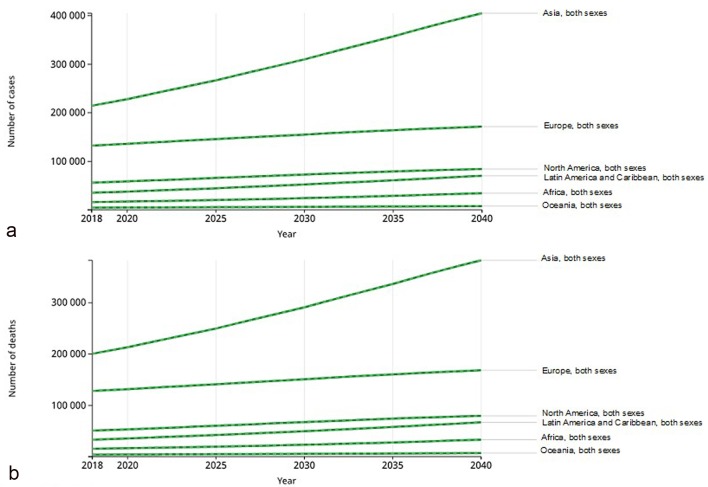
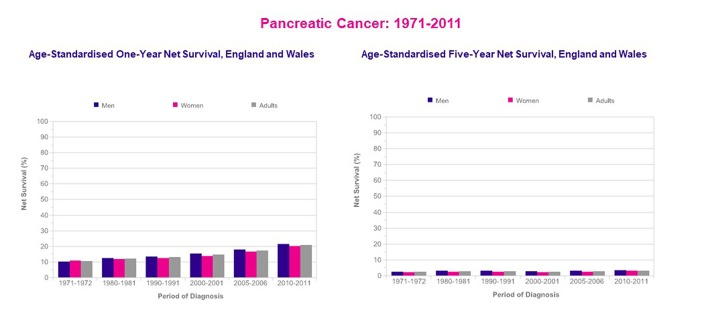
Pancreatic cancer is the seventh leading cause of cancer-related deaths worldwide. However, its toll is higher in more developed countries. Reasons for vast differences in mortality rates of pancreatic cancer are not completely clear yet, but it may be due to lack of appropriate diagnosis, treatment and cataloging of cancer cases. Because patients seldom exhibit symptoms until an advanced stage of the disease, pancreatic cancer remains one of the most lethal malignant neoplasms that caused 432,242 new deaths in 2018 (GLOBOCAN 2018 estimates). Globally, 458,918 new cases of pancreatic cancer have been reported in 2018, and 355,317 new cases are estimated to occur until 2040. Despite advancements in the detection and management of pancreatic cancer, the 5-year survival rate still stands at 9% only. To date, the causes of pancreatic carcinoma are still insufficiently known, although certain risk factors have been identified, such as tobacco smoking, diabetes mellitus, obesity, dietary factors, alcohol abuse, age, ethnicity, family history and genetic factors, Helicobacter pylori infection , non-O blood group and chronic pancreatitis. In general population, screening of large groups is not considered useful to detect the disease at its early stage, although newer techniques and the screening of tightly targeted groups (especially of those with family history), are being evaluated. Primary prevention is considered of utmost importance. Up-to-date statistics on pancreatic cancer occurrence and outcome along with a better understanding of the etiology and identifying the causative risk factors are essential for the primary prevention of this disease. World J Oncol. 2019;10(1):10-27 doi: https://doi.org/10.14740/wjon1166
Overview
The claims and statistics of this paper haven’t been checked yet.
Run the check — free, no account needed. It reads the open-access text and checks the sources it cites.
Integrity signals
Registry
Cites
Statistics
Figures
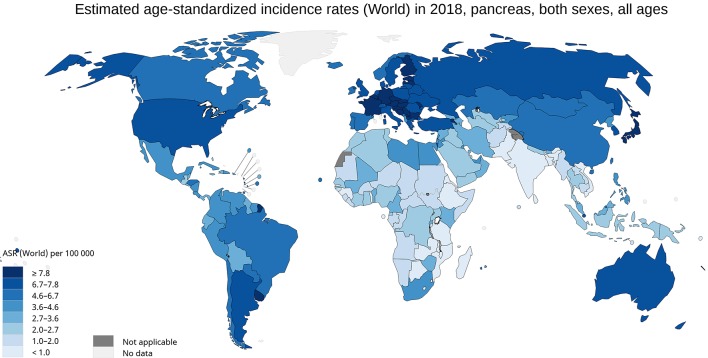
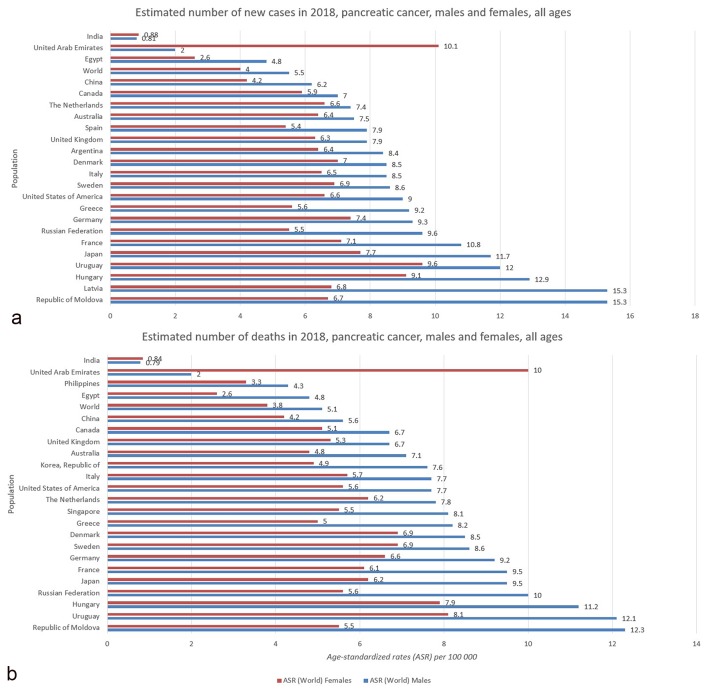
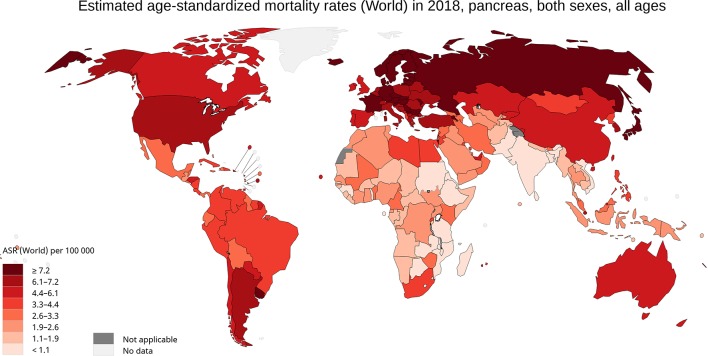
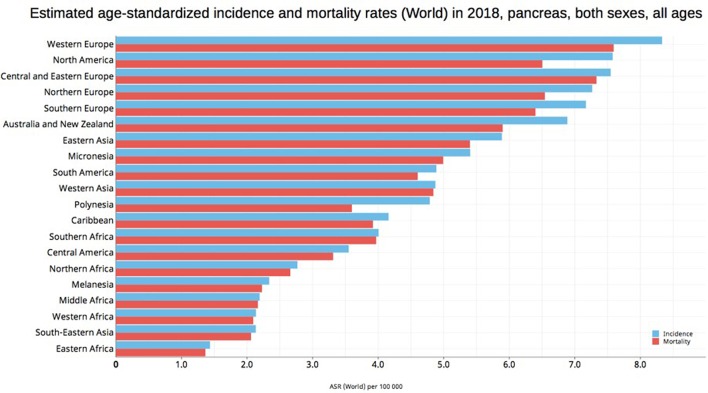
Verification
Claims the paper makes
The claims and statistics of this paper haven’t been checked yet.
Run the check — free, no account needed. It reads the open-access text and checks the sources it cites.
Claims other papers make about this one
Each is checked against this paper’s own text: does it say what the citing paper says it does?
The source backs part of the claim, not all of it — or backs it for a different population, condition or comparison.
In the citing paper
“The two major PC subtypes are pancreatic ductal adenocarcinoma (PDAC) and pancreatic neuroendocrine tumours (PNETs), with PDAC being the more aggressive subtype and accounting for 90% of all PC cases [2, 3].”
From Pyrvinium Pamoate Alone and With Gemcitabine Exhibits Anti‐Pancreatic Cancer Activity in 2D and 3D Cell Culture Models (2024) · cites this paper as [2]
Experimental — accuracy not yet measured
Self-check
Percentages, sums and reported differences re-computed from the paper’s own numbers.
The self-check needs the paper’s full text.
Citations
Cites
Bray, F., Ferlay, J., Soerjomataram, I., Siegel, R. L., Torre, L. A., & Jemal, A. (2018) · CA: A Cancer Journal for Clinicians · doi:10.3322/caac.21492 · Cited by 84,109
Global Cancer Statistics, 2002
Parkin, D. M., Bray, F., Ferlay, J., & Pisani, P. (2005) · CA A Cancer Journal for Clinicians · doi:10.3322/canjclin.55.2.74 · Cited by 18,710
Siegel, R. L., Miller, K. D., & Jemal, A. (2018) · CA A Cancer Journal for Clinicians · doi:10.3322/caac.21442 · Cited by 16,632
Overweight, obesity, and mortality from cancer in a prospectively studied cohort of U.S. Adults
Calle, E. E., Rodriguez, C., Walker-Thurmond, K., & Thun, M. J. (2003) · New England Journal of Medicine · doi:10.1056/nejmoa021423 · Cited by 7,696
Spencer, P. M., Cameron, J. L., & Lin, L. (2000) · Cited by 7,202
Cancer incidence and mortality patterns in Europe: Estimates for 40 countries in 2012
Ferlay, J., Steliarova‐Foucher, E., Lortet‐Tieulent, J., Rosso, S., Coebergh, J. W. W., Comber, H., Forman, D., & Bray, F. (2013) · European Journal of Cancer · doi:10.1016/j.ejca.2012.12.027 · Cited by 5,243
Parkin, D. M., Pisani, P., & Ferlay, J. (1999) · CA A Cancer Journal for Clinicians · doi:10.3322/canjclin.49.1.33 · Cited by 3,398
Vincent, A., Herman, J. M., Schulick, R., Hruban, R. H., & Goggins, M. (2011) · The Lancet · doi:10.1016/s0140-6736(10)62307-0 · Cited by 2,678
Cancer is a preventable disease that requires major lifestyle changes
Anand, P., Kunnumakara, A. B., Sundaram, C., Harikumar, K. B., Tharakan, S. T., Lai, O. S., Sung, B., & Aggarwal, B. B. (2008) · Pharmaceutical Research · doi:10.1007/s11095-008-9661-9 · Cited by 2,632
Hidalgo, M. (2010) · New England Journal of Medicine · doi:10.1056/nejmra0901557 · Cited by 2,570
Cited by
Sorted by citations
Maintenance Olaparib for Germline BRCA -Mutated Metastatic Pancreatic Cancer
Golan, T., Hammel, P., Reni, M., Van Cutsem, E., Macarulla, T., Hall, M. J., Park, J.-O., Hochhauser, D., Arnold, D., Oh, D.-Y., et al. (2019) · New England Journal of Medicine · doi:10.1056/nejmoa1903387 · Cited by 2,302
Park, W., Chawla, A., & O'Reilly, E. M. (2021) · JAMA · doi:10.1001/jama.2021.13027 · Cited by 2,040
Photodynamic and Photothermal Therapies: Synergy Opportunities for Nanomedicine
Overchuk, M., Weersink, R., Wilson, B. C., & Zheng, G. (2023) · ACS Nano · doi:10.1021/acsnano.3c00891 · Cited by 1,375
PARP Inhibitors: Clinical Relevance, Mechanisms of Action and Tumor Resistance
Rose, M., Burgess, J. T., O'Byrne, K. J., Richard, D. J., & Bolderson, E. (2020) · Frontiers in Cell and Developmental Biology · doi:10.3389/fcell.2020.564601 · Cited by 775
Chemoresistance in Pancreatic Cancer
Zeng, S., Pöttler, M., Lan, B., Grützmann, R., Pilarsky, C. P., & Yang, H. (2019) · International Journal of Molecular Sciences · doi:10.3390/ijms20184504 · Cited by 613
Metadata
- Authors
- Rawla, P., Sunkara, T., & Gaduputi, V.
- Affiliations
- Sovah Health Martinsville (US)
- Mercy Medical Center (US)
- Corresponding author
- Rawla, Prashanth
- Venue
- World Journal of Oncology
- Publisher
- Elmer Press, Inc.
- Published
- 2019
- Volume
- 10
- Issue
- 1
- Pages
- 10-27
- ISSN
- 1920-4531 (ISSN-L)
- 1920-454X
- PMC
- PMC6396775
- OpenAlex
- W2917919815
- Cited by
- 2,269
- References
- 206
- Citations by year
- 2026: 147 · 2025: 246 · 2024: 320 · 2023: 372 · 2022: 435 · 2021: 415 · 2020: 271 · 2019: 63
- FWCI
- 28.47
- Type
- journal article
- Language
- en
- Open access
- diamond
- doi.org
- Licence
- cc-by-nc
- Locations
- World Journal of Oncology (publishedVersion, cc-by-nc)
- Europe PMC (PubMed Central) (publishedVersion, cc-by-nc)
- PubMed Central (publishedVersion, cc-by-nc)
- PubMed (publishedVersion)
- Topics
- Health Sciences › Medicine › Oncology › Pancreatic and Hepatic Oncology Research
- Health Sciences › Medicine › Oncology › Global Cancer Incidence and Screening
- Health Sciences › Medicine › Surgery › Pancreatitis Pathology and Treatment
- Keywords
- pancreatic cancer, epidemiology, cancer incidence, cancer mortality, risk factors, etiology, smoking, diabetes mellitus, obesity, alcohol abuse, chronic pancreatitis, Helicobacter pylori, family history (medicine), genetic susceptibility, cancer screening, primary prevention, five-year survival
About these checks
Registry, retraction, Cites and statistics results are computed, not judged, with one exception: a printed reference that no index lists is read once by a model before it counts as a citation error. Claims are extracted by a model and kept only when their quote appears verbatim in the text; each cited source is then checked, with a model’s help, for whether it says what the claim relies on. Those verdicts can be wrong — read the claim’s quote and the cited source before relying on one.
Statistics and arithmetic are recomputed, not judged.
Confidence bands are shown only for fields calibrated on our annotated test set. None is calibrated yet, so no band is shown.
What counts as a claim ›How we measure confidence ›How we check this ›
Are you an author, or do you see a problem with this page? Request a review
