

Variability as normal as apple pie
Open accessThe DOI matches its Crossref record; 22 of the 22 references it cites were found in a registry or an index; none of the 37 sources its claims cite is checked for support yet.
Abstract
In recent studies in second language (L2) development, notably within the focus of Complex Dynamic Systems Theory (CDST), non-systematic variation has been extensively studied as intra-individual variation, which we will refer to as variability. This paper argues that variability is functional and is needed for development. With examples of four longitudinal case studies we hope to show that variability over time provides valuable information about the process of development. Phases of increased variability in linguistic constructions are often a sign that the learner is trying out different constructions, and as such variability can be evidence for change, and change can be learning. Also, a limited degree of variability is inherent in automatic or controlled processes. Conversely, the absence of variability is likely to show that no learning is going on or the system is frozen.
Overview
CoChat Summary
TL;DR
The paper argues from a Complex Dynamic Systems Theory perspective that variability in second language development is functional, not noise, and often signals learning. Using four longitudinal case studies, it illustrates that increased variability accompanies change while absence of variability suggests no learning or a frozen system.
Key findings
- Variability is functional and needed for development: increased variability often shows a learner trying out different linguistic constructions, whereas absence of variability likely indicates no learning is going on or the system is frozen.
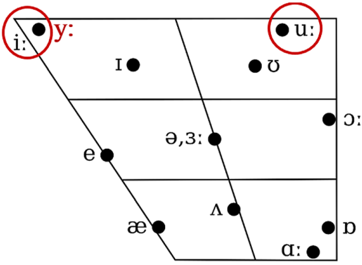
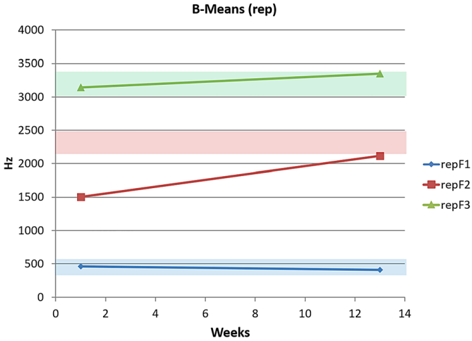
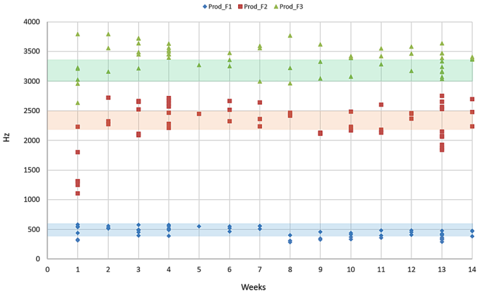
- In a five-year-old American boy learning Dutch, production of the front rounded vowel /y/ over 14 weeks showed seemingly random variation between /i/ and /u/ variants, with occasional diphthong /ui/ or /iu/, and later tended toward the target /y/; his older sister showed very little variability and hardly any change.
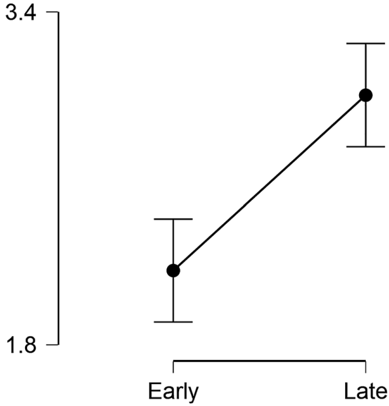
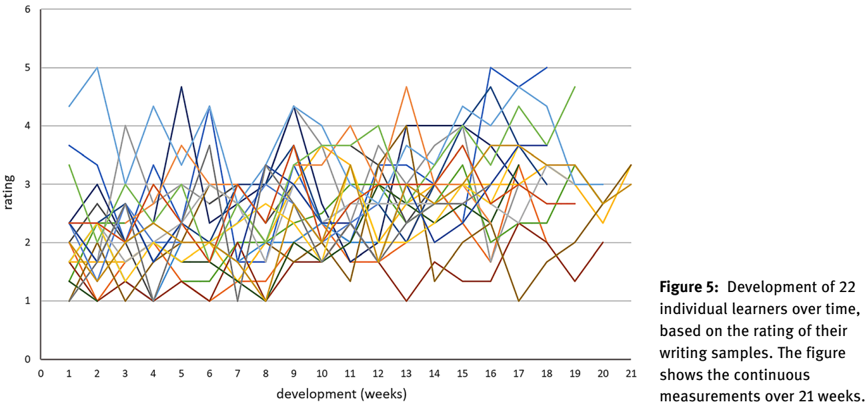
- In 22 highly similar 13-year-old Dutch learners of English, weekly writing samples over 21 weeks improved at group level (Wilcoxon signed rank = 20.50; p < 0.01; effect size = 0.84), but individual trajectories varied enormously and no individual factor reliably predicted proficiency gains.
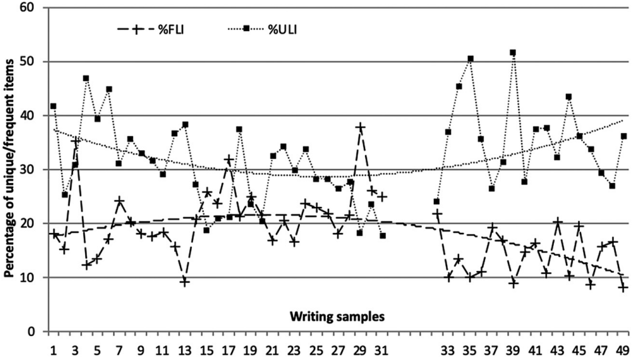
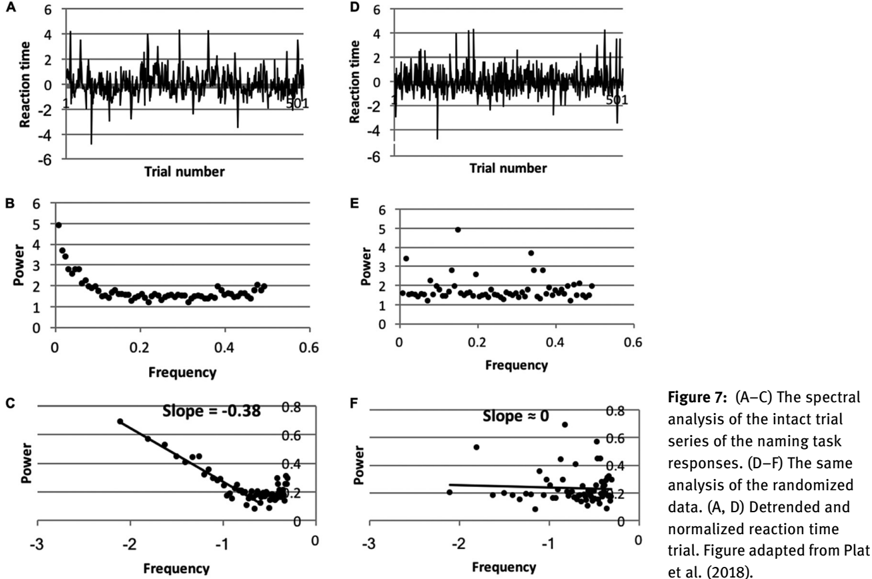
- In one advanced EFL learner followed over 13 years with a five-year gap and about 50 similar-genre texts, no linguistic variable developed linearly; significant peaks in unique lexical items occurred at data points 35 and 39 (5000 random reshuffles; peak <250 times considered significant at α 0.05), and unique lexical items differed significantly between teacher-training and university phases. In a word naming task with 520 observations in about 15 min, response times varied between about 350 and 600 ms and followed a fractal pattern (spectral slope = -1); L1 naming generally showed more fractal coordination than L2, and increased language contact raised fractal coordination in that language and lowered it in the no-contact language.
Methods
- Design: a theoretical CDST argument illustrated with four longitudinal case studies/examples rather than a single new experiment.
- Data/sample: (1) a five-year-old American boy learning Dutch, followed weekly for about a year, with focus on /y/ over 14 weeks; (2) 22 13-year-old Dutch learners of English, weekly writing samples over 21 weeks rated by three trained raters; (3) one advanced EFL learner over 13 years with a five-year gap, using about 50 similar-genre texts; (4) a word naming task with 520 observations in about 15 min.
- Main analysis: acoustic formant analysis; holistic writing ratings and Wilcoxon signed rank; complexity, accuracy, and fluency measures with random reshuffling 5000 times for peaks; spectral analysis/log-log power spectrum for fractal coordination.
Limitations
- Paper-stated: the fractal coordination line of research is still young; the observation of variability depends on the observer’s perspective, and from the language user’s perspective variability does not exist.
- Evident from the text: the evidence rests on small-N longitudinal case studies and selected examples, limiting generalizability.
- Evident from the text: some analyses are not fully reported here (e.g., the sister’s analysis is not included; detailed reports appear elsewhere), and the examples come from different studies with different timescales and measures, making the synthesis qualitative rather than systematic.
Model-written summary. Check it against the paper before relying on it.
Integrity signals
Registry
Cites
Statistics
Figures
Verification
Claims the paper makes
0 Valid · 6 Not valid · 34 Not checked · 67 Own results and interpretations
A result the paper reports from its own data — it cites no other source for it, so there is none to check. The quote shows it is in the paper.
In the paper
“Our data show that variability can provide valuable information about the process of development.”
§ Variability as normal as apple pie > 7 Conclusion
plainstates an association- Asserted: passes — The authors put it forward as true.
- Checkable: passes — It can be checked against evidence.
- Load-bearing: passes — The paper’s conclusions depend on it.
- Based: passes — The paper gives a reason why it holds.
A result the paper reports from its own data — it cites no other source for it, so there is none to check. The quote shows it is in the paper.
In the paper
“What we observed in our longitudinal data collected over a period of 14 weeks was that there was a seemingly random variation between variants of /i/ and variants of /u/, with the occasional combination of the two as a diphthong /ui/.”
§ Variability as normal as apple pie > 3 Variability in beginner L2 pronunciation
plainSingle case- Asserted: passes — The authors put it forward as true.
- Checkable: passes — It can be checked against evidence.
- Load-bearing: passes — The paper’s conclusions depend on it.
- Based: passes — The paper gives a reason why it holds.
A result the paper reports from its own data — it cites no other source for it, so there is none to check. The quote shows it is in the paper.
In the paper
“In our final example we even showed that variability in real-time language processing can help to quantify the relative degree of coordination and control of the complex dynamic system.”
§ Variability as normal as apple pie > 7 Conclusion
plainstates a possible cause- Asserted: passes — The authors put it forward as true.
- Checkable: passes — It can be checked against evidence.
- Load-bearing: passes — The paper’s conclusions depend on it.
- Based: passes — The paper gives a reason why it holds.
A result the paper reports from its own data — it cites no other source for it, so there is none to check. The quote shows it is in the paper.
In the paper
“An acoustic analysis of the mean formant values of the vowels during each session shows a clear tendency towards native speaker values.”
§ Variability as normal as apple pie > 3 Variability in beginner L2 pronunciation
boostedstates an associationSingle case- Asserted: passes — The authors put it forward as true.
- Checkable: passes — It can be checked against evidence.
- Load-bearing: passes — The paper’s conclusions depend on it.
- Based: passes — The paper gives a reason why it holds.
A result the paper reports from its own data — it cites no other source for it, so there is none to check. The quote shows it is in the paper.
In the paper
“Even though there was some dispersion (more towards the end), the group effect was clearly significant (Wilcoxon signed rank = 20.50;p < 0.01; effect size = 0.84).”
§ Variability as normal as apple pie > 3 Variability in beginner L2 pronunciation
boostedstates an association- Asserted: passes — The authors put it forward as true.
- Checkable: passes — It can be checked against evidence.
- Load-bearing: passes — The paper’s conclusions depend on it.
- Based: passes — The paper gives a reason why it holds.
40 more claims
Create a free account to see all 107 claims and to verify the 34 references still open.
- It may state two separate claims as one. 33
- Probably not a substantial claim. 36
Self-check
Percentages, sums and reported differences re-computed from the paper’s own numbers.
Each contradiction between two passages listed here was confirmed by an independent check.
Rated minor: it would not touch a result — a value no result rests on, a p-value that stays on the same side of the significance level, or a conflict that is clerical, resolved elsewhere in the paper, or outside its own findings.
In the paper
§ Variability as normal as apple pie > 5 Peaks in variability in the lexical subsystem in an advanced L2 learner
“The data shown so far contain between 14 and 50 occasions of weekly observations collected in longitudinal studies over a period of several months.”
§ Variability as normal as apple pie > 5 Peaks in variability in the lexical subsystem in an advanced L2 learner
“Penris and Verspoor (2017) who traced one learner of English as a foreign language over the course of 13 years with a five year gap.After high school he is at an estimated low B2 level when he enters a teacher training college, and when he finishes his MA thesis at a university (an international, all-English MA program in Applied Linguistics), he is at an estimated C2 level.From all the texts he wrote, about 50 were selected because they were similar in genre.”
Citations
Cites
Self-organized criticality: An explanation of the 1/f noise
Bak, P., Tang, C., & Wiesenfeld, K. (1987) · Physical Review Letters · doi:10.1103/physrevlett.59.381 · Cited by 7,591
Bak, P., Tang, C., & Wiesenfeld, K. (1988) · Physical Review A · doi:10.1103/physreva.38.364 · Cited by 4,713
The Study of Second Language Acquisition
Brown, C., & Ellis, R. (1996) · The Modern Language Journal · doi:10.2307/329065 · Cited by 4,199
Pagani, M., Lombardi, F., Guzzetti, S., Rimoldi, O., Furlan, R., Pizzinelli, P., Sandrone, G., Malfatto, G., Dell'Orto, S., & Piccaluga, E. (1986) · Circulation Research · doi:10.1161/01.res.59.2.178 · Cited by 4,130
A Dynamic Systems Approach to the Development of Cognition and Action
Thelen, E., & Smith, L. B. (1994) · doi:10.7551/mitpress/2524.001.0001 · Cited by 3,470
A dynamic systems approach to the development of cognition and action
(1996) · Computers & Mathematics with Applications · doi:10.1016/s0898-1221(96)90021-8 · Cited by 3,453
The Social Motivation of a Sound Change
Labov, W. (1963) · WORD · doi:10.1080/00437956.1963.11659799 · Cited by 2,111
A Dynamic Systems Theory approach to second language acquisition
DE BOT, K., LOWIE, W., & VERSPOOR, M. (2007) · Bilingualism: Language and Cognition · doi:10.1017/s1366728906002732 · Cited by 1,730
Self-citationFlege, J. E. (1987) · Journal of Phonetics · doi:10.1016/s0095-4470(19)30537-6 · Cited by 1,148 · cited 2×
“This is also typically what has been observed for English learners of French /y/ (see Flege 1987).”
BackgroundSelf-organization of cognitive performance.
Van Orden, G. C., Holden, J. G., & Turvey, M. T. (2003) · Journal of Experimental Psychology: General · doi:10.1037/0096-3445.132.3.331 · Cited by 718
Research works printed but not linked: 2
- Cancino, Herlinda, Ellen Rosansky & John Schumann. 1978. The acquisition of English negatives and interrogatives by native Spanish speakers. In Evelyn Hatch (ed.), Second language acquisition: A book of readings, 207-230.
- Verspoor, Marjolijn H. & Marijn van Dijk. 2013. Variability in a dynamic systems approach. In Carol A. Chapelle (ed.), The Encyclopedia of Applied Linguistics, 6051-6059. Oxford: Wiley-Blackwell.
Cited by
Measures of variability in transitional phases in second language development
Verspoor, M. H., & de Bot, K. (2021) · IRAL - International Review of Applied Linguistics in Language Teaching · doi:10.1515/iral-2021-0026 · Cited by 55
Self-citationCha, L., & Zhang, L. J. (2023) · Journal of Psycholinguistic Research · doi:10.1007/s10936-023-09950-7 · Cited by 51
The complexity epistemology and ontology in second language acquisition: A critical review
Han, Z., Kang, E. Y., & Sok, S. (2022) · Studies in Second Language Acquisition · doi:10.1017/s0272263122000420 · Cited by 44
Kruk, M., Pawlak, M., Taherian, T., Yüce, E., Shirvan, M. E., & Barabadi, E. (2023) · Studies in Second Language Learning and Teaching · doi:10.14746/ssllt.37174 · Cited by 40
Dynamic development of cohesive devices in English as a second language writing
Tabari, M. A., & Wind, A. M. (2023) · IRAL - International Review of Applied Linguistics in Language Teaching · doi:10.1515/iral-2022-0205 · Cited by 31
Metadata
- Authors
- Verspoor, M., Lowie, W., & de Bot, K.
- Affiliations
- University of Pannonia (HU)
- University of Groningen (NL)
- Corresponding author
- Verspoor, Marjolijn
- Venue
- Linguistics Vanguard
- Publisher
- Walter de Gruyter GmbH
- Published
- 2021-02-01
- Volume
- 7
- Issue
- s2
- Pages
- 20200034
- ISSN
- 2199-174X (ISSN-L)
- OpenAlex
- W3135361592
- Semantic Scholar
- bec49aab3b6b207bb8a74291bffaa58998967f9c
- Cited by
- 61
- References
- 21
- Citations by year
- 2026: 13 · 2025: 15 · 2024: 11 · 2023: 13 · 2022: 7 · 2021: 2
- FWCI
- 17.88
- Type
- journal article
- Language
- en
- Open access
- hybrid
- doi.org
- Locations
- Linguistics Vanguard (publishedVersion, cc-by)
- University of Groningen research database (University of Groningen / Centre for Information Technology) (publishedVersion, cc-by)
- University of Groningen research database (University of Groningen / Centre for Information Technology) (submittedVersion, cc-by)
- Topics
- Social Sciences › Arts and Humanities › Language and Linguistics › EFL/ESL Teaching and Learning
- Social Sciences › Psychology › Developmental and Educational Psychology › Second Language Acquisition and Learning
- Social Sciences › Psychology › Developmental and Educational Psychology › Language Development and Disorders
- Keywords
- variability, second language acquisition, within-person variability, complex dynamic systems theory, developmental changes, linguistic construction, automatic and controlled processes, longitudinal case study
About these checks
Registry, retraction, Cites and statistics results are computed, not judged, with one exception: a printed reference that no index lists is read once by a model before it counts as a citation error. Claims are extracted by a model and kept only when their quote appears verbatim in the text; each cited source is then checked, with a model’s help, for whether it says what the claim relies on. Those verdicts can be wrong — read the claim’s quote and the cited source before relying on one.
A language model drew the claims from the paper on 2026-11-24, under version 3 of the claim definition (model deepseek-v4.1-flash, prompt extract-v3).
A second model labelled each claim on 2026-11-24 (model jev-1.13-20260917, definition revision gold-guideline-v0.2).
Statistics and arithmetic are recomputed, not judged.
Confidence bands are shown only for fields calibrated on our annotated test set. None is calibrated yet, so no band is shown.
What counts as a claim ›How we measure confidence ›How we check this ›
Are you an author, or do you see a problem with this page? Request a review
How to cite
Cite CoChat for the checks on this page, and the paper for its own findings.
- This page
- CoChat. (2026). Citation check: Variability as normal as apple pie. https://app.cochat.ai/papers/10.1515/lingvan-2020-0034
- The paper
- Verspoor, M., Lowie, W., & de Bot, K. (2021). Variability as normal as apple pie. Linguistics Vanguard. https://doi.org/10.1515/lingvan-2020-0034
Data sources
Bibliographic data: Semantic Scholar, OpenAlex, Crossref.
Contains information from the Semantic Scholar Academic Graph Datasets, made available under the ODC Attribution License (ODC-BY 1.0).
Semantic Scholar’s data is described in: Kinney, R., et al. (2023). The Semantic Scholar Open Data Platform. arXiv:2301.10140.
