

Polymer modulators in silicon photonics: review and projections
Open accessThe DOI matches its Crossref record; 115 of the 116 references it cites were found in a registry or an index.
Abstract
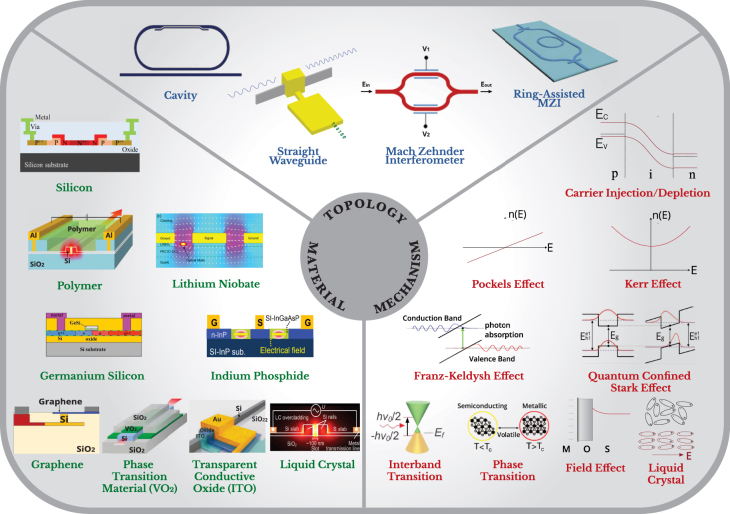
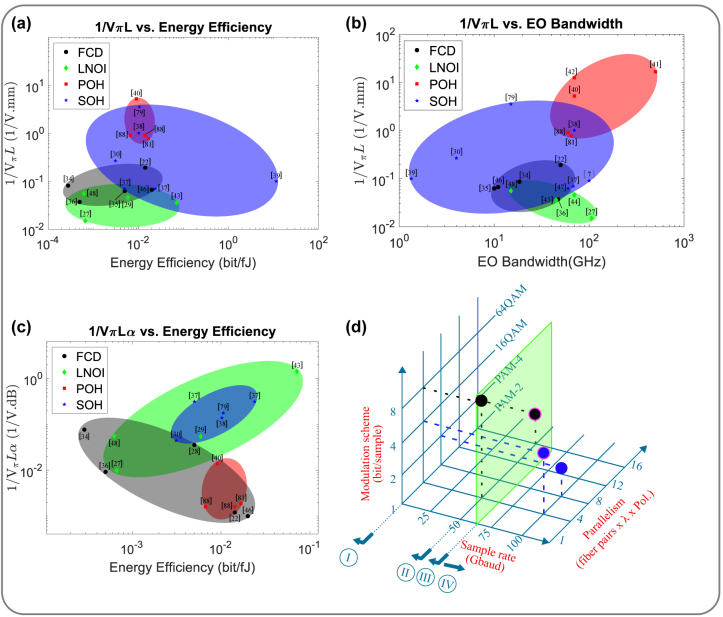
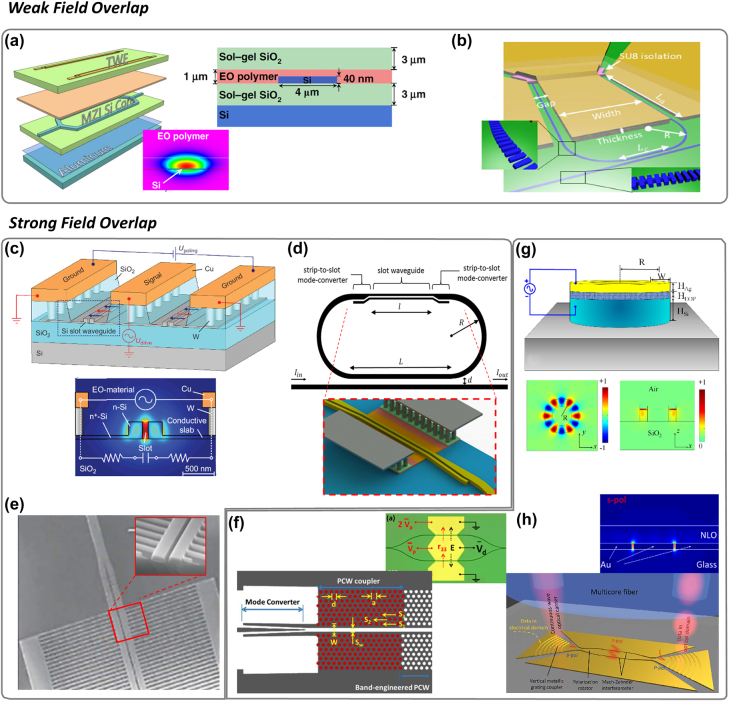
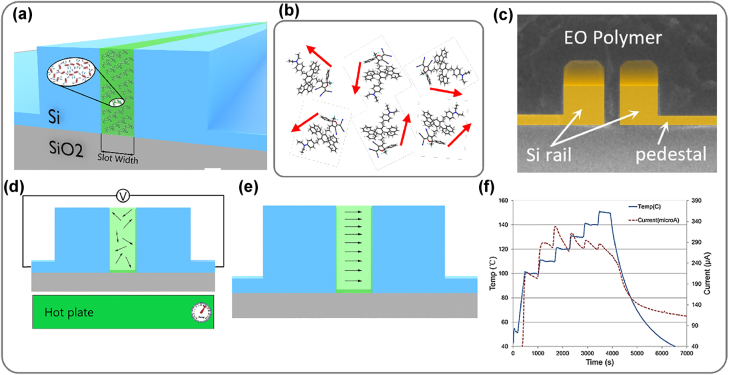
Optical modulators are vital for many applications, including telecommunication, data communication, optical computing, and microwave photonic links. A compact modulator with low voltage drive requirement, low power, high speed, and compatibility with CMOS foundry process is highly desirable. Current modulator technologies in Si suffer from trade‐offs that constrain their power, performance (speed, drive voltage), and area. The introduction of additional materials to the silicon platform for efficient phase shift promises alternatives to relax those trade‐offs. Si‐organic‐hybrid (SOH) devices demonstrate large modulation bandwidth leveraging the electro‐optic (EO) effect and smaller drive voltage or footprint owing to a strong EO coefficient. In this study, we review various SOH modulators and describe their path towards integration to silicon, including their challenges associated with aging and temperature. We also briefly discuss other high‐performance modulators such as plasmonic‐organic‐hybrid (POH), photonic‐crystal‐assisted SOH, and LiNbO 3 .
Overview
The claims and statistics of this paper haven’t been checked yet.
Free: it reads the open-access text and checks the first 5 claims that cite a source we can check. Create a free account to check every claim.
Integrity signals
Registry
Cites
Statistics
Figures
Verification
Claims the paper makes
The claims and statistics of this paper haven’t been checked yet.
Free: it reads the open-access text and checks the first 5 claims that cite a source we can check. Create a free account to check every claim.
Claims other papers make about this one
Each is checked against this paper’s own text: does it say what the citing paper says it does?
The source backs part of the claim, not all of it — or backs it for a different population, condition or comparison.
In the citing paper
“All modulators suffer from a tradeoff between FoMefficiency and E/O BW49–51.”
From Roadmapping the next generation of silicon photonics (2024) · cites this paper as [49]
Experimental — accuracy not yet measuredThe cited source says what the claim attributes to it.
In the citing paper
“Note that a large Pockels coefficient in the device is important, which requires a good overlap of the electric modulation field and the propagating optical mode49,72.”
From Roadmapping the next generation of silicon photonics (2024) · cites this paper as [49]
Self-check
Percentages, sums and reported differences re-computed from the paper’s own numbers.
The self-check needs the paper’s full text.
Citations
Cites
Integrated lithium niobate electro-optic modulators operating at CMOS-compatible voltages
Wang, C., Zhang, M., Chen, X., Bertrand, M., Shams-Ansari, A., Chandrasekhar, S., Winzer, P., & Lončar, M. (2018) · Nature · doi:10.1038/s41586-018-0551-y · Cited by 2,593
Reed, G. T., Mashanovich, G., Gardes, F. Y., & Thomson, D. J. (2010) · Nature Photonics · doi:10.1038/nphoton.2010.179 · Cited by 2,470 · cited 1×
“When an electric field is applied, both the real ( Δ n ) and the imaginary ( Δ 𝛼 ) part of the refractive index are changed, leading to both electrorefraction and electroabsorption effects, respectively [21].”
Photonics for artificial intelligence and neuromorphic computing
Shastri, B. J., Tait, A. N., Ferreira de Lima, T., Pernice, W. H. P., Bhaskaran, H., Wright, C. D., & Prucnal, P. R. (2021) · Nature Photonics · doi:10.1038/s41566-020-00754-y · Cited by 1,756
Self-citationIntegrated photonics on thin-film lithium niobate
Zhu, D., Shao, L., Yu, M., Cheng, R., Desiatov, B., Xin, C. J., Hu, Y., Holzgrafe, J., Ghosh, S., Shams-Ansari, A., et al. (2021) · Advances in Optics and Photonics · doi:10.1364/aop.411024 · Cited by 1,516 · cited 1×
“However, their modulation efficiency remains low, and the issue of lithium contamination in a CMOS foundry process must be resolved [28].”
He, M., Xu, M., Ren, Y., Jian, J., Ruan, Z., Xu, Y., Gao, S., Sun, S., Wen, X., Zhou, L., et al. (2019) · Nature Photonics · doi:10.1038/s41566-019-0378-6 · Cited by 1,204
All-optical high-speed signal processing with silicon–organic hybrid slot waveguides
Koos, C., Vorreau, P., Vallaitis, T., Dumon, P., Bogaerts, W., Baets, R., Esembeson, B., Biaggio, I., Michinobu, T., Diederich, F., et al. (2009) · Nature Photonics · doi:10.1038/nphoton.2009.25 · Cited by 914
High-speed plasmonic phase modulators
Melikyan, A., Alloatti, L., Muslija, A., Hillerkuss, D., Schindler, P. C., Li, J., Palmer, R., Korn, D., Muehlbrandt, S., Van Thourhout, D., et al. (2014) · Nature Photonics · doi:10.1038/nphoton.2014.9 · Cited by 660 · cited 1×
“Finally, the most noteworthy example is a plasmonic-based structure, i.e., a plasmonic-organic-hybrid (POH) [41, 80, 81].”
Nanophotonic lithium niobate electro-optic modulators
Wang, C., Zhang, M., Stern, B., Lipson, M., & Lončar, M. (2018) · Optics Express · doi:10.1364/oe.26.001547 · Cited by 652
The potential and global outlook of integrated photonics for quantum technologies
Pelucchi, E., Fagas, G., Aharonovich, I., Englund, D., Figueroa, E., Gong, Q., Hannes, H., Liu, J., Lu, C.-Y., Matsuda, N., et al. (2021) · Nature Reviews Physics · doi:10.1038/s42254-021-00398-z · Cited by 533 · cited 1×
“Modulators play a key role in various photonic integrated circuits (PICs) for versatile applications, including data transmission [1–3], quantum computing [4, 5], optical computing [6–11], and sensing [12].”
Demonstration of 110 GHz electro-optic polymer modulators
Chen, D., Fetterman, H. R., Chen, A., Steier, W. H., Dalton, L. R., Wang, W., & Shi, Y. (1997) · Applied Physics Letters · doi:10.1063/1.119162 · Cited by 477 · cited 1×
“Thus, a low dielectric constant dispersion and a small velocity mismatch can lead to large BW for EOP modulators, exceeding 100 GHz [41, 50, 51].”
Research works printed but not linked: 3
- Nikogosyan D. N. Nonlinear Optical Crystals: A Complete Survey New York, NY Springer Science & Business Media 2006
- Lebby M. Polymer modulators with >50ghz performance for power consumption reduction at 400, 800, and 1600 gbaud aggregated datarates ECOS Market Focus SPIE 2019
- Liu K. Scaling for speed: the impact of polymer pics on optical roadmaps Photonic Integration Conference 2018
Cited by
Roadmapping the next generation of silicon photonics
Shekhar, S., Bogaerts, W., Chrostowski, L., Bowers, J. E., Hochberg, M., Soref, R., & Shastri, B. J. (2024) · Nature Communications · doi:10.1038/s41467-024-44750-0 · Cited by 878
“All modulators su ↵ er from a tradeo ↵ between FoM e � ciency and E/O BW [49–51].”
BackgroundSelf-citationRoadmap to neuromorphic computing with emerging technologies
Mehonić, A., Ielmini, D., Roy, K., Mutlu, O., Kvatinsky, S., Serrano‐Gotarredona, T., Linares-Barranco, B., Spiga, S., Savel'ev, S. E., Balanov, A. G., et al. (2024) · APL Materials · doi:10.1063/5.0179424 · Cited by 201
Silicon photonics for the visible and near-infrared spectrum
Poon, J. K. S., Gövdeli, A., Sharma, A., Mu, X., Chen, F., Xue, T., & Liu, T. (2024) · Advances in Optics and Photonics · doi:10.1364/aop.501846 · Cited by 121
Fedotova, A. N., Carletti, L., Zilli, A., Setzpfandt, F., Staude, I., Toma, A., Finazzi, M., Angelis, C. D., Pertsch, T., Neshev, D. N., et al. (2022) · ACS Photonics · doi:10.1021/acsphotonics.2c00835 · Cited by 110
Roadmap on Neuromorphic PhotonicsPreprint
Brunner, D., Shastri, B. J., Al-Qadasi, M., Ballani, H., Barbay, S., Biasi, S., Bienstman, P., Bilodeau, S., Bogaerts, W., Böhm, F., et al. (2025) · arXiv (Cornell University) · doi:10.48550/arxiv.2501.07917 · Cited by 63
Self-citationYan, Y., Zhang, H., Liu, X., Peng, L., Zhang, Q., Yu, G., Wu, Q. Y., & Li, H. (2024) · Laser & Photonics Review · doi:10.1002/lpor.202400624 · Cited by 57
Dalton, L. R., Leuthold, J., Robinson, B. H., Haffner, C., Elder, D. L., Johnson, L. E., Hammond, S. R., Heni, W., Hosessbacher, C., Baeuerle, B., et al. (2023) · APL Materials · doi:10.1063/5.0145212 · Cited by 55
Nonlinear photonics on integrated platforms
Geng, W., Fang, Y., Wang, Y., Bao, C., Liu, W., Pan, Z., & Yue, Y. (2024) · Nanophotonics · doi:10.1515/nanoph-2024-0149 · Cited by 52
“Polymer, as another large group of materials [63], has been extensively investigated before 2000.”
BackgroundIntegrated Optical Tunable Delay Line and Microwave Photonic Beamforming Chip: A Review
Shi, S., Niu, H., Shi, W., Lin, D., Li, S., Pan, S., & Yun, B. (2024) · Laser & Photonics Review · doi:10.1002/lpor.202400663 · Cited by 38
High-Performance Modulators Employing Organic Electro-Optic Materials on the Silicon Platform
Freude, W., Kotz, A., Kholeif, H., Schwarzenberger, A., Kuzmin, A. A., Eschenbaum, C., Mertens, A., Sarwar, S., Erk, P., Bräse, S., et al. (2024) · IEEE Journal of Selected Topics in Quantum Electronics · doi:10.1109/jstqe.2024.3385375 · Cited by 34
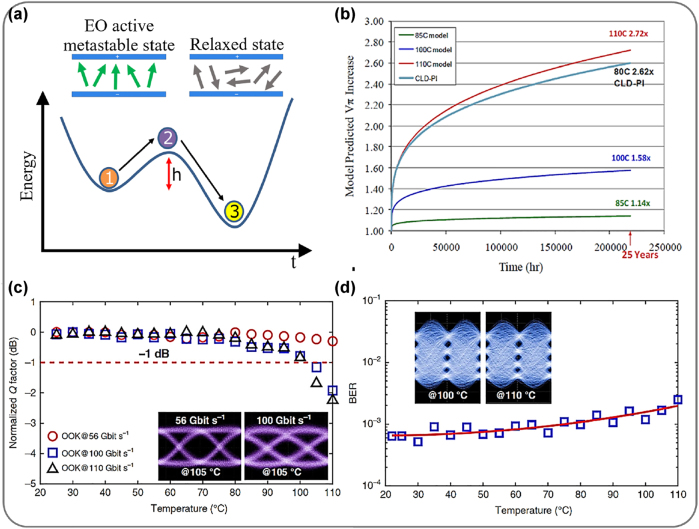
“Thetargetedmaximum operatingtemperatureaccordingtothisstandardis85°C. Long-termstabilityexperiments: Afirststudyofthelong-term stability of an SOH MZM [22] investigated an EO material with a bulky adamantly sidegroup (Fig.”
BackgroundEmerging Trends in Thermo-Optic and Electro-Optic Materials for Tunable Photonic Devices
Butt, M. A. (2025) · Materials · doi:10.3390/ma18122782 · Cited by 35
“To address this limitation, significant efforts have been directed toward the heterogeneous or hybrid integration of materials exhibiting strong Pockels or TO effects, such as LN [70,107,194], BTO [195,196], and EO polymers [197,198] onto Si substrates.”
χ(2) nonlinear photonics in integrated microresonators
Liu, P., Wen, H., Ren, L., Shi, L., & Zhang, X. (2023) · Frontiers of Optoelectronics · doi:10.1007/s12200-023-00073-4 · Cited by 29
“including silicon (Si), silicon nitride (Si3N4) and silicon dioxide (SiO2), do not possess χ(2) nonlinearity due to their centrosymmetric crystalline structures [25, 26].”
BackgroundWeis, M. (2025) · Applied Sciences · doi:10.3390/app15074028 · Cited by 26
Sol–Gel Barium Titanate Nanohole Array as a Nonlinear Metasurface and a Photonic Crystal
Talts, Ü., Weigand, H., Saerens, G., Benedek, P., Winiger, J., Wood, V. C., Leuthold, J., Vogler‐Neuling, V. V., & Grange, R. (2023) · Small · doi:10.1002/smll.202304355 · Cited by 24
Ultra‐Low‐Loss Slow‐Light Thin‐Film Lithium Niobate Optical Modulator
Li, C., He, J., Zhang, M., Tong, Y., Liu, W., Wang, S., Song, L., Liu, H., Cao, H., Liu, L., et al. (2025) · Laser & Photonics Review · doi:10.1002/lpor.202401998 · Cited by 26
Xu, H., Sun, Y., Kan, Y., & Gao, K. (2022) · Chinese Journal of Chemistry · doi:10.1002/cjoc.202200460 · Cited by 23
Integrated platforms and techniques for photonic neural networks
Zhang, H., Song, Y., Chen, S., Bai, Y., Xu, X., Huang, C., Wang, J., Chen, H., Moss, D. J., & Xu, K. (2025) · npj Nanophotonics · doi:10.1038/s44310-025-00088-z · Cited by 26
A comprehensive survey on optical modulation techniques for advanced photonics applications
Liu, H., Liu, X., Peng, L., Huang, Z., & Wu, Q. (2024) · Optics and Lasers in Engineering · doi:10.1016/j.optlaseng.2024.108773 · Cited by 22
Ultrahigh Performance Cross-Linkable Organic Electro-Optic Material for Hybrid Modulators
Xu, H., Elder, D. L., Johnson, L. E., de Coene, Y., Heni, W., Moor, D., Hammond, S. R., O’Malley, K. M., Clays, K., Leuthold, J., et al. (2025) · Chemistry of Materials · doi:10.1021/acs.chemmater.5c00027 · Cited by 20
What can be integrated on the silicon photonics platform and how?
Zhang, Y., Guo, X., Ji, X., Shen, J., He, A., & Su, Y. (2024) · APL Photonics · doi:10.1063/5.0220463 · Cited by 21
Taghavi, I., Esmaeeli, O., Chowdhury, S. J., Awan, K. M., Hammood, M., Mitchell, M., Witt, D. M., Pecinovsky, C. S., Sickler, J. W., Young, J. F., et al. (2025) · Nature Communications · doi:10.1038/s41467-025-63924-y · Cited by 17
“Furthermore, the preceding approaches cannot meet the trade-offs between various device metrics of a particular modulator, such as foot-print, EO and optical BW, IL, V π , and dynamic energy consumption ( E dyn ) 16,17 .”
Self-citation3D Optoelectronics and Co-Packaged Optics: Innovations, Challenges, and Future Trends
Yi, Y., & Yu, B. (2025) · IEEE Journal of Selected Topics in Quantum Electronics · doi:10.1109/jstqe.2025.3641790 · Cited by 16
“Third,thermalreliabilityandpowerdissipationareparamount to avoid performance drift and premature failure in dense photonic-electronic packages [26], [59], [95], [96], [97], [98], [99], [100].”
All-polymer monolithic resonant integrated optical gyroscope
Xue, X.-M., Tang, J., Zhou, H., Qin, Y., Song, Y., Li, R., Zhang, X., & Zhang, T. (2022) · Optics Express · doi:10.1364/oe.474447 · Cited by 15
Emerging Modulator Technologies in Silicon Photonics
Huang, W.-T., Hsiao, F., Miao, W., Chang, C.-T., Hong, K.-B., Sher, C.-W., Hong, Y., Lin, G., Chow, C., Chang, S., et al. (2025) · IEEE Nanotechnology Magazine · doi:10.1109/mnano.2025.3551177 · Cited by 15
“Hybrid platforms combine silicon with other materials, such as electro-optic polymers or conductive oxides, leveraging the unique advantages of each to achieve high modulation efficiency and bandwidth, suitable for applications demanding efficient and high-speed modulation [5].”
Bio‐inspired building blocks for all‐organic metamaterials from visible to near‐infrared
Holder, S. T., Estévez‐Varela, C., Pastoriza‐Santos, I., López‐García, M., Oulton, R., & Núñez‐Sánchez, S. (2023) · Nanophotonics · doi:10.1515/nanoph-2022-0690 · Cited by 13
Organic electro-optic materials: theory and experiment, devices, and applications [Invited]
Dalton, L. R. (2025) · Optical Materials Express · doi:10.1364/ome.567555 · Cited by 12
Integrated laser technologies for artificial intelligence applications [Invited]
Han, C., Li, M., Guo, J., & Bowers, J. E. (2025) · Optics Express · doi:10.1364/oe.571227 · Cited by 15
Integrated Pockels Modulators on Silicon Photonics Platform
Shen, J. X., Zhang, Y., Chen, Y., Zhou, W., Zhang, X., Sun, M., Wang, X., Zhang, L., Li, X., Li, J., et al. (2024) · Advanced Physics Research · doi:10.1002/apxr.202400096 · Cited by 9
Overcoming Silicon Limitations in Nanophotonic Devices by Geometrical Innovation: Review
Karsenty, A. (2023) · IEEE photonics journal · doi:10.1109/jphot.2023.3295077 · Cited by 9
Sparse Aperiodic Optical Phased Arrays on Polymer Integration Platform
Raptakis, A., Lymperakis, G., Gounaridis, L., Weigel, M., Kleinert, M., Tsokos, C., Groumas, P., Andrianopoulos, E., Keil, N., Avramopoulos, H., et al. (2024) · IEEE Photonics Technology Letters · doi:10.1109/lpt.2024.3367973 · Cited by 9
“Furthermore, the electro-optic (EO) properties of polymer devices offer the possibility for ultra-high bandwidth modulation, although manufacturing challenges relevant to EO modulators are still to be resolved to support high-volume production [14].”
BackgroundSupasai, W., Suwanarat, S., Wannaprapa, M., Chaisakul, P., Siritaratiwat, A., Srichan, C., Jutong, N., Narkglom, S., & Surawanitkun, C. (2024) · IEEE Transactions on Nanotechnology · doi:10.1109/tnano.2024.3353789 · Cited by 8
“Additionally, the most remarkable part of these devices is the development of low-cost, high-performance solutions that are compatible with complementary metal oxide semiconductor (CMOS) technology for ultra-fast optical modulators [4].”
BackgroundHybrid silicon-barium-titanate tunable racetrack resonators based on chemical solution deposition
Zhang, L., Wang, X., Zhang, Y., Shen, J., Feng, C., Xu, J., Liu, M., Wang, W., Deng, Y., Yang, X., et al. (2024) · Advanced Photonics Nexus · doi:10.1117/1.apn.3.6.066005 · Cited by 8
“23 In our work, a hybrid Si-BTO integrated photonics platform is demonstrated using the CSD method.”
Comparison of Thin-Film Lithium Niobate, SOH, and POH for Silicon Photonic Modulators
Yu, T.-C., Liu, A.-C., Huang, W.-T., Wu, C., Li, C., Kao, T.-S., Chang, S., Sher, C.-W., Lin, H.-Y., Chow, C., et al. (2025) · Photonics · doi:10.3390/photonics12050429 · Cited by 7
Yang, F., Hu, Y., Li, Y., Zhang, D., Yao, Z., Luo, J., He, F., Duan, J., Yao, Y., Wang, L., et al. (2025) · Chinese Optics Letters · doi:10.3788/col202523.051303 · Cited by 7
“With the explosive growth in global data traffic driven by band-width-hungry applications such as artificial intelligence and cloud computing [1 – 4] , the demand for large bandwidth and power-efficient electro-optic (EO) modulators remains relent-less.”
Clearing a path for light through non‐Hermitian media
Dave, U. D., Bhatt, G. R., Rodrigues, J. R., Datta, I., & Lipson, M. F. (2024) · Nanophotonics · doi:10.1515/nanoph-2024-0140 · Cited by 6
Photo‐Crosslinked Electro‐Optic Polymers Based on Carbene Insertion Reactions
Xu, H., Li, P., Rahman, A., Chen, Z., Liu, H., He, J., & Bo, S. (2025) · Small Methods · doi:10.1002/smtd.202501208 · Cited by 6
Comprehensive Phase Shifter Review: State of the Art and Future Trends
Gharsalli, S., Aloui, R., Mhatli, S., Corona‐Chávez, A., Brito‐Brito, Z., Mishra, S. K., & Llamas-Garro, I. (2025) · Progress In Electromagnetics Research B · doi:10.2528/pierb25082704 · Cited by 7
Photonic Hybrid Integration: Strategies and Promises of Advanced Additive Manufacturing
Shi, Z., Huang, H., Penty, R. V., & Cheng, Q. (2025) · Advanced Optical Materials · doi:10.1002/adom.202501750 · Cited by 5
Lu, T.-W., Jung, C.-C., Huang, H.-W., & Lee, P.-T. (2025) · ACS Photonics · doi:10.1021/acsphotonics.5c00534 · Cited by 5
A Novel Silicon Forward-Biased PIN Mach–Zehnder Modulator with Two Operating States
Yu, H., Tu, D., Huang, X., Yin, Y., Yu, Z., Guan, H., jiang, L., & Li, Z. (2023) · Micromachines · doi:10.3390/mi14081608 · Cited by 5
Physics to system-level modeling of silicon-organic-hybrid nanophotonic devices
Moridsadat, M., Tamura, M., Chrostowski, L., Shekhar, S., & Shastri, B. J. (2024) · Scientific Reports · doi:10.1038/s41598-024-61618-x · Cited by 5
“SOH modulators show a linear EO (Pockels) effect using highly nonlinear organic materials ( χ 2 nonlinearity) as cladding on the silicon waveguide 35 .”
BackgroundMethodSelf-citationLow-temperature growth of epitaxial BaTiO3 thin films with significant electro-optic coefficients
Cao, Y., Wen, Y., Yang, Y., Zhang, F., Zhang, W., Du, J., Zhang, Y., Wu, Z., & Wu, J. (2025) · Applied Physics Letters · doi:10.1063/5.0237644 · Cited by 5
Onural, D., Wang, I., Chiang, L.-Y., Raja, S., Zhang, X., Singh, M., Li, D. Z., Dao, H., Pajk, S., Sickler, J. W., et al. (2024) · Conference on Lasers and Electro-Optics · doi:10.1364/cleo_si.2024.sw3r.1 · Cited by 6
Synergistic antenna-modulator integration for a monolithic photonic RF receiver
Liu, C., Du, Y., Zou, X., Zou, F., Zhang, J., Zhang, J., Xie, X., Pan, W., Yan, L., & Yao, J. (2026) · Nature Communications · doi:10.1038/s41467-026-73862-y · Cited by 3
Fully integrated quantum frequency processor on a silicon chip
Congia, S., Virot, L., Rovetta, E., Fincato, A., Bœuf, F., Galli, M., Bajoni, D., & Borghi, M. (2026) · Nature Communications · doi:10.1038/s41467-026-77287-5 · Cited by 3
“Alternatives are actively being explored, including the integration of CMOS-compatible electro-optic polymers 58 and the heterogeneous integration of thin-fi lm lithium niobate on silicon 59 .”
Denda, N. M., Rohloff, E., Kurth, F. R., Zhao, L., Johannes, H., Kowalsky, W., König, C., Behrens, P. J., & Schneider, A. M. (2025) · The Journal of Physical Chemistry B · doi:10.1021/acs.jpcb.5c02832 · Cited by 3
Enami, Y., & Yoshida, Y. (2023) · Optics Express · doi:10.1364/oe.500462 · Cited by 3
Gharsalli, S., Aloui, R., Mhatli, S., & Llamas‐Garro, I. (2024) · Preprints.org · doi:10.20944/preprints202411.1386.v1 · Cited by 3
All-Fiber Micro-Ring Resonator Based p-Si/n-ITO Heterojunction Electro-Optic Modulator
Zhu, Y., Wang, Z., Chen, X., Zhu, H., Zhou, L., Zhou, Y., Liu, Y., Zhang, Y., Tian, X., Sun, S., et al. (2025) · Materials · doi:10.3390/ma18020307 · Cited by 2
The emerging applications of silicon photonics
Ranno, L., Tan, Y. Z., Coleto, A. G., To, V. H. N., Tian, S., Sun, Y., Xu, Z., Chae, S. H., Martin‐Monier, L., Huang, Z., et al. (2025) · Newton · doi:10.1016/j.newton.2025.100357 · Cited by 2
“9 The heterogeneous integration of Pock-els materials such as lithium niobate, lithium tantalate, or BaTiO 3 presents an exciting strategy to enable ultra-fast and linear phase control.”
Silicon-Based Highly c -Axis-Oriented Strontium Barium Niobate Films with Large Pockels Coefficients
Yuan, J., Zheng, J., Liang, S., Rui, P., Yu, H., & Ye, H. (2026) · ACS Omega · doi:10.1021/acsomega.6c04548 · Cited by 2
Binary Addressable Optical Multiplexing Waveguides via Electrochromic Switching
Rhim, S., Heyl, M., Busch, K., & List, E. J. W. (2023) · physica status solidi (a) · doi:10.1002/pssa.202300177 · Cited by 2
Yuexin, 尹. Y., & Daming, 张. Z. (2024) · Acta Optica Sinica · doi:10.3788/aos240905 · Cited by 3
Wang, Y., & Khan, F. N. (2025) · Optics Express · doi:10.1364/oe.554943 · Cited by 1
SOH Modulators Enable Ultra-Low Power Consumption and High Bandwidth Scaling in Silicon Photonics
Yu, T.-C., Chow, C., & Kuo, H. C. (2025) · IEEE Optoelectronics Global Conference (OGC) · doi:10.1109/ogc66041.2025.11262095 · Cited by 1
“[8,9] Over time, thermally stable and low-loss electro-optic polymers will improve SOH device durability and efficacy.”
Organic micro-nanophotonics: Materials, devices and integrated circuits
Xu, X., Liu, H., Jian, J., Chen, Z., Tang, Y., Ye, W., Gao, Y., Gao, Z., Li, L., Zhao, W., et al. (2026) · Science China Physics Mechanics and Astronomy · doi:10.1007/s11433-025-2815-1 · Cited by 3
Thériault, P.-L., Humeniuk, H. V., He, Z., Juteau, G., Malinge, A., Perepichka, D. F., & Kéna‐Cohen, S. (2026) · Advanced Optical Materials · doi:10.1002/adom.202502212 · Cited by 1
“It requires electrodes, which not only add process complexity for back-end-of-the-line (BEOL) fabrication 16 but also introduce optical absorption losses.”
Deleau, C., Seat, H. C., Bernal, O. D., & Surre, F. (2026) · Photonics · doi:10.3390/photonics13020149 · Cited by 1
Ultrahigh-efficiency slow-light modulator based on thin-film lithium niobate
He, J., Gu, Y., Dai, W., Tang, J., Wang, W., Guo, Q., & Xu, H. (2026) · Optics Express · doi:10.1364/oe.588072 · Cited by 1
Efficient Second-Harmonic Generation from Molecular Monolayers
Emmanuele, R., Chen, J., Sai, H., Namgung, S. D., Gosztola, D. J., Wang, Y., Lou, J., Stupp, S. I., Hersam, M. C., & Ma, X. (2026) · ACS Nano · doi:10.1021/acsnano.6c00996 · Cited by 1
Poling-free integrated second-order nonlinear optics with evaporated organic thin films
Thériault, P.-L., Petit, A., S, A. A. V., & Kéna‐Cohen, S. (2026) · Science Advances · doi:10.1126/sciadv.aeg3170 · Cited by 1
“Nevertheless, the poling requirement adds substantial fabrication complexity and necessitates the use of metal electrodes ( 17 ).”
Integrated Photonic Modulator Circuit With Programmable Intensity and Phase Modulation Response
Deng, H., Zhang, Y., Chen, X., & Bogaerts, W. (2026) · Laser & Photonics Review · doi:10.1002/lpor.202502837 · Cited by 1
“…or Pockels effect) [ 16 ], thin film LiNbO 3 on insulator (LNOI) [ 17, 18 ], thin-film BaTiO 3 [ 19 ] (Pock-els effect), polymer modulators [ 20 ], and silicon-organic hybrids [ 21 ], can also been heterogeneously integrated onto silicon photonic circuits, with wafer-to-wafer, die-to-wafer…”
A review of photonic integrated neural networksPreprint
Moss, D. (2025) · OSF Preprints (OSF Preprints) · doi:10.31219/osf.io/u7v9k_v1 · Cited by 1
Wang, L., Tong, L., Rong, J., & Wu, J.-W. (2024) · Journal of Polymer Engineering · doi:10.1515/polyeng-2023-0217
Topological edge states electro-optic modulator based on valley photonic crystals
Wang, Y., & Khan, F. N. (2024) · Advanced Fiber Laser Conference (AFL) · doi:10.1117/12.3023638
“The traditional silicon Mach-Zehnder modulators (MZMs) have a large optical bandwidth but their size is usually in the mm scale [11] .”
BackgroundByoung Seung, H. A. M. (2024) · arXiv (Cornell University) · doi:10.48550/arxiv.2405.08456
Synthesis, electro‐optic properties, and performance of novel fluorinated polyurethaneimide
Wang, L., Tong, L., Wu, J., & Rong, J. (2024) · Polymer Engineering and Science · doi:10.1002/pen.26853
CMOS Compatible Add-drop Silicon-Organic Hybrid Racetrack Modulator
Moridsadat, M., Tamura, M., & Shastri, B. J. (2024) · Photonics North (PN) · doi:10.1109/pn62551.2024.10621821
“Cost-effective organic materials with high second-order nonlinearity, low power, exceptional electro-optic (EO) coefficients, and easy fabrication stand out among emerging materials [4].”
BackgroundSelf-citationYe, L., Su, S., Zhang, Y., Zhu, C., Zhuo, J., & Liu, Q. H. (2024) · Physica Scripta · doi:10.1088/1402-4896/ad7abd
Broadband Tunable Metal-Dielectric Color Filters for the Visible Spectrum
Carvalho, C. H. V. L., Rêgo, D. F., & Rodríguez‐Esquerre, V. F. (2024) · SBFoton International Optics and Photonics Conference (SBFoton IOPC) · doi:10.1109/sbfotoniopc62248.2024.10813500
High speed 8PSK optical modulator using silicon/electro-optic polymer hybrid coupled ring resonator
Ayalew, H. D., Talabattula, S., Annamalai, P., & Mishra, P. (2025) · Journal of Optical Communications · doi:10.1515/joc-2024-0320 · Cited by 1
“To assess EO modulator performance, key fi gures of merit include modulation e ffi ciency, 3 dB bandwidth, extinction ratio, footprint, power consumption, and fabrication complexity [19, 22].”
Review on Integrated Photonic Neural NetworksPreprint
Xu, X., & Moss, D. J. (2025) · Preprints.org · doi:10.20944/preprints202508.1621.v1
Review of photonic integrated neural networksPreprint
Moss, D., & Xu, X. (2025) · doi:10.1364/opticaopen.30006112
Candidate electro-optic molecular crystals for future optoelectronic integration
Sunami, K., Horiuchi, S., Sonoda, Y., Fujiki, N., Higashino, T., Atsumi, Y., Ishibashi, S., & Tsutsumi, J. (2026) · Materials Horizons · doi:10.1039/d6mh00613b
Ayalew, H. D., Talabattula, S., & Annamalai, P. (2025) · Asia Pacific Conference on Innovation in Technology (APCIT) · doi:10.1109/apcit65661.2025.11410854
“While InP based IQ modulators have achieved impressive data rates with complex modulation formats, their fabrication remains costly and lacks integration with mainstream electronics [1-3].”
Highly photostabilized electro-optic polymer for next-generation high-speed optical modulator
Onodera, S., Furukawa, M., Ouchi, S., Hashimoto, S., Ishii, H., Kuma, H., & Nakamura, H. (2026) · doi:10.1117/12.3082207
“Compared to traditional silicon-based optical modulators, EO polymers offer faster operation and lower power consumption, thereby significantly enhancing the efficiency of data centers and telecommunication networks [1][2].”
Photonic integrated circuits for dual-comb interferometry
López-Querol, P. (2026) · UPM Digital Archive (Technical University of Madrid) · doi:10.20868/upm.thesis.94006
Kim, K., Lee, J., & Kim, Y. (2026) · Scientific Reports · doi:10.1038/s41598-026-43882-1 · Cited by 1
“For N P of 10, 20, and 30, both n-Si and n-InGaAsP exhibit nearly linear relationships with identical slopes.”
Surface-Normal Electro-Optic Polymer Modulator using Single-Layer Plasmonic Grating
Du, Y. (2024) · Institutional Repositories DataBase (IRDB)
Low-Loss Photonic Modulator toward Future Quantum Information Processing
Guo, S., Lee, S., Juperi, S., Han, Y., Kim, M., Yang, Y., Gong, X., Yu, R., Leong, J., Zograf, G., et al. (2026) · ACS Nano · doi:10.1021/acsnano.6c02532
Taghavi, I., Tofini, A., Leung, E., Pecinovsky, C., Jaeger, N. A. F., Chrostowski, L., & Shekhar, S. (2026) · Optica · doi:10.1364/optica.591830
“…been demonstrated in inorganic materials such as lithium niobate [7] and barium titanate [8], parallel advancements in organic electro-optic (EO) materials — primarily EO polymers (EOP) [9]— have achieved several device performance metrics that surpass those of their inorganic counterparts [10–12].”
Self-citationBian, Y., Chandran, S., Liu, Q., Aboketaf, A. A., Lee, W. S., Stanev, T. K., Ding, H., Popielarski, B., Brahma, M., Zhang, M. M., et al. (2026) · Research Square · doi:10.21203/rs.3.rs-9682597/v1
Self-citationRaptakis, A. (2026) · DSpace - NTUA (National Technical University of Athens) · doi:10.26240/heal.ntua.32541
Monolithic Integrated Chip of PdSe 2 Photodetector and Lithium Niobate Modulator
Tingfei, Y. U. A. N., Sun, X., Dong, Q., Sun, S., GAO, L., Zhou, T., Fu, B., Yu, J., Chen, J. C., Wang, Z., et al. (2026) · Laser & Photonics Review · doi:10.1002/lpor.71450
“The former is constrained by insufficient device bandwidth and poor linearity, while the latter is hindered by complex fabrication processes and extremely high costs [ 8, 9 ], both of which limit the application of silicon-based modulators.”
Jian, 苏. S., Caiqiang, 古. G., Jiamin, 陈. C., Junhua, 钟. Z., Liang, H., Yu, 乔. Q., Xian, 张. Z., Wang, R., & Siyuan, 于. Y. (2026) · Acta Optica Sinica · doi:10.3788/aos261023
Muchun, 林. L., Kaixuan, 陈. C., & Liu, L. (2026) · Acta Optica Sinica · doi:10.3788/aos260725
Easy-to-Integrate UV-Curable Magneto-Optical Films: MOF-Encapsulated ZnFe₂O₄ on Silicon SubstratesPreprint
Lin, Y., Xie, X., Xie, J., Zhang, P., Zhang, Y., Zhang, B., Hu, X., & Zhuang, N. (2026) · SSRN Electronic Journal · doi:10.2139/ssrn.7195533
Biswas, D., Shah, T., Das, S., Dey, A. B., Chowdhary, A. K., & Sikdar, D. (2026) · International Conference on Signal Processing and Communications (SPCOM) · doi:10.1109/spcom71105.2026.11622912
“This hybrid approach is a forward-looking methodology with strong precedent, as demonstrated by the successful integration of other functional materials like thin-film lithium niobate and various polymers with silicon platforms [19], [20], [21], [22], [23].”
Ultra-high extinction ratio optical modulation via interference-engineered mach-zehnder modulator
Shi, Z., Lou, Z., Xu, J., & Alouini, M. (2026) · Communications Engineering · doi:10.1038/s44172-026-00745-x
Amrar, R. (2026) · Knowledge UdeS (Institutional Deposit of the University of Sherbrooke) · doi:10.71892/11143/1854
Bertot, F., Tomasino, A., Tam, C. Y., Withayachumnankul, W., & Benea-Chelmus, I.-C. (2026) · APL Photonics · doi:10.1063/5.0335962
Dadkhah, Z., Safian, R., & Firouzeh, Z. H. (2026) · Advanced Photonics Research · doi:10.1002/adpr.70284
Design Optimization of Slab Width for High-Performance Silicon PN Junction Modulators
Jiang, J., Cui, J., & Chang, C. (2026) · Photonics · doi:10.3390/photonics13110997
Smart Electro-Optic Polymers and Their Applications
Bhat, A., & Sadhu, S. P. P. (2026) · Springer series in materials science · doi:10.1007/978-3-032-21977-0_12
Tong, 葛. G., Yujie, 任. R., Tao, Y., Xiangzhi, 谢. X., Yifan, 吴. W., Feng, H., & Cheng, 王. W. (2026) · Laser & Optoelectronics Progress · doi:10.3788/lop260477
Integration beyond silicon photonics
Su, Y., Zhang, Y., Guo, X., He, Y., He, A., Zhao, Y., Hu, X., Lao, Y., Cai, H., & Chu, W. (2026) · Progress in Quantum Electronics · doi:10.1016/j.pquantelec.2026.100664
Metadata
- Authors
- Taghavi, I., Moridsadat, M., Tofini, A., Raza, S., Jaeger, N. A. F., Chrostowski, L., Shastri, B. J., & Shekhar, S.
- Affiliations
- University of British Columbia (CA)
- Queen's University (CA)
- Corresponding author
- Taghavi, Iman
- ORCID
- Venue
- Nanophotonics
- Publisher
- Wiley
- Published
- 2022-07-15
- Volume
- 11
- Issue
- 17
- Pages
- 3855-3871
- ISSN
- 2192-8606 (ISSN-L)
- 2192-8614
- PMC
- PMC11502111
- OpenAlex
- W4285589045
- Cited by
- 78
- References
- 116
- Citations by year
- 2026: 20 · 2025: 24 · 2024: 22 · 2023: 9 · 2022: 3
- FWCI
- 0.95
- Type
- journal article
- Language
- en
- Open access
- gold
- doi.org
- Licence
- cc-by
- creativecommons.org/licenses/by/4.0/ (vor)
- doi.wiley.com/10.1002/tdm_license_1.1 (tdm)
- Locations
- Nanophotonics (publishedVersion, cc-by)
- PubMed Central (publishedVersion, cc-by)
- PubMed (publishedVersion)
- DOAJ (DOAJ: Directory of Open Access Journals) (submittedVersion, cc-by-sa)
- Funders
- Natural Sciences and Engineering Research Council of Canada
- Topics
- Physical Sciences › Engineering › Electrical and Electronic Engineering › Photonic and Optical Devices
- Physical Sciences › Physics and Astronomy › Atomic and Molecular Physics, and Optics › Photorefractive and Nonlinear Optics
- Physical Sciences › Physics and Astronomy › Atomic and Molecular Physics, and Optics › Plasmonic and Surface Plasmon Research
- Keywords
- silicon photonics, electro-optic effect, optical phase shifter, low driving voltage, modulation bandwidth, device aging, temperature dependence, lithium niobate modulator
About these checks
Registry, retraction, Cites and statistics results are computed, not judged, with one exception: a printed reference that no index lists is read once by a model before it counts as a citation error. Claims are extracted by a model and kept only when their quote appears verbatim in the text; each cited source is then checked, with a model’s help, for whether it says what the claim relies on. Those verdicts can be wrong — read the claim’s quote and the cited source before relying on one.
Statistics and arithmetic are recomputed, not judged.
Confidence bands are shown only for fields calibrated on our annotated test set. None is calibrated yet, so no band is shown.
What counts as a claim ›How we measure confidence ›How we check this ›
Are you an author, or do you see a problem with this page? Request a review
Data sources
Bibliographic data: Semantic Scholar, OpenAlex, Crossref.
Contains information from the Semantic Scholar Academic Graph Datasets, made available under the ODC Attribution License (ODC-BY 1.0).
Semantic Scholar’s data is described in: Kinney, R., et al. (2023). The Semantic Scholar Open Data Platform. arXiv:2301.10140.
