

Improving the usefulness of research data with better paradata
Open accessThe DOI matches its Crossref record; 149 of the 155 references it cites were found in a registry or an index.
Abstract
Considerable investments have been made in Europe and worldwide for developing research data infrastructures. Instead of a general lack of data about data, it has become apparent that a pivotal factor that drastically constrains data use is the absence of contextual knowledge about how data was created and how it has been curated and used. This applies especially to many branches of social science and humanities research, where data is highly heterogeneous, both by its kind (e.g. being qualitative, quantitative, naturalistic, purposefully created) and origins (e.g. being historical/contemporary, from different contexts and geographical places). The problem is that there may be enough metadata (data about data) but there is too little paradata (data on the processes of its creation, curation and use). The aim of this position paper is to draw attention 1) to the need for a better and more systematic understanding and documentation of the contexts of creation, curation and use of research data to make it useful and usable for researchers and other potential users in the future, and 2) to specific obstacles that make the capturing of this particular type of metadata, known as paradata, especially difficult. Failing to understand what information about the creation, curation and use of research data is needed and how to capture enough of that information risks that the currently collected vast amounts of research data become useless in the future.
Overview
The claims and statistics of this paper haven’t been checked yet.
Free: it reads the open-access text and checks the first 5 claims that cite a source we can check. Create a free account to check every claim.
Integrity signals
Registry
Cites
Statistics
Figures
Verification
Claims the paper makes
The claims and statistics of this paper haven’t been checked yet.
Free: it reads the open-access text and checks the first 5 claims that cite a source we can check. Create a free account to check every claim.
Claims other papers make about this one
Each is checked against this paper’s own text: does it say what the citing paper says it does?
The source backs part of the claim, not all of it — or backs it for a different population, condition or comparison.
In the citing paper
“However, without paradata documenting a dataset's origins, that data's reusability and comparability are severely limited:”
From Positioning Paradata: A Conceptual Frame for AI Processual Documentation in Archives and Recordkeeping Contexts (2023) · cites this paper as [31]
Experimental — accuracy not yet measuredThe source backs part of the claim, not all of it — or backs it for a different population, condition or comparison.
In the citing paper
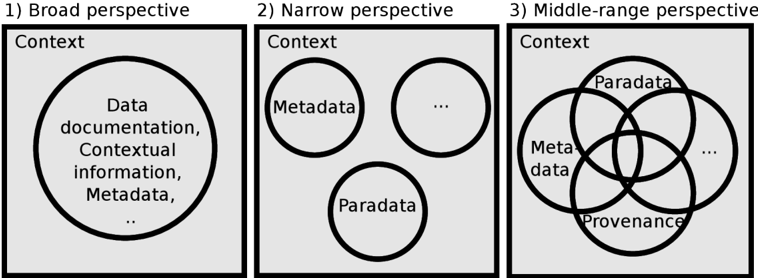
“Although he does view paradata as a subset of metadata, Huvila advocates for a dynamic middle perspective (as illustrated in Section 2 of Figure 1 ) toward paradata, noting that when addressing a particular question, a given piece of information may appear as part of one or more of an object's paradata, metadata, or provenance.”
From Positioning Paradata: A Conceptual Frame for AI Processual Documentation in Archives and Recordkeeping Contexts (2023) · cites this paper as [31]
Experimental — accuracy not yet measuredThe cited source says what the claim attributes to it.
In the citing paper
“As Huvila's middle perspective notes, a piece of information that may be understood as paradata at one moment may serve as metadata, provenance, or contextual information from another perspective.”
From Positioning Paradata: A Conceptual Frame for AI Processual Documentation in Archives and Recordkeeping Contexts (2023) · cites this paper as [31]
The cited source says what the claim attributes to it.
In the citing paper
“Huvila notes the increasing use of the term to refer to research process data across multiple fields, and the emerging problem of a lack of standardization for how to define, collect, maintain, and make accessible a dataset's paradata.”
From Positioning Paradata: A Conceptual Frame for AI Processual Documentation in Archives and Recordkeeping Contexts (2023) · cites this paper as [31]
Self-check
Percentages, sums and reported differences re-computed from the paper’s own numbers.
The self-check needs the paper’s full text.
Citations
Cites
The FAIR Guiding Principles for scientific data management and stewardship
Wilkinson, M. D., Dumontier, M., Aalbersberg, I. J., Appleton, G., Axton, M., Baak, A., Blomberg, N., Boiten, J.-W., da Silva Santos, L. B., Bourne, P. E., et al. (2016) · Scientific Data · doi:10.1038/sdata.2016.18 · Cited by 18,423 · cited 2×
“Its significance is acknowledged also in the recent standards and guidelines, including the FAIR principles for scientific data management and stewardship (Wilkinson et al., 2016).”
Star, S. L., & Griesemer, J. R. (1989) · Social Studies of Science · doi:10.1177/030631289019003001 · Cited by 10,847 · cited 2×
“Star & Griesemer, 1989; Bowker, 1994; Pickering, 1995, see also e.g. Giulierini et al., 2020) demonstrating that it is not especially far fetched to suggest that approaches similar to those used by codicologists, palaeographers and art historians can be applied to research documentation as well.”
The Mangle of Practice: Time, Agency, and Science
Pickering, A. (1995) · University of Chicago Press eBooks · doi:10.7208/chicago/9780226668253.001.0001 · Cited by 2,699 · cited 1×
“Star & Griesemer, 1989; Bowker, 1994; Pickering, 1995, see also e.g. Giulierini et al., 2020) demonstrating that it is not especially far fetched to suggest that approaches similar to those used by codicologists, palaeographers and art historians can be applied to research documentation as well.”
10 ''Where Are the Missing Masses? The Sociology of a Few Mundane Artifacts''
Latour, B. (1992) · Cited by 2,255
Archives, records, and power: The making of modern memory
Schwartz, J. M., & Cook, T. (2002) · Archival Science · doi:10.1007/bf02435628 · Cited by 906 · cited 1×
“…to the creation and use, also curation (Buchanan, 2016; Voss, 2012), archiving, and data and collections management (Kelleher, 2017; Newman, 2012; Schwartz & Cook, 2002) are non-neutral, generative activities with an impact on data and consequently, on how it can and should be interpreted.”
The conundrum of sharing research data
Borgman, C. L. (2012) · Journal of the American Society for Information Science and Technology · doi:10.1002/asi.22634 · Cited by 880 · cited 3×
“…on creation, curation and use of research data, the difficulty of using others’ research materials and data is not unique to archaeology but has been observed across disciplines and pertains to all research working – in some meaning – with data (see e.g. Leonelli & Tempini, 2020; Borgman, 2012).”
Big Data, Little Data, No Data: Scholarship in the Networked World
Borgman, C. L. (2015) · The MIT Press eBooks · doi:10.7551/mitpress/9963.001.0001 · Cited by 601 · cited 3×
“Many researchers are much less concerned about reuse than collecting and working with new data (Voss, 2012; Borgman, 2015b).”
Provenance and scientific workflows: challenges and opportunities
Davidson, S. B., & Freire, J. (2008) · Proceedings of the 2008 ACM SIGMOD international conference on Management of data · doi:10.1145/1376616.1376772 · Cited by 468 · cited 5×
“…(e.g. Antonijevic & Cahoy, 2018; Chiquet, 2020), social science and humanities disciplines generally lack equivalent to scientific workflows (Davidson & Freire, 2008) applied in many laboratory sciences that could be used directly as a basis for developing a framework for systematic…”
InfluentialLeveraging Tacit Organizational Knowledge
(2000) · Journal of Management Information Systems · doi:10.1080/07421222.2000.11045655 · Cited by 407 · cited 1×
“Similarly, because the documentation of work practices, both in research and generally, is seldom considered a priority (Raghu & Vinze, 2007; Stenmark, 2000) and often means to an end (new knowledge) rather than the main task of those who are expected to produce such records, it would be important…”
Towards a New Paradigm? The Third Science Revolution and its Possible Consequences in Archaeology
Kristiansen, K. (2021) · Current Swedish Archaeology · doi:10.37718/csa.2014.01 · Cited by 337 · cited 1×
“…research topics (incl. geographical information science, data science, and natural sciences oriented work in humanities and social sciences, see Kristiansen 2014; Cooper & Green 2015; Bevan 2015; McCoy 2017) and fields like digital humanities (Poole & Garwood, 2018) and heritage research, and…”
Research works printed but not linked: 17
- 7. Ball, A. (2011). International digital curation conference 2010. Ariadne, (66). http://www.ariadne.ac.uk/issue66/idcc-2010-rpt/
- 39. Couper, M. (1998). Measuring survey quality in a CASIC environment. In Proceedings of the Section on Survey Research Methods of the American Statistical Association.
- 49. De Oliveira, D., Silva, V., & Mattoso, M. (2015). How much domain data should be in provenance databases? In Workshop on Theory and Practice of Provenance (TaPP).
- 57. Doran, M., Edmond, J., & Nugent-Folan, G. (2019). Reconciling the cultural complexity of research data: Can we make data interdisciplinary without hiding disciplinary knowledge? Preprint of manuscript submitted to CODATA. http://hdl.handle.net/2262/83156
- 58. Drachsler, H., Greller, W., Fazeli, S., Niemann, K., Sanchez-Alonso, S., Rajabi, E., Palmér, M., Ebner, H., Simon, B., Nösterer, D., et al. (2012). D8. 1 Review of Social Data Requirements. Open Discovery Space project.
- 60. Duranti, L. (1998). Diplomatics : new uses for an old science. Lanham, MD: Scarecrow Press.
- 65. Fagan, B. (1995). Timelines: Archaeology's dirty secret. Archaeology, 48(4), 14-17.
- 69. Faniel, I. M., & Yakel, E. (2017). Practices do not make perfect: Disciplinary data sharing and reuse practices and their implications for repository data curation. In L. R. Johnston (Ed.) Curating Research Data, Volume One: Practical Strategies for Your Digital Repository, (pp. 103-126). Chicago: ACRL.
- 85. Greengrass, M. (2008). Introduction. In M. Greengrass, & L. M. Hughes (Eds.) The virtual representation of the past. Aldershot and Burlington: Ashgate.
- 87. Harrison, R., Morel, H., Maricevic, M., & Penrose, S. (2017). Heritage and Data: Challenges and Opportunities for the Heritage Sector: Report of the Heritage Data Research Workshop Held Friday 23 June 2017 at the British Library, London. London: Heritage Research, Heritage Futures, Alan Turing Institute, British Library.
- 88. Hauck, O., & Kuroczyński, P. (2015). Cultural heritage markup language-designing a domain ontology for digital reconstructions. In Proceedings of the 2nd International Conference on Virtual Archaeology, Hermitage Museum, St. Petersburg/Russia, (pp. 250-255).
- 91. Hinds, P. J., & Pfeffer, J. (2003). Why organizations don't "know what they know": Cognitive and motivational factors affecting the transfer of expertise. In M. S. Ackerman, V. Pipek, & V. Wulf (Eds.) Sharing expertise : beyond knowledge management, (pp. 3-26). Cambridge, MA: MIT Press.
- 157. Pančur, A., Šorn, M., & Erjavec, T. (2018). SlovParl 2.0: The collection of Slovene parliamentary debates from the period of secession. In D. Fišer, & a. d. J. Maria Eskevich (Eds.) ParlaCLARIN 2018 Workshop Proceedings May 7, 2018 Phoenix Seagaia Conference Center, Miyazaki, Japan. Luxembourg: ELRA.
- 179. Tempini, N. (2017). Till data do us part: Understanding data-based value creation in data-intensive infrastructures. Information and Organization, 27(4), 191-210. http://www.sciencedirect.com/science/article/pii/S1471772716300653 The London Charter Organisation (2009). The London Charter for the computer-based visualisation of cultural heritage. Tech. Rep. 2.1, London.
- 180. Turner, M. J. (2012). Lies, damned lies and visualizations: Will metadata and paradata be a solution or a curse? In A. Bentkowska-Kafel, H. Denard, & D. Baker (Eds.) Paradata and transparency in virtual heritage, (pp. 135-143). Farnham: Ashgate.
- 181. Vatanen, I. (2003). Deconstructing the (re)constructed: issues on annotation of the archaeological virtual realities. In M. Doerr, & A. Sarris (Eds.) CAA2002 The Digital Heritage of Archaeology. Computer Applications and Quantitative Methods in Archaeology. Proceedings of the 30th Conference, Heraklion, Crete, April 2002, (pp. 69-74). Archive of Monuments and Publications, Hellenic Ministry of Culture.
- 188. Wilson, E. A. (2020). Text encoding with the text encoding initiative (TEI) and the music encoding initiative (MEI). In E. A. Wilson (Ed.) Digital Humanities for Librarians, (pp. 87-106). Lanham; Boulder; New York; London: Rowman & Littlefield.
Cited by
Archivist in the machine: paradata for AI-based automation in the archives
Davet, J., Hamidzadeh, B., & Franks, P. (2023) · Archival Science · doi:10.1007/s10502-023-09408-8 · Cited by 26
“(Huvila 2022) Statistical social science research relies on a particularly expansive conception of paradata, defined in at least one case as “those data which fall outside the intentionally or purposefully collected data.”
BackgroundCameron, S., Franks, P., & Hamidzadeh, B. (2023) · Journal on Computing and Cultural Heritage · doi:10.1145/3594728 · Cited by 25
Moullou, D., Vital, R., Sylaiou, S., & Ragia, L. (2023) · Heritage · doi:10.3390/heritage7010005 · Cited by 23
“Furthermore, the inclusion of paradata becomes imperative, offering insights into the process of data creation, decision making during research, and details about workflow, data collection techniques, and any modifications applied during the research process [66,67].”
BackgroundArchaeological information-making activities according to field reports
Huvila, I., Börjesson, L., & Sköld, O. (2022) · Library & Information Science Research · doi:10.1016/j.lisr.2022.101171 · Cited by 24
“…Givens, 1995), methods sections of research papers, and increasingly, various forms of researcher-generated provenance metadata (Missier, 2016) and paradata (Edwards, Goodwin, O ’ Connor, & Phoenix, 2017; Huvila, 2022a) that are produced to improve the findability and reusability of research data.”
Self-citationStarópoli, L., Acevedo, V. J., Ávido, D., & Vitores, M. (2023) · Virtual Archaeology Review · doi:10.4995/var.2023.19292 · Cited by 20
“Al mismo tiempo, sin la documentación adecuada de los procesos humanos de creación, comprensión e interpretación de los datos, existe el riesgo de crear y archivar grandes colecciones de datos que son incapaces de respaldar la investigación y otros tipos de reutilización (Huvila, 2022.”
BackgroundLate, E., Ruotsalainen, H., & Kumpulainen, S. (2024) · International Journal on Digital Libraries · doi:10.1007/s00799-023-00390-1 · Cited by 14
“Therefore, Huvila [26] calls for paradata (data on the processes of its creation, curation, and use) for digitally shared research data.”
Huvila, I., & Sinnamon, L. S. (2024) · Journal of the Association for Information Science and Technology · doi:10.1002/asi.24957 · Cited by 20
“In contrast to the assumption that making information and data available is enough to ensure its use (Davies & Edwards, 2012), sharing involves complex negotiations and transformations of the shared information and data (Tabak & Willson, 2012; see also Huvila, 2022a, 2022b).”
Self-citationKnowing-in-Practice, Its Traces and Ingredients
Huvila, I., Sköld, O., & Andersson, L. (2023) · Springer eBooks · doi:10.1007/978-3-031-42276-8_2 · Cited by 8
Self-citationDistribution patterns of Gaza wine vs. Cilician wine in the eastern Mediterranean in Late Antiquity
Kizhner, I. A., Gambash, G., Bar‐Oz, G., & Avni, G. (2024) · Levant · doi:10.1080/00758914.2024.2411109 · Cited by 11
Patterns in paradata preferences among the makers and reusers of archaeological data
Huvila, I., Andersson, L., & Sköld, O. (2024) · Data and Information Management · doi:10.1016/j.dim.2024.100077 · Cited by 8
“However, so far the understanding of the broader patterns of how the preferences of specific types of paradata are linked to each other from data makers and users perspectives remains limited (Huvila, 2022).”
Self-citationBridging Digital Approaches and Legacy in Archaeology
Katsianis, M., Kalaycı, T., & Sarris, A. (2022) · Digital · doi:10.3390/digital2040029 · Cited by 13
“To that end, the paradata, namely the creation method of digital research outputs, are receiving further attention [36,37].”
MethodHuvila, I., & Sköld, O. (2023) · Journal of Information Science · doi:10.1177/01655515231203506 · Cited by 7
“…devices of archaeological documentation work in terms of their purposes, actors, audiences and in relation to each other and (RQ3) if the instructions in field manuals were followed, what kind of paradata (data about processes, cf. [ 12]) on archaeological documentation work would be produced.”
Self-citationThe Matrix: connecting and re-using digital records and archives of archaeological investigations
England, H., May, K., & Taylor, J. S. (2023) · Internet Archaeology · doi:10.11141/ia.61.2 · Cited by 13
Upcycling historical data collections. A paradigm for digital history?
Scheltjens, W. (2023) · Journal of Documentation · doi:10.1108/jd-12-2022-0271 · Cited by 10
Huvila, I. (2024) · Lecture notes in computer science · doi:10.1007/978-3-031-78590-0_1 · Cited by 6
Self-citationNavigating accountability: the role of paradata in AI documentation and governance
Cameron, S., Franks, P. C., Huvila, I., & Mooradian, N. (2025) · Journal of Documentation · doi:10.1108/jd-01-2025-0009 · Cited by 6
Self-citationOrganically Grown Archaeological Databases and their ‘Messiness’: Hobby Metal Detecting in Norway
Axelsen, I., & Fredriksen, C. (2024) · European Journal of Archaeology · doi:10.1017/eaa.2024.10 · Cited by 5
“This can, as Balázs et al. (2021: 147) point out, to some extent be remed-ied by ensuring that the relevant metadata and paradata is acquired and stored (see also Huggett, 2020: 12; Huvila, 2022).”
Huvila, I., & Ekman, S. (2024) · Linköping electronic conference proceedings · doi:10.3384/ecp205004 · Cited by 7
“More recently, paradata has been instituted in information and data management [8] and AI and records management contexts [9].”
BackgroundSelf-citationCategorizing methods and approaches for generating and identifying paradata
Juneström, A., & Huvila, I. (2025) · Journal of Librarianship and Information Science · doi:10.1177/09610006251342811 · Cited by 8
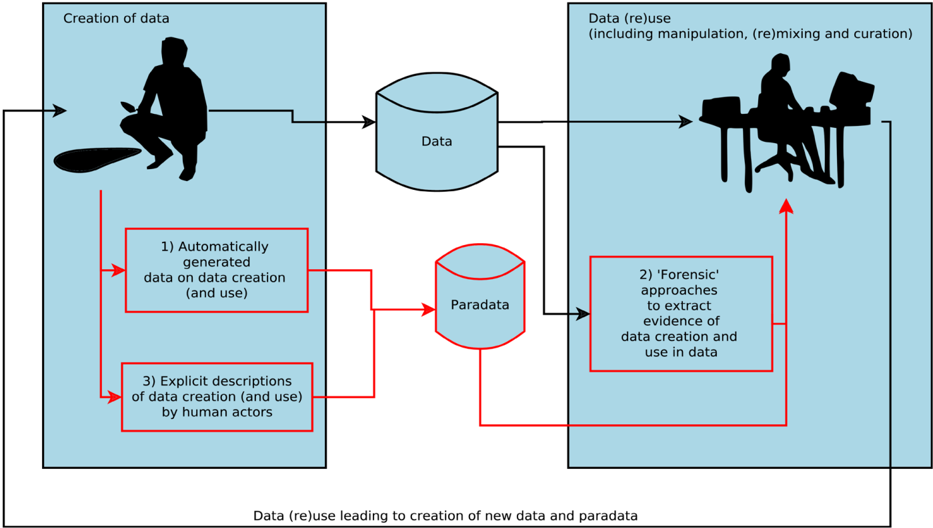
“In addition to intentionally collected documentation, much automatically captured data carry finger-prints and log data that provide information about data creation and use (cf. Huvila, 2022).”
InfluentialSelf-citationBuilding the Foundations of Cyber Humanities: Cultural Cyber-Critical Ecosystem Conceptualization
Bellini, E., & Degl’Innocenti, E. (2025) · IEEE International Conference on Cyber Humanities (IEEE-CH) · doi:10.1109/ieee-ch65308.2025.11279317 · Cited by 4
“• P : Paradata -according to [24] Paradata is distinct from traditional metadata; it focuses on documenting the processes and decisions involved in data production rather than just describing the data itself.”
Encounters with the Archaeological Archive
Ward, C. (2022) · Journal of Field Archaeology · doi:10.1080/00934690.2022.2155768 · Cited by 6
“Issues of how to preserve procedural information and meta-data with digital storage resources is an ongoing discussion within archaeology (Börjesson et al. 2022; Huvila 2022).”
BackgroundA Leap of Faith: Revisiting Paradata in 3D Scholarship
Papadopoulos, C. (2024) · Knowledge management and organizational learning · doi:10.1007/978-3-031-53946-6_4 · Cited by 5
Sköld, O. (2025) · Cambridge University Press eBooks · doi:10.1017/9781009366564.003 · Cited by 5
Huvila, I. (2025) · Cambridge University Press eBooks · doi:10.1017/9781009366564.008 · Cited by 3
Self-citationparts and the whole. Integrate knowledge
Valacchi, F. (2022) · JLIS it · doi:10.36253/jlis.it-477 · Cited by 3
Concluding Discussion: Paradata for Information and Knowledge Management
Huvila, I., Andersson, L., & Sköld, O. (2024) · Knowledge management and organizational learning · doi:10.1007/978-3-031-53946-6_14 · Cited by 3
Self-citationSköld, O., & Andersson, L. (2025) · Cambridge University Press eBooks · doi:10.1017/9781009366564.004 · Cited by 3
Future Directions: Making Paradata Matter
Huvila, I. (2025) · Cambridge University Press eBooks · doi:10.1017/9781009366564.009 · Cited by 2
Self-citationHuvila, I. (2026) · Journal of Documentation · doi:10.1108/jd-11-2025-0367 · Cited by 3
“Such process information is typically termed in the contemporary literature as paradata (Huvila, 2022).”
InfluentialSelf-citationManaging Information Gaps and Non‐Information
Huvila, I., Andersson, L., Fulton, C., Haider, J., & Harviainen, J. T. (2023) · Proceedings of the Association for Information Science and Technology · doi:10.1002/pra2.863 · Cited by 2
“Missing (meta-)information—metadata (Tenopir et al., 2015), and for instance, paradata (Huvila, 2022)—is a barrier to data reuse that sometimes can be remedied by effective management and curation (Luong et al., 2021), sometimes through meticulous analysis of the data itself by using methods such…”
Self-citationTowards Embodied Paradata. A Diffractive Art/Archaeology Approach
Dawson, I., & Reilly, P. (2024) · Knowledge management and organizational learning · doi:10.1007/978-3-031-53946-6_6 · Cited by 2
Re-use of research data in the social sciences. Use and users of digital data archive
Late, E., & Ochsner, M. (2024) · PLoS ONE · doi:10.1371/journal.pone.0303190 · Cited by 1
“Systematic documentation and providing high quality paradata (i.e. data about the data) is valued by the data users [8, 9, 12, 62].”
BackgroundHuvila, I. (2025) · Transformations a DARIAH Journal · doi:10.46298/transformations.14747 · Cited by 1
Self-citationThe Impact of Human Decision-Making on the Research Value of Archaeological Data
Lewis, M., Oksanen, E., Ehrnsten, F. N., Rantala, H., Tuominen, J., & Eero Hyvönen, A. (2025) · Journal on Computing and Cultural Heritage · doi:10.1145/3736770 · Cited by 1
“With this comes a greater need to capture and explore paradata, or information on the processes by which the data were collected [11].”
Functions of paradata in data papers
Ekman, S., Sköld, O., & Huvila, I. (2025) · Journal of Documentation · doi:10.1108/jd-11-2024-0293 · Cited by 1
Self-citationMethods for Generating and Documenting Paradata
Liu, Y., & Huvila, I. (2025) · Cambridge University Press eBooks · doi:10.1017/9781009366564.005 · Cited by 1
Self-citationIntroduction: Paradata – Documenting Data Creation, Management and Use
Huvila, I. (2025) · Cambridge University Press eBooks · doi:10.1017/9781009366564.002 · Cited by 1
Self-citationHuvila, I., Andersson, L., & Sköld, O. (2025) · Journal of the Association for Information Science and Technology · doi:10.1002/asi.70003 · Cited by 6
“…little in explicit terms as a specific information practice, or in more narrow terms, data behavior (Zhang et al., 2023), it is vital to understand to know where to find paradata, and what new paradata creation needs to be stimulated or supported by information policy development (Huvila, 2022).”
InfluentialSelf-citationWikidata as a Reconciliation Anchor: Curating Data for Long-Term Preservation
Trognitz, M., Mandell, R., Štuhec, S., & Palacz, J. (2026) · Journal of Open Humanities Data · doi:10.5334/johd.450 · Cited by 1
Huvila, I., Sköld, O., Zengenene, D., & Andersson, L. I. (2026) · Journal of Documentation · doi:10.1108/jd-10-2025-0324 · Cited by 1
Self-citationPrerequisites for a computational approach to Minoan chronology
Panagiotopoulos, D., & Trognitz, M. (2025) · Archaeometry · doi:10.1111/arcm.13066 · Cited by 1
Representational exchange and edgework: towards theorising the coping with fragmentary information
Huvila, I. (2024) · Information Research · doi:10.47989/ir292832
Self-citationParadata for Digitization Processes and Digital Scholarly Editions
Dillen, W. (2024) · Knowledge management and organizational learning · doi:10.1007/978-3-031-53946-6_8
Making Research Code Useful Paradata
Bilderbeek, R. J. C. (2024) · Knowledge management and organizational learning · doi:10.1007/978-3-031-53946-6_3
Researching Informational Technologies of Trust: From Blockchain to Paradata and Digital Archives
Huvila, I., Lemieux, V. L., Sköld, O., & Donaldson, D. R. (2024) · Proceedings of the Association for Information Science and Technology · doi:10.1002/pra2.1099
“…1995) and the appended system(s) of archival description and metadata (Duff & Harris, 2002) and standardised digitisation workflows, whereas in knowledge organisation and data management, metainformation, including metadata and paradata, have a comparable function (Pomerantz, 2015; Huvila, 2022).”
Self-citationSiesel, C., Lee, J., Phadnis, R., Davlin, S. L., Brevik, T., & Lea, V. A. (2025) · Oxford Open Digital Health · doi:10.1093/oodh/oqaf003
Methods for Identifying Paradata for Data Reuse
Liu, Y., & Huvila, I. (2025) · Cambridge University Press eBooks · doi:10.1017/9781009366564.006
Self-citationObserving reuse of 3D data in archaeological excavations
Derudas, P., Dell’Unto, N., Berggren, Å., Campanaro, D. M., Svensson, A., Fauvelle, M., Larsson, J., Dininno, D., & ricerche, C. N. D. (2026) · Internet Archaeology · doi:10.11141/ia.71.5
Archival Paradata and Artificial Intelligence in Archaeology
Huvila, I. (2026) · Open Archaeology · doi:10.1515/opar-2025-0091 · Cited by 1
“Finally, paradata can support stakeholders of activities where AI is deployed to interrogate AI systems (Cameron et al. 2023; Huvila 2022) to articulate what types of information is necessary for satisfying speci fi c ethical, legal and practical needs (Davet et al. 2023).”
Self-citationHuvila, I. (2026) · Oxford University Press eBooks · doi:10.1093/9780197835210.003.0082
Self-citationToward a cultural cyber-critical ecosystem: concepts, threats and challenges
Bellini, E., & Degl’Innocenti, E. (2026) · Digital Library Perspectives · doi:10.1108/dlp-01-2026-0031
Metadata
- Authors
- Huvila, I.
- Affiliations
- Uppsala University (SE)
- Corresponding author
- Huvila, Isto
- ORCID
- Huvila, Isto
- Venue
- Open Information Science
- Publisher
- Walter de Gruyter GmbH
- Published
- 2022-01-01
- Volume
- 6
- Issue
- 1
- Pages
- 28-48
- ISSN
- 2451-1781 (ISSN-L)
- OpenAlex
- W4226117346
- Cited by
- 51
- References
- 155
- Citations by year
- 2026: 7 · 2025: 16 · 2024: 15 · 2023: 9 · 2022: 4
- FWCI
- 10.89
- Type
- journal article
- Language
- en
- Open access
- diamond
- doi.org
- Locations
- Open Information Science (publishedVersion, cc-by)
- Uppsala University Publications (Uppsala University) (submittedVersion, other-oa)
- DOAJ (DOAJ: Directory of Open Access Journals) (submittedVersion)
- Funders
- European Commission (818210, HORIZON2020)
- Topics
- Physical Sciences › Computer Science › Information Systems › Research Data Management Practices
- Social Sciences › Sociology and Political Science › Data Analysis and Archiving
- Social Sciences › Decision Sciences › Information Systems and Management › Scientific Computing and Data Management
- Keywords
- paradata, research data, metadata, research data infrastructure, data curation, data provenance, data utilization, social science data, humanities data, data reuse
About these checks
Registry, retraction, Cites and statistics results are computed, not judged, with one exception: a printed reference that no index lists is read once by a model before it counts as a citation error. Claims are extracted by a model and kept only when their quote appears verbatim in the text; each cited source is then checked, with a model’s help, for whether it says what the claim relies on. Those verdicts can be wrong — read the claim’s quote and the cited source before relying on one.
Statistics and arithmetic are recomputed, not judged.
Confidence bands are shown only for fields calibrated on our annotated test set. None is calibrated yet, so no band is shown.
What counts as a claim ›How we measure confidence ›How we check this ›
Are you an author, or do you see a problem with this page? Request a review
Data sources
Bibliographic data: Semantic Scholar, OpenAlex, Crossref.
Contains information from the Semantic Scholar Academic Graph Datasets, made available under the ODC Attribution License (ODC-BY 1.0).
Semantic Scholar’s data is described in: Kinney, R., et al. (2023). The Semantic Scholar Open Data Platform. arXiv:2301.10140.
