

Improving the usefulness of research data with better paradata
Open accessThe DOI matches its Crossref record; 149 of the 155 references it cites were found in a registry or an index.
Abstract
Considerable investments have been made in Europe and worldwide for developing research data infrastructures. Instead of a general lack of data about data, it has become apparent that a pivotal factor that drastically constrains data use is the absence of contextual knowledge about how data was created and how it has been curated and used. This applies especially to many branches of social science and humanities research, where data is highly heterogeneous, both by its kind (e.g. being qualitative, quantitative, naturalistic, purposefully created) and origins (e.g. being historical/contemporary, from different contexts and geographical places). The problem is that there may be enough metadata (data about data) but there is too little paradata (data on the processes of its creation, curation and use). The aim of this position paper is to draw attention 1) to the need for a better and more systematic understanding and documentation of the contexts of creation, curation and use of research data to make it useful and usable for researchers and other potential users in the future, and 2) to specific obstacles that make the capturing of this particular type of metadata, known as paradata, especially difficult. Failing to understand what information about the creation, curation and use of research data is needed and how to capture enough of that information risks that the currently collected vast amounts of research data become useless in the future.
Overview
The claims and statistics of this paper haven’t been checked yet.
Free: it reads the open-access text and checks the first 5 claims that cite a source we can check. Create a free account to check every claim.
Integrity signals
Registry
Cites
Statistics
Figures
Verification
Claims the paper makes
The claims and statistics of this paper haven’t been checked yet.
Free: it reads the open-access text and checks the first 5 claims that cite a source we can check. Create a free account to check every claim.
Claims other papers make about this one
Each is checked against this paper’s own text: does it say what the citing paper says it does?
The source backs part of the claim, not all of it — or backs it for a different population, condition or comparison.
In the citing paper
“However, without paradata documenting a dataset's origins, that data's reusability and comparability are severely limited:”
From Positioning Paradata: A Conceptual Frame for AI Processual Documentation in Archives and Recordkeeping Contexts (2023) · cites this paper as [31]
Experimental — accuracy not yet measuredThe source backs part of the claim, not all of it — or backs it for a different population, condition or comparison.
In the citing paper
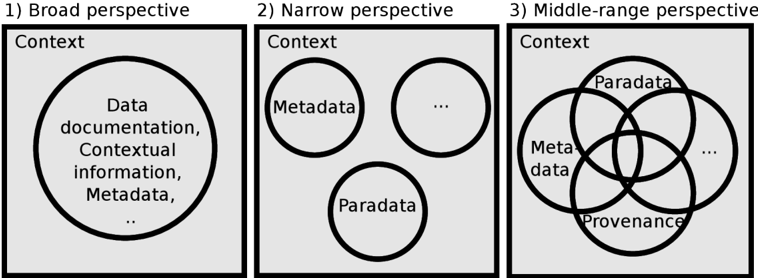
“Although he does view paradata as a subset of metadata, Huvila advocates for a dynamic middle perspective (as illustrated in Section 2 of Figure 1 ) toward paradata, noting that when addressing a particular question, a given piece of information may appear as part of one or more of an object's paradata, metadata, or provenance.”
From Positioning Paradata: A Conceptual Frame for AI Processual Documentation in Archives and Recordkeeping Contexts (2023) · cites this paper as [31]
Experimental — accuracy not yet measuredThe cited source says what the claim attributes to it.
In the citing paper
“As Huvila's middle perspective notes, a piece of information that may be understood as paradata at one moment may serve as metadata, provenance, or contextual information from another perspective.”
From Positioning Paradata: A Conceptual Frame for AI Processual Documentation in Archives and Recordkeeping Contexts (2023) · cites this paper as [31]
The cited source says what the claim attributes to it.
In the citing paper
“Huvila notes the increasing use of the term to refer to research process data across multiple fields, and the emerging problem of a lack of standardization for how to define, collect, maintain, and make accessible a dataset's paradata.”
From Positioning Paradata: A Conceptual Frame for AI Processual Documentation in Archives and Recordkeeping Contexts (2023) · cites this paper as [31]
Self-check
Percentages, sums and reported differences re-computed from the paper’s own numbers.
The self-check needs the paper’s full text.
Citations
Cites
The FAIR Guiding Principles for scientific data management and stewardship
Wilkinson, M. D., Dumontier, M., Aalbersberg, I. J., Appleton, G., Axton, M., Baak, A., Blomberg, N., Boiten, J.-W., da Silva Santos, L. B., Bourne, P. E., et al. (2016) · Scientific Data · doi:10.1038/sdata.2016.18 · Cited by 18,423 · cited 2×
“Its significance is acknowledged also in the recent standards and guidelines, including the FAIR principles for scientific data management and stewardship (Wilkinson et al., 2016).”
Star, S. L., & Griesemer, J. R. (1989) · Social Studies of Science · doi:10.1177/030631289019003001 · Cited by 10,847 · cited 2×
“Star & Griesemer, 1989; Bowker, 1994; Pickering, 1995, see also e.g. Giulierini et al., 2020) demonstrating that it is not especially far fetched to suggest that approaches similar to those used by codicologists, palaeographers and art historians can be applied to research documentation as well.”
The Mangle of Practice: Time, Agency, and Science
Pickering, A. (1995) · University of Chicago Press eBooks · doi:10.7208/chicago/9780226668253.001.0001 · Cited by 2,699 · cited 1×
“Star & Griesemer, 1989; Bowker, 1994; Pickering, 1995, see also e.g. Giulierini et al., 2020) demonstrating that it is not especially far fetched to suggest that approaches similar to those used by codicologists, palaeographers and art historians can be applied to research documentation as well.”
10 ''Where Are the Missing Masses? The Sociology of a Few Mundane Artifacts''
Latour, B. (1992) · Cited by 2,255
Archives, records, and power: The making of modern memory
Schwartz, J. M., & Cook, T. (2002) · Archival Science · doi:10.1007/bf02435628 · Cited by 906 · cited 1×
“…to the creation and use, also curation (Buchanan, 2016; Voss, 2012), archiving, and data and collections management (Kelleher, 2017; Newman, 2012; Schwartz & Cook, 2002) are non-neutral, generative activities with an impact on data and consequently, on how it can and should be interpreted.”
The conundrum of sharing research data
Borgman, C. L. (2012) · Journal of the American Society for Information Science and Technology · doi:10.1002/asi.22634 · Cited by 880 · cited 3×
“…on creation, curation and use of research data, the difficulty of using others’ research materials and data is not unique to archaeology but has been observed across disciplines and pertains to all research working – in some meaning – with data (see e.g. Leonelli & Tempini, 2020; Borgman, 2012).”
Big Data, Little Data, No Data: Scholarship in the Networked World
Borgman, C. L. (2015) · The MIT Press eBooks · doi:10.7551/mitpress/9963.001.0001 · Cited by 601 · cited 3×
“Many researchers are much less concerned about reuse than collecting and working with new data (Voss, 2012; Borgman, 2015b).”
Provenance and scientific workflows: challenges and opportunities
Davidson, S. B., & Freire, J. (2008) · Proceedings of the 2008 ACM SIGMOD international conference on Management of data · doi:10.1145/1376616.1376772 · Cited by 468 · cited 5×
“…(e.g. Antonijevic & Cahoy, 2018; Chiquet, 2020), social science and humanities disciplines generally lack equivalent to scientific workflows (Davidson & Freire, 2008) applied in many laboratory sciences that could be used directly as a basis for developing a framework for systematic…”
InfluentialLeveraging Tacit Organizational Knowledge
(2000) · Journal of Management Information Systems · doi:10.1080/07421222.2000.11045655 · Cited by 407 · cited 1×
“Similarly, because the documentation of work practices, both in research and generally, is seldom considered a priority (Raghu & Vinze, 2007; Stenmark, 2000) and often means to an end (new knowledge) rather than the main task of those who are expected to produce such records, it would be important…”
Towards a New Paradigm? The Third Science Revolution and its Possible Consequences in Archaeology
Kristiansen, K. (2021) · Current Swedish Archaeology · doi:10.37718/csa.2014.01 · Cited by 337 · cited 1×
“…research topics (incl. geographical information science, data science, and natural sciences oriented work in humanities and social sciences, see Kristiansen 2014; Cooper & Green 2015; Bevan 2015; McCoy 2017) and fields like digital humanities (Poole & Garwood, 2018) and heritage research, and…”
Programme to Practice: Gender and Feminism in Archaeology
Conkey, M. W., & Gero, J. M. (1997) · Annual Review of Anthropology · doi:10.1146/annurev.anthro.26.1.411 · Cited by 234 · cited 2×
“It is easy to list names, places, tools and moments in time whereas really keeping and making ‘human-agency visible’, to borrow the concept of (Conkey & Gero, 1997), has proven to be much harder.”
Suchman, L. (1996) · Computerization and Controversy · doi:10.1016/b978-0-12-415040-9.50118-4 · Cited by 226 · cited 1×
“A lot of work could be done to incentivise explicit ’articulation work’ (Suchman, 1996) i.e. documentation of work processes in data curation and reuse especially for and within research fields whenever there is a reason to consider that their meticulous documentation is relevant.”
Slow Research: Thoughts for a movement in Global Health
Adams, V., Burke, N. J., & Whitmarsh, I. (2014) · Medical Anthropology · doi:10.1080/01459740.2013.858335 · Cited by 219 · cited 2×
“…quality of research as the proponents of mindfully collected ’slow data’ (for the concept, see Kansa, 2016) and ’slow’ research (for the concept, see Adams et al., 2014) indirectly underline by emphasising qualitative value over efficiency in measuring outcomes and implications of scientific…”
(2020) · Springer eBooks · doi:10.1007/978-3-030-37177-7 · Cited by 202 · cited 2×
“…on creation, curation and use of research data, the difficulty of using others’ research materials and data is not unique to archaeology but has been observed across disciplines and pertains to all research working – in some meaning – with data (see e.g. Leonelli & Tempini, 2020; Borgman, 2012).”
Data at work: supporting sharing in science and engineering
Birnholtz, J. P., & Bietz, M. J. (2003) · Proceedings of the 2003 international ACM SIGGROUP conference on Supporting group work · doi:10.1145/958160.958215 · Cited by 200 · cited 1×
“Independent of discipline, the reasons why contextual information is needed, tend to be similar (see e.g. Faniel & Yakel, 2017; Yoon, 2016; Birnholtz & Bietz, 2003).”
Critical approaches to fieldwork: contemporary and historical archaeological practice
(2001) · Choice Reviews Online · doi:10.5860/choice.39-1025 · Cited by 198
How do financial analysts make decisions? A process model of the investment screening decision
Bouwman, M. J., Frishkoff, P. A., & Frishkoff, P. (1987) · Accounting, Organizations and Society · doi:10.1016/0361-3682(87)90013-4 · Cited by 198 · cited 1×
“…1997) and sharing (Hinds & Pfeffer, 2003) procedural expertise is difficult, people do not necessarily know why and how they know what they know (Bouwman et al., 1987), and the accuracy and reliability of explicit descriptions of work and research processes and their usefulness in facilitating…”
Law, J., & Lynch, M. (1988) · Human Studies · doi:10.1007/bf00177306 · Cited by 190 · cited 1×
“…(Hawthorne, 2021), studies of scientific and scholarly documentation and work practices provide plenty of evidence of the underlying variety and messiness of how the work proceeds even in cases where standardisation has been championed as a major priority (e.g. Bowker, 1994; Law & Lynch, 1988).”
Karasti, H., Baker, K. S., & Halkola, E. (2006) · Computer Supported Cooperative Work (CSCW) · doi:10.1007/s10606-006-9023-2 · Cited by 182 · cited 1×
“…data management (e.g. Faniel et al., 2019; Mostafa, 2018; Wilkinson et al., 2016; Borgman, 2012) to computer-supported cooperative work (e.g. Karasti et al., 2006), different branches of sciences (Kim & Yoon, 2017) including zoology and quantitative social sciences (Faniel & Yakel, 2017),…”
Scholarly research and information practices: a domain analytic approach
Fry, J. (2004) · Information Processing & Management · doi:10.1016/j.ipm.2004.09.004 · Cited by 176 · cited 1×
“While certain contextual information is necessary for using all types of research materials, old and new, in all contexts, in tight disciplinary communities much of such knowledge is readily available and already known by all of its members (Fry, 2006; Prainsack et al., 2014).”
A business process context for Knowledge Management
Raghu, T. S., & Vinzé, A. (2005) · Decision Support Systems · doi:10.1016/j.dss.2005.05.031 · Cited by 168 · cited 1×
“Similarly, because the documentation of work practices, both in research and generally, is seldom considered a priority (Raghu & Vinze, 2007; Stenmark, 2000) and often means to an end (new knowledge) rather than the main task of those who are expected to produce such records, it would be important…”
1 Memory Practices in the Sciences
Bowker, G. (2014) · Cited by 165
Towards a Theory of Social Work Expertise
Fook, J., Ryan, M. M., & Hawkins, L. A. (1997) · The British Journal of Social Work · doi:10.1093/oxfordjournals.bjsw.a011220 · Cited by 160 · cited 1×
“Even if articulating (Carr, 2005; Fook et al., 1997) and sharing (Hinds & Pfeffer, 2003) procedural expertise is difficult, people do not necessarily know why and how they know what they know (Bouwman et al., 1987), and the accuracy and reliability of explicit descriptions of work and research…”
Using the Jupyter Notebook as a Tool for Open Science: An Empirical Study
Randles, B. M., Pasquetto, I. V., Golshan, M. S., & Borgman, C. L. (2017) · ACM/IEEE Joint Conference on Digital Libraries · doi:10.1109/jcdl.2017.7991618 · Cited by 155
Improving Surveys with Paradata
(2013) · Wiley eBooks · doi:10.1002/9781118596869 · Cited by 149
The politics of boundary objects: Hegemonic interventions and the making of a document
Huvila, I. (2011) · Journal of the American Society for Information Science and Technology · doi:10.1002/asi.21639 · Cited by 144 · cited 2×
“Examples of such practices are, for instance, anthropological and archaeological field documentation, which is generally expected to contain information on both findings and the investigation process (e.g. Gustafsson & Magnusson Staaf, 2001; Huvila, 2011; Rytter et al., 2020; Marsh et al., 2020).”
Self-citationCultural Heritage Data Management: The Role of Formal Ontology and CIDOC CRM
Bruseker, G., Carboni, N., & Guillem, A. (2017) · Quantitative methods in the humanities and social sciences · doi:10.1007/978-3-319-65370-9_6 · Cited by 144 · cited 2×
“Moreover, as noted earlier, paradata is a key constituent in the process of opening research data in the broad intra-and cross-disciplinary knowledge ecosystem in the sense of making it not only available but also intelligible (cf. Bruseker et al., 2017b).”
Usability Evaluation of Computer-Assisted Survey Instruments
Couper, M. P. (2000) · Social Science Computer Review · doi:10.1177/089443930001800402 · Cited by 143 · cited 2×
“…and interpretation of data objects (The London Charter Organisation, 2009), in practice, having this information means that it is necessary to capture paradata in a much broader sense (as for Couper, 2000, or that Huggett 2012 calls provenance ) as a premise of these fairly advanced insights.”
Luhmann, J., & Burghardt, M. (2021) · Journal of the Association for Information Science and Technology · doi:10.1002/asi.24533 · Cited by 137
Bevan, A. (2015) · Antiquity · doi:10.15184/aqy.2015.102 · Cited by 135 · cited 2×
“…information science, data science, and natural sciences oriented work in humanities and social sciences, see Kristiansen 2014; Cooper & Green 2015; Bevan 2015; McCoy 2017) and fields like digital humanities (Poole & Garwood, 2018) and heritage research, and the exceedingly multidisciplinary…”
Using Paradata to Explore Item Level Response Times in Surveys
Couper, M. P., & Kreuter, F. (2012) · Journal of the Royal Statistical Society Series A (Statistics in Society) · doi:10.1111/j.1467-985x.2012.01041.x · Cited by 134 · cited 1×
“In survey research, the concept has been found useful in evaluating data quality (Kreuter, 2013), response times (Couper & Kreuter, 2013), non-response adjustment (Olson, 2013), and for instance, understanding what respondents do while filling in web questionnaires (Stieger & Reips, 2010).”
Scientists' data reuse behaviors: A multilevel analysis
Kim, Y., & Yoon, A. (2017) · Journal of the Association for Information Science and Technology · doi:10.1002/asi.23892 · Cited by 125 · cited 2×
“…2018; Wilkinson et al., 2016; Borgman, 2012) to computer-supported cooperative work (e.g. Karasti et al., 2006), different branches of sciences (Kim & Yoon, 2017) including zoology and quantitative social sciences (Faniel & Yakel, 2017), survey research (Edwards et al., 2017), cultural…”
Cooper, A., & Green, C. (2015) · Journal of Archaeological Method and Theory · doi:10.1007/s10816-015-9240-4 · Cited by 120 · cited 2×
“Reuse-oriented research has often been struggling to find and get access to and make data usable (e.g. Löwenborg, 2014; Cooper & Green, 2015; Doran et al., 2019) that raises legitimate concerns of the present, often limited consideration of the usefulness, limits and contextuality of the currently…”
Stieger, S., & Reips, U. (2010) · Computers in Human Behavior · doi:10.1016/j.chb.2010.05.013 · Cited by 120 · cited 1×
“In survey research, the concept has been found useful in evaluating data quality (Kreuter, 2013), response times (Couper & Kreuter, 2013), non-response adjustment (Olson, 2013), and for instance, understanding what respondents do while filling in web questionnaires (Stieger & Reips, 2010).”
Archaeological Reflexivity and the "Local" Voice
Hodder, I. (2003) · Anthropological Quarterly · doi:10.1353/anq.2003.0010 · Cited by 115 · cited 1×
“…of the state-of-the-art methodological innovations on the “interpretation at the trowel’s edge” in the field rather than working with legacy collections (Hodder, 2003; Voss, 2012; Dell’Unto et al., 2017) is exemplary of this general tendency, which is not specific to that particular discipline.”
The relevance of ?work-practice? for design
Button, G., & Harper, R. H. R. (1995) · Computer Supported Cooperative Work (CSCW) · doi:10.1007/bf00749172 · Cited by 113
Berggren, Å., Dell’Unto, N., Forte, M., Haddow, S. D., Hodder, I., Issavi, J., Lercari, N., Mazzucato, C., Mickel, A., & Taylor, J. S. (2015) · Antiquity · doi:10.15184/aqy.2014.43 · Cited by 111 · cited 1×
“In archaeology, the use of videos, diaries and the introduction of ’daily sketches’ at Çatalhöyük (Berggren et al., 2015) serves as an example of some of these possibilities – even if some of them would be unattainable for many less well-resourced research projects.”
A framework for contextual information in digital collections
Lee, C. A. (2011) · Journal of Documentation · doi:10.1108/00220411111105470 · Cited by 108 · cited 1×
“…domain-specific (e.g. Bentkowska-Kafel et al., 2012; Edwards et al., 2017), focused on either highly generic or very specific, not seldom curatorial (as e.g. in Lee, 2011; Beaudoin, 2012) rather reusers’, needs (Faniel et al., 2019), and lacked detail how to tackle with the issue in practice.”
The challenges of digging data
Faniel, I. M., Kansa, E. C., Kansa, S. W., Barrera-Gomez, J., & Yakel, E. (2013) · ACM/IEEE Joint Conference on Digital Libraries · doi:10.1145/2467696.2467712 · Cited by 106 · cited 5×
“…that describes processes, Couper, 2000, cf. metadata that describes data, Pomerantz, 2015), also the terms context and context information (e.g. Faniel et al., 2013, 2019) and provenance and provenance metadata (e.g. Doerr et al., 2016; Huggett, 2012 cf. the earlier popular notion provenience…”
InfluentialCuration as research. A case study in orphaned and underreported archaeological collections
Voss, B. L. (2012) · Archaeological Dialogues · doi:10.1017/s1380203812000219 · Cited by 106 · cited 9×
“Many researchers are much less concerned about reuse than collecting and working with new data (Voss, 2012; Borgman, 2015b).”
InfluentialScience on the run: Information management and Industrial Geophysics at Schlumberger (1920-1940)
Bowker, G. C. (2003) · Bulletin de la Sabix · doi:10.4000/sabix.425 · Cited by 99
Geospatial Big Data and archaeology: Prospects and problems too great to ignore
McCoy, M. D. (2017) · Journal of Archaeological Science · doi:10.1016/j.jas.2017.06.003 · Cited by 99 · cited 1×
“…science, data science, and natural sciences oriented work in humanities and social sciences, see Kristiansen 2014; Cooper & Green 2015; Bevan 2015; McCoy 2017) and fields like digital humanities (Poole & Garwood, 2018) and heritage research, and the exceedingly multidisciplinary research, for…”
DIY and digital archaeology: what are you doing to participate?
Morgan, C., & Eve, S. (2012) · World Archaeology · doi:10.1080/00438243.2012.741810 · Cited by 98 · cited 1×
“Calls for adequate contextual information have been made in evidence-based studies of research practices (Borgman, 2012; Faniel et al., 2013; Kim & Yoon, 2017) and theoretical and normative literature (e.g. Niven & Richards, 2017; Huggett, 2016; Lake, 2012; Morgan & Eve, 2012) alike.”
Context from the data reuser’s point of view
Faniel, I. M., Frank, R. D., & Yakel, E. (2019) · Journal of Documentation · doi:10.1108/jd-08-2018-0133 · Cited by 94 · cited 4×
“…that describes processes, Couper, 2000, cf. metadata that describes data, Pomerantz, 2015), also the terms context and context information (e.g. Faniel et al., 2013, 2019) and provenance and provenance metadata (e.g. Doerr et al., 2016; Huggett, 2012 cf. the earlier popular notion provenience…”
InfluentialFrom Visual Exploration to Storytelling and Back Again
Gratzl, S., Lex, A., Gehlenborg, N., Cosgrove, N., & Streit, M. (2016) · Computer Graphics Forum · doi:10.1111/cgf.12925 · Cited by 86 · cited 1×
“…computational data analysis and visualisation tools for enquiring into (para)data (e.g. De Oliveira et al., 2015; Curcin, 2016), (re-)generating human-readable accounts of structured paradata (e.g. Gratzl et al., 2016), and in some cases, even reproduce workflows (Ludaescher et al., 2013).”
Public Libraries, Archives and Museums: Trends in Collaboration and Cooperation
Yarrow, A., Clubb, B., & Draper, J.-L. (2008) · Cited by 85
Curating Archaeological Knowledge in the Digital Continuum: from Practice to Infrastructure
Dallas, C. (2015) · Open Archaeology · doi:10.1515/opar-2015-0011 · Cited by 82 · cited 1×
“It links to the research agenda advocated by Dallas (2015) to conduct in-depth research on research practices and methods, and to devise and develop curation linked to existing pervasive digital infrastructures from the premises of how research works in specific domains, disciplinary and…”
Data reusers’ trust development
Yoon, A. (2017) · Journal of the Association for Information Science and Technology · doi:10.1002/asi.23730 · Cited by 82 · cited 1×
“Independent of discipline, the reasons why contextual information is needed, tend to be similar (see e.g. Faniel & Yakel, 2017; Yoon, 2016; Birnholtz & Bietz, 2003).”
Akmon, D., Zimmerman, A., Daniels, M., & Hedstrom, M. L. (2011) · Archives and Museum Informatics · doi:10.1007/s10502-011-9151-4 · Cited by 76 · cited 1×
“There is also a large variation in what researchers consider important to document even within small and tight groups (e.g. Akmon et al., 2011).”
Till data do us part: Understanding data-based value creation in data-intensive infrastructures
Tempini, N. (2017) · Information and Organization · doi:10.1016/j.infoandorg.2017.08.001 · Cited by 72 · cited 1×
“Unsurprisingly, the importance of contextual information has been underlined especially in data infrastructures and (re)use-oriented research (e.g. Tempini, 2017; Faniel & Yakel, 2017) in such data-intensive fields as, for instance, corpus linguistics (e.g. Pančur et al., 2018), large-scale survey…”
Durrant, G. B., D’Arrigo, J., & Steele, F. (2011) · Journal of the Royal Statistical Society Series A (Statistics in Society) · doi:10.1111/j.1467-985x.2011.00715.x · Cited by 69 · cited 1×
“Paradata has also been used for research in data collection practices (Laflamme, 2009; Elliot et al., 2015) and for helping to understand and plan data acquiring procedures in interview research (Durrant et al., 2011).”
Holmes, F. L., Renn, J., & Rheinberger, H. (2003) · Archimedes · doi:10.1007/0-306-48152-9 · Cited by 68
Pomerantz, J. (2015) · The MIT Press eBooks · doi:10.7551/mitpress/10237.001.0001 · Cited by 64
Introduction to Manuscript Studies
Clemens, R., & Graham, T. (2008) · Cited by 64
Paradata for Nonresponse Adjustment
Olson, K. M. (2012) · The Annals of the American Academy of Political and Social Science · doi:10.1177/0002716212459475 · Cited by 63 · cited 1×
“In survey research, the concept has been found useful in evaluating data quality (Kreuter, 2013), response times (Couper & Kreuter, 2013), non-response adjustment (Olson, 2013), and for instance, understanding what respondents do while filling in web questionnaires (Stieger & Reips, 2010).”
Genetics as Social Practice: Transdisciplinary Views on Science and Culture
Prainsack, B., Schicktanz, S., & Werner‐Felmayer, G. (2014) · Cited by 62
Interdisciplinary problem- solving: emerging modes in integrative systems biology
MacLeod, M., & Nersessian, N. J. (2016) · European Journal for Philosophy of Science · doi:10.1007/s13194-016-0157-x · Cited by 59 · cited 1×
“The same applies to notes, memos and paper drafts that often contain cues of the process that led to final publications, products and outcomes (Latour, 1992; MacLeod & Nersessian, 2016).”
Kersel, M. M. (2015) · Journal of Eastern Mediterranean Archaeology & Heritage Studies · doi:10.5325/jeasmedarcherstu.3.1.0042 · Cited by 59 · cited 1×
“Long before the current surge of attention to the complications of data reuse, already from the 1970s onwards, archaeologists have been debating an emerging ’curation crisis’ (Flexner, 2016; Kersel, 2015; Voss, 2012; Marquardt et al., 1982).”
The durability and fragility of knowledge infrastructures: Lessons learned from astronomy
Borgman, C. L., Sands, A. E., Darch, P. T., & Golshan, M. S. (2016) · Proceedings of the Association for Information Science and Technology · doi:10.1002/pra2.2016.14505301057 · Cited by 58 · cited 1×
“…of existing research data infrastructures (e.g. European Strategy Forum on Research Infrastructures, 2011; Moulin et al., 2011; Borgman, 2015a; Borgman et al., 2016) in enabling such, both data-intensive large-scale and qualitative small-scale, research and outreach that has never been…”
CRMdig: A Generic Digital Provenance Model for Scientific Observation.
Doerr, M., & Θεοδωρίδου, Μ. (2011) · Cited by 56
Méndez, E., Lawrence, R. N., MacCallum, C., Moar, E., Lossau, N., Deketelaere, K., Luyben, K. C. A. M., Epure, M., Bertero, M., Garfinkel, M. S., et al. (2020) · Open Research Exeter (University of Exeter) · doi:10.2777/00139 · Cited by 56 · cited 1×
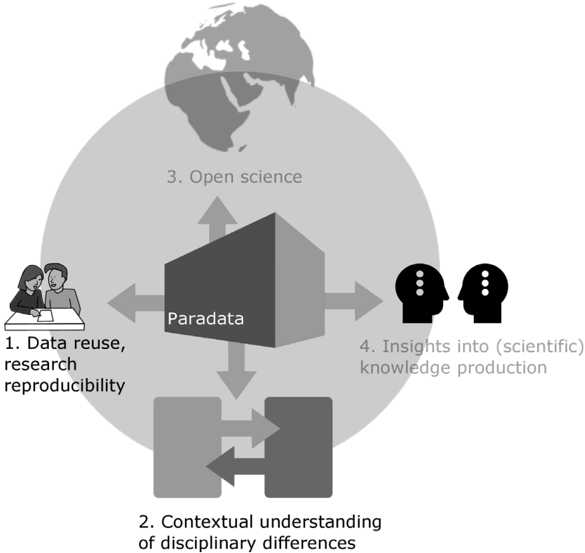
“Third, a proper understanding and documentation of paradata is also a central premise for the successful implementation of current visions of open science (e.g. Beck & Neylon, 2012; Mendez et al., 2020) and the contemporary open data policies (e.g. DCC, 2017).”
Resolving the Crisis in Archaeological Collections Curation
Marquardt, W. H., Montet-White, A., & Scholtz, S. C. (1982) · American Antiquity · doi:10.1017/s0002731600061308 · Cited by 54 · cited 1×
“Long before the current surge of attention to the complications of data reuse, already from the 1970s onwards, archaeologists have been debating an emerging ’curation crisis’ (Flexner, 2016; Kersel, 2015; Voss, 2012; Marquardt et al., 1982).”
Cultural Heritage Infrastructures in Digital Humanities
Benardou, A., Champion, E., Dallas, C., & Hughes, L. (2017) · Routledge eBooks · doi:10.4324/9781315575278 · Cited by 54
Looking Inside the Black-Box: Capturing Data Provenance Using Dynamic Instrumentation
Stamatogiannakis, M., Groth, P., & Bos, H. (2015) · Lecture notes in computer science · doi:10.1007/978-3-319-16462-5_12 · Cited by 53 · cited 2×
“…automated and semi-automated means of automatic and non-invasive real-time (e.g. Curcin, 2016; Pinheiro et al., 2013) and post-hoc tracking the movements of data implemented by, for instance, dynamic instrumentation (Stamatogiannakis et al., 2015) and citation analysis (Geser & Selhofer, 2015).”
1.1. Why Paperless: Technology and Changes in Archaeological Practice, 1996–2016
Wallrodt, J. (2016) · UWM Digital Commons (University of Wisconsin–Milwaukee) · Cited by 49
Huvila, I. (2016) · The Information Society · doi:10.1080/01972243.2016.1177763 · Cited by 48 · cited 1×
“This does not mean, of course, that it would not be necessary to investigate further and determine what approaches function best (e.g. Huvila, 2016, 2011; Vatanen, 2004) and when and how such data could and should be managed in practice (Bentkowska-Kafel et al., 2012).”
Self-citationDell’Unto, N., Landeschi, G., Apel, J., & Poggi, G. (2017) · Journal of Archaeological Science Reports · doi:10.1016/j.jasrep.2017.03.011 · Cited by 45 · cited 1×
“…of the state-of-the-art methodological innovations on the “interpretation at the trowel’s edge” in the field rather than working with legacy collections (Hodder, 2003; Voss, 2012; Dell’Unto et al., 2017) is exemplary of this general tendency, which is not specific to that particular discipline.”
Embedding data provenance into the Learning Health System to facilitate reproducible research
Ćurčin, V. (2016) · Learning Health Systems · doi:10.1002/lrh2.10019 · Cited by 44 · cited 3×
“…possibility to utilise dedicated computational data analysis and visualisation tools for enquiring into (para)data (e.g. De Oliveira et al., 2015; Curcin, 2016), (re-)generating human-readable accounts of structured paradata (e.g. Gratzl et al., 2016), and in some cases, even reproduce workflows…”
Demetrescu, E., & Fanini, B. (2017) · Journal of Archaeological Science Reports · doi:10.1016/j.jasrep.2017.06.034 · Cited by 42 · cited 3×
“In addition to general standards and models, multiple technical (e.g. Doerr et al., 2014a for the management of 3D models) and institutional frameworks (e.g. the CARARE model links to Europeana) and tools (e.g. in the context of 3D-COFORM project, Niccolucci, 2010; EM/EMF, Demetrescu & Fanini, 2017) incorporate featur…”
Lake, M. (2012) · World Archaeology · doi:10.1080/00438243.2012.748521 · Cited by 42 · cited 3×
“…creation, curation and use – or as Leonelli and colleagues (Leonelli & Tempini, 2020) refer to it, data journey – is a major impediment of open science (Lake, 2012), effective data reuse (e.g. Faniel et al., 2013), and keeping, as Conkey and Gero (1997) put it, human-agency visible in knowledge…”
Logic and the Organization of Information
Frické, M. H. (2012) · Springer eBooks · doi:10.1007/978-1-4614-3088-9 · Cited by 39 · cited 1×
“As information science research demonstrated already decades ago, users do not (necessarily) know very well what information they really need to succeed in their pursuits (Frické, 2012).”
Enabling European Archaeological Research: The ARIADNE E-Infrastructure
Consiglio Nazionale Delle Ricerche, I. S. T. I., Aloia, N., Binding, C., Cuy, S., Doerr, M., Fanini, B., Felicetti, A., Fihn, J., Gavrilis, D., Geser, G., et al. (2017) · Internet Archaeology · doi:10.11141/ia.43.11 · Cited by 39 · cited 2×
“It provides keys to understanding how data (re)use could, and according to its different stakeholders, should be supported (Aloia et al., 2017) and how to facilitate sharing of data by describing how the data has been used earlier by others.”
Archaeological Data Models and Web Publication Using XML
Schloen, J. D. (2001) · Computers and the Humanities · doi:10.1023/a:1002471112790 · Cited by 38 · cited 1×
“…and reliability of explicit descriptions of work and research processes and their usefulness in facilitating data reuse have been questioned (e.g. Schloen, 2001; Button & Harper, 1996), it would be too hasty to belittle their value as paradata, especially when used in combination with other…”
Beck, A. R., & Neylon, C. (2012) · World Archaeology · doi:10.1080/00438243.2012.737581 · Cited by 38 · cited 1×
“Third, a proper understanding and documentation of paradata is also a central premise for the successful implementation of current visions of open science (e.g. Beck & Neylon, 2012; Mendez et al., 2020) and the contemporary open data policies (e.g. DCC, 2017).”
CARARE 2.0: A metadata schema for 3D cultural objects
D’Andrea, A., & Fernie, K. (2013) · Digital Heritage International Congress · doi:10.1109/digitalheritage.2013.6744745 · Cited by 37 · cited 5×
“…al., 2012), the Music (MEI) and Text (TEI) Encoding Initiatives (Wilson, 2020), and the CARARE 2.0 model for documenting 3D cultural heritage data (D’Andrea & Fernie, 2013) do also incorporate fields for documenting such information similarly to the generic PROV and PREMIS metadata standards for…”
InfluentialSustaining the Digital Archaeological Record
Kintigh, K. W., & Altschul, J. H. (2010) · Heritage Management · doi:10.1179/hma.2010.3.2.264 · Cited by 36 · cited 1×
“As the critics have warned (e.g. Bauer-Clapp & Kirakosian, 2017; Flexner, 2016; Olivier, 2015; Kintigh & Altschul, 2010; Fagan, 1995), the massive number and ongoing exponential increase of poorly documented and difficult to access data collections are undermining the legitimacy and rationale of…”
Metadata and Tools for Integration and Preservation of Cultural Heritage 3D Information
Felicetti, A., & Lorenzini, M. (2011) · Geoinformatics FCE CTU · doi:10.14311/gi.6.16 · Cited by 35 · cited 1×
“With an appropriate set of tools, the manipulation and ingestion of this data can be (semi-)automatised and built-in technical infrastructures (e.g. Felicetti & Lorenzini, 2011).”
Tracing the traces: The critical role of metadata within networked communications
Mayernik, M. S., & Acker, A. (2017) · Journal of the Association for Information Science and Technology · doi:10.1002/asi.23927 · Cited by 34 · cited 2×
“It is both it is fair to accept that similarly to all data on data (Mayernik & Acker, 2018), also paradata is bound to be incomplete.”
Promise and Paradox: Accessing Open Data in Archaeology
Huggett, J. (2014) · Enlighten: Publications (University of Glasgow) · doi:10.17613/pw2b0-ewm28 · Cited by 33
2 Digital Haystacks: Open Data and the Transformation of Archaeological Knowledge
Huggett, J. (2015) · doi:10.1515/9783110440171-003 · Cited by 33 · cited 7×
“As Huggett (2016) suggests for metadata, it is not very far-fetched to suggest that the principal value of structured paradata is in its machine-readability by computational tools rather than in being directly usable or useful for human beings.”
Influential3D Research Challenges in Cultural Heritage II
Ioannides, M., Kuroczyński, P., Pfarr-Harfst, M., & Münster, S. (2016) · Lecture notes in computer science · doi:10.1007/978-3-319-47647-6 · Cited by 33 · cited 1×
“…heritage studies (e.g. Bentkowska-Kafel et al., 2012; Kowal et al., 2017; Kolenda & Markiewicz, 2017; Ball, 2011; Niccolucci, 2010) heritage management (e.g. Foster & Rafferty, 2016; Münster et al., 2016; Krauwer et al., 2017; Harrison et al., 2017), and science studies (e.g. Bauman & Raud, 2015).”
Knowing nursing – The challenge of articulating knowing in practice
Carr, S. M. (2005) · Nurse Education in Practice · doi:10.1016/j.nepr.2005.03.006 · Cited by 32 · cited 1×
“Even if articulating (Carr, 2005; Fook et al., 1997) and sharing (Hinds & Pfeffer, 2003) procedural expertise is difficult, people do not necessarily know why and how they know what they know (Bouwman et al., 1987), and the accuracy and reliability of explicit descriptions of work and research…”
Paradata in Documentation Standards and Recommendations for Digital Archaeological Visualisations
Börjesson, L. (2021) · Digital Culture & Society · doi:10.14361/dcs-2020-0210 · Cited by 31 · cited 1×
“…body of literature on the uses and usefulness of paradata in survey research (Kreuter, 2013; Kreuter & Casas-Cordero, 2010), education (e.g. Milligan et al., 2014), heritage visualisation (e.g. Bentkowska-Kafel et al., 2012) and recently, information science (e.g. Börjesson et al., 2020).”
Bauman, Z., & Raud, R. (2015) · Cited by 31
Paradata and transparency in virtual heritage
Bentkowska-Kafel, A., Denard, H., & Baker, D. (2012) · Cited by 28
Tracking and Sketching Distributed Data Provenance
Malik, T., Nistor, L., & Gehani, A. (2010) · IEEE International Conference on eScience · doi:10.1109/escience.2010.51 · Cited by 27 · cited 1×
“…been done to develop and implement automated methods for tracing movements and transformations of provenance data in digital systems (Missier, 2016; Malik et al., 2010; da Cruz et al., 2011) but what appears to be missing, is a comprehensive understanding of the processes of creation and use in…”
Gant, S., & Reilly, P. (2017) · Journal of Visual Art Practice · doi:10.1080/14702029.2017.1384974 · Cited by 27 · cited 4×
“The imprints of tools in visual documents (Gant & Reilly, 2017) is another comparable source of information.”
InfluentialPoole, A. H., & Garwood, D. A. (2018) · Library & Information Science Research · doi:10.1016/j.lisr.2018.08.003 · Cited by 27 · cited 1×
“…work in humanities and social sciences, see Kristiansen 2014; Cooper & Green 2015; Bevan 2015; McCoy 2017) and fields like digital humanities (Poole & Garwood, 2018) and heritage research, and the exceedingly multidisciplinary research, for instance, in historical and linguistic studies and…”
Archives Without Archives: (Re)Locating and (Re)Defining the Archive Through Post-Custodial Praxis
Kelleher, C. (2017) · Journal of Critical Library and Information Studies · doi:10.24242/jclis.v1i2.29 · Cited by 26 · cited 1×
“…from the fact that similarly to the creation and use, also curation (Buchanan, 2016; Voss, 2012), archiving, and data and collections management (Kelleher, 2017; Newman, 2012; Schwartz & Cook, 2002) are non-neutral, generative activities with an impact on data and consequently, on how it can…”
Wofford, M. F., Boscoe, B., Borgman, C. L., Pasquetto, I. V., & Golshan, M. S. (2019) · Computing in Science & Engineering · doi:10.1109/mcse.2019.2932067 · Cited by 26 · cited 1×
“Keeping notebooks is typical also in laboratory sciences (Klokmose & Zander, 2010) and increasingly in data-intensive research (Wofford et al., 2020; Graham, 2017).”
Modeling Context for Digital Preservation
Brocks, H., Kranstedt, A., Jäschke, G., & Hemmje, M. (2009) · Studies in computational intelligence · doi:10.1007/978-3-642-04584-4_9 · Cited by 25 · cited 1×
“…information are sometimes either implicitly or explicitly used in a generic but in practice often either rather broad (e.g. the definition of Brocks et al., 2009) and unspecific, or in a fairly narrow meaning to refer to everything or to only a small subset of all possible information that…”
A Metadata Schema for Cultural Heritage Documentation
Hermon, S., Niccolucci, F., & Ronzino, P. (2012) · doi:10.1400/187333 · Cited by 25 · cited 1×
“The datatype-specific STARC metadata model for documenting 3D digital media files (Ronzino et al., 2012), the Music (MEI) and Text (TEI) Encoding Initiatives (Wilson, 2020), and the CARARE 2.0 model for documenting 3D cultural heritage data (D’Andrea & Fernie, 2013) do also incorporate fields for…”
InfluentialManagement of Archaeological Information and Knowledge in Digital Environment
Huvila, I. (2019) · Knowledge management and organizational learning · doi:10.1007/978-3-030-10922-6_8 · Cited by 25 · cited 3×
“…if the critique of the archaeological curation crisis refers to general lack of documentation and publishing of collections (Voss, 2012; Friberg & Huvila, 2019), a closer look at its underpinnings has made apparent that a central issue, which makes analysing archaeological excavation…”
Self-citationEriksson‐Backa, K., Hirvonen, N., Enwald, H., & Huvila, I. (2021) · Informatics for Health and Social Care · doi:10.1080/17538157.2021.1902331 · Cited by 24 · cited 1×
“Fourth and finally, especially for science and information studies research, paradata can help to provide new understanding of scholarly knowledge production and in a broader sense, how scholarship is achieved in terms of a ’socio-techno-informational’ (Eriksson-Backa et al., 2021) practice.”
Self-citationRethinking Laboratory Notebooks
Klokmose, C. N., & Zander, P.-O. M. (2010) · Springer eBooks · doi:10.1007/978-1-84996-211-7_8 · Cited by 22 · cited 1×
“Keeping notebooks is typical also in laboratory sciences (Klokmose & Zander, 2010) and increasingly in data-intensive research (Wofford et al., 2020; Graham, 2017).”
Improving Archaeologists’ Online Archive Experiences Through User-Centred Design
Power, C., Lewis, A., Petrie, H., Green, K., Richards, J. D., Eramian, M., Chan, B., Walia, E., Sijaranamual, I., & de Rijke, M. (2017) · Journal on Computing and Cultural Heritage · doi:10.1145/2983917 · Cited by 22 · cited 2×
“…and research processes and their usefulness in facilitating data reuse have been questioned (e.g. Schloen, 2001; Button & Harper, 1996), it would be too hasty to belittle their value as paradata, especially when used in combination with other information (e.g. Henninger, 2018; Power et al., 2017).”
Friberg, Z., & Huvila, I. (2019) · Museum Management and Curatorship · doi:10.1080/09647775.2019.1612270 · Cited by 20 · cited 2×
“Many of these issues can be traced back to the discipline-specific characteristics of information processes and scholarly information (Huvila, 2019) that complicate their documentation and management.”
Self-citationThe Quality of Paradata: A Literature Review
West, B. T., & Sinibaldi, J. (2013) · doi:10.1002/9781118596869.ch14 · Cited by 19 · cited 2×
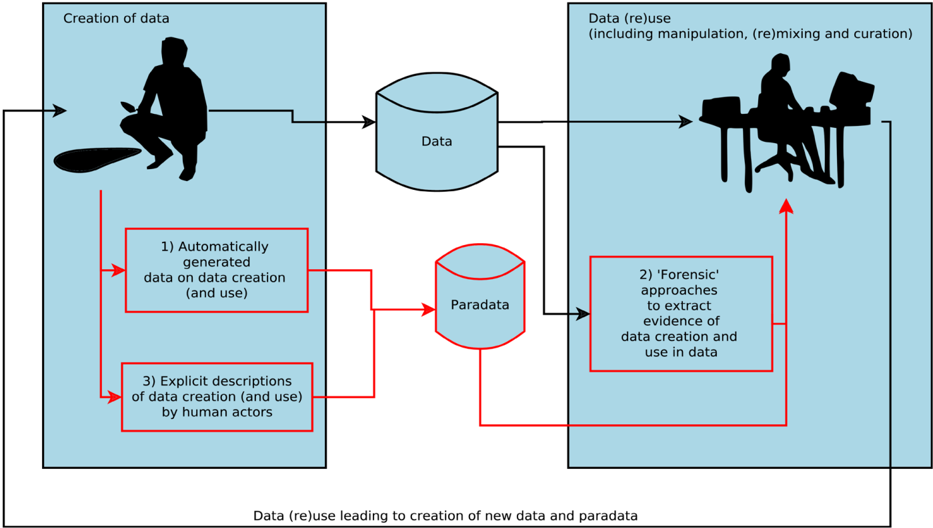
“As West and Sinibaldi (2013) observe, different sources and mechanisms of processing data and generating paradata have their distinct advances but also their respective sources of errors and omissions.”
The Storage and Long-Term Preservation of 3D Data
Niven, K., & Richards, J. D. (2017) · Elsevier eBooks · doi:10.1016/b978-0-12-804602-9.00013-8 · Cited by 19 · cited 2×
“Calls for adequate contextual information have been made in evidence-based studies of research practices (Borgman, 2012; Faniel et al., 2013; Kim & Yoon, 2017) and theoretical and normative literature (e.g. Niven & Richards, 2017; Huggett, 2016; Lake, 2012; Morgan & Eve, 2012) alike.”
Recordkeeping in the continuum: An Australian tradition
McKemmish, S. M. (2017) · Cited by 19
Cedars guide to preservation metadata
Day, M. J. (2002) · The University of Bath Online Publications Store (The University of Bath) · Cited by 19
Research Infrastructures in the Digital Humanities
Moulin, C., Nyhan, J., Ciula, A., Kelleher, M. C., Mittler, E., Tadić, M., Ågren, M., Bozzi, A., & Kuutma, K. (2011) · GoeScholar The Publication Server of the Georg-August-Universität Göttingen (Georg-August-Universität Göttingen) · Cited by 19
We still have to excavate – but not at any price
Demoule, J.-P. (2011) · Archaeological Dialogues · doi:10.1017/s1380203811000043 · Cited by 18 · cited 1×
“…archaeological excavation documentation created by someone who has not excavated at a specific archaeological site a very „difficult endeavour“ (Demoule, 2011) is not the lack of information about the data, but that the late-comer has not excavated there i.e. does not have enough contextual…”
Mi, X., & Pollock, B. M. (2017) · Cataloging & Classification Quarterly · doi:10.1080/01639374.2017.1388894 · Cited by 18 · cited 1×
“Also, such conventional techniques such as static relational schemes developed for specific needs (e.g. Mi & Pollock, 2017), and unstructured free-text fields (e.g. as in Battini & Sorge, 2017) can be adequate in some cases (e.g. especially for human readers, Huggett, 2016) even if they have…”
From mud to the museum: Metadata challenges in archaeology
Henninger, M. (2017) · Journal of Information Science · doi:10.1177/0165551517741790 · Cited by 18
Working with Paradata, Marginalia and Fieldnotes
Fahmy, E., Bell, K., Goodwin, J., O’Connor, H., Phoenix, A., & Edwards, R. (2017) · Edward Elgar Publishing eBooks · doi:10.4337/9781784715250 · Cited by 18 · cited 6×
“…et al., 2012; D’Andrea & Fernie, 2013; Greengrass, 2008; Kolenda & Markiewicz, 2017; Niccolucci et al., 2013), in social science to survey research (Edwards et al., 2017) and in the information field, there is a considerable corpus of research on automatic tracing of the provenance of digital…”
InfluentialBauer‐Clapp, H., & Kirakosian, K. (2017) · Advances in Archaeological Practice · doi:10.1017/aap.2017.16 · Cited by 17 · cited 1×
“As the critics have warned (e.g. Bauer-Clapp & Kirakosian, 2017; Flexner, 2016; Olivier, 2015; Kintigh & Altschul, 2010; Fagan, 1995), the massive number and ongoing exponential increase of poorly documented and difficult to access data collections are undermining the legitimacy and rationale of…”
Being Formal and Flexible: Semantic Wiki as an Archaeological e-Science Infrastructure
Huvila, I. (2012) · doi:10.1017/9789048516865.022 · Cited by 15
Self-citationRevisiting Archive Collections: Developing Models for Participatory Cataloguing
Newman, J. (2012) · Journal of the Society of Archivists · doi:10.1080/00379816.2012.666404 · Cited by 15 · cited 1×
“…that similarly to the creation and use, also curation (Buchanan, 2016; Voss, 2012), archiving, and data and collections management (Kelleher, 2017; Newman, 2012; Schwartz & Cook, 2002) are non-neutral, generative activities with an impact on data and consequently, on how it can and should be…”
Nicolaas, G. (2011) · Cited by 15
A provenance research study of archaeological curation
Buchanan, S. A. (2016) · Texas ScholarWorks (Texas Digital Library) · doi:10.15781/t2pn8xj3n · Cited by 13
Researcher as Bricoleur: Contextualizing humanists’ digital workflows
Antonijević, S., & Cahoy, E. S. (2018) · Digital humanities quarterly · doi:10.63744/t4cdcn4qwtd7 · Cited by 13 · cited 1×
“Partly, even if some work has been done to develop means to document scholarly processes (e.g. Antonijevic & Cahoy, 2018; Chiquet, 2020), social science and humanities disciplines generally lack equivalent to scientific workflows (Davidson & Freire, 2008) applied in many laboratory sciences that…”
Automated data provenance capture in spreadsheets, with case studies
Asuncion, H. U. (2013) · Future Generation Computer Systems · doi:10.1016/j.future.2013.04.009 · Cited by 12 · cited 1×
“At the same time, however, studies of data provenance suggest that human readers have found specific types of structured paradata useful in their work (e.g. Asuncion, 2013).”
Provenance description of metadata using PROV with PREMIS for long-term use of metadata
Li, C., & Sugimoto, S. (2014) · Cited by 12
Capturing Distributed Provenance Metadata from Cloud-Based Scientific Workflows
da Cruz, S. M. S., Paulino, C. E., de Oliveira, D., Campos, M. L. M., & Mattoso, M. (2011) · Journal of Information and Data Management · doi:10.5753/jidm.2011.1384 · Cited by 12
The Lifecycle of Provenance Metadata and Its Associated Challenges and Opportunities
Missier, P. (2016) · Springer proceedings in business and economics · doi:10.1007/978-3-319-40226-0_8 · Cited by 12
(2014) · Routledge eBooks · doi:10.4324/9780203780190 · Cited by 12
A Framework for Contextual Metadata Used in the Digital Preservation of Cultural Objects
Beaudoin, J. E. (2012) · D-Lib Magazine · doi:10.1045/november2012-beaudoin2 · Cited by 11 · cited 2×
“To exemplify the contrasts, Faniel and colleagues (2019) write of context information literally consisting of in practice all context-related information whereas, for instance, Beaudoin (2012) focuses on information relevant for digital preservation.”
Dark and Bright Futures for Museum Archaeology
Flexner, J. L. (2016) · Museum Worlds · doi:10.3167/armw.2016.040101 · Cited by 11 · cited 2×
“Long before the current surge of attention to the complications of data reuse, already from the 1970s onwards, archaeologists have been debating an emerging ’curation crisis’ (Flexner, 2016; Kersel, 2015; Voss, 2012; Marquardt et al., 1982).”
Digital Humanities as Epistemic Cultures: How DH Labs Make Knowledge, Objects, and Subjects
Malazita, J. W., Teboul, E. J., & Rafeh, H. (2020) · Digital humanities quarterly · doi:10.63744/3zv72m4dkb4g · Cited by 10 · cited 1×
“…research practices and their implications, and perhaps, especially to the development of new and emerging cross-and sub-disciplinary constellations (cf. e.g. Luhmann & Burghardt, 2022; Malazita et al., 2020) including those emerging from and within digital humanities and social sciences.”
Data Collection Research using Paradata at Statistics Canada
Laflamme, F. (2008) · Cited by 9
Introduction: working with paradata, marginalia and fieldnotes
Goodwin, J. D., O’Connor, H., Phoenix, A., & Edwards, R. (2017) · Edward Elgar Publishing eBooks · doi:10.4337/9781784715250.00007 · Cited by 9 · cited 1×
“Similarly, earlier studies show (e.g. Goodwin et al., 2017; Anderson & Larson, 2013) that collecting and investigating different forms of data from automatically collected technical data to hand-written marginalia can convey a lot of invaluable information on research processes.”
Marsh, D. E., Punzalan, R. L., & Johnston, J. A. (2019) · The American Archivist · doi:10.17723/aarc-82-02-01 · Cited by 9 · cited 1×
“Examples of such practices are, for instance, anthropological and archaeological field documentation, which is generally expected to contain information on both findings and the investigation process (e.g. Gustafsson & Magnusson Staaf, 2001; Huvila, 2011; Rytter et al., 2020; Marsh et al., 2020).”
Löwenborg, D. (2014) · Cited by 8
4.2. Click Here to Save the Past
Kansa, E. C. (2016) · Minds at UW (University of Wisconsin) · Cited by 8
Narrative analysis of paradata from the Poverty in the UK survey: a worked example
Elliot, H., Edwards, R., Phoenix, A., & Boddy, J. (2015) · Sussex Research Online (University of Sussex) · Cited by 7
Automatic capture of provenance data in genome project workflows
Pinheiro, R., de Holanda, M. T., Araújo, A., Walter, M. E. M. T., & Lifschitz, S. (2013) · IEEE International Conference on Bioinformatics and Biomedicine (BIBM) · doi:10.1109/bibm.2013.6732621 · Cited by 7 · cited 1×
“Data provenance research has suggested automated and semi-automated means of automatic and non-invasive real-time (e.g. Curcin, 2016; Pinheiro et al., 2013) and post-hoc tracking the movements of data implemented by, for instance, dynamic instrumentation (Stamatogiannakis et al., 2015) and citation…”
A balancing act: The ideal and the realistic in developing Dryad’s preservation policy
Mannheimer, S., Yoon, A., Greenberg, J., Feinstein, E., & Scherle, R. (2014) · First Monday · doi:10.5210/fm.v19i8.5415 · Cited by 7 · cited 1×
“…a comprehensive understanding of the underpinnings of data requires a much more complex body of evidence (Huggett, 2012; Gant & Reilly, 2017) than limiting it to the tracking of the curatorial provenance of datasets within specific digital information infrastructures (cf. Mannheimer et al., 2014).”
Managing Digital Cultural Objects
(2016) · Facet eBooks · doi:10.29085/9781783301539 · Cited by 7
Kolenda, J., & Markiewicz, M. (2017) · Studies in Digital Heritage · doi:10.14434/sdh.v1i2.23458 · Cited by 7
Grey Literature and Professional Knowledge Making
Schöpfel, J. (2018) · Springer eBooks · doi:10.1007/978-3-319-94177-6_8 · Cited by 7 · cited 1×
“Similar examples of creative use of field notes, diaries and summaries and development of new digital tools and genres can also be found in many other disciplines from laboratory work to industrial research (Schöpfel, 2019; Randles et al., 2017; Bowker, 1994).”
Anthropology Inside Out: Fieldworkers Taking Notes
Andersen, A. O., Dalsgård, A. L., Kusk, M. L., Nielsen, M., Rubow, C., & Rytter, M. (2020) · Sean Kingston Publishing eBooks · doi:10.26581/b.ande01 · Cited by 7 · cited 1×
“Examples of such practices are, for instance, anthropological and archaeological field documentation, which is generally expected to contain information on both findings and the investigation process (e.g. Gustafsson & Magnusson Staaf, 2001; Huvila, 2011; Rytter et al., 2020; Marsh et al., 2020).”
Internet histories and computational methods: a “round-doc” discussion
Brügger, N., Milligan, I., Ben-David, A., Gébeil, S., Nanni, F., Rogers, R., Turkel, W. J., Weber, M. S., & Webster, P. M. (2019) · Internet Histories · doi:10.1080/24701475.2019.1639352 · Cited by 6 · cited 1×
“A closer consideration of matching documentation approach with the objects being documented (Vatanen, 2003), what Ben-David has recently called a ’’structural fit’ between medium and method’ (Brügger et al., 2019), would be equally important.”
Niccolucci, F. (2010) · 2010 IST-Africa · Cited by 5
The Nya Lödöse Project. Strategies and Context
Rosén, C., Gainsford, S., Toreld, C., Alfsdotter, C., Carlstein, C., & Öbrink, M. (2017) · International Journal of Historical Archaeology · doi:10.1007/s10761-017-0406-5 · Cited by 5 · cited 2×
“…data implemented in current data format specifications (e.g. national standards like SIKB0102: Boasson & Visser, 2017 and CSGDM: Metadata Ad Hoc Working Group, 1998; internal formats of individual software packages like in Intrasis, Rosén et al., 2017) opens up for using them in storing paradata.”
Digital Method for Verifying Archaeological Hypotheses. Medieval Gord Under Pułtusk Castle
Kowal, S., Koszewski, K., Słyk, J., & Wrona, S. K. (2017) · Studies in Digital Heritage · doi:10.14434/sdh.v1i2.23412 · Cited by 5 · cited 1×
“…social sciences (Faniel & Yakel, 2017), survey research (Edwards et al., 2017), cultural heritage studies (e.g. Bentkowska-Kafel et al., 2012; Kowal et al., 2017; Kolenda & Markiewicz, 2017; Ball, 2011; Niccolucci, 2010) heritage management (e.g. Foster & Rafferty, 2016; Münster et al.,…”
SIKB0102: Synchronizing Excavation Data for Preservation and Re-Use
Boasson, W., & Visser, R. (2017) · Studies in Digital Heritage · doi:10.14434/sdh.v1i2.23262 · Cited by 5 · cited 2×
“…local and domain-specific vocabularies and attribute data implemented in current data format specifications (e.g. national standards like SIKB0102: Boasson & Visser, 2017 and CSGDM: Metadata Ad Hoc Working Group, 1998; internal formats of individual software packages like in Intrasis, Rosén et…”
A Framework for Maintaining Provenance Information of Cultural Heritage 3D-models
Doerr, M., Chrysakis, L., Axaridou, A., Theodoridou, M., Georgis, C., & Maravelakis, E. (2014) · Electronic workshops in computing · doi:10.14236/ewic/eva2014.63 · Cited by 5
Rapport om rapporter : en diskussion kring kvalitetsbedömningar av arkeologiska rapporter
Gustafsson, A., & Staaf, B. M. (2001) · Diva portal (Dalarna University Library) · Cited by 5
Data Curation: How and Why. A Showcase with Re-use Scenarios.
Gerth, P., Sieverling, A., & Trognitz, M. (2017) · Studies in Digital Heritage · doi:10.14434/sdh.v1i2.23235 · Cited by 4 · cited 2×
“In parallel, the potential of data-and collections-based research resting on the utilisation of digital collections of data is becoming increasingly evident (Drude et al., 2016; Gerth et al., 2017).”
Marginalia, or the knowledge of excess
Anderson, C. M., & Larson, S. (2013) · Social & Cultural Geography · doi:10.1080/14649365.2013.811535 · Cited by 3 · cited 1×
“Similarly, earlier studies show (e.g. Goodwin et al., 2017; Anderson & Larson, 2013) that collecting and investigating different forms of data from automatically collected technical data to hand-written marginalia can convey a lot of invaluable information on research processes.”
Argumentation Paths in Information Infrastructure of the Archaeological Virtual Realities
Vatanen, I. (2004) · Universitätsbibliothek Tübingen · doi:10.15496/publikation-2954 · Cited by 3 · cited 3×
“For instance, there is a clear lack of intuitive and unobtrusive tools for collecting structured paradata according to events (e.g. D’Andrea & Fernie, 2013; Niccolucci et al., 2013), workflow (Davidson & Freire, 2008), and argumentation (Vatanen, 2004) based models of documenting activities.”
Mostafa, J. (2017) · Journal of the Association for Information Science and Technology · doi:10.1002/asi.23993 · Cited by 3 · cited 1×
“…data has been highlighted in the literature across disciplines from information science and research data management (e.g. Faniel et al., 2019; Mostafa, 2018; Wilkinson et al., 2016; Borgman, 2012) to computer-supported cooperative work (e.g. Karasti et al., 2006), different branches of…”
Quality control in the production of 3D documentation of monu- ments
Niccolucci, F., Felicetti, A., Amico, N., & D’Andrea, A. (2013) · Cited by 2
Supporting Sustainable Digital Data Workflows in the Art and Humanities
Chiquet, V. (2020) · edoc (University of Basel) · doi:10.5281/zenodo.3754263 · Cited by 2
Amphitheater of Volterra: Case Study for the Representation of Excavation Data
Battini, C., & Sorge, E. (2017) · Studies in Digital Heritage · doi:10.14434/sdh.v1i2.23242 · Cited by 1 · cited 1×
“…techniques such as static relational schemes developed for specific needs (e.g. Mi & Pollock, 2017), and unstructured free-text fields (e.g. as in Battini & Sorge, 2017) can be adequate in some cases (e.g. especially for human readers, Huggett, 2016) even if they have apparent shortcomings…”
Ludaescher, B., Cuevas-Vicenttín, V., Paolo Missier, B., Dey, S., Kianmajd, P., Wei, Y., Koop, D., Chirigati, F., Altıntaş, İ., Belhajjame, K., et al. (2013) · AGU Fall Meeting Abstracts · Cited by 1
An Insider’s Take on Data Curation: Context, Quality, and Efficiency
Hawthorne, S. (2021) · Journal of eScience Librarianship · doi:10.7191/jeslib.2021.1200 · Cited by 1 · cited 1×
“Even if the major steps undertaken during a research study would follow a fairly linear pattern (Hawthorne, 2021), studies of scientific and scholarly documentation and work practices provide plenty of evidence of the underlying variety and messiness of how the work proceeds even in cases where…”
Miniere della memoria scavi in archivi, depositi e biblioteche
Giulierini, P., Coralini, A., & Calandra, E. (2020) · Cited by 1
Research works printed but not linked: 17
- 7. Ball, A. (2011). International digital curation conference 2010. Ariadne, (66). http://www.ariadne.ac.uk/issue66/idcc-2010-rpt/
- 39. Couper, M. (1998). Measuring survey quality in a CASIC environment. In Proceedings of the Section on Survey Research Methods of the American Statistical Association.
- 49. De Oliveira, D., Silva, V., & Mattoso, M. (2015). How much domain data should be in provenance databases? In Workshop on Theory and Practice of Provenance (TaPP).
- 57. Doran, M., Edmond, J., & Nugent-Folan, G. (2019). Reconciling the cultural complexity of research data: Can we make data interdisciplinary without hiding disciplinary knowledge? Preprint of manuscript submitted to CODATA. http://hdl.handle.net/2262/83156
- 58. Drachsler, H., Greller, W., Fazeli, S., Niemann, K., Sanchez-Alonso, S., Rajabi, E., Palmér, M., Ebner, H., Simon, B., Nösterer, D., et al. (2012). D8. 1 Review of Social Data Requirements. Open Discovery Space project.
- 60. Duranti, L. (1998). Diplomatics : new uses for an old science. Lanham, MD: Scarecrow Press.
- 65. Fagan, B. (1995). Timelines: Archaeology's dirty secret. Archaeology, 48(4), 14-17.
- 69. Faniel, I. M., & Yakel, E. (2017). Practices do not make perfect: Disciplinary data sharing and reuse practices and their implications for repository data curation. In L. R. Johnston (Ed.) Curating Research Data, Volume One: Practical Strategies for Your Digital Repository, (pp. 103-126). Chicago: ACRL.
- 85. Greengrass, M. (2008). Introduction. In M. Greengrass, & L. M. Hughes (Eds.) The virtual representation of the past. Aldershot and Burlington: Ashgate.
- 87. Harrison, R., Morel, H., Maricevic, M., & Penrose, S. (2017). Heritage and Data: Challenges and Opportunities for the Heritage Sector: Report of the Heritage Data Research Workshop Held Friday 23 June 2017 at the British Library, London. London: Heritage Research, Heritage Futures, Alan Turing Institute, British Library.
- 88. Hauck, O., & Kuroczyński, P. (2015). Cultural heritage markup language-designing a domain ontology for digital reconstructions. In Proceedings of the 2nd International Conference on Virtual Archaeology, Hermitage Museum, St. Petersburg/Russia, (pp. 250-255).
- 91. Hinds, P. J., & Pfeffer, J. (2003). Why organizations don't "know what they know": Cognitive and motivational factors affecting the transfer of expertise. In M. S. Ackerman, V. Pipek, & V. Wulf (Eds.) Sharing expertise : beyond knowledge management, (pp. 3-26). Cambridge, MA: MIT Press.
- 157. Pančur, A., Šorn, M., & Erjavec, T. (2018). SlovParl 2.0: The collection of Slovene parliamentary debates from the period of secession. In D. Fišer, & a. d. J. Maria Eskevich (Eds.) ParlaCLARIN 2018 Workshop Proceedings May 7, 2018 Phoenix Seagaia Conference Center, Miyazaki, Japan. Luxembourg: ELRA.
- 179. Tempini, N. (2017). Till data do us part: Understanding data-based value creation in data-intensive infrastructures. Information and Organization, 27(4), 191-210. http://www.sciencedirect.com/science/article/pii/S1471772716300653 The London Charter Organisation (2009). The London Charter for the computer-based visualisation of cultural heritage. Tech. Rep. 2.1, London.
- 180. Turner, M. J. (2012). Lies, damned lies and visualizations: Will metadata and paradata be a solution or a curse? In A. Bentkowska-Kafel, H. Denard, & D. Baker (Eds.) Paradata and transparency in virtual heritage, (pp. 135-143). Farnham: Ashgate.
- 181. Vatanen, I. (2003). Deconstructing the (re)constructed: issues on annotation of the archaeological virtual realities. In M. Doerr, & A. Sarris (Eds.) CAA2002 The Digital Heritage of Archaeology. Computer Applications and Quantitative Methods in Archaeology. Proceedings of the 30th Conference, Heraklion, Crete, April 2002, (pp. 69-74). Archive of Monuments and Publications, Hellenic Ministry of Culture.
- 188. Wilson, E. A. (2020). Text encoding with the text encoding initiative (TEI) and the music encoding initiative (MEI). In E. A. Wilson (Ed.) Digital Humanities for Librarians, (pp. 87-106). Lanham; Boulder; New York; London: Rowman & Littlefield.
Cited by
Archivist in the machine: paradata for AI-based automation in the archives
Davet, J., Hamidzadeh, B., & Franks, P. (2023) · Archival Science · doi:10.1007/s10502-023-09408-8 · Cited by 26
“(Huvila 2022) Statistical social science research relies on a particularly expansive conception of paradata, defined in at least one case as “those data which fall outside the intentionally or purposefully collected data.”
BackgroundCameron, S., Franks, P., & Hamidzadeh, B. (2023) · Journal on Computing and Cultural Heritage · doi:10.1145/3594728 · Cited by 25
Moullou, D., Vital, R., Sylaiou, S., & Ragia, L. (2023) · Heritage · doi:10.3390/heritage7010005 · Cited by 23
“Furthermore, the inclusion of paradata becomes imperative, offering insights into the process of data creation, decision making during research, and details about workflow, data collection techniques, and any modifications applied during the research process [66,67].”
BackgroundArchaeological information-making activities according to field reports
Huvila, I., Börjesson, L., & Sköld, O. (2022) · Library & Information Science Research · doi:10.1016/j.lisr.2022.101171 · Cited by 24
“…Givens, 1995), methods sections of research papers, and increasingly, various forms of researcher-generated provenance metadata (Missier, 2016) and paradata (Edwards, Goodwin, O ’ Connor, & Phoenix, 2017; Huvila, 2022a) that are produced to improve the findability and reusability of research data.”
Self-citationStarópoli, L., Acevedo, V. J., Ávido, D., & Vitores, M. (2023) · Virtual Archaeology Review · doi:10.4995/var.2023.19292 · Cited by 20
“Al mismo tiempo, sin la documentación adecuada de los procesos humanos de creación, comprensión e interpretación de los datos, existe el riesgo de crear y archivar grandes colecciones de datos que son incapaces de respaldar la investigación y otros tipos de reutilización (Huvila, 2022.”
Background
Metadata
- Authors
- Huvila, I.
- Affiliations
- Uppsala University (SE)
- Corresponding author
- Huvila, Isto
- ORCID
- Huvila, Isto
- Venue
- Open Information Science
- Publisher
- Walter de Gruyter GmbH
- Published
- 2022-01-01
- Volume
- 6
- Issue
- 1
- Pages
- 28-48
- ISSN
- 2451-1781 (ISSN-L)
- OpenAlex
- W4226117346
- Cited by
- 51
- References
- 155
- Citations by year
- 2026: 7 · 2025: 16 · 2024: 15 · 2023: 9 · 2022: 4
- FWCI
- 10.89
- Type
- journal article
- Language
- en
- Open access
- diamond
- doi.org
- Locations
- Open Information Science (publishedVersion, cc-by)
- Uppsala University Publications (Uppsala University) (submittedVersion, other-oa)
- DOAJ (DOAJ: Directory of Open Access Journals) (submittedVersion)
- Funders
- European Commission (818210, HORIZON2020)
- Topics
- Physical Sciences › Computer Science › Information Systems › Research Data Management Practices
- Social Sciences › Sociology and Political Science › Data Analysis and Archiving
- Social Sciences › Decision Sciences › Information Systems and Management › Scientific Computing and Data Management
- Keywords
- paradata, research data, metadata, research data infrastructure, data curation, data provenance, data utilization, social science data, humanities data, data reuse
About these checks
Registry, retraction, Cites and statistics results are computed, not judged, with one exception: a printed reference that no index lists is read once by a model before it counts as a citation error. Claims are extracted by a model and kept only when their quote appears verbatim in the text; each cited source is then checked, with a model’s help, for whether it says what the claim relies on. Those verdicts can be wrong — read the claim’s quote and the cited source before relying on one.
Statistics and arithmetic are recomputed, not judged.
Confidence bands are shown only for fields calibrated on our annotated test set. None is calibrated yet, so no band is shown.
What counts as a claim ›How we measure confidence ›How we check this ›
Are you an author, or do you see a problem with this page? Request a review
Data sources
Bibliographic data: Semantic Scholar, OpenAlex, Crossref.
Contains information from the Semantic Scholar Academic Graph Datasets, made available under the ODC Attribution License (ODC-BY 1.0).
Semantic Scholar’s data is described in: Kinney, R., et al. (2023). The Semantic Scholar Open Data Platform. arXiv:2301.10140.
